Cardiovascular Assessment PPT - E1
 Call Kai
 Learn
Learn Practice Test
 Spaced Repetition
 Match
Match Flashcards
 Knowt Play
1/60

There's no tags or description
Looks like no tags are added yet.
Name | Mastery | Learn | Test | Matching | Spaced | Call with Kai | Chat |
|---|
No analytics yet
Send a link to your students to track their progress
61 Terms
Subjective Assessment + History
pain, dyspnea, cough, fatigue, edema, color, cardiac Hx, family Hx, risk factors
Using OLDCART for chest pain
Onset?
Location? → can you point to it, does it radiate?
Duration? → constant? intermittent?
Characteristics? → how does it feel?
Associated symptoms?
Relief? → what makes it better/worse? rest? movement? breathing? lying flat?
Treatment? → what treatment have you had?
Using OLDCART for dyspnea
“Do you get short of breath?”
Onset?
Location → does it originate in your throat or chest?
Duration? → constant? any particular time of day? awakens you from sleep?
Characteristics? mucus, urge to cough?
Associated manifestations? → wheezing, chest pain, nausea?
Relief? → is it related to position?
*Orthopnea: how many pillows do you sleep with at night?
Treatment?
Using OLDCART for cough
“Do you have a cough?”
Onset?
Location?
Duration? → frequency?
Characteristics? → type: productive/nonproductive
Associated manifestations?
Relief? → what makes it better/worse?
Treatment
Using OLDCART for edema
“Any swelling in feet or legs?”
Onset?
Location?
Duration? → recent changes, time of day, do your shoes feel tight at the end of the day?
Characteristics? → how much swelling?
Associated symptoms?
Relief? → is there decreased swelling in a.m.?
Treatment?
Asking about fatigue
Do you tire easily?
Onset?
Related to time of day?
Asking about cyanosis/pallor
Have you noticed OR has anyone ever told you that your face has turned blue/gray?
Asking about cardiac Hx
Look for: HTN, high cholesterol, murmurs, congenital heart disease, rheumatic fever
Heart disease: treatments?
Heart tests? ECG, cholesterol, echo…
Asking about family Hx
“Does anyone of your family have/have a history of?”… Hypertension, Obesity, Diabetes, Coronary Artery Disease, sudden death under age 40
Asking about personal risk factors
Nutrition: high fat, sodium, weight
Smoking: PPD, how long, cigarettes or other, have you ever quit?
Alcohol: how many drinks per day/week? how many drinks per episode? ever been told you have a drinking problem?
Exercise
Drugs: prescriptions (antihypertensives, digoxin, ASA, OTC, street drugs)
Asking about Peripheral Vascular: Leg Pain or Cramps
-Type of pain
-What causes the pain?
-Has the amount of pain changed recently?
-Does the pain wake you up at night?
Using OLDCART for swelling in arms / legs
Onset? → when did it start?
Location? → where is it?
Duration? → time of day? constant or intermittent?
Characteristics? → what brings it on?
Associated manifestations? → pain, heat, redness, ulceration, hardened skin?
Relief? → what relieves the swelling?
Treatment? → what helps? how is it being treated?
Asking about skin changes on arms / legs
-What color change is present? → red, blue, brown, pallor
-Temperature
-Veins
-Leg sores or ulcers
Changes in older adults
-Gradual BP rise → arteriosclerosiis
-Palpate carotid cautiously
-A-P diameter may increase w/ aging, making AP more difficult to palpate
-LVH (enlarges)
-Dysrhythmias
-Orthostatic hypotension
Physical EXAM: Observe, Palpate, & Auscultate the Carotid Arteries
Palpate one side at a time! DO NOT COMPROMISE BLOOD FLOW
-feels smooth w/ rapid upstroke and slower down stroke
-Normal = 2+ (moderate)
-Auscultate the carotid → as pt. to hold breath while you listen so you don’t mistake a breath for a bruit
use the BELL of the stethoscope
Carotid artery bruits
ABNORMAL blood flow sounds with a narrowed/blocked artery
Hearing carotid artery bruits
Audible at occluded of approx. 30-50%
Loudness increases until occlusion is 60-70%, then it decreases
Bruit disappears w/ 100% occlusion
occlusion = blockage
EXAM: Inspect for Jugular Vein Distention (JVD)
Jugular venous pressure - significant distention indicates CHF
*assess JVD w/ head elevated 45 degrees
EXAM: Inspect Anterior Chest
Observe for pulsations → you may or may not see apical pulse (AP)
*heave indicates ventricular hypertrophy + increased workload
EXAM: Palpation
palpate the apical pulse - PMI (Point of Max. Impulse)
-locate using 1 finger pad
location: usually 4th or 5th interspace, abt. midclavicular line
should occupy only 1 intercostal space
SIZE: 1x2 cm
AMPLITUDE: short, gentle tap
DURATION: short, first ½ of systole
EXAM: Palpate Across Precordium
-use the palm of hand
-should NOT feel a thrill (vibration)
EXAM: Auscultation
Listen as you inch along the 5 areas
1) Aortic valve
2) Pulmonic valve
3) Erb’s point (2nd pulmonic area)
4). Tricuspid valve
5) Mitral valve
5 areas of exam auscultation
1) Aortic valve → 2nd R intercostal space
2) Pulmonic valve → 2nd L intercostal space
3) Erb’s Point (2nd pulmonic area) → 3rd L intercostal space
4) Tricuspid valve → 4th L intercostal space
5) Mitral valve → 5th intercostal space (midclavicular line) (APEX)
When auscultating the aortic valve, where are we listening
2nd R intercostal space
When auscultating the pulmonic valve, where are we listening
2nd L intercostal space
When auscultating the Erb’s point (second pulmonic are), where are we listening
3rd L intercostal space
When listening to the tricuspid valve, where are we listening
4th L intercostal space
When listening to the mitral valve, where are we listening
5th L intercostal space, midclavicular line, APEX (bottom of heart)
Auscultation Examination Visual
“All Physicians Enjoy Taking Money”
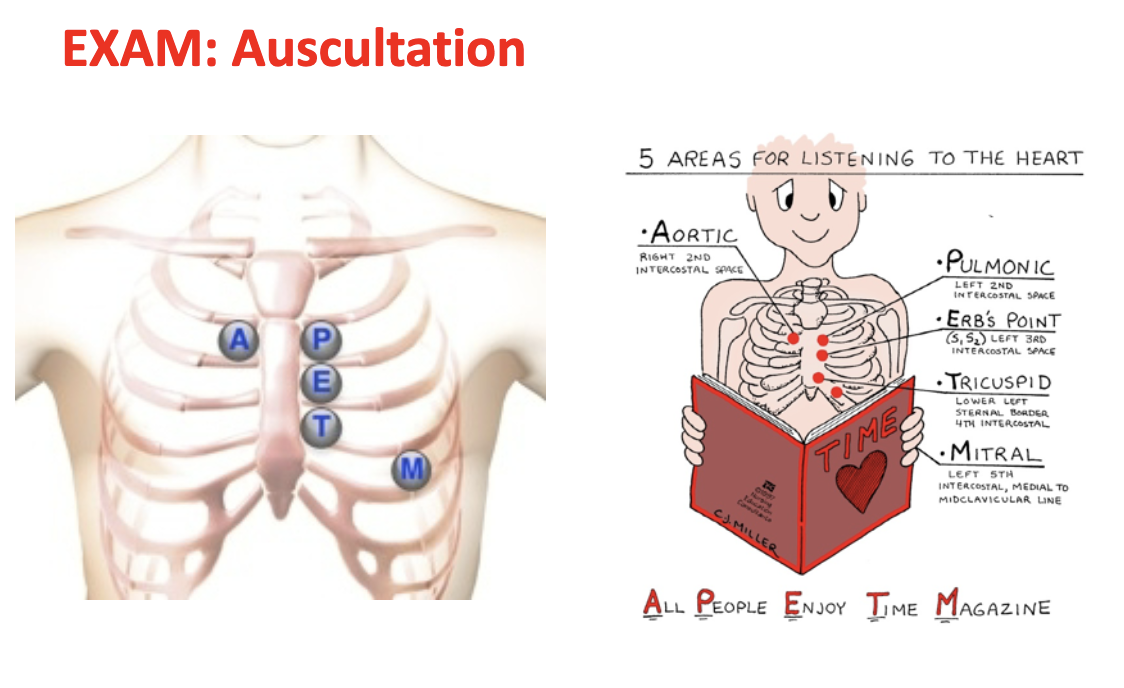
Details for doing an Auscultation Examination
-Note the rate and rhythm
-Listen for 1 sound at a time
-ID S1 + S2 (lub dub) → S1 coincides w/ carotid artery pulse
-Assess S1 + S2 separately
-Listen for extra heart sounds, murmurs, etc.
S1 Heart Sound
-beginning of systole / AV valves close (tricuspid + mitral)
Loudest at the APEX (bottom tip of heart)
S2 Heart Sound
-end of systole (diastole) / SL valves close (pul. + aortic)
Loudest at the BASE
S3 Heart Sound
Ventricular filling causes vibrations during diastole in early filling due to increased pressure in atria.
Present in CHF
“KEN” “TUCK” “Y”
S4 Heart Sound
Occurs at the end of diastole — ventricles resistant filling.
Common after MI
Murmurs
-caused by turbulent blood flow
-gentle blowing, swooshing sound heart on chest wall
-structural defects in the valves or unusual openings occur in chambers
*listen w/ bell of stethoscope
things that cause increased blood velocity where you may hear a heart murmur
exercise, thyrotoxicosis
things that cause decreased blood viscosity where you may hear a heart murmur
Anemia
Structural defects in valves where you may hear a murmur
Structural defects: narrowed valve, incompetent valve
Heart Sounds in Older Adults
-S4 common even w/ no disease
-50% systolic murmur
-Premature ectopic beats common
Premature ectopic beats
extra or early heartbeats that happen when a cell outside the heart's normal pacemaker triggers an early electrical signal
*common in older adults
EXAM: Inspect & Palpate Arms
Capillary refill: < 3 secs
Hands should be pink, warm
Palpate radial pulses bilaterally
Allen test if indicated
Pulse amplitude 0-3
EXAM: Inspect & Palpate Legs
-compare leg size, symmetry
-warm, pink
-capillary refill < 3
-edema 1+ to 4+ scale for pitting
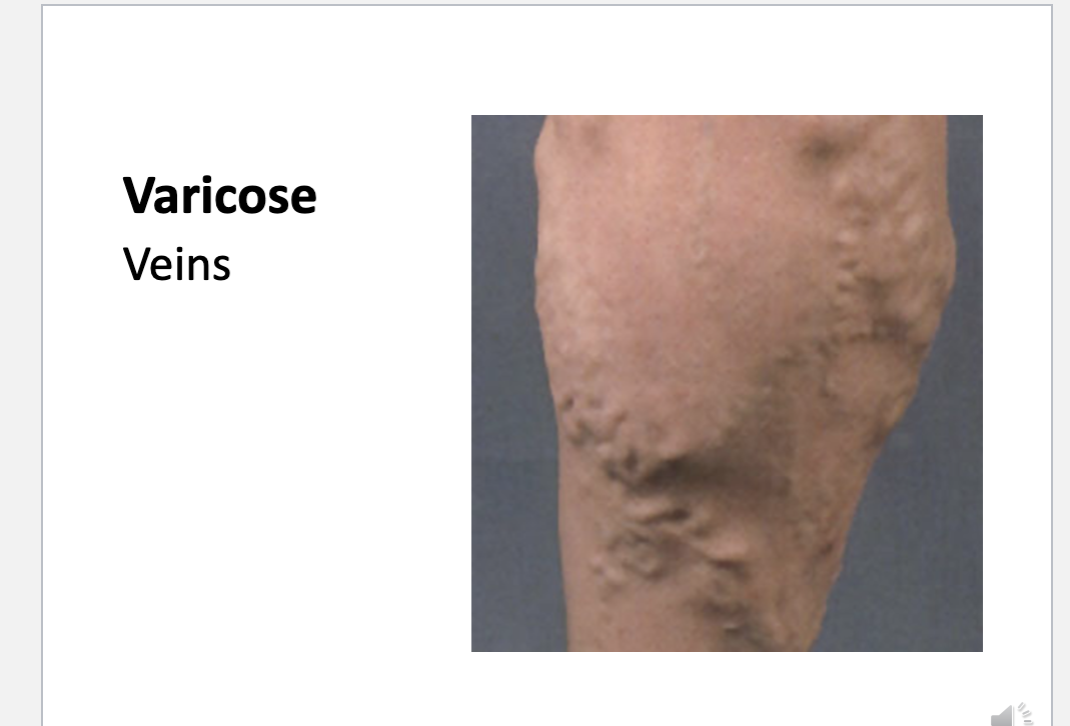
-varicosities
depression of a 1+ edema scale
2mm
depression of a 2+ edema scale
4mm
depression of a 3+ edema scale
6mm
depression of a 4+ edema scale
8mm
EXAM: Palpate pulses of lower extremities
-Dorsalis Pedis
-Post tibial
-Popliteal
-Femoral
*use of pulse amplitude
Pulse Amplitude
3+ → bounding
2+ → brisk, expected (NORMAL)
1+ → diminished, weak or intermittent
0 → absent, unable to palpate
The “Missing” pulse
doppler pulse will sound like a “swish” rather than a beat or lub-dub
Venous stasis ulcer
a type of chronic wound that occurs due to insufficient blood flow of external veins

Arterial insufficiency
a condition where there is inadequate blood flow to the arteries, often leading to tissue damage or ulcers.

Varicose veins image
view img
Deep Vein Thrombosis (DVT) image
view image

CHF ppt. summarization slide
view img

Common Signs/Symptoms of HF (view img)
SOB, swelling of feet / legs, chronic lack of energy, difficult sleeping at night due to breathing issues, swollen or tender abdomen w/ loss of appetite, cough w/ frothy sputum, increased urination at night, confusion and/or impaired memory

Modifiable risk factors of Hypertension (HTN)
obesity, physical activity, smoking, excess dietary Na+, insufficient intake of K+, excess alcohol consumption
Hypertension (HTN) Non-modifiable factors
age
family Hx of HTN and/or CVD
Modifiable risk factors of Coronary Heart Disease (CHD)
DM, systolic/diastolic HTN, smoking, obesity, physical inactivity
Non-modifiable factors of Coronary Heart Disease
increasing age
Hx of cardiovascular disease
family Hx of early HD
Risk factors used to assess the 10 yr coronary heart disease (CHD) risk score
age
gender
height, weight, waist circumference (of BMI)
smoking
Hx of CVD or DM
Systolic / Diastolic BP
Total cholesterol, LDL, and HDL cholesterol
Triglycerides
Family Hx of early HD
Unusual chamber openings where you may hear a murmur
Unusual openings: dilated chamber, wall defect