Rates of reactions
 Call Kai
 Learn
Learn Practice Test
 Spaced Repetition
 Match
Match Flashcards
 Knowt Play
1/35

There's no tags or description
Looks like no tags are added yet.
Name | Mastery | Learn | Test | Matching | Spaced | Call with Kai | Chat |
|---|
No analytics yet
Send a link to your students to track their progress
36 Terms
Definition of: activation energy
The minimum energy required to start a chemical reaction OR the energy required to form the activated complex
Definition of: activated complex
A high energy, unstable transition state between the reactants and the products
Definition of: catalyst
A substance that increases the rate of the reaction but remains unchanged at the end of the reaction
Definition of: reaction rate of a chemical reaction
The change in amount or concentration per unit time of either a reactant or product
Definition of: heat of reaction (ΔH)
The net change in chemical potential energy of the system. (ΔH > 0 for endothermic reactions and ΔH < 0 for exothermic reactions.)
Definition of: exothermic reactions
Reactions which transform chemical potential energy into thermal energy
Definition of: endothermic reactions
Reactions which transform thermal energy into chemical potential energy
Definition of: collision theory
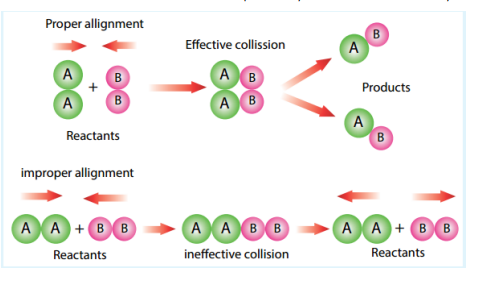
A model that explains that a reaction will only proceed when reactant particles collide effectively
Definition of: effective (successful) collision
One in which the colliding reactant particles have the correct orientation and sufficient kinetic energy, i.e. kinetic energy equal to or greater than the activation energy
What is H and ΔH
Enthalpy and change in enthalpy
Calculations for ΔH
= Energy of product – Energy of reactants
= Energy absorbed - Energy released
What does ΔH < 0 mean?
Exothermic reaction.
What does ΔH > 0 mean?
endothermic reaction.
How do you know a reaction is endothermic?
ΔH > 0
How do you know a reaction is exothermic?
ΔH < 0
What is an average rate of reaction?
Measured over a time interval
What is an instantaneous rate of reaction?
Rate at one specific moment
Factors affecting the reaction rate
Nature of the reactants
Surface area of a solid
Concentration of a solution
Pressure of a gas reactant
Temperature at which a reaction takes place
Use of a catalyst
How does the following effect the rate of reaction: Nature of the reactants
Organic reactions take longer to take place than inorganic reactions (more bonds need to be broken in organic molecules). More reactive metals react faster since they lose electrons easily. Magnesium reacts faster than copper.
How does the following effect the rate of reaction: Surface area of a solid
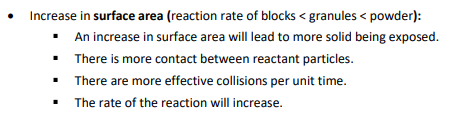
A greater number of surface particles are exposed during collisions. Powdered solids react faster than solid pieces. (When a solid is dissolved the state of division is increased.)
Larger surface area = faster reaction
How does the following effect the rate of reaction: Concentration of a solution
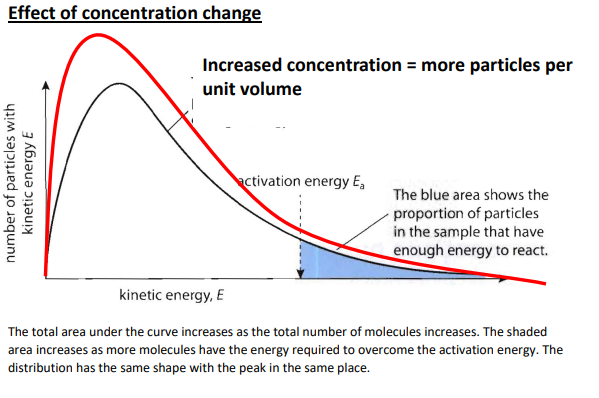
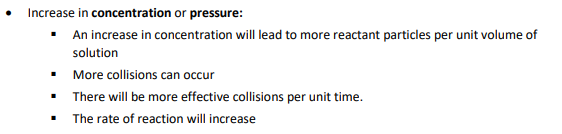
Rate of reaction increases with an increase in concentration. The number of particles per unit volume in the container increases.
How does the following effect the rate of reaction: Pressure of a gas reactant
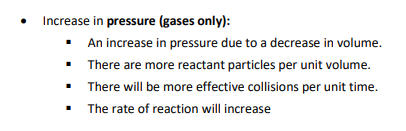
Reaction rate increases with increase in gas pressure. More collisions between gas particles and the sides of the container take place. [GAS] ∝ pressure of a gas.
How does the following effect the rate of reaction: Temperature at which a reaction takes place
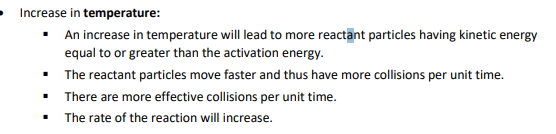
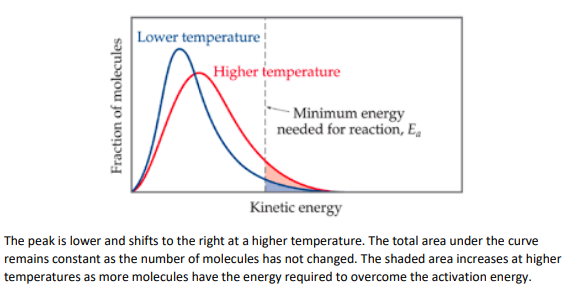
Teaction rate increases as temperature increases. Temperature ∝ average Ek of a substance. If temperature increases the average kinetic energy of particles will increase.
How does the following effect the rate of reaction: Use of a catalyst
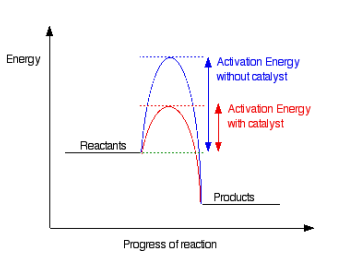
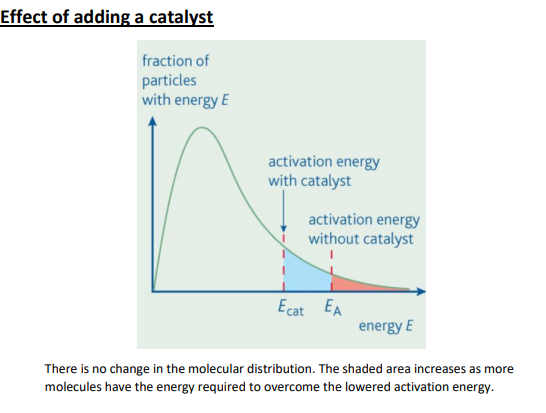
A catalyst increases reaction rate by lowering activation energy. More particles have enough energy to overcome lowered activation energy.
Examples of methods for measuring rates of reaction
Reaction rates can be measured by measuring gas volumes, turbidity (precipitate formation), colour changes, temperature changes and mass change of a reaction container to name the most important procedures.
How does a catalyst affect an energy / reaction progress graph?
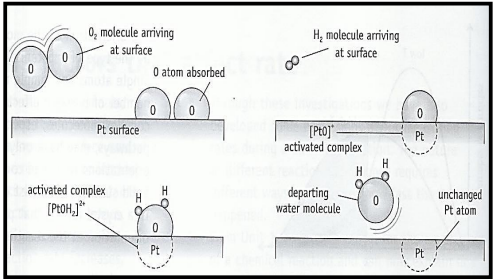
How does platinum act as a catalyst with oxygen gas and hydrogen gas to form water?
Make use of the following general format when answering questions using the Collision Theory:
How does the introduced change affect the particles?
Link this change to the conditions for an effective collision, i.e. refer to the frequency of collisions, the correct orientation or the energy requirement.
How does this affect the number of effective collisions per unit time?
What is the effect on the reaction rate?
Worked example answers using the Collision Theory: Increase in concentration or pressure:
Worked example answers using the Collision Theory: Increase in surface area (reaction rate of blocks < granules < powder):
Worked example answers using the Collision Theory: Increase in temperature:
Worked example answers using the Collision Theory: Increase in pressure (gases only):
How does the Maxwell-Boltzmann distribution look?
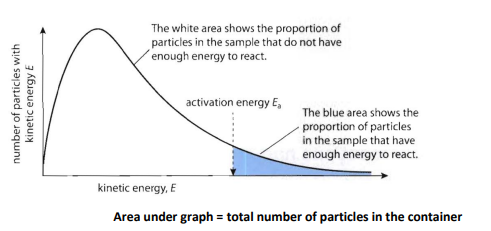
Maxwell-Boltzmann distribution: Effect of temperature
Maxwell-Boltzmann distribution: Effect of adding a catalyst
Maxwell-Boltzmann distribution: Effect of concentration change