Oral Ana Part 1: Extra and Intra
 Call Kai
 Learn
Learn Practice Test
 Spaced Repetition
 Match
Match Flashcards
 Knowt Play
1/32

There's no tags or description
Looks like no tags are added yet.
Name | Mastery | Learn | Test | Matching | Spaced | Call with Kai | Chat |
|---|
No analytics yet
Send a link to your students to track their progress
33 Terms
lips and perioral region
vermilion border or zone
labial commissures
philtrum and philtral ridges
nasolabial fold or sulcus
right and left commissures
mentolabial sulcus
oral fissures
Parts of the extraoral anatomy:
upper lip
aka labial superius
bounded superiorly by the base of the nose
bounded inferiorly by the oral fissure (rima oris)
bounded laterally by the nasolabial folds
cutaneous layer
made of stratified squamous keratinized epithelium and contains hair follicles, sebaceous glands, and sweat glands.
subcutaneous layer
thin layer of connective tissue and fat containing and supporting superficial blood vessels, nerves, and minor salivary glands
muscular layer
mainly composed of the orbicularis oris muscle, which acts as the sphincter of the mouth and controls the movements of the lips
cutaneous layer
subcutaneous layer
muscular layer
what are the 3 histological or tissue layers (CSM)
transitional vermillion border and zone
located between the external skin (cutaneous layer) and the internal oral mucosa, forming the reddish visible part of the lips
vermillion border
a mucocutaneous junction separating the facial skin from the vermillion zone of the lips
vermillion zone
the reddish portion of the lips with thin, non-keratinized epithelium, allowing the underlying blood vessels to show through
labial commissures
(commissura labiorum)
bilateral junction between upper or lower lip meet at the lateral corners of the oral fissure
undergoes significant stress during wide jaw opening
philtrum
a philtral depression or groove, is the median or shallow vertical depression located in the midline of the upper lip
formed during the 4th to 7yh weeks of intrauterine development by the two fussion of the nassal processes
philtral ridges
two vertical, elevated borders of skin that frame the philtrum in the center of the upper lip
mentolabial sulcus
deep diagonal crease or grooves that extend across the area between the lowe lip and chin
right and left commissure
right and left lip meets at the corner, forming the lateral boundary or the oral fissures
modiolus
a dense muscular node located directly lateral to the corner of the mouth, where several facial muscles converge
oral fissure or rima oris
physical opening of the mouth
horizontal gap between the upper or lower lips when they are close or slightly parted
intraoral anatomy
what anatomy is this
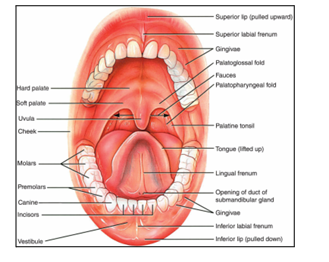
oral vestibule
the space between the lips and cheeks externally and the teeth and gingiva internally
oral cavity proper
the space inside the dental arches, extending from the teeth to the oropharynx
palate
roof of the mouth
hard palate
the bony, anterior part of the roof of the mouth that separates the oral and nassal cavities and provides a firm surface for chewing
soft palate
flexible posterior, fibromuscular fold that extend backward
incisive papilla
a small pear or oval elevation of soft tissue located on the anterior part of the hard palate
palatine rugae
symmetrical, transverse ridge of connective tissue located on the anterior mucosal surfaces
uvula palatina
small conical, fleshy projection of the muscular tissue that hangs down
dorsum of the tongue
upper surface of the tongue. it is covered by specialized mucosa containing papillae, many of which contain taste buds
lingual frenum
a thin vertical fold of mucous membrane that extends from the underside of the tongue to the floor of the mouth
labial mucosa
lines the inner surface of the lips
buccal mucosa
lines the inner surface of the cheeks
labial frena
folds of mucosa at the midline connecting the lips to the gingiva
buccal frena
folds of mucosa connecting the cheeks to the gingiva
oral vestibule
oral cavity proper
hard and soft palate
incisive papilla
palatine rugae
uvula palatina
dorsum of the tongue
lingual frenum
cheeks and lips
what tissues can be seen in intraoral anatomy
labial mucosa
buccal mucosa
labial frena
buccal frena
what can be seen on the cheeks and lips under the intraoral anatomy