Lecture 1: Body Fluid Compartments and Transport Across Cell Membranes
 Call Kai
 Learn
Learn Practice Test
 Spaced Repetition
 Match
Match Flashcards
 Knowt Play
1/72

There's no tags or description
Looks like no tags are added yet.
Name | Mastery | Learn | Test | Matching | Spaced | Call with Kai | Chat |
|---|
No analytics yet
Send a link to your students to track their progress
73 Terms
Total body water describes…
total amount of water in the body
Lean animals have a [higher/lower] percentage of body water compared to obese animals
higher
Total body water is __% of body weight (BW)
~60%
Total body water present in the intracellular fluid is __% of BW
~40%
Total body water present in extracellular fluid is __% of BW
20%
ECF is divided into _______ and _______
interstitial fluid and plasma
Interstitial fluid and plasma are components of the ______.
ECF
Total body water present in the interstitial fluid is __% of BW
~16%
Total body water present in the plasma is __% of BW
~4%
average blood volume
70 ml/kg BW or 7%
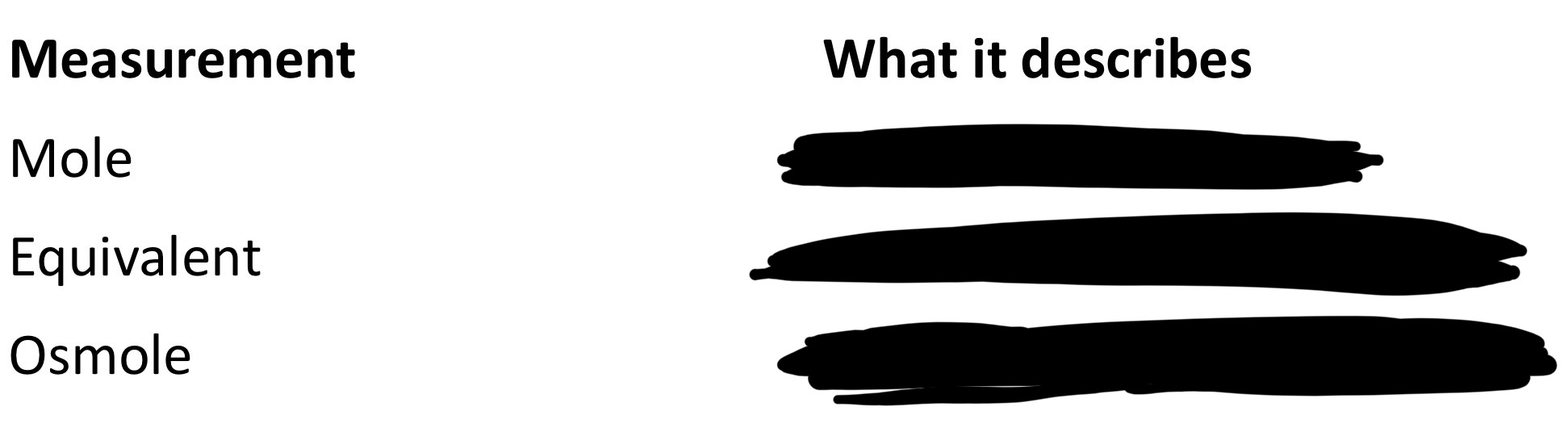
mole: amount of substance
equivalent: amount of electrical charge
osmole: number of dissolved particles
concentration units
mol/L or mmol/L
mEq/L
Osm/L or mOsm/L
osmoles/L
concentration units for osmolarity
what does osmolarity describe clinically?
osmoles/L
determines water movement between compartments
electroneutrality
in each body compartment, total positive charges must equal the total negative charges
major ions in the ECF
Na+
Cl-
HCO3-
Na+ mEq/L concentrations in the ECF and ICF
ECF: 140
ICF: 14
K+ mEq/L concentrations in the ECF and ICF
ECF: 4
ICF: 120
Ca2+ mEq/L concentrations in the ECF and ICF
ECF: 2.5
ICF: 1×10^-4
Cl- mEq/L concentrations in the ECF and ICF
ECF: 105
ICF: 10
HCO3- mEq/L concentrations in the ECF and ICF
ECF: 24
ICF: 10
pH in the ECF and ICF
ECF: 7.4
ICF: 7.1
osmolarity mOsm/L concentration in the ECF and ICF
ECF: 290
ICF: 290
What is ionized Ca2+?
free Ca2+, unbound, typically low within the cell to prevent unwanted contractions
major ions in the ICF
K+
proteins
organic phosphates
Na+/K+ ATPase
directly uses ATP
Na+ out of cell
K+ into cell
Ca2+/ATPase pump
directly uses ATP
Ca2+ out of cell
What ion concentration difference allows nerve and muscle cells to have resting membrane potentials?
K+ (higher inside cell)
What ion concentration difference allows for the upstroke of action potentials in nerve and muscle cells, as well as the absorption of nutrients?
Na+ difference (higher outside cell)
What ion concentration difference allows for excitation-contraction coupling in muscle cells?
Ca2+ difference (typically lower in cell, but when high causes contraction)
Cell membranes are composed of ______ and ____.
lipids and proteins
What types of lipids are present in the cell membrane? What do they allow to happen?
phospholipids, cholestarol, glycolipids
allow free permeability to lipid substances
Ex. CO2, O2, fatty acids, steroid hormones
What are the functions of the proteins present in the cell membrane?
transporters, receptors, enzymes, channels
can be integral, transmembrane, or peripheral
Describe the phospholipid component of the cell membrane
Forms lipid bilayer - amphipathic
hydrophilic head (glycerol)
hydrophobic tail (fatty acids)
integral proteins
span the cell membrane once
transmembrane proteins
span the cell membrane more than once
can be:
hormone or neurotransmitter receptors
pores
ion channels
peripheral proteins
only on one side of the cell membrane
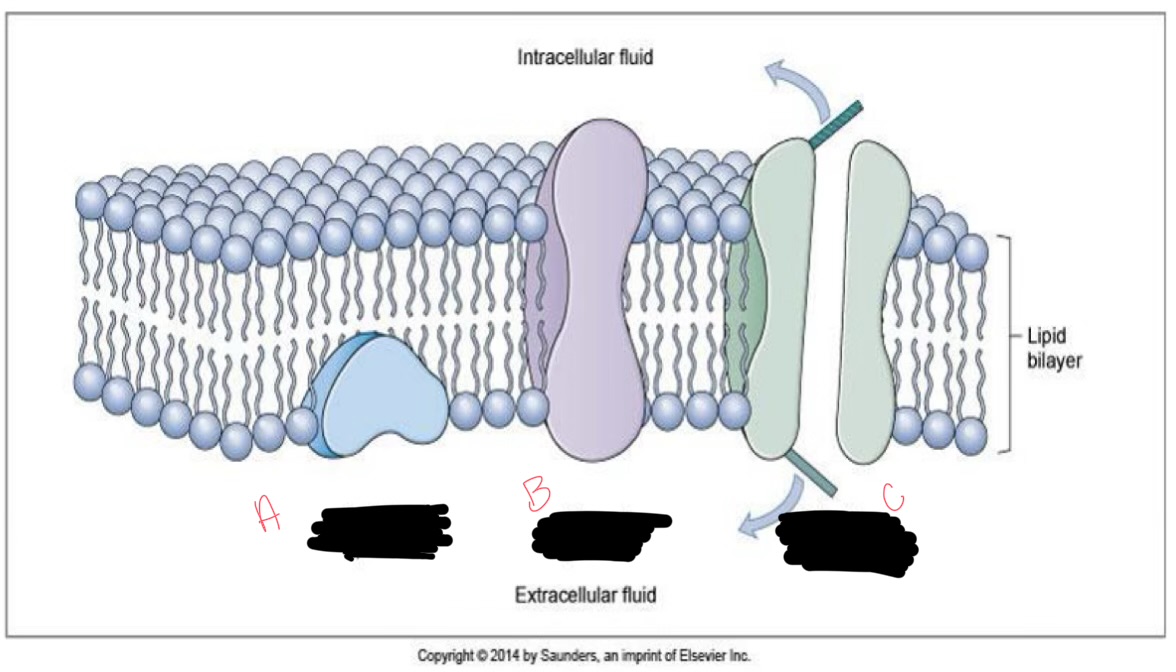
Describe the structure indicated by letters A, B, and C.
peripheral protein
integral protein
gated ion channel (transmembrane protein)
What types of transport can occur down an electrochemical gradient? Does this require energy?
simple or facilitated
No energy input needed
What types of transport can occur against an electrochemical gradient? Does this require energy?
primary transport
uses a carrier and direct energy input
secondary transport
uses a carrier and indirect energy input
Which type of transport does not require energy, and is not carrier mediated?
simple diffusion
Which type of transport does not need energy, but is carrier mediated?
facilitated diffusion
Which type of transport is carrier mediated, but does not require energy?
facilitated diffusion
Which type of transport is carrier mediated, and uses indirect energy?
secondary active transport
What are the 5 variables that determine diffusion rate (Fick’s Law)?
concentration gradient
partition coefficient
diffusion coefficient
thickness of membrane
surface area
The larger the concentration difference, the [greater/lesser] the driving force. This driving force determines the ______.
greater
concentration gradient
The higher the lipid solubility, the [higher/lower] the ease of movement, and the [higher/lower] the partition coefficient.
higher
higher
The partition coefficient is determined by the _________ of a solute.
lipid solubility
The diffusion coefficient is based on the ______ of a solute and the _______ of a solution.
size
viscosity
The [larger/smaller] the solute and the [increased/decreased] viscosity of a solution allow for an increased diffusion coefficient (allows for faster diffusion).
smaller
decreased
4 factors that determine membrane permeability
partition coefficient
diffusion coefficient
thickness of a membrane
surface area
What 2 factors make up the electrochemical gradient?
electrical forces and concentration forces
What are the two additional consequences that a charge of a diffusing ion has?
a diffusion potential can be created when a charged solute diffuses down its concentration gradient
a potential difference across a membrane will alter the rate of diffusion of a charged solute
Diffusion of a positively-charged ion will [slow down/quicken] if diffusing into an area of positive charge.
slow down
diffusion potential
potential difference created across a membrane because of an ion concentration difference
Facilitated diffusion proceeds [slower/faster] at a low solute concentration due to a limited number of carriers.
faster
GLUT4 transporter in skeletal and adipose tissue (insulin-responsive transporter) is an example of what type of transport?
facilitated diffusion
transports glucose into cells
D-galactose also competes for binding
saturation
feature of carrier-mediated transport
carrier proteins have a limited number of binding sites for solute
rate of transport is higher at lower solute concentrations
stereospecificity
feature of carrier-mediated transport
binding sites for solute on carrier proteins are specific
transporters for D-glu won’t transport L-glu
competition
feature of carrier-mediated transport
binding sites are specific, but carriers may recognize and bind chemically-related solutes
D-galactose can bind carriers for D-gly
What type of transport is carrier-mediated, and uses direct energy?
primary active transport
primary active transport (what it is, examples)
one or more solutes moved against a concentration gradient directly using ATP
Na+/K+ ATPase pump
Ca2+ ATPase pump
H+/K+ ATPase pump
Na+/K+ ATPase pump
primary active transport
present in membranes of ALL cells
uses 20-40% of cellular ATP in many tissues
3 Na+ pumped out of cell, 2 K+ pumped in
creates a charge separation and potential difference
inhibited by cardiac glycosides (digoxin, ouabain, oleandrin)
Ca2+ ATPase pump
primary active transport
Plasma-membrane Ca2+ ATPase (PMCA)
1 Ca2+ out of the cell
Sarcoplasmic and endoplasmic reticulum Ca2+ ATPase (SERCA)
2 Ca2+ from ICF into SR
H+/K+ ATPase pump
primary active transport
parietal cells of gastric mucosa
pumps H+ into lumen of stomach
inhibited by proton pump inhibitors (omeprazole, Prilosec, Prevacid)
secondary active transport
indirectly uses energy by utilizing Na+ gradient to transport solutes against their concentration gradient
maintained by Na+/K+ ATPase pump
co-transport (symport)
counter-transport (antiport)
co-transport (symport)
secondary active transport
all solutes transported in the same direction
Na+/glucose co-transporter (SGLT 1) (intestine and renal tubule)
Na+/amino acid co-transporter (intestine and renal tubule)
Na+/K+/2Cl- co-transporter (renal tubule)
counter-transport (antiport)
solutes move in opposite directions
Na+ moves into cell, other solute moves out
Ca2+/Na+ exchange
Na+/H+ exchange
Body water is distributed between the _______ and ______.
ICF and ECF
Cell membranes are ________ permeable.
selectively
Lipid-soluble molecules diffuse _______.
directly
carrier proteins exhibit ________, ________, and _______.
saturation
stereospecificity, and competition
Primary active transport uses ATP _________.
directly
Secondary active transport uses ____________ established by primary active transport.
ion gradients