1.1 - Renal Function Test
 Call Kai
 Learn
Learn Practice Test
 Spaced Repetition
 Match
Match Flashcards
 Knowt Play
1/53

There's no tags or description
Looks like no tags are added yet.
Name | Mastery | Learn | Test | Matching | Spaced | Call with Kai | Chat |
|---|
No analytics yet
Send a link to your students to track their progress
54 Terms
What are the 2 regions of the kidney?
Cortex
Medulla
What is the functional unit of the kidney?
What are its 5 basic parts?
NEPHRONS
Glomerulus
Proximal Convoluted Tubule (PCT)
Loop of Henle
Distal Convoluted Tubule (DCT)
Collecting Ducts
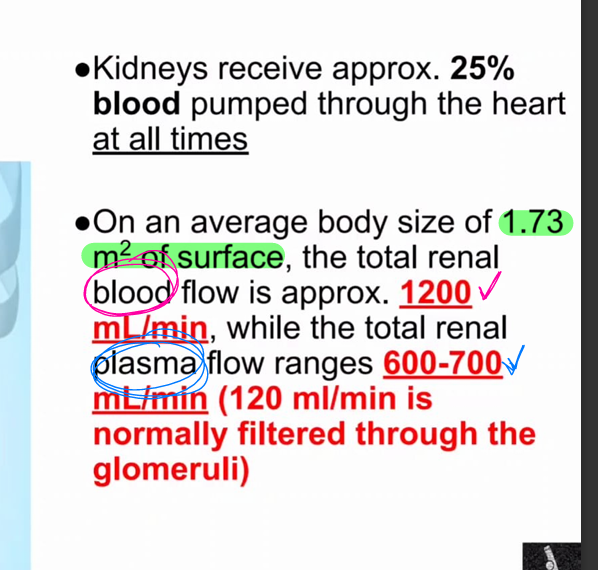
The kindey receives about how much blood pumped through the heart at all times?
25%
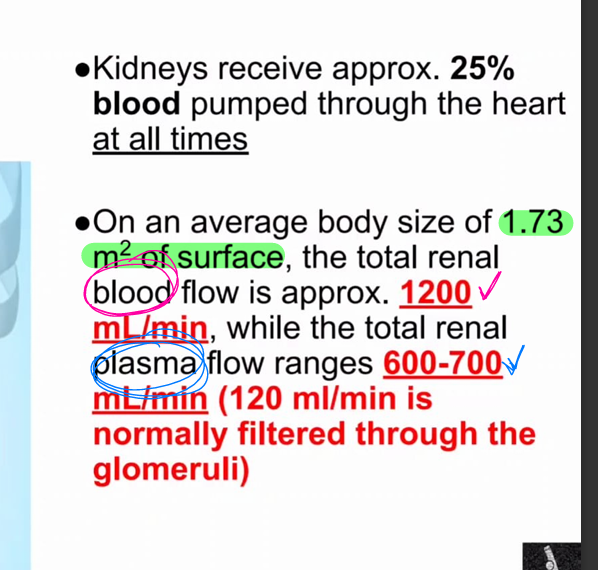
On an average body size of 1.73 m2 of surface, the about how much is the:
total renal BLOOD flow
total renal PLASMA flow
BLOOD FLOW = 1,200 mL/min
PLASMA FLOW = 600-700 mL/min
The glomerulus consist of approximately how many capillaries?
What kind of capillaries?
What is do you call the walls of these capillaries?
about 8 capillaries
Fenestrated capillaries
glomerular filtration barrier
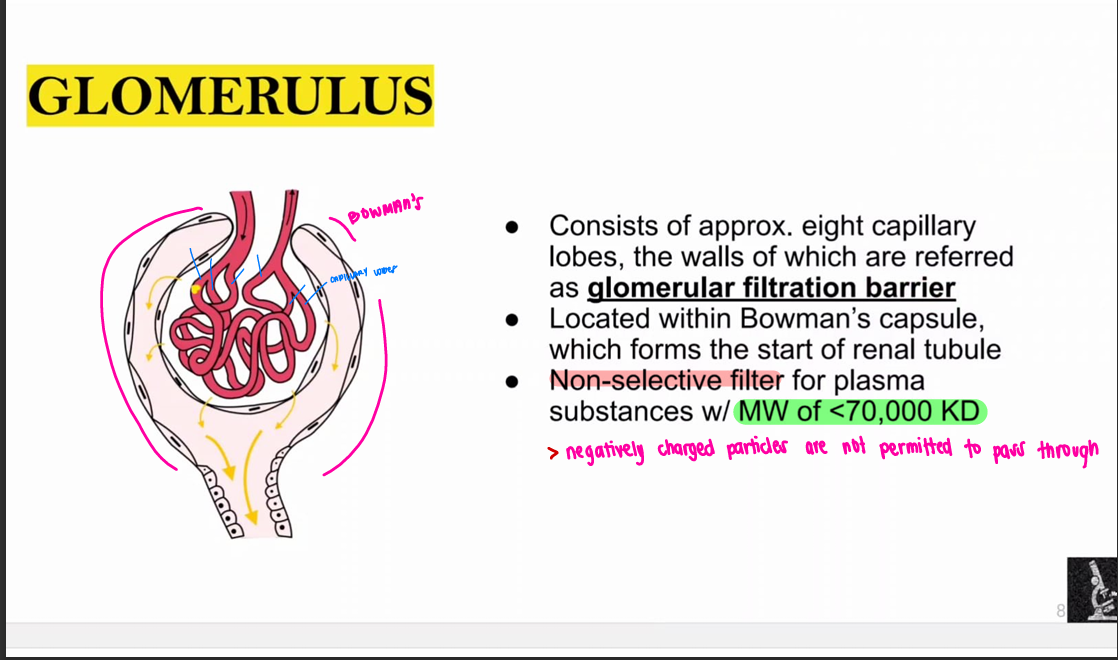
What characteristics of a substance is filtered in the glomerulus?
[Non-selective] substances with molecular weight of <70,000 KD
Negatively charged particles (ex. protein)
![<ul><li><p>[Non-selective] substances with molecular weight of <span style="color: red;"><strong><70,000 KD</strong></span></p></li><li><p><span style="color: red;"><strong>Negatively charged</strong></span> particles (ex. protein)</p></li></ul><p></p>](https://assets.knowt.com/user-attachments/991e3b39-4e7f-4ac1-9161-2e548e7ae064.png)
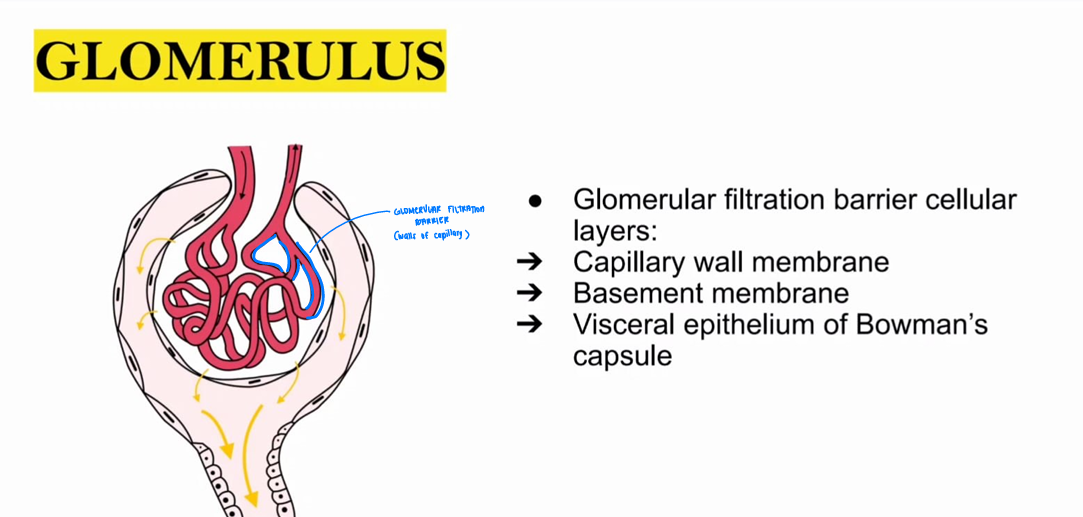
Glomerular Filtration Barrier —refers to the walls of the capillaries of glomerulus. What are the cellular layers of these walls?
Capillary wall membrane
Basement membrane
Visceral epithelium of Bowman’s Capsule
What are the two type of Glomerular Pressure? differentiate each?
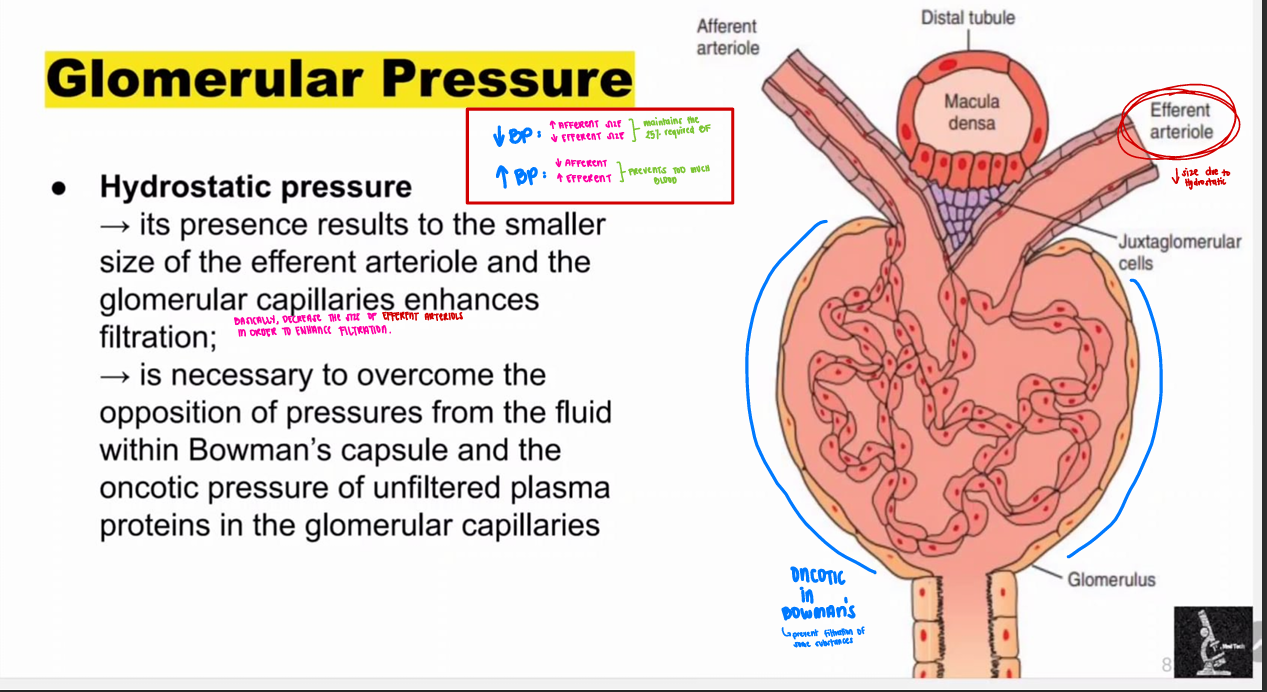
HYDROSTATIC PRESSURE
pushes fluid out of the blood vessels (filtration), driven by blood pressure
ONCOTIC PRESSURE
pulls fluid back into the vessels (reabsorption)
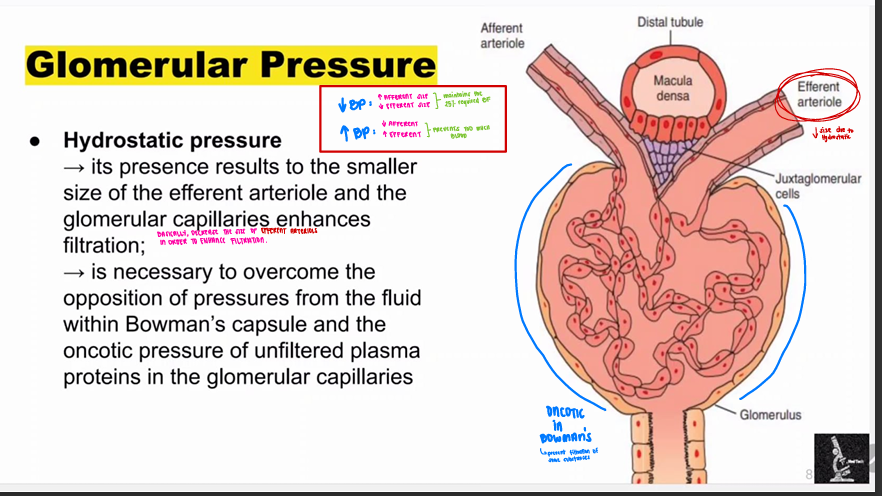
This type of Glomerular Pressure results to the smaller size of the efferent arteriole and the glomerular capillaries enhances filtration
Hydrostatic Pressure
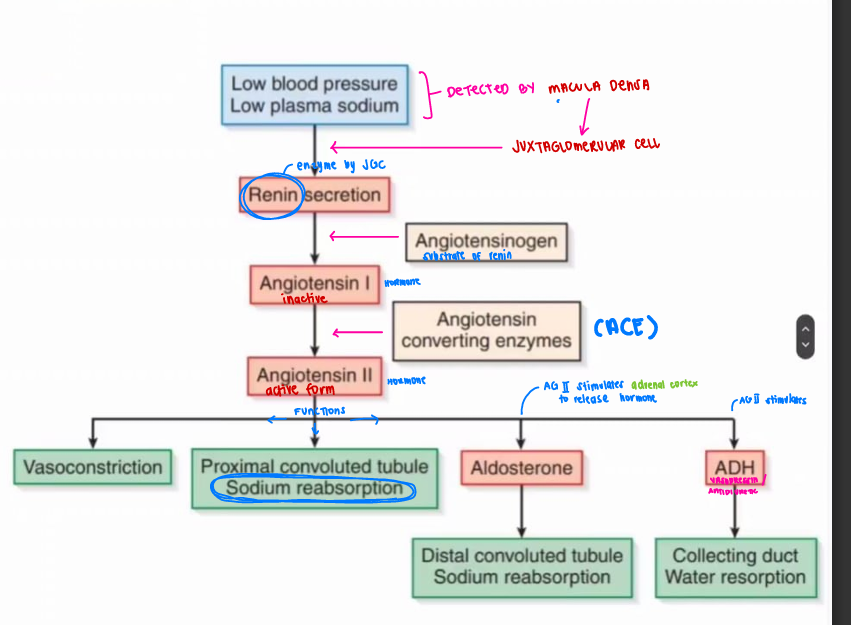
Explain the Renin-Angiotensin-Aldosterone-System (RAAS)
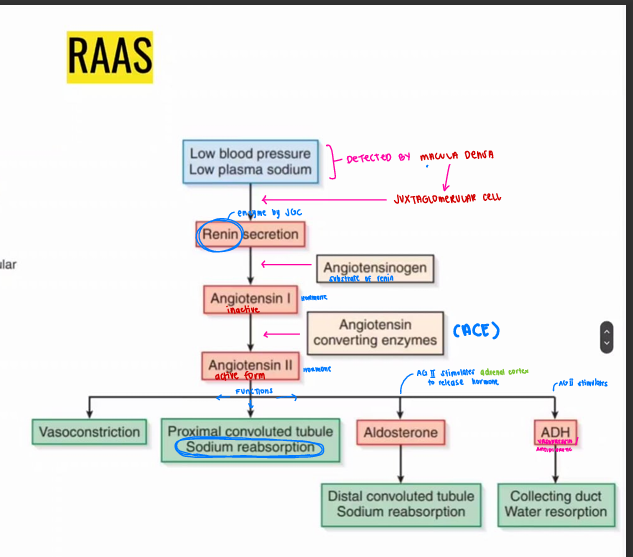
Macula Densa detects LOW blood pressure and sodium level
Macula Densa signals Juxtamedullary cells to release RENIN
RENIN binds to ANGIOTENSINOGEN to form ANGIOTENSIN 1
ANGIOTENSIN CONVERTING ENZYME (ACE) converts ANGIOTENSIN 1 → 2
ANGIOTENSIN 2 actions:
Vasoconstriction of efferent arteriole
Reabsorption of Sodium in PCT
Stimulates adrenal cortex to release Aldosterone → Reabsorption of Sodium in DCT
Stimulates hypothalamus to release Antidiuretic Hormone (ADH) → Reabsorption of Water in collecting duct
RECALL: What are the action of the Renin-Angiotensin-Aldosterone-System (RAAS)
Vasoconstriction of efferent arteriole
Reabsorption of Sodium in PCT
Stimulates adrenal cortex to release Aldosterone
Aldosterone → reabsorption of sodium in DCT
Stimulates hypothalamus to release Antidiuretic Hormone (ADH)
ADH → reabsorption of water in collecting duct
This is the BEST overall indicator of the level of kidney function
The STANDARD TEST used to measure the filtering capacity of the glomeruli
Glomerular Filtration Rate (Clearance Tests)
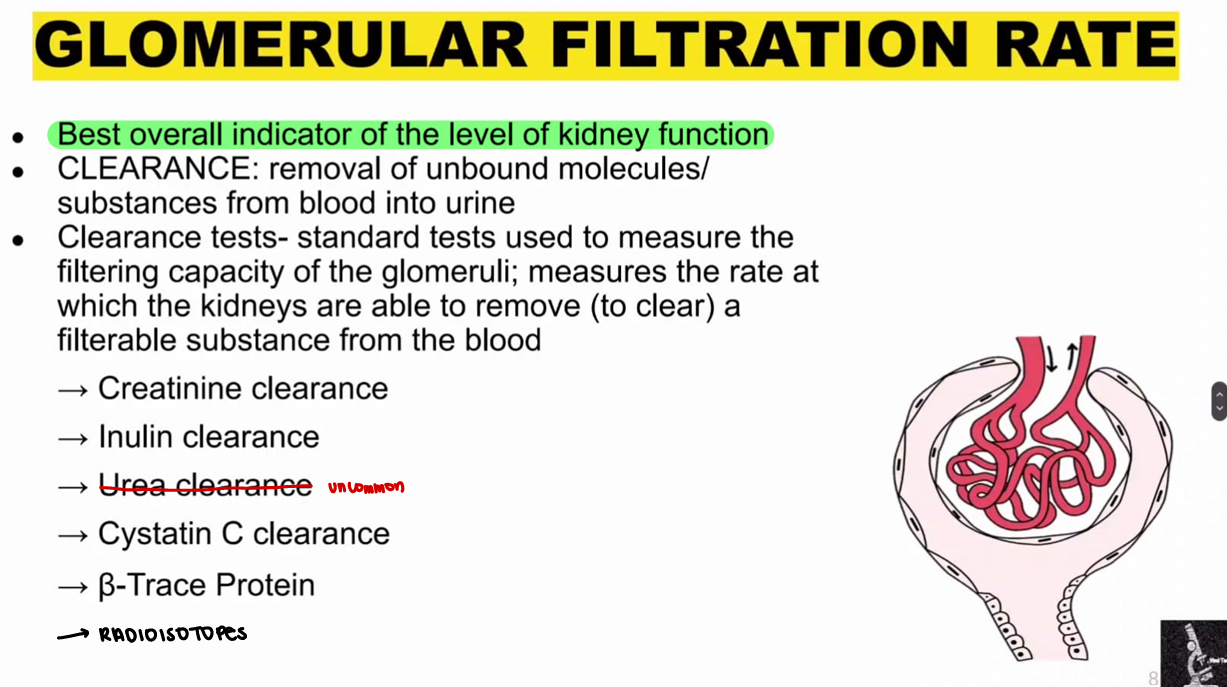
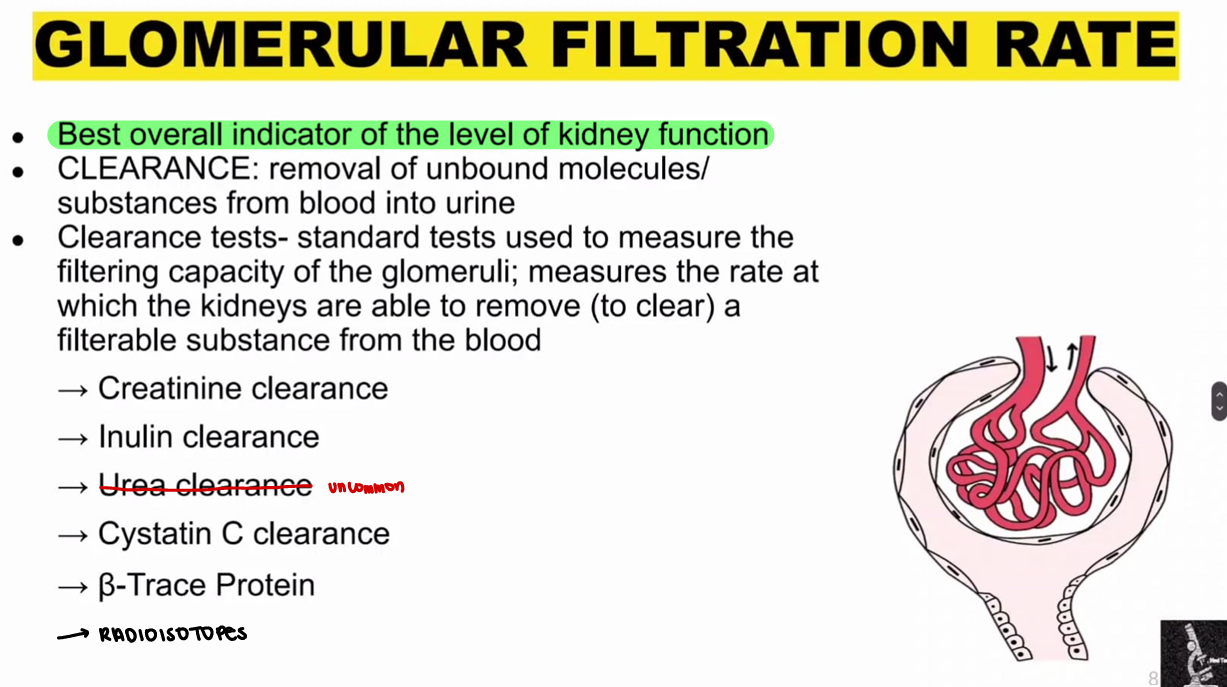
What are the different Clearance Tests?
Creatinine Clearance —never mistaken of CREATINE
Inulin Clearance
Cystatin C Clearance
Beta-Trace Protein
Radioisotopes
Will the function of Glomerular Filtration Rate (GFR) decreases when half of the nephrons are non-functional (ex: 1 kidney donated)?
NO — GFR remains unchanged if functional nephrons double their filtering capacity
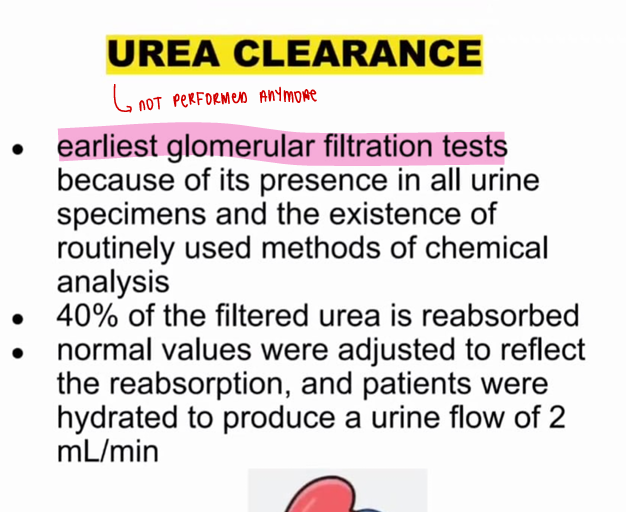
This clearance test if the earliest glomerular filtration test because of its presence in all urine specimens
Urea Clearance