D4.2 Stability and Change
 Call Kai
 Learn
Learn Practice Test
 Spaced Repetition
 Match
Match Flashcards
 Knowt Play
1/33

There's no tags or description
Looks like no tags are added yet.
Name | Mastery | Learn | Test | Matching | Spaced | Call with Kai | Chat |
|---|
No analytics yet
Send a link to your students to track their progress
34 Terms
Requirements for sustainable ecosystems
Sufficient energy supply
Light, harnessed through photosynthesis by producers—> move up food web to all trophic levels
Nutrient recycling
Carbon, phosphorus, nitrogen cycling → Nutrients are finite so must be recycled
Genetic diversity
Protects against events that can decimate entire populations —> disease, climatic events, increase in predators
Response to climate change
Genetic diversity can help is variables of climate change are within species tolerance levels
Mesocosm
A self-contained system that provides a living environment for organisms
Keystone species
Species that have a disproportionate effect on the structure and function of their ecosystem
Trophic cascade
When changes at one trophic level have indirect effects on other trophic levels
Eutrophication
The process by which bodies of water becomes unnaturally enriched with nutrients, leading to excessive plant and algae growth and subsequent oxygen depletion
Explain the process of eutrophication
Excessive nutrients from fertilizer run-off on land enters body of water
Minerals promote aquatic plants and algae to grow rapidly
Algae bloom blocks sunlight from penetrating below surface of water and therefore aquatic plants
Water oxygen levels fall
Aerobic bacteria decomposes excess algae growth and organic matter at an increased rate
Increased biochemical oxygen demand (BOD), depleting levels of dissolved oxygen in water
Aerobic organisms die due to insufficient oxygen in water
Biochemical oxygen demand
The oxygen needed by bacteria in a body of water
Biomagnification
When harmful substances in the environment build up in the organisms towards the top of the food chain
Substance becomes more concentrated in tissue of the consumer organism
e.g. Mercury, DDT
Explain the biomagnification of Mercury
Industrial sources emit mercury into aquatic environments
Microorganisms at bottom of aquatic food chain convert elemental mercury into methyl mercury
Methyl mercury becomes more concentrated in animal tissues as it moves up ocean food chain
Humans who eat large fish (e.g tuna) are at risk to high levels of mercury exposure
Explain the biomagnification of DDT
DDT is a synthetic insecticide that was discovered to be harmful to birds
DDT sprayed on crops would leech into waterways, eventually entering marine and freshwater ecosystems
DDT enters food chain through plankton and accumulates in bodies of fish
Birds eat the fish, accumulating higher concentration of DDT
Lead to thin eggshells that couldn’t survive incubation, fewer young birds in population
Microplastic
Plastic debris smaller than 5mm
Macroplastic
Plastic debris larger than 5mm
Describe ways animals are impacted by plastic
Turtles may eat plastic bags that resemble jellyfish
Albatrosses accidently consume plastic when fishing, and may feed it to their chicks when they regurgitate food —> chicks starve due to stomach being filled with plastic
Animals get caught in plastic
Breakdown of plastic releases toxins and biomagnification in food chain
Microplastics ingested by animals enters food chain
Rewilding
Conservation activities aimed at restoring and protecting natural processes and wilderness areas
Form of ecological restoration that leaves an area to nature, as opposed to active resource management
List the methods of rewilding
Reintroduction of apex predators and keystone species
Establishing wildlife corridors to connect habitats over larger areas
Limiting human influences
Stopping agriculture and resource harvesting (e.g logging, hunting)
Ecological management techniques (Controlled grazing or burning to restore habitat)
Ecological succession
The progressive change in the species that make up an ecological community over time
Primary succession
When newly formed or newly exposed land is inhabited by an increasing number of species
Magma from erupting volcanos cooling and forming new rock surfaces
Landslide that exposes bare rock
Colonization
The arrival of organisms on bare land
Secondary succession
When an existing ecosystem is drastically altered, and the remains of the previous ecosystem are used as a starting point for further changes
Soil is already present
Compare primary and secondary succession
Primary succession begins with no life while secondary succession follows a disturbance of primary succession
Primary succession starts with no soil while secondary succession has soil
Primarily succession begins in a new area while secondary succession occurs in an old area
Primarily succession has low biomass while secondary succession had higher biomass
Primary succession has low production while secondary succession had higher production
Primary production takes much longer to occur than secondary succession due to the process of creating soil
Production
The increase in biomass
Pioneer species
The first species to colonize new land
Climax community
The relatively stable, mature community that has reached the end of ecological succession
Characteristics of primary succession progression over time
Increasing species diversity
Increasing size of plants in the community
Increasing primary production
More complex food webs
Increasing nutrient cycling
Cyclical succession
A repeating pattern in which communities in an ecosystem replace each other in a cycle
Arrested succession
When a community is held or deflected at a stage before the natural climax is reached
Explain how loss of the Amazon rainforest can reach a tipping point
A tipping point is a threshold beyond in which a small additional change can cause a large and irreversible ecosystem shift
Deforestation of the Amazon affects the climate and weather patterns by reducing transpiration and water vapour
This decreases rainfall, causing soil and vegetation to dry
Increased drought and forest fires, causing tree growth and survival to decline
Forest cover declines, decreasing transpiration
Positive feedback loop
Factors affecting sustainable harvesting
Soil erosion —> Erosion of topsoil from heavy rainfall can wash away nutrients and organic matter
Leaching of nutrients —> Rain and irrigation water dissolves nutrients and carries them away from the root zone of a crop. Typically ends up contaminating nearby water supply
Fertilizer supply —> Farmers demand for fertilizer exceeds supply, Fertilizer production is energy intensive so costs are affected by global energy prices
Pollution —> Water runoff + leaching pollutes water —> kill non-target species
Carbon footprint —> Reliance on fossil fuels for transportation, machinery, and synthetic fertilizers increases carbon footprint
Tipping point
A critical threshold within an ecosystem where a small change can lead to significant, often irreversible shift’s in the systems state
Carbon footprint
The total amount of greenhouse gases that is generated by an activity
Outline the process of cyclical succession in wood pastures
Grazers graze on pockets of land, consuming tree seedlings (prevents tree growth)
Thorny species (e.g thickets, brambles) grow within the open pasture
Tree species survive using thorny vegetation as protection, deterring grazers
Later, shade from the tree restricts the thicket from growing and eventually dies
Once the tree dies, the cycle restarts
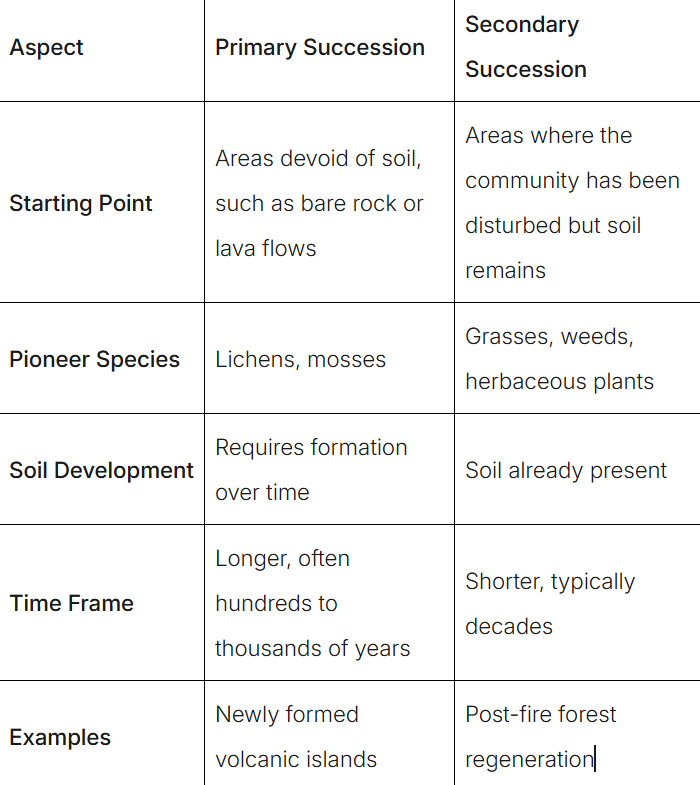
Distinguish between primary and secondary succession
Autogenic succession
Succession driven by interactions among species in an ecosystem
Allogenic succession
Succession influenced by external environmental factors (e.g climate change, soil development)