Limestone
 Call Kai
 Learn
Learn Practice Test
 Spaced Repetition
 Match
Match Flashcards
 Knowt Play
1/25

There's no tags or description
Looks like no tags are added yet.
Name | Mastery | Learn | Test | Matching | Spaced | Call with Kai | Chat |
|---|
No analytics yet
Send a link to your students to track their progress
26 Terms
What percentage of Jamaica is limestone
70%
Describe three different features of limestone
made mainly of calcium carbonate
weathered by carbonation
Permeable rock
Uses of limestone
extract fresh groundwater from limestone
main raw material for manufacturing cement
crushed to make aggregate for construction industry
Cut into blocks, used as building material
Why is limestone vulnerable / susceptible?
Limestone is vulnerable or susceptible because of its chemical makeup and open structure make it especially prone to weathering and erosion in humid or rainy environments.
Chemical structures containing calcium carbonate content, well a well‑jointed structure, and is permeable and porous
What is the 3rd most common mineral in the Earth’s crust
Calcite
Describe calcite
Crystal-like appearance
form crystals in a wide variety of shapes and colors
Calcite, an extremely abundant mineral composed of calcium carbonate (CaCO3)
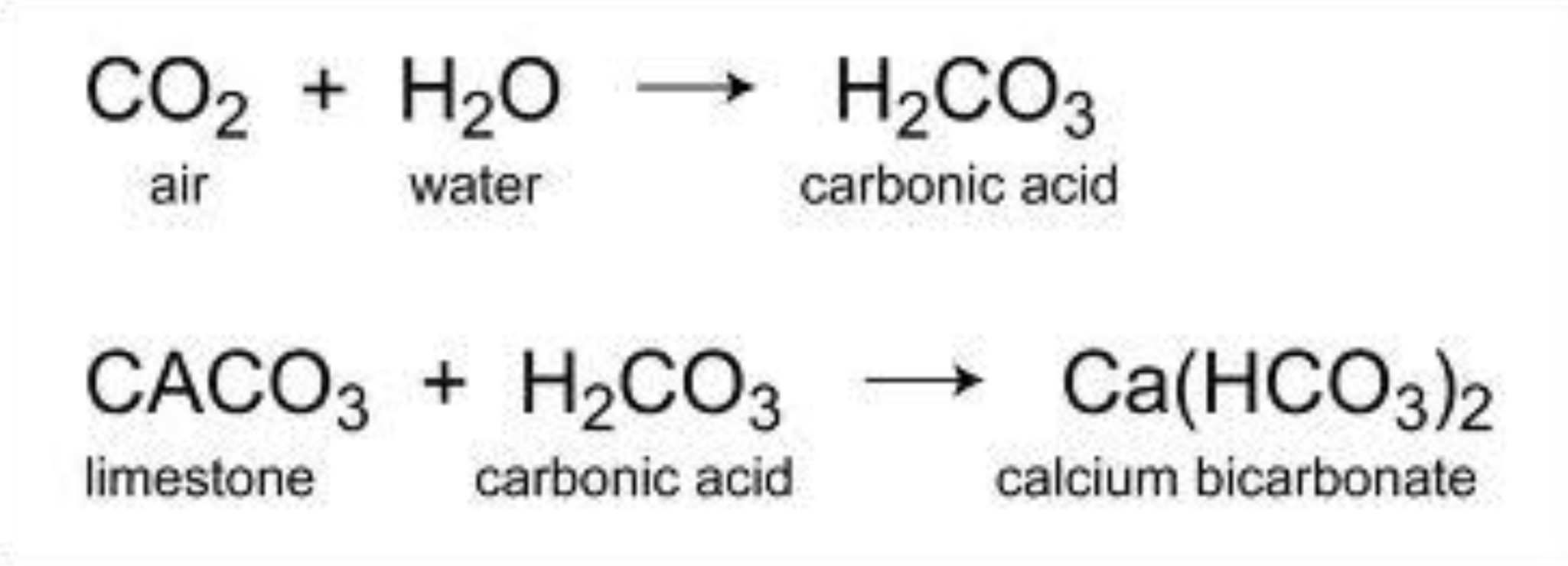
Explain the process of carbonation with limestone
Carbonation is a form of chemical weathering in limestone.
Rain in the atmosphere absorb CO2 —> produces weak carbonic acid ( H2CO3)
Upon contact with limestone, it react with calcium carbonate mineral (CaCO3)
The reaction produces calcium bicarbonate (Ca(HCO3)2
this is soluble and will easily be removed by water creating openings in limestone rocks
Carbonation on limestone equation (Chemical weathering process)
What is created since limestone is permeable
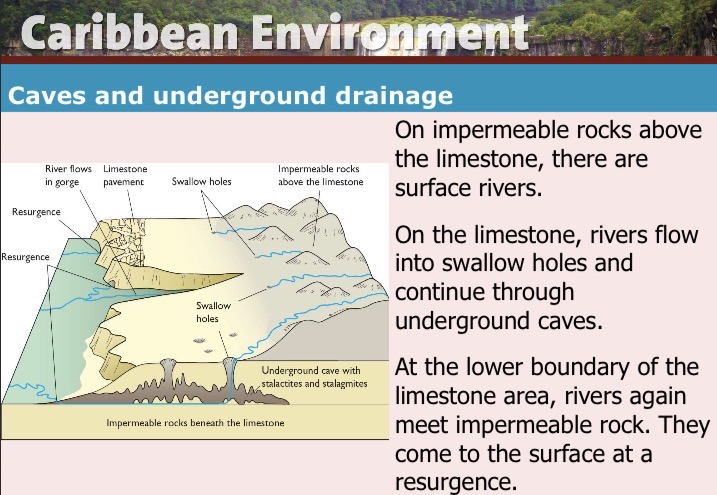
Because limestone is permeable, water seeps through cracks instead of flowing on the surface, creating underground drainage and few surface rivers
Define “Karst Topography”
Kart Topography is the resultant features formed in limestone from the process of Carbonation
SURFACE FEATURES
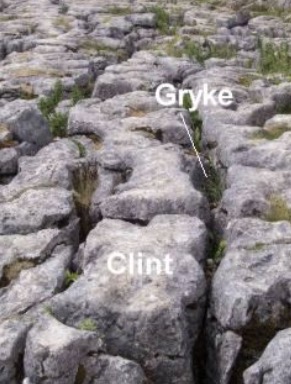
Limestone pavement (Clints and Grykes)
Definition: A surface of exposed limestone rock divided into blocks (clints) and cracks (grykes).
Formation: Rainwater collects in joints and dissolves the rock by carbonation, widening cracks into grykes and leaving raised blocks called clints.
SURFACE FEATURE (SURFACE DEPRESSION)
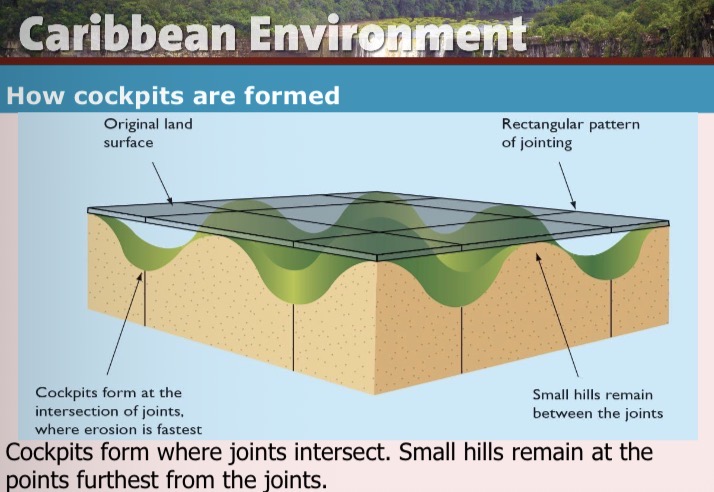
Cockpit
Formation: Continuous chemical weathering enlarges sinkholes until they merge, forming a series of enclosed basins - common in Jamaica's Cockpit Country.
Cockpit
cockpit country in Jamaica made of pure white limestone crossed by joints and faults
Joints and faults intersect, rapid weathering form star-shaped depression
Small conical hill remain away from joints
Where jointing is regular hills are arranged in rows
SURFACE FEATURE (SURFACE DEPRESSION)
Swallow hole / Sinkhole
Definition: A hole or depression where a surface stream disappears underground.
Formation: Carbonation enlarges cracks until the roof collapses or water erodes downward, allowing rivers to "swallow" into underground channels.
SURFACE FEATURE (SURFACE DEPRESSION)
Doline
Definition: A small depression formed by solution of limestone
Formation: Acidic water dissolves limestone below the surface, creating a cavity that eventually collapses.
Doline
Collapse dolines are formed when a cave roof falls in
Solution dolines are formed where there are many joints and fissures leading to rapid weathering
When a doline is lined with clay, a small lake may form
SURFACE FEATURE (SURFACE DEPRESSION)
Polje
Definition: A large, flat-bottomed depression often with temporary lakes.
Formation: Several dolines join together and widen through erosion and collapse, forming a broad basin.
SURFACE FEATURE (SURFACE DEPRESSION)
Uvala
Definition: A large irregular hollow formed by the merging of smaller dolines.
Formation: Continuous dissolution and collapse of limestone cause several dolines to combine into one large depression.
UNDERGROUND FEATURES
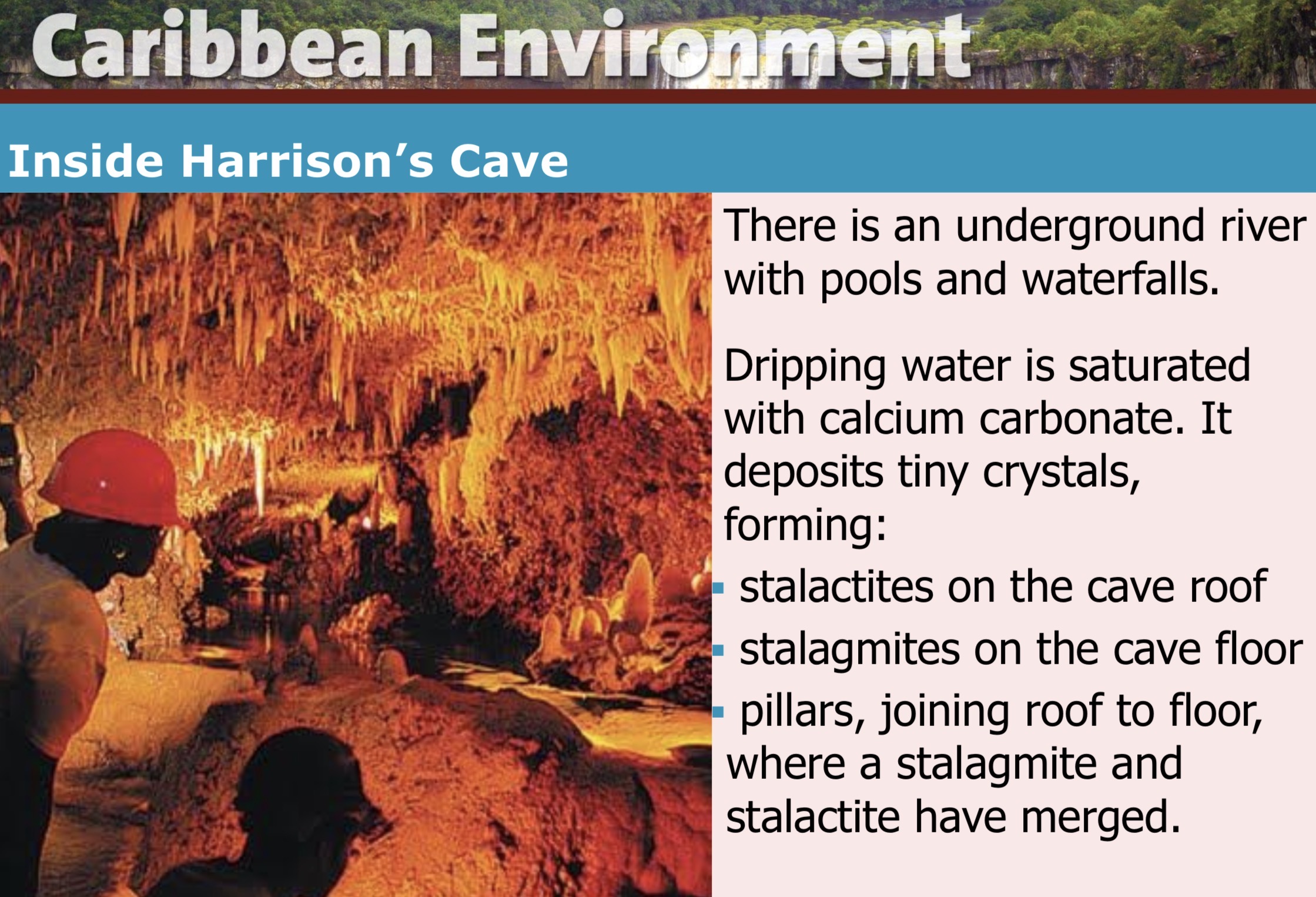
Cave
Definition: A natural underground chamber formed in limestone.
Formation: Rainwater seeps through cracks and dissolves limestone along joints and bedding planes, enlarging them into tunnels and chambers.
UNDERGROUND FEATURES
Stalactite and Stalagmite
Definition: Stalactites hang from cave ceilings; stalagmites rise from cave floors.
Formation: Water dripping from the cave roof leaves behind calcium carbonate deposits - stalactites grow downward, stalagmites upward.
UNDERGROUND FEATURES
Pillar
Definition: A column formed when a stalactite and stalagmite join together.
Formation: Continuous deposition of calcium carbonate connects the two features over time.
UNDERGROUND FEATURES
Underground river
Definition: A stream that flows through limestone caves and channels beneath the surface.
Formation: Surface water enters swallow holes and travels through underground passages dissolved by carbonation.
What are the above ground features
Limestone pavement
cockpits
sink holes/swallow holes
dolines
polje
uvala
What are the underground features
caves
stalagmite and stalactite
pillar
underground rivers
Caves and underground drainage
Harrison’s Cave