Chapter 10 - Intelligence
 Call Kai
 Learn
Learn Practice Test
 Spaced Repetition
 Match
Match Flashcards
 Knowt Play
1/45

There's no tags or description
Looks like no tags are added yet.
Name | Mastery | Learn | Test | Matching | Spaced | Call with Kai | Chat |
|---|
No analytics yet
Send a link to your students to track their progress
46 Terms
Aristotle
he distinguished 2 dimensions of behavioural flexibility:
1. Practical Wisdom
2. Theoretical Wisdom
Practical Wisdom
distinguished by Aristotle; the application of knowledge, reasoning
Theoretical Wisdom
distinguished by Aristotle; understanding objective truth, science
Flynn Effect
The rise in average IQ scores that has occurred over the decades in many nations due to nutrition & medical care, education, & environmental complexity.
Binet & Simon
developed the first standardized IQ test using behavioural measures to identify children with learning disabilities.
it measured direction (knowing what and how to do), adaptation (strategy for implementation), and criticism (finding errors).
introduced mental age.
Wechsler
test of intelligence based on normal distribution of IQ with average score of 100.
it is unaffected by age of the participant, uses point system, and adds performance IQ tests to measure ability & to detect non-obvious patterns.
Atkinson and Shiffrin's Multi-Store (Modal) Model of Memory
Atkinson & Shiffrin (1968) proposed that memory is not one single system. Instead, it flows through three separate stores:
Sensory Memory
Short‑Term Memory (STM)
Long‑Term Memory (LTM)
Information moves through these stores depending on attention, rehearsal, and encoding.
Stimulus → Sensory Memory → (Attention) → STM → (Rehearsal) → LTM → (Retrieval) → STM
Short-Term Memory
Function: Temporary workspace for information you're actively thinking about. Duration: 15-30 seconds
Key process: Rehearsal
If you rehearse → info moves to LTM
If you don't → info is lost through decay or displacement
Example: Repeating a phone number to yourself so you don't forget it.
Long-Term Memory
Function: Permanent storage of knowledge, experiences, skills.
Duration: Potentially lifelong
Capacity: Essentially unlimited
Key process: Encoding. Information must be meaningfully processed to enter LTM.
Retrieval: Information flows back from LTM → STM when you recall something.
Example: Remembering your first day of school or how to ride a bike.
Robert Sternberg
concluded that people go through different components when completing complex problems:
intelligent people take longer during first components but are faster overall.
Eugenics
incorrect belief that intelligence is biologically fixed by certain races and classes that led to discriminatory policies (encouraging reproduction in superior races/classes & sterilization of inferior races/classes)
(1890s) via Galton & Terman believed white people of European ancestry and upper classes were the most intelligent.
major influence on some North American gov.t policies & development of Nazism.
Race & IQ
racial distinctions are unreliable and not scientifically or genetically meaningful. the intelligent test are easily influenced by situational factors (poverty, limited schooling, lack of adequate healthcare, poor nutrition) and lack of familiarity with certain topics.
Stereotype Threat
people in marginalized group experience increased anxiety and divided attention during testing.
Mindset
Can decrease performance if someone believes their intelligence is fixed at a low level.
Normal Distribution
distribution of IQ scores follows a bell curve with: Mean = 100 & Standard deviation = 15
Most people fall in the middle:
68% of people score between 85-115
95% score between 70-130
Why this matters: The normal distribution shows that intelligence varies within the population, and the WAIS adjusts for age so that intelligence is measured relative to peers, not absolutely.
This supports the idea that intelligence is not fixed—it changes with development, environment, and aging.
Gender and IQ
no difference in overall intelligence: MEN are better visuospatial tasks, WOMEN are better verbal tasks. differences are influenced by culture, mindset, and stereotypes.
Two Components of Intelligence by Spearman
1. g (General intelligence)
2. s (Specific intelligence)
General Intelligence (Spearman)
higher order; generalizes to many contexts and can apply to any content area (quantitative reasoning, abstract verbal reasoning, short-term memory)
System of Basic Abilities (Spearman)
1. Apprehension of own experiences
2. Eduction of relations (ability to see how things are connected)
3, Eduction of correlates (ability to predict what should come next)
Basic Abilities (Spearman)
reflects mental energy available throughout entire cortex (more intelligent people have more energy to devote).
Factor Analysis
statistical method used to figure out which abilities cluster together, used to determine whether there is a general ability (g) and how that g breaks into specific abiliites.
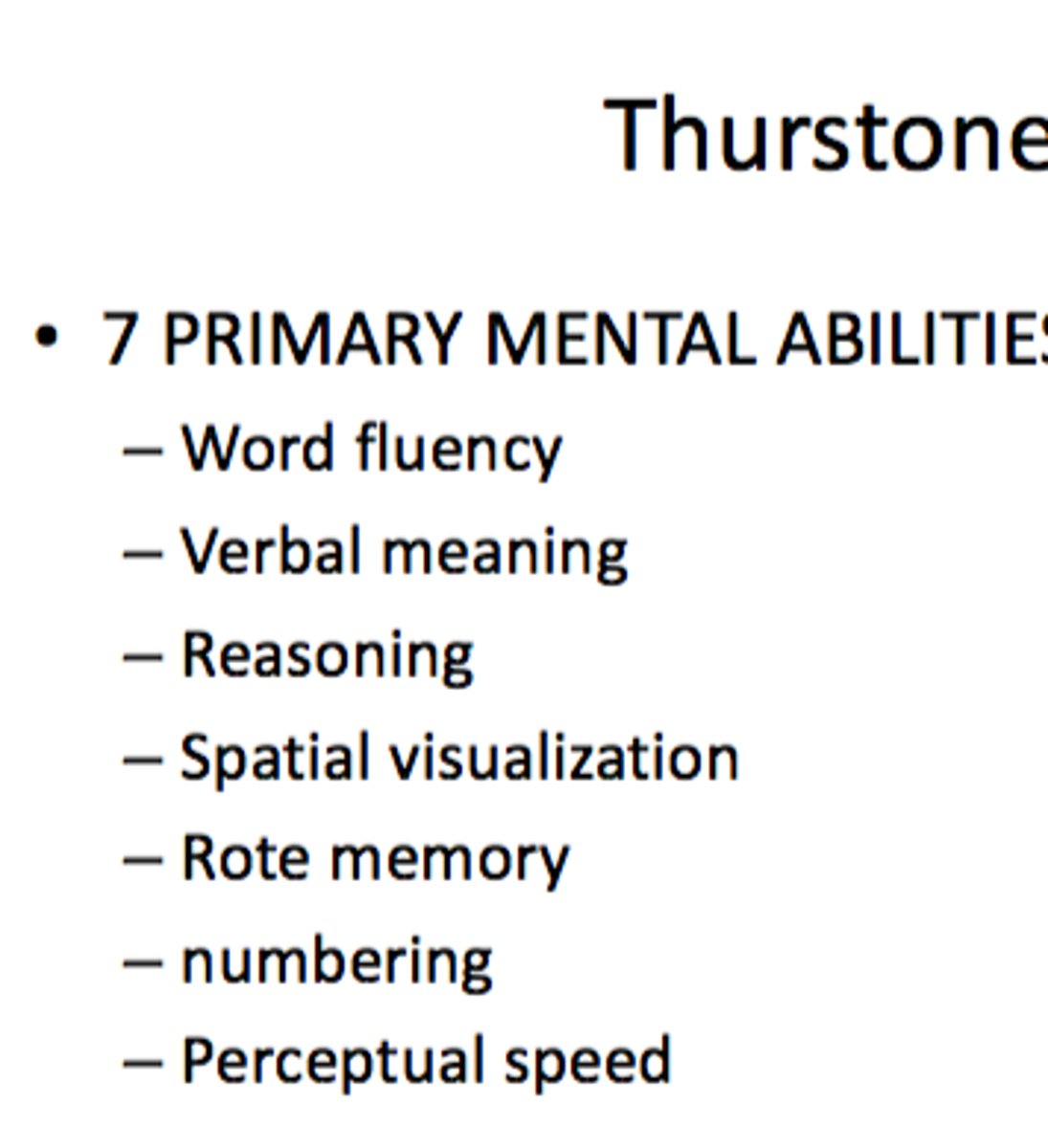
Louis Thurstone
developed that intelligence is made up of 7 factor analysis - primary mental abilities to contradict Spearman's theories.
Thurstone believed people have different strengths, and doing poorly in one area doesn't mean you'll do poorly in another.
Cognitive Flexibility
ability to know when and how to apply knowledge.
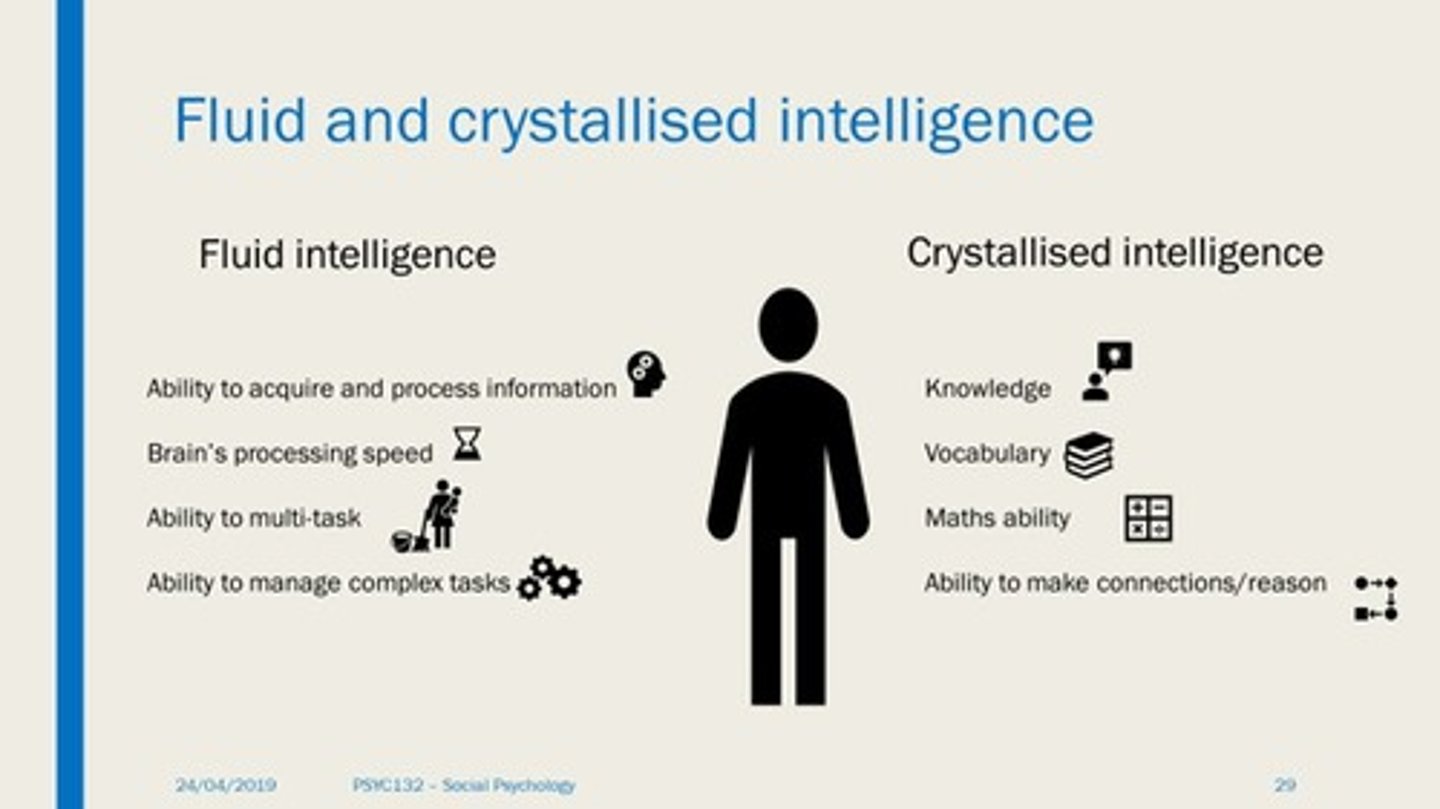
Fluid General Intelligence
ability to think flexibly and handle complex situations.
Crystallized General Intelligence
ability to solve problems by applying knowledge.
Upper Paleolithic Transition
Humans went from "basic survival mode" to creative, innovative, and advanced thinkers.
It was like a sudden "upgrade" in human behavior — a burst of intelligence, creativity, and culture.
This transition marks the moment humans started acting like modern humans:
thinking ahead, expressing themselves, organizing time, making art, building culture.
It's one of the biggest leaps in human history.
Intelligence
the ability to learn from experience, adapt, reason, and solve problems. And is hard to measure and understand.
How much % of population consider themselves smarter than average?
65%
Williams
he performed detailed analysis stating that intelligence allows us to adapt to changes and learn from experience.
Galton
measured intelligence using physiological measures like traits (hair, eye colour, differences in weights or pitch).
introduced normal distribution in intelligence.
conclusion = incorrect assumptions
Terman (Stanford-Binet)
Problem: IQ decreases with age because mental age plateus.
- mental age stops increasing meaningfully after about 16.
- chronological age keeps increasing.
- so IQ scores would drop every year even if a person's intelligence stays the same.
Solution: deviation IQ by Wechsler.

Sensory Memory
What stage of memory?
Function: Holds raw sensory information for a very brief moment.
Duration:
Iconic (visual): 0.5 seconds
Echoic (auditory): 2-4 seconds
Capacity: Very large
Loss mechanism: Decay — if you don't pay attention, it disappears.
Example: You glance at a billboard. The image stays for a split second even after you look away.
Nettelbeck and Lalley
proposed that a good way to measure intelligence was to measure how quickly an individual could identify which of the two lines was the longer line (inspection time) / speed of processing basic information.
Authur Jensen
proposed that intelligence is linked to speed of neural transmissions (choice reaction time) by selecting correct response among options, pressing a button corresponding to the opened light, processing time may be important, but not central.
Componential Analysis
studying intelligence by determining how complex problems are solved by breaking the complex problems down into their simpler component problems - Reverse Engineering (underlying processes: encoding, inferring & mapping relations, & applying)
Wechsler Adult Intelligence Scale (WAIS)
Widely used adult IQ test.
It measures intelligence using multiple subtests, not a single score:
Verbal comprehension
Working memory
Perceptual reasoning
Processing speed
Why this matters: WAIS scores are age‑normed: means your score is compared to people your age, not younger adults.
Avoids the flaw in Terman's formula (where IQ dropped as you aged).
Charles Spearman
intelligence; found that specific mental talents were highly correlated, concluded that all cognitive abilities showed a common core which he labeled 'g' (general ability)
Specific Intelligence (Spearman)
lower level; contextually sensitive and can apply to limited content area (algebra, mathematical concepts involves in quantitative reasoning)
Raymond Cattell
reconciled theories through hierarchical model, general intelligence at the top of structure:
1. Fluid General Intelligence
2. Crystallized General Intelligence
Emotional Intelligence
ability to perceive emotions, use emotions to facilitate thoughts, understand emotions, and manage them.
can contribute to general intelligence by helping us recognize what information is important.
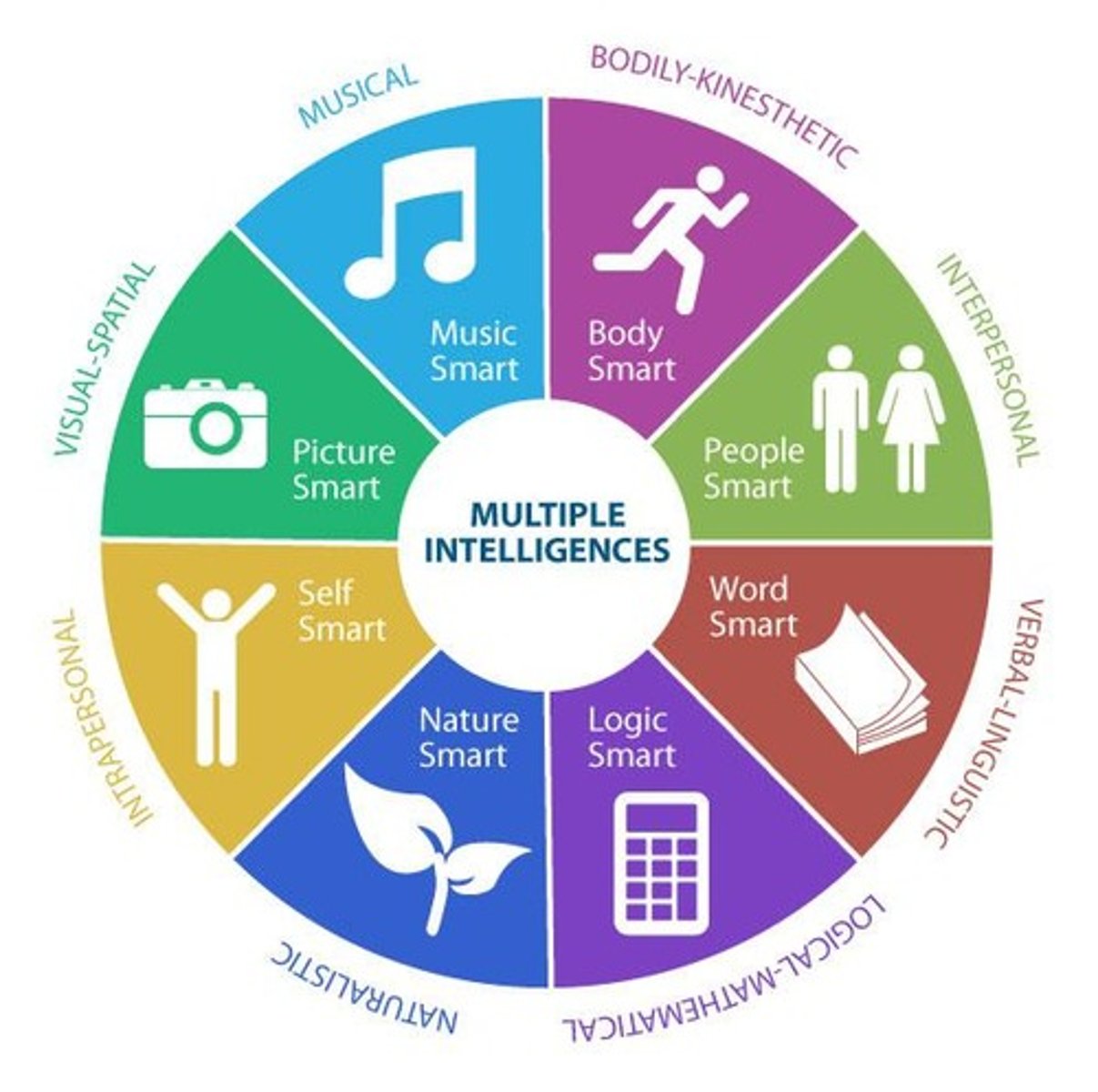
Gardner's Multiple Intelligences
our abilities are best classified into eight independent intelligences, which include a broad range of skills beyond traditional school smarts
this theory is heavily incorporated into educational theory.
General Intelligence: Influence of Culture
we are more efficient when working in groups.
culture allows for the transmission of information between individuals and across generations.
Knowledge Illusion
believing we know more than we really do.
Nature and Nurture
level of intelligence is function of both nature and nurture, probably due to dynamic coupling of gene activity and environmental conditions.
Twin Studies
suggest intelligence is partially genetic, though cultural environment still influence intelligence.
Still learning (26)
You've started learning these terms. Keep it up!