Animal Genetics Exam 2
 Call Kai
 Learn
Learn Practice Test
 Spaced Repetition
 Match
Match Flashcards
 Knowt Play
1/65

There's no tags or description
Looks like no tags are added yet.
66 Terms
How do we decide if the results meet our hypothesis about the mode of inheritance and expression of genotypes? What is the critical chi value? F its higher or less than, we?
Ex: In the Sweet Pea trial we expect a 9 C: 7 c ratio, we observe 50 C : 30 c out of 80 plants
Experiment 1: observe 50 C : 30 c out of 80 plants
• Test statistic; 𝜒2 = (50−45)²/45 + (30-35)²/ 35 = 1.27
Compare the calculated Chi-square value with the Chi-square critical value from Table of Chi-square at particular significance threshold (e.g. P<0.05) and 1 degree of freedom. The critical Chi-square value is 3.841
Why we use 1 degree of freedom?
If calculated 𝜒 2 value is less than 3.841, Accept (fail to reject) the null hypothesis (i.e. H 0 )
If calculated 𝜒 2 value is higher than 3.841, Reject the null hypothesis
What are alleles?
Alleles are different forms (versions) of mutation, genetic variant, or genes possible in a physical position on the genome

Allele Frequency: Beta casein
What is Beta casein? It’s two forms? Which breed has highest A2A2?
• is a protein that makes up around 30% of all milk proteins
• BTA6
• There are two main versions of beta casein: A1 and A2.
• Codominance mode of action
We need to know genotype frequency and then breed A2A2 x A1A1 → A2A2 X A2A1 → 50% A2A2 replacement and 50% A1A2 (cull)

What is Allele Frequency?
Refers to how frequently a particular allele detected (i.e., observed) in a population.

Why do we care about Allele and Genotype Frequency? Overall idea and 4 specific uses?
They underpin practical breeding decisions:
=> Genomic prediction (GEBVs) relies on allele frequencies at markers across the genome to estimate breeding values and compute genomic relationship matrices.
=> Estimating heterozygosity and inbreeding depression risk in a herd requires genotype frequency data. Inbreeding depression risk = reduction in the animal performance
=> Frequency of a deleterious or favorable allele (e.g., a fertility-linked variant) tells you how much genetic potential exists to select for or against it, and how fast you could move that frequency through selection.
=> Carrier frequency for recessive genetic defects (important in dairy cattle, where several recessive lethals are tracked) is calculated directly from genotype/allele frequencies, which is critical for mating decisions to avoid carrier × carrier matings.
Calculating Allele Frequencies: assumptions, two methods
Assumptions: We are dealing with a single locus in a large and random mating
population. we are dealing with diploid species.
What are the frequencies of A1 and A2 alleles?
We can calculate allele frequency by two methods:
▪ Counting
▪ Proportion

Calculating Allele Frequencies by Counting: fill in blanks
Dominant vs minor allele? What does p and q mean?
Dominant/major allele is the most commonly frequent allele in this population (p)
Minor allele is the less common or frequent allele in this population (MAF) (q)


2. Calculating Allele Frequencies by Proportion: q + p = 1
Frequency of A1? Frequency of A2? What is genotype frequency?
o P = f(A1A1) = 78/150 = 0.52
o H = f(A1A2) = 54/150 = 0.36
o Q = f(A2A2) = 18/150 = 0.12
o Frequency of A1 = f(A1)= p = P + ½ H = 0.52 + ½ 0.36 = 0.7
o Frequency of A2 = f(A2)= q = Q + ½ H = 0.12 + ½ 0.36 = 0.3
o Minor Allele Frequency = MAF= q = 0.3
Rules and assumptions of calculating allele frequencies?
❑ p = P + ½ H
❑ q = Q + ½ H
❑ P + H + Q =1
❑ p + q = 1
❑ Assumptions?
o Large number
o Random mating
Hardy-Weinberg Equilibrium: use for what kind of population and in the absence of what 3 things?
In large and random mating population
In the absence of migration, mutation and selection

HWE: _(1)__ and _(2)__ frequencies remain __(3)___
1) allele 2) genotypic

HWE: _(1)__ frequencies are determined by _(2)__
Calculate the next gen frequencies via random mating? How?
p = f(B) = 0.8 & q = f(b) = 0.2
What is random mating
1) genotypic frequencies 2) allele frequencies
Computing a Punnet Square is the same as random mating, random mating me and that any male and nay female have equal chnage of mating

If genotypic and allied frequencies in g0 and g1 are not constant then does g0 follow HWE?
No
Is g1 population HWE or not?
p = f(B) = 0.8 & q = f(b) = 0.2
How many generation of random mating required for g0 population to reach HWE?
Calaucte genotypic frequencies for g2 population
Genotypic Freq.
P = f(BB) = p2 =0.64
H = f(Bb) = pq + pq = 2pq = 0.16 + 0.16 = 0.32
Q = f(bb) = q2 = 0.04
Allelic Freq.
p = f(B) = P + ½ H = 0.64 + ½ 0.32 = 0.8
q = f(b) = Q + ½ H = 0.04 + ½ 0.2 = 0.2
▪ Allelic and genotypic frequencies don’t change with random mating from generation to the next generation. So, g1 is in HWE.
▪How many generation of random mating required for g0 population to reach HWE? ONE
Estimating Allele Frequencies using recessive condition genotypes:
Suppose we know a recessive condition, bb, has a frequency of 1% in the population. Can we estimate q?
As you must know that we are ignoring the contribution of the heterozygotes to q calculation (i.e. we are assuming HWE)
if you use q^2 = f(bb) and estimate
q = sqrt(q²) = sqrt(f(bb))
Only use f(bb) to estimate f(b) if f(Bb) is not available.
If we assume this population is in HWE, so can we estimate q as following: If f(bb) = q 2 = 0.01, then q = sqrt(0.01) =0.1 p = 1-0.1 =0.9
Example:
We have a population with a recessive condition, bb, having a frequency of 1% in the population. Can we estimate q?
This is only correct in the case if f(Bb)=2pq = 18%
q = Q + 1/2 H = 0.01 + 1/2 (0.18) = 0.1
Suppose we discovered f(Bb) is 5% then
q = Q + 1/2 H = 0.01 + 1/2 (0.05) = 0.035

Properties of Equilibrium Populations: 1. Frequency of heterozygote (H = 2pq)
What is the biggest H (Hmax ) can be?

Properties of Equilibrium Populations:
H = 2sqrt(PQ) or H/(sqrt(PQ)) = 2
This gives us a quick test for H-W equilibrium that doesn’t need __(1)__
Calculate if population 1 and 2 are HWE or not?
1) allele frequencies
Population 1 is, 2 isnt

Detection of Carriers: What is a carrier? How to detect a carrier?
What Is a Carrier? An individual (of any species) that carries a single allele of a genetic variant (i.e. Heterozygote) that is associated with a specific genetic disorder.
How to detect a carrier?
⇒DNA Testing Technology: SNP chip that can test for several genetic
conditions or disorders. Relatively Cheap & Many service providers
⇒ Test Mating
Use of HWE in Detection of Carriers:
If we have a locus controlling coat color and the Genotypes on that locus are BB Bb bb
• we have a bull B? , which is a suspected carrier (Bb).
• what is the probability of being a carrier P(Bb)?
P(Bb) = P (of being carrier or having red calf)
• P(detect this bull as a carrier (i.e. Bb)): we can say there is a X%
chance we would detect that bull is a carrier. => level of confidence
• P(not detecting): P(from n matings without seeing a homozygous
recessive offspring bb)
• P(detect Bb) = 1 – P(from n matings without seeing a homozygous
recessive offspring bb)
• P(detect Bb) =1- P(not detecting) =1- P(Bb after n mating)
Use of HWE in Detection of Carriers: Test Mating
With one mating to a bb cow =>
P(Bb after n) = P(not detecting) = ½
level of confidence = P(detect Bb) = 1- P(not detecting)
= 1- ½ = ½ => 50% Low
But if we make the mating n times with red cows (bb) and don’t see a bb (red) calf
P(Bb bull) = (1/2)^n since each calf is independent
For large n red cows (bb), P(Bb) gets very small
level of confidence = P(detect Bb) = 1- (½) 4 = 0.9375
level of confidence = P(detect Bb) =1- (½) 10 = 0.999
Detection of Carriers
P(detect Bb) = 1 - P(Bb carrier)
P(detect Bb) = 1 - P(not detecting)
General rule:
o Test crosses to a variety of genotypes
P(Detect Bb after n) =
1- [1*f(BB) + 3/4 f(Bb) + 1/2 f(bb)] n
where f(genotype) = frequency of that genotype in test crosses
Ex Detection of Carriers:
P(Detect Bb after n) = 1-[f(BB) + ¾ f(Bb) + ½ f(Bb)]^n
If all 1000 cows are BB, f(BB) = 1
=> If all 1000 cows are BB, f(BB) = 1
P(Detect Bb) = 1-(1)1000 = 1-1 = 0, for all n>0
=> If mated to 10 cows, 1/2 are Bb, 1/2 bb
P(Detect Bb) = 1 - [3/4 (1/2) + 1/2 (1/2)]10
= 0.9909 ≈ 99%
=> If mated to 8 cows, 1/2 are Bb, 1/2 bb
P(Detect Bb) = 1 - [3/4 (1/2) + 1/2 (1/2)]^8 = ?
Applications of HWE Continue
Genotypes Quality Control (QC) for genomic studies
o If genotypes are not in HWE, they are excluded before being used in further analyses (e.g. Genome wide Association studies) as they are considered as genotyping errors
Assumption: “Loci not in HWE can be lethal or causing disease”
o depart recessive or dominant allele from HWE
o Practically using HWE for detection of lethal alleles is difficult for two main reasons:
1. The need of large number of individuals to detect the rare variants
2. Standard QC eliminate these genotypes as they are considered genotyping/sequencing errors
Applications of HWE cont.
Parentage testing (human + livestock) => in HWE
Forensics (wildlife + crime) => in HWE
o In these test panels, the markers (SNPs) should be
in HWE
Segregate in most of the breeds
o These tests are so sensitive for genotyping errors
Most populations in real world
May not be in HWE, BUT HWE serves as a baseline model for
studying effects of many evolutionary and demographic factors on the
genetic structure of the population (i.e., departure from HWE).
Genetic & Genomic improvement have been done using
selection or crossbreeding so if we maintain all conditions
for HWE, no genetic improvement would be achieved
Factors affecting Hardy-Weinberg Equilibrium: The conditions of HWE? Factors violating HWE?
The conditions of HWE:
A random mating population
A large population
No Migration
No Mutation
No Selection
o Factors violating HWE:
No random mating
(Assortative mating (+& -) and Linkage (autosomal and sex
linkage)
A small population
Migration => crossing => importing and exporting semen and
embryos
Mutation
Selection
A random mating population: What is random mating? What violates random mating?
⇒ What is random mating?
o A mating system in which all matings are equally likely
o To achieve HWE from a non-equilibrium population, one generation of random mating is required
Violate Random Mating
Positive Assortative mating
o Individuals like mates within like (i.e. specific phenotype mating
together)
o Leading to more to homozygotes
o Like? Purebreeding
Negative Assortative mating
o Individuals unlike mates (i.e. different phenotype mating together)
o Leading to more to heterozygotes
o Like? Crossbreeding
(+) OR (-) => Change in genotypic frequency but not allele
frequency
Positive Assortative mating (Homogamy)
Individuals with similar phenotypes or genotypes mate with one another.
Mating like to like (i.e., based on pedigree likeness or individual likeness, such as performance success, disposition, or body shape; breed best to the best, specific phenotype mating together)
Example: 16 individuals
All mate
All replaced
No dominance so the heterozygote has distinct phenotype

Negative Assortative mating (disassortative mating), effect on allele frequency?
Unlike mates to Unlike (i.e. different genotype/phenotypes mating together)
Example: 16 individuals
All mate
All replaced
More to heterozygotes → crossbreeding

Assortative matings with no selection leads to changes in what frequencies?
(+) Assortative matings →
(-) Assortative matings →
Selection for or against a particular allele changes what frequencies?
Recap:
• Assortative matings with no selection leads to change in (1) genotypes frequencies not (2) allele frequencies (no removal)
(+) Assortative matings => More to homozygotes => Like? Purebreeding
(-) Assortative matings => More to Heterozygotes => Like? Crossbreeding
• Selection => for or against particular allele
=>change both genotypic and allele frequencies
Factors affecting Hardy-Weinberg Equilibrium: Selection, what is the goal of selection in a breeding program?
frequencies
The goal of selection in a breeding program:
o To remove deleterious alleles and
o To increase frequencies of favorable genes (alleles) in a population
Selection under heterozygote advantage vs selection under heterozygote disadvantage

Selection: Selection => Selection against a recessive homozygote
Selection acts against aa gentoype
Freq of dominant allele (A) rapidly approaches fixation from any initial allele freq.

Factors affecting Hardy-Weinberg Equilibrium cont.
Migration:
Migration is movement of alleles from one population to another
Animals do not necessary to move but if their genetic materials moved using reproductive technology (e.g. frozen embryos, semen)
If allele frequencies are the same between the two populations, then the migration has no effect on allele frequency in the new population
If allele frequencies are different, then migration alter the allele frequency for the new pop.
Mutation:
I will not talk about mutation because the mutations frequency is extremely low in the time frame we can normally observe in a population
Small population:
Sampling from small population will lead to random genetic drift
Genetic drift is the random change in allele frequencies due to sampling a finite number of parents
What is the genetic architecture of a trait?
P = G + E + G*E
o Traits such as coat colour, Polled, milk yield, butterfat, type, disease resistance, fertility and so on
o How many genes are contributing to the genetic variation of a trait? One or many?
Simple inherited trait (Non complex): phenotype? Number of loci? Effects? Environmental Effects
Mostly discrete phenotype
One/few loci
Monogenic/Mendelian
Low environmental effects
Simple inherited trait (Complex): phenotype? Number of loci? Effects? Environmental Effects
Continues P
Few loci
Oligogenic
, distinguishable influence of each locus on P
Environmental (E) effects
Finitesimal model: phenotype? Number of loci? Effects? Environmental Effects
Discrete or Continues Phenotypes
Many loci
Most loci have small effect, fe loci distinguishable influence of each locus on P (QTL)
High/more complex E and G*E effects on phenotype
Infinitesimal Model: phenotype? Number of loci? Effects? Environmental Effects
Discrete or continues phenotype
So many loci
All loci have very small effects
High/more complex E and G*E effects on phenotype
Infinitesimal model effect model (Ronald Fischer 1918): assumes? Industry significance?
Assumes that traits are determined by an infinite number of
unlinked and additive loci/genes, each with an infinitesimally
small effect. so what?
The foundation of animal genetic improvement and
breeding values estimation (e.g. Animal Model)
Has been very successful in dairy & beef industry for
many production traits

The finitesimal model effect (Shrimpton and Robertson 1998, Hayes and Goddard 2001): assumes? Few genes of effects (QTL) & many genes of ___ effects
Assumes there is a finite number of loci underlying the genetic variation in quantitative traits because of the existence of a finite (limited) number of genes on the genome (genetically inherited material
Thus, there are a few genes with large effect, quantitative trait loci (QTL), and a many genes of small effect
One of the main models for QTL mapping
QTL mapping: The process of identifying the genomic regions, genes or genetic variants associated with (or causing) the genetic variation in a trait of interest

Myostatin gene is an example of a ____ quantitative trait
Simply-inherited trait
A deletion of 11 bp nucleotides in the third exon causes a loss of 102 amino acids due to a frame-shift
• Absence of functional myostatin increases in all muscles up to 40%, and the gene is incomplete autosomal dominance

Polygenic traits: Affected by ___ genes, examples?
affected by many genes with no single gene having an overriding influence,
such as most of the traits of economic importance, more likely affected by
environmental conditions.
Examples: Milk yield, butterfat, feed efficiency, longevity, type, Productive life,
milking speed in dairy cattle, Carcass traits, Growth performance, and meat
quality
Simply-Inherited traits: Type? Affected by __ genes, examples? Is it always qualitative traits?
Mendelian/monogeneic/oligogenic traits
affected by only a few genes e.g. horned/polled characteristic in cattle, coat
colour, Genetic Disorders (Conditions) in dairy cattle, less or not affected by
environmental conditions.
May not be a qualitative traits such as double muscling and some disease
resistance
Threshold trait: a ___ trait, examples?
A polygenic trait in which phenotypes are expressed in categories e.g.
dystocia, disease and fertility in dairy and beef cattle
Genetic Value = ___ + ___ + ___
Genetic value = Additive + Dominance + Interaction
Additive genetic component, A: allelic effects in ___ loci, definition, predicted transmitting ability on beef and dairy cattle industry?
Allelic effects in one or many loci
What an animal passes (transmit) to its offspring = breeding value
o Estimated Breeding Value (EBV), A measure of the sum of effects of individual alleles (“genes working together”)
o Only Additive genetic effects are inherited or passed on due to independent assortment or allelic segregation
o In the beef cattle industry, (also swine / equine )
Expected Progeny Difference (EPD = ½ EBV)
o In the dairy cattle industry
Predicted Transmitting Ability (PTA = ½ EBV)
Mendelian random sampling factor?
This is the random chance factor of distributing half of the parent alleles to their progeny
Dominance genetic component, D
o A measure of the combined dominance effects of individual loci (not
transmitted to progeny). It is a non-additive genetic effect
Interaction genetic component, I
o A measure of the combined interactions between loci (e.g. epistasis) (not
transmitted to progeny). It is a non-additive genetic effect
Dominance + Interaction: genetic effect? Allelic interaction with loci? GCV?
Non-additive genetic effects
Allelic interaction within and between loci
Gene Combination Value (GCV)
o Combination effects
o unique to an individual
o will not get inherited if bred
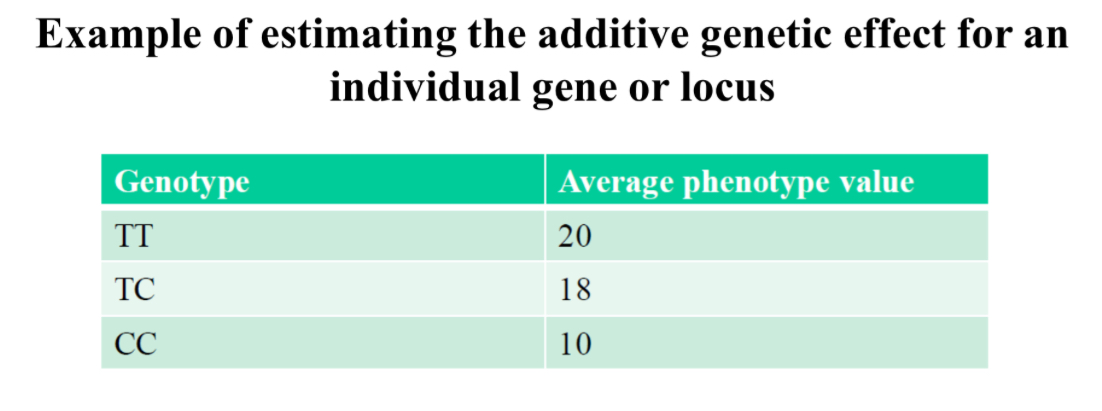
Calculate additive effect of T, and C allele and dominance effect of TC And the additive genetic value based on SNP1
Additive effect of T allele = (P of TT - P of CC/2) = (20-10)/2 = +5
Additive effect of C allele = (P of CC - P of TT/2) = (10-20)/2 = -5
Dominance effect = P of CT - (P of TT + P of CC/2) = 18- (20+10)/2 = +3
Additive genetic value based on SNP1:
CC → -5 + (-5) = -10
CT → -5 +5 = 0
TT → +5+5 = +10
If looking for positive genetic value you select for TT

Estimate additive genetic effects (Allele A) from the reference population?
SNP1= +4
SNP2= +2
SNP3= +1
SNP4= −3
Comprehensive genetics model?
Formula?
P =
BV =
GCV + E + E*G =
P = BV + GCV + E + E*G
P = traits that we are interested in and can observe and measure
BV = value of individual to breeding program
GCV + E + E*G P= factors influencing phenotypic value that will not be passed on and are not part of value used in selection for breeding
The genetic model of quantitative traits in a population
P individual = micro = anything that makes an animals different from average is a deviation from average wither positive or negative (BV + GCV + E expressed as deviation from average
What is the expected value for a phenotype in a population for quantitative traits
Genetics and genomic evaluation:
Dairy cattle: rely on a single central organization like CDCB
P individual= μ + Genetic value + E
Model represents? Average of G and E = ? Quantitative genetic models?
The model represents the genetic and environmental contributions to a single performance record on one animal
P 1= μ + G1 + E1;
P 2= μ + G2 + E2;
P n= μ + Gn + En
2. The values (G1, G2,Gn) are trait specific.
3. Because Gn and En are expressed as deviations from a mean, average of G and E = 0
4. If G and E are considered independent, the genotype has no influence on the environmental effect and vice versa
What does each symbol mean? ____

Weaning weight for 3 calves
Micro = pop. Average

Goal, challenges and management perspectives for quantitative traits
The goal => is to select the best animal based on an accurate estimation (Prediction) of its BV (or Predicted Transmitted Ability: PTA, or Expected Progeny difference: EPD)
As P = G + E
Want to know the contribution of G to P (breeding value) to inform selection decision to increase the frequency of good alleles in populations.
The challenge =>
1. Most important traits are polygenic and
2. have environmental influences (i.e. complexes traits
In management perspective,
we want to understand relationship between P and G
and E to manage E to optimize the P
Heritability: Broad sense heritability, narrow sense heritability
Broad sense heritability, =>
- The proportion of variation that is explained by genetics (a scale from 0 to 1)
- The proportion of total variance that is genetic variance
ℎ^2 = 𝜎²G/𝜎²P
Narrow sense heritability, ℎ^2 = 𝜎²A/𝜎²P = 𝜎²BV/𝜎²P
- The proportion of total variance that is additive genetic,
- Describe the degree to which variation BV explains the variation in phenotypes
- h² is a scale from 0 to 1, when h² is high, 𝜎²𝐸 is low and vice versa
- h² is a population specific genetic parameter due to mainly the
differences in E (i.e. different 𝜎²𝐸) which affects the phenotypic variance
H² is name not squared and scale 0-1 cant be negative or decimal
h²n = narrow h²b = broad sense

Heritability: High, medium and low heritability
High heritability
Ranged from 0.4 - 0.8
Examples: Structure traits, stature, and height
Medium heritability
Ranged from 0.2 - 0.4
Examples: Average daily gain, feed efficiency, marbling
score, somatic cell score
Low heritability
Ranged from 0.01 - 0.2
Examples: Fertility, disease, behaviour traits
Note: ℎ² = 0.4 does not mean 40% of the trait is determined by
genetics but 40% of all the phenotypic variation for that trait is
due to variation in genotypes for that trait
Why do we care to measure Heritability? What is the genetic change rate?
⇒ Heritability enable us to evaluate how an individual animal (e.g. bull or cow) can genetically influence its offspring traits based on the estimate of heritability for these traits (i.e. the relationship between the phenotypic performance and the genetic value)
⇒ We can use heritability to calculate the genetic value of the animal for particular trait Genetic change rate
⇒ Heritability is one of the main component in genetic change (i.e. Key Equation) so The higher the heritability, the faster genetic progress can be achieved for traits.
⇒ It is difficult to make much genetic progress through selection and mating for a trait that has low heritability traits (<0.1)

What do the symbols stand for chnage G = Sh²/t
Genetic change rate = (s-selection differential)(h²)/t(generation interval in years)
Is h²n = and (o²G =0) then h²n = 0 and genetic improvement is 0
Ex: bull phonetype = 2.5kg/day for ADG, average 2kg/day, h² = 0.35
EBV = (P-micro)xh²b
P = phenotype and micro = average mean angus Hereford
EBV = (2.5-2)x0.35 = 0.175kg/day
EPD = 0.175/2 = 0.0875 kg/day
Ex: sale bulls: 1) 3kg/day 2) 1.5 kg/day and ADG=2.5kg/day
BV = (3-2)x0.35 =0.35 kg/day
EPD = 0.35/2 =0.175 kg/day
Total gain = 0.175×120days = 21 kg
BV1 = (2.5-2)x0.35=0.175 kg/day
EPD = 0.175/2=0.0875 kg/day
4 Misconceptions about the heritability
Misconception 1: A heritability of 0.4 indicates that 40 % of the trait is determined by genetics”.
ℎ² =0.4 does not mean 40% of the trait is determined by genetics.
Misconception 2: A low heritability means that traits are not determined by genes
- Genetic variance is small relative to phenotypic variance
Misconception 3: low heritability means that genetic differences are small
- It can also mean that the error variance is large due to large E effects
Misconception 4: A heritability is a fixed value h² is a population specific due to 𝝈²𝑬
Difference between Broad sense and narrow sense heritability
What does h²n = 0.4 vs h²b = 0.4 mean
The proportion of the phenotypic variance that is explain by dominance (o²D) and the interaction between genetics (o² I)
h²n = 0.4 → 40% of the phenotypic variance is due the the additive genetic variance (o²A)
h²b = 0.4 → 40% of the phenotypic variance is due to the total genetic variance (o²A+o²D+o²I)
h²b = 0.4 what does this mean
40% of the phenotypic variance is due to the genetic variance
(Differences of alleles within the genes on the genome)