Electrophilic addition of halogen to alkenes.
 Call Kai
 Learn
Learn Practice Test
 Spaced Repetition
 Match
Match Flashcards
 Knowt Play
1/6

There's no tags or description
Looks like no tags are added yet.
Name | Mastery | Learn | Test | Matching | Spaced | Call with Kai | Chat |
|---|
No analytics yet
Send a link to your students to track their progress
7 Terms
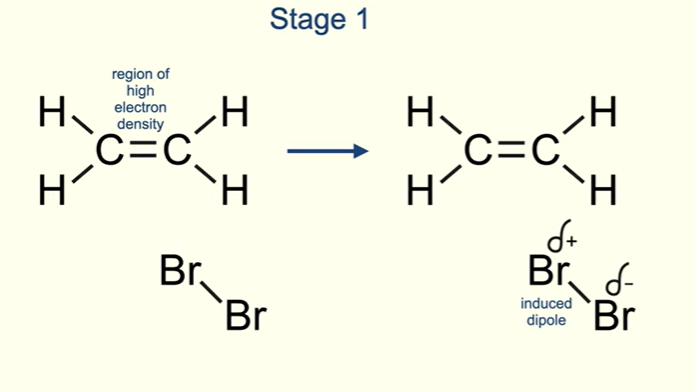
Whats first stage in electrophillic addition mechanism for ethene and bromine
Bromine molecule approaches ethene molecule (bromine does not have permanent dipole)
The double bond of the alkene is a region of high electron density, this repels the electron pair of the covalent bond in the bromine molecule.
This means that the bromine molecule now has an induced dipole.
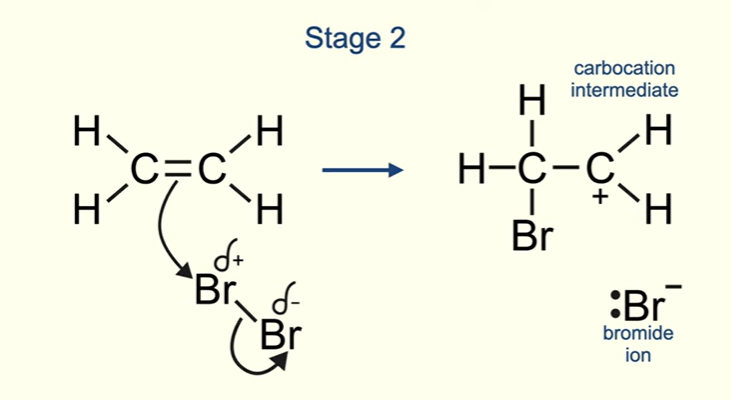
Whats second stage in electrophilic addition mechanism for ethene and bromine
The pair of electrons in pi bond of alkene are attracted to the positive bromine , so positive bromine is the electrophile, and electron pair now forms a covalent bond to this bromine atom
At same time , cov bond in bromine molecule now breaks , and pair of electrons move onto the other bromine atom. ( heterolytic fission)
So at end of stage2 we have carbocation intermediate and bromide ion
What is heterolytic fission
When a covalent bond breaks, and both atoms go to the same atom
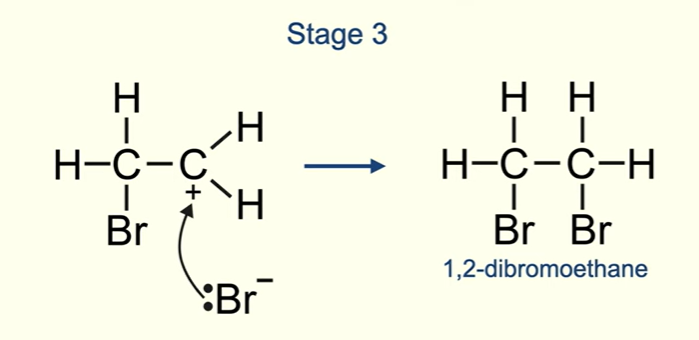
Whats third stage in electrophilic addition mechanism for ethene and bromine
The electron pair on the bromide ion are attracted to the positive carbon atom in the carbocation intermediate
This electron pair now forms a covalent bond and we have our final product. In this case the product is 1,2 dibromoethane
The halogen molecule adds across the double bond, this means that two halogen atoms end up on two adjacent carbon atoms.
What are the differences between adding alkene to halogen and adding hydrogen halide to alkene
Hydrogen halide molecules have permanent dipole , halogen has induced dipole
Halogen only makes one product with asymmetric alkene, hydrogen halide makes major and minor product with asymmetric alkene.
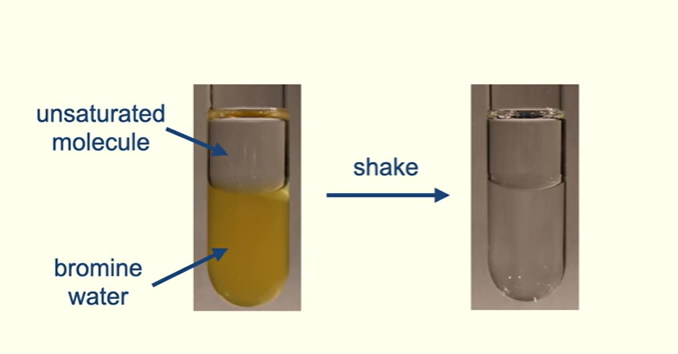
How do we test for presence of unsaturated molecule such as an alkene
Use bromine water, has orange / brown colour.
We add a few drops of bromine water and gently shake test tube, if substance unsaturated, then bromine adds across double bond , product will be colourless.