AP Art History - CA1 - Global Prehistory
 Call Kai
 Learn
Learn Practice Test
 Spaced Repetition
 Match
Match Flashcards
 Knowt Play
1/13

There's no tags or description
Looks like no tags are added yet.
Name | Mastery | Learn | Test | Matching | Spaced | Call with Kai | Chat |
|---|
No analytics yet
Send a link to your students to track their progress
14 Terms
• most prehistoric sculpture is portable; some are very small
• images of humans, particularly female, have enlarged sexual organs and diminutive feet and arms
• carvings on cave walls make use of the natural modulations in the wall surface to enhance the image
• more rarely, sculptures are built from clay and lean upon slanted surfaces
• some sculptures are made from found objects such as bones, some form of natural material such as sandstone, and some carved with other stones
• early forms of human-made materials, such as ceramics, are also common
Prehistoric Sculpture
• most prehistoric paintings that survive exist in caves, sometimes deeply recessed from their openings
• images of animals dominate with black outlines emphasizing their contours
• paintings appear to be placed about the cave surface within relationship to one another; may have been executed over the centuries by various groups who wanted to establish a presence in given location
• although animals are realistically represented with a palpable three-dimensionality, humans are depicted as stick figures with little anatomical detail
• handprints abound in cave paintings, most of them as negative prints, meaning that a hand was placed on the wall and paint blown or splattered over it, leaving a silhouette
• handprints are of left hands, since most people are right-handed, the right being used to apply the paint
• handprints occasionally show missing joints or fingers, perhaps indicating that prehistoric people practiced voluntary mutilation; however, the thumb, the most essential finger, is never harmed
Prehistoric Painting
• prehistoric people known to build shelters our of large animal bones heaped in the shape of a semicircular hut
• however, the most famous structures were not for habitation but almost certainly for worship
• sometimes menhirs, or large individual stones, were erected singularly or in long rows stretching into the distance
• megaliths are menhirs cut into rectangular shapes and used in construction of a complex
• a henge is a circle of megaliths, usually with lintels placed on top; built to align with the important dates in the calendar
• prehistoric people built structures in which two uprights were used to support a horizontal beam, thereby establishing post-and-lintel architecture, the most fundamental type of architecture in history
Prehistoric Architecture
Animal facing left, from the Apollo 11 Cave, Namibia, c. 23,000 BCE. Charcoal on stone, 4.25" x 5".
• some of the world's oldest works of art
• profile of an animal seen in profile: head, body, tail, and all four legs visible
• done in charcoal
• several stone fragments found
• named after Apollo 11 moon landing; cave was discovered at the time of landing

Great Hall of Bulls. Lascaux, France, c.15,000-13,000 BCE. Rock painting.
• natural products used to make paint: charcoal, iron ore, plants
• 650 paintings: most common are cows, bulls, horses, deers
• animals placed deep inside cave, some hundreds of feet from the entrance
• bodies seen in profile; frontal or diagonal view of horns, eyes, and hooves; some animals appear pregnant
• many overlapping figures
• evidence still visible of scaffolding erected to get to higher areas of the caves
• caves were not dwellings because prehistoric people led migratory lives following herds of animals; some evidence exists that people sought shelter at the mouths of caves
• walls were scraped to an even surface; paint colors were bound with animal fat; lamps light the interior of caves; flat stones served as palettes
• many theories about reasons for the paintings: to ensure successful hunt; ancestral animal worship; shamanism--a religion based on the idea that the forces of nature can be contacted by intermediaries, called shamans, who go into a trancelike state to reach another state of consciousness

Camelid sacrum in the shape of a canine, Tequixquiac, central Mexico. 14,000-7,000 BCE. Bone.
• bone sculpture from a camel-like animal
• sacrum is the triangular bone at the base of a spine
• has been worked to create image of dog/wolf
• one natural form used to take the shape of another
• Mesoamerican idea that a sacrum is a "second skull"
• may be a mask for ceremony or spiritual hunt
• found in 1870

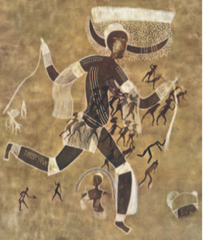
Running horned woman. Tassel n'Ajjer, Algeria. 6,000-4,000 BCE. Pigment on rock.
• more than 15,000 drawings and engravings found at this site
• at one time the area was grasslands; climate changes have turned it into desert
• some drawings are naturalistic, some abstract; some Negroid features, some Caucasian
• composite view of the body: profile legs and torso; twisted arms and horns
• horns represent animal, which relates to power and strength; may be a deity
• dots may reflect body paint applied for ritual
• the entire site was probably painted by many different groups over a large expanse of time
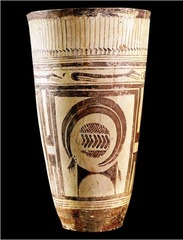
Beaker with ibex motifs. Susa, Iran. 4,200-3,500 BCE. Painted terra cotta.
• found near a burial site, but not with human remains
• found with hundreds of basket bowls and metallic items
• from a village in a fertile river valley
• use of potters wheel, a technological advance
• thin walls of pot
• frieze of stylized aquatic birds on top; below stylized running dogs with long narrow bodies
• goat oversized horns, abstract stylized motif
• in the middle of the horns is a clan symbol of family ownership
• perhaps the image identifies the deceased as belonging to a particular group or family
Jade cong. Liangzhu, China. 3,300-2,200 BCE. Carved jade.
• cong - square hollow tube decorated with incised lines
• circular patterns may represent humans, animals, spirits, or deities
• four corners of the cong usually carry mask-like images with pronounced eyes and fanged mouth
• jades appear in burials of people with high rank
• jade religious objects found in tombs; interred with the dead in elaborate rituals
• Chinese linked jade with virtues: durability, subtlety, beauty
• placed in a burial around bodies, some broken, so show signs of intentional burning
• a special tool must be used because jade is hard; craftsmanship suggests high rank

Anthropomorphic stele. 4,000 BCE. Arabian peninsula. Sandstone.
• one of earliest known works from Arabia
• found in an area with extensive ancient trade routes
• religious or burial purpose
• belted robe from which hangs a double bladed knife or sword
• anthropomorphic: resembling human form but not in itself human

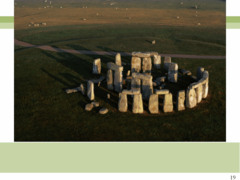
Stonehenge. Salisbury Plain, Wiltshire, England. c. 2,500-1,600 BCE. Sandstone, circle 97' in diameter; trilithons 24' high.
• perhaps took thousands of years to build, gradually redeveloped by each succeeding generation
• post and lintel building; lintels grooved in place by the mortise-and-tenon system of construction
• large megaliths in center are over 20 ft tall and form a horseshoe surrounding a central flat stone
• some of the megaliths weigh 50 tons
• the circles of trilithons probably functioned as an astronomical observatory and solar calendar
• hundreds of smaller stones of unknown purpose placed around monument
• some stones imported from over 200 miles away
• generally thought to be oriented towards the sunrise on the longest day of the year; may also predict eclipses
• new theory that it was the center of ceremonies concerning death and burial
The Ambum Stone. Ambum Valley, Enga, Papua New Guinea. c. 1,500 BCE. Greywacke.
• rare sculpture found in a cave in early 1960s
one of earliest known Pacific works of art
• artists used stone to carve stone
• greywacke stone is tough; would have involved many weeks of laborious chipping/hammering
• may depict an embryonic form of long-beaked anteater and a human body
• such objects are often considered sacred and credited with supernatural powers by present-day people in the region, where they are used as spirit stones in sorcery or other rituals
• purpose and significance unknown because little is known about its sculptor/s

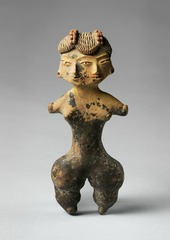
Tlatilco female figurine. Central Mexico, site of Tlatilco. 1,200-900 BCE. Ceramic.
• Tlatilco Mexico known for pottery
• many shapes and forms: male, female, couples, genre scenes, ball playing games, animals, imaginary creatures, etc.
• female figures show elaborate details of hair styles, clothing, and body ornaments
• many show deformities (eg. two-headed females):
perhaps signifying a cluster of conjoined or Siamese twins; stillborn
• theories that they show bifacial images, and therefore would show the first evidence of congenital defects
• may have had shamanistic function
• style: flipper-like arms, huge thighs, pronounced hips, narrow waist; unclothed except jewelry: arms extend from body
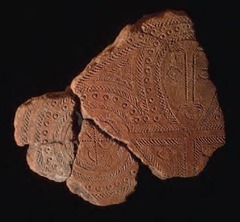
Terra cotta fragment. Lapita, Solomon Islands, Reef Islands. 1,000 BCE. Terra cotta (incised).
• one of oldest human faces in Oceanic art
• one of the finest examples of Lapita art, known for their pottery
• depicts a human face incorporated into intricate geometric designs
• characteristic use of curved stamped patterns: dots, circles, hatching
• outlined forms: used a comb-like tool used to stamp design onto the clay