mental wellbeing P1
 Call Kai
 Learn
Learn Practice Test
 Spaced Repetition
 Match
Match Flashcards
 Knowt Play
1/14

There's no tags or description
Looks like no tags are added yet.
Name | Mastery | Learn | Test | Matching | Spaced | Call with Kai | Chat |
|---|
No analytics yet
Send a link to your students to track their progress
15 Terms
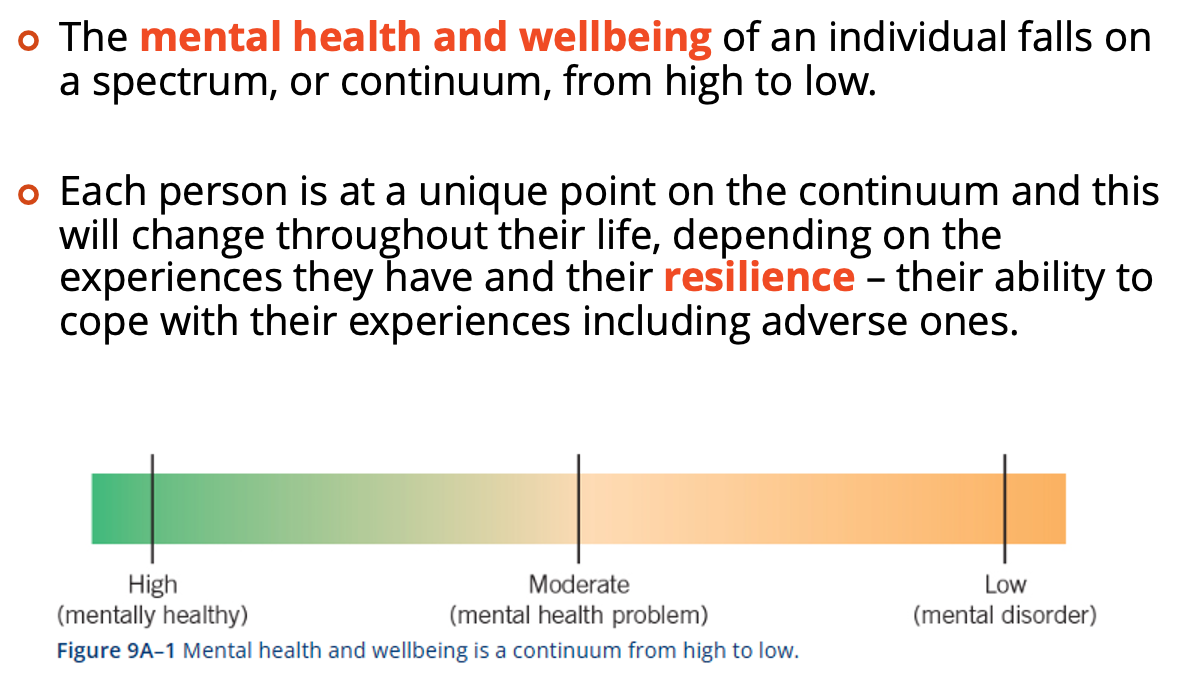
The continuum
-The mental health and wellbeing of an individual falls on a spectrum, or continuum, from high to low.
-Each person is at a unique point on the continuum and this will change throughout their life, depending on the experiences they have and their resilience – their ability to cope with their experiences including adverse ones.
Influenced by factors and fluctuating over time
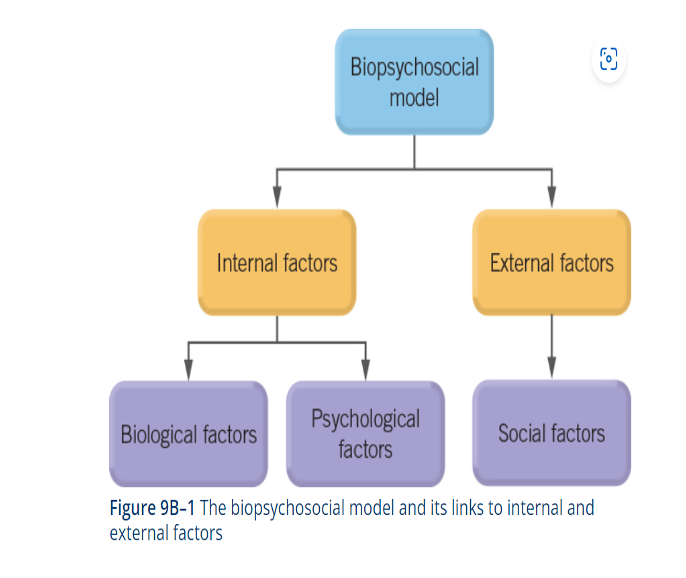
-An individual’s mental wellbeing is influenced by the interaction of internal and external factors and this helps account for why we shift back and forth along the mental wellbeing continuum at different points in time.
-There are many factors that affect where someone generally sits on the continuum, and also where they sit at any given point in time.
-This complex interaction of multiple factors helps account for individual differences in mental wellbeing, as well as the onset or experience of mental health problems and disorders.
-For example, depression could be explained by the combined effects of genes and brain chemistry (biological), negative ways of thinking and prior learning experiences (psychological) and the death of a loved one (social).
Internal Factors
-Internal factors are influences that originate inside or within a person.
-These can be organised as biological and psychological factors.
-Biological factors involve physiologically based or determined influences, often not under our control
-the genes we inherit
-whether we are male or female
-balances or imbalances in specific neurotransmitters
-our physiological response to medication
-brain and nervous system functioning,
-hormonal activities
-fight-or-flight-or-freeze and other bodily responses to stress.
-There are also biological factors that may be under our control, if not entirely, at least to some extent, such as our diet and sleep hygiene.
-Psychological factors involve all those influences associated with mental processes
-our ways of thinking
-beliefs, attitudes
-our skills in interacting with others
-prior learning
-perceptions of ourselves, others and our external environment
-how we learn, make decisions, solve problems
-How we understand and experience emotions, respond to and manage stress, and reconstruct memories.
External Factors
-External factors are influences that originate outside a person.
-Social Factors - These can include:
school- and work-related factors
the range and quality of our interpersonal relationships
the amount and type of support available from others when need
exposure to stressors
level of education
employment history
level of income
Housing
risks of violence
access to health care and other community resources
exposure to social stigma
specific cultural background influences such as our values and traditions.
Demonstrating the Continuum using Stress, Anxiety and Phobia
-Stress (U3) = a state of mental or physical tension that occurs when an individual must adjust or adapt to their environment but do not feel they have the capacity to do so.
-Anxiety = feelings of apprehension, unease, or worry that something is wrong or that something bad is about to happen.
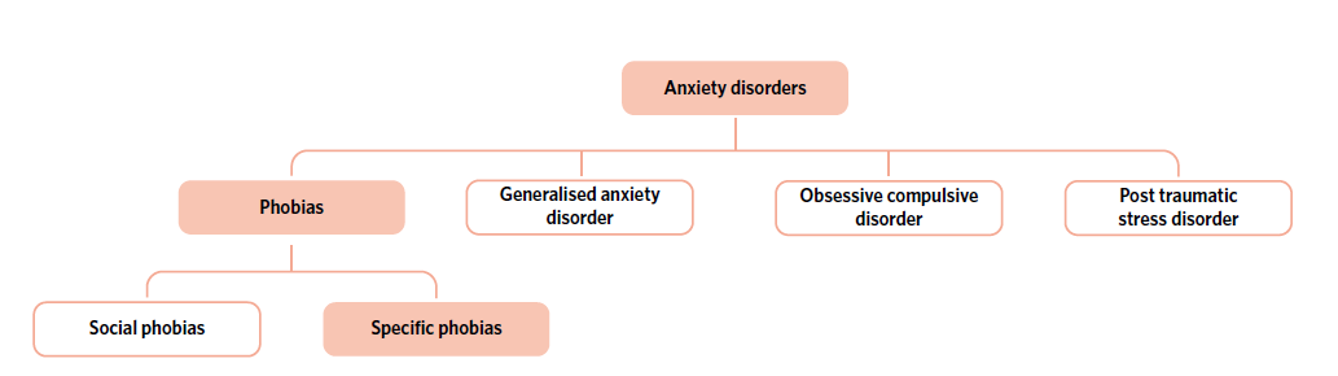
-Stress and Anxiety in some situations are normal and appropriate and usually we only feel this way for a short period of time.
It makes us more alert and our reactions faster
Mild to moderate levels can improve our ability to cope.
When does anxiety become an anxiety disorder?
-If anxiety is severe or exaggerated and does not subside, it can be counterproductive and disabling
It can reduce our ability to concentrate, learn, think clearly and logically, plan, made accurate judgements and perform motor tasks
Severe anxiety may be accompanied by intense physiological sensations and response and may disrupt a persons life.
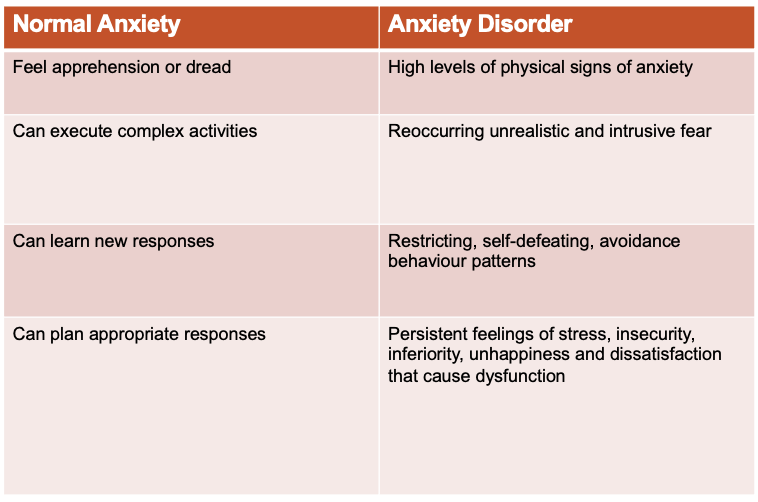
Anxiety disorders
-Anxiety disorder = a group of disorders that are characterised by chronic feelings of anxiety, distress, nervousness and apprehension with a negative effect.
The level of anxiety is so severe that it interferes with everyday life but does not cause them to lose touch with reality or consistently behave in socially unacceptable ways.
Normal Vs Disorder?
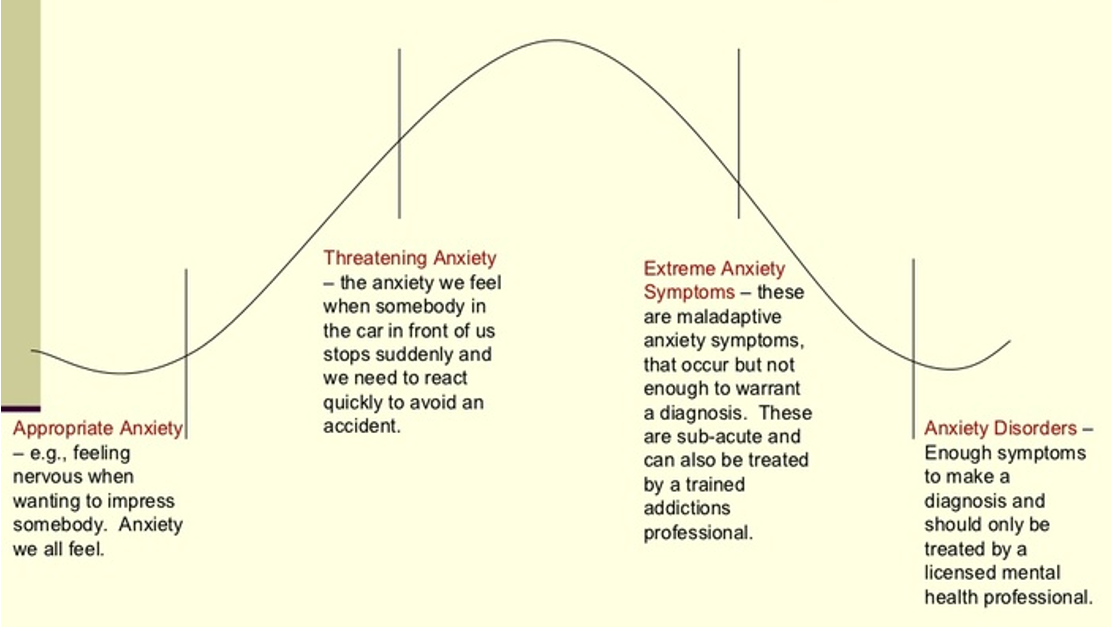
Variations along a
Continuum
-A person’s level of anxiety can be represented along a continuum ranging from normal feelings of being nervous to extreme feelings that can be diagnosed as symptoms of a mental disorder.
Definitions
-Wellbeing = a positive state related to the enjoyment of life, feeling connected to others, the ability to deal with challenges and having a strong sense of purpose and control
-Indicates the capacity of an individual to interact with others, cope effectively with problems and stress.
-Mental wellbeing is just as important as physical wellbeing, and a vital part of overall health and wellbeing.
-It is a dynamic state that doesn’t always stay the same.
-It can vary over time as circumstances change and as we move through different stages of our life.
-Its different components may also vary and be more or less apparent in different individuals at different times
-Mentally Healthy = a state of social and emotional well-being in which individuals understand their own abilities and cope (with the normal stresses of life, work productively and can contribute to the community.) with everyday life.
-Mental health problems = a disruption to an individual’s usual level of social and emotional wellbeing
-Occurs when the difficulties experienced by a person are mild, temporary and able to be treated within a relatively short period of time
definitions
-Mental illness = a psychological state characterised by emotional difficulties (that lead to emotional or behavioral impairment or disability) that interfere with the persons ability to cope with everyday life
-Usually involves psychological dysfunction that results in impairment in coping ability with feeling and behaviours that are atypical and inappropriate within their culture
-Mental disorders can sometimes be referred to as a psychological dysfunction experienced by an individual and usually involving
-Emotional distress
-Impairment in the ability to cope with everyday life
-Thoughts, feelings and/or behaviour that are not typical of the person or not appropriate within their society and/or culture
Ways of considering Wellbeing
1) Levels of Functioning
Mental Wellbeing: Functioning
Functioning refers to how well a person independently manages and performs everyday activities in their environment. It is shown through observable behaviour and how effectively they cope with everyday challenges.
Areas of functioning include:
Daily living skills: Self-care, hygiene, eating, medication, household responsibilities, managing resources and travelling safely.
Interpersonal relationships: Ability to interact positively and maintain relationships with family, friends, peers and others.
Emotions: Ability to regulate emotions and manage worries, stress and everyday difficulties.
Cognitive skills: Learning, communicating, logical thinking, planning and decision-making.
School/work: Being productive and achieving goals.
Leisure/recreation: Participating in hobbies, sports, extracurricular and community activities.
High functioning is generally associated with positive mental wellbeing. Mentally healthy people usually:
Cope effectively with everyday challenges and independent living.
Build and maintain positive, trusting relationships.
Participate in a range of activities.
Balance work, rest and recreation.
Remain positive, flexible and productive when facing challenges.
Manage emotions, worries and stress effectively.
Have direction and goals in life.
Feel a sense of belonging and acceptance in their community.
Contribute meaningfully to society.
Have a degree of self-determination, meaning they can make choices and have control over their lives.
Adaptive behaviour: Behaviour that allows a person to adjust to their environment appropriately and effectively. It helps them manage daily demands in age-appropriate ways and function relatively independently across different settings.
Maladaptive behaviour: Behaviour that is detrimental, counterproductive or interferes with a person’s ability to adjust to their environment and fulfil their usual roles.
Maladaptive behaviour can also be called dysfunctional behaviour because it disrupts everyday functioning and reduces a person’s ability to complete normal daily activities.
Ways of considering Wellbeing
2) RESILIENCE
·Resilience, = the ability to cope with and manage change and uncertainty
·This is the definition from the study design – use it!!
-Means a person can ‘bounce back’ from adversity
-Resilient people are better able to cope with life’s challenges such as negative life events and to maintain their social and emotional wellbeing
-Resilience is influenced by a person’s cognitions, behaviours and biology and social and situational factors.
There are a number of characteristics that enable someone to ‘bounce back’ and get back on track when faced with adversity:
•a strong belief in their abilities to accomplish tasks and succeed (i.e. high self-efficacy)
•high self-esteem
•approaching adversity with a sense of optimism, opportunity and hope
•being adaptable and flexible
•being organised
•having problem-solving skills
•having the ability to make realistic plans and carry them out.
Ways of considering Wellbeing
3) Social and Emotional Wellbeing (SEWB)
·Dot Point: Social and emotional wellbeing (SEWB), as a multidimensional and holistic framework for wellbeing that encapsulates all elements of being (body, mind and emotions, family and kinship, community, culture, country, spirituality and ancestors) for Aboriginal and Torres Strait Islander people
social and emotional wellbeing (SEWB)
-The term social and emotional wellbeing (SEWB) is used by Aboriginal and Torres Strait Islander people to describe the physical, social, emotional, spiritual and cultural wellbeing of a person.
-It is based on a multidimensional and holistic view of health that recognises their connection to Country, culture, spirituality, ancestry, family and community, which are important to their people and impact on their wellbeing.
-The SEWB holistic concept refers to the wellbeing of the individual and the wellbeing of their family and community. More specifically, the holistic view focuses on the physical, social, emotional, spiritual and cultural wellbeing of the individual, their family and the entire community to which they belong, thereby bringing about the total wellbeing of their community. This reflects the collectivist culture of Aboriginal and Torres Strait Islander peoples and encapsulates all elements of being an Aboriginal and Torres Strait Islander that are not evident in the mainstream view of mental health and wellbeing. ¢The SEWB holistic concept refers to the wellbeing of the individual and the wellbeing of their family and community.
-The multidimensional and holistic view focuses on the:
-Physical
-Social
-Emotional
-Spiritual
-cultural wellbeing
OF
the individual
their family
the entire community to which they belong
thereby bringing about the total wellbeing of their community.
-This reflects the collectivist culture of Aboriginal and Torres Strait Islander peoples and encapsulates all elements of being an Aboriginal and Torres Strait Islander that are not evident in the mainstream view of mental health and wellbeing.
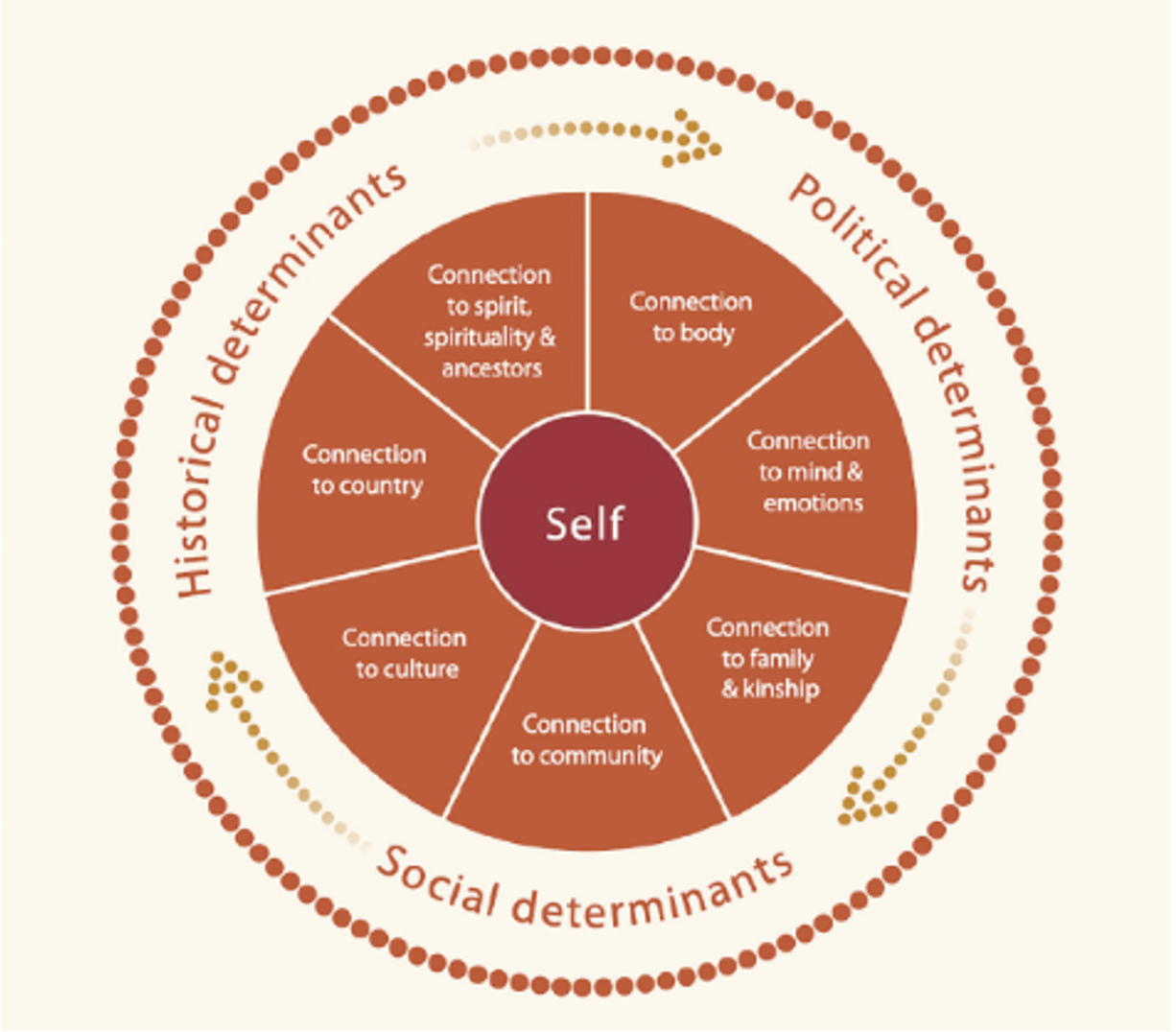
The SEWB domains
-Connection to body and behaviours. Involves all aspects of physical health and wellbeing, especially feeling a strong and positive connection to one’s body and appreciating everything it allows us to do and experience in life. This domain is interrelated with all other domains. For example, a strong and positive connection for this domain can help one feel stronger and more closely connected mentally, culturally and spiritually.
-Connection to mind and emotions. Emphasises the individual’s personal experience of their mental wellbeing (or mental ill-health) and their ability to manage thoughts and feelings. Intimately linked with spirituality.
-Connection to family and kinships. Recognises that family and kinship systems have always been central to the functioning of traditional and contemporary Aboriginal and Torres Strait Islander peoples’ lives. These systems are complex and diverse, maintain interconnectedness through cultural ties and caring relationships, and provide a strong sense of belonging.
-Connection to community. Emphasises a connection to a communal space that can take many forms and provides opportunities for individuals and families to connect with each other, support each other, and work together.
-Connection to culture. Refers to one’s secure sense of cultural identity and cultural values through connection to Aboriginal and Torres Strait Islander heritage. Includes all knowledge systems, ways of knowing, and cultural traditions and practices. Provides a sense of continuity with the past and helps underpin a strong identity.
-Connection to Country. Country refers to an area where Aboriginal and Torres Strait Islander people have a traditional or spiritual association and the deep sense of belonging this brings. This domain recognises that the relationship with Country underpins all other forms of relational wellbeing. Being on and caring for Country has positive physical and mental health outcomes for Aboriginal and Torres Strait Islander people.
-Connection to spirit, spirituality and ancestors. Recognises the sacred and interconnective relationship between Country, human and non-human beings, as well as the past, present and future. Includes knowledge and belief systems, and the Dreaming. Aboriginal and Torres Strait Islander peoples’ world views are grounded in spirituality and connection to ancestors. These connections also provide a sense of purpose and belonging.