10 Respiratory System
 Call Kai
 Learn
Learn Practice Test
 Spaced Repetition
 Match
Match Flashcards
 Knowt Play
1/10

There's no tags or description
Looks like no tags are added yet.
Name | Mastery | Learn | Test | Matching | Spaced | Call with Kai | Chat |
|---|
No analytics yet
Send a link to your students to track their progress
11 Terms
Ectoderm derivatives
neural crest cells
laryngeal cartilages
intramural ganglia
Mesoderm derivatives
splanchnic layer of lateral plate
tracheal and bronchial cartilages
somitomeres
smooth muscle of trachea and bronchi
Endoderm derivatives
epithelial lining and glands
GI tract
respiratory tract
Development of larynx + trachea
separation of lung buds from foregut
outgrowth of 2 esophagotracheal ridges pinches 2 tracts
esophagotracheal septum separates trachea + lung buds vs esophagus
elongation of tracheal and esophageal tubes
form separate respiratory and digestive tracts
respiratory system remains connected to gut tube via pharynx
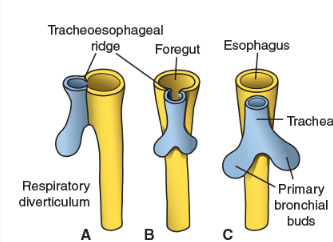
respiratory diverticulum
lung bud
cricothyroid muscle origin
4th pharyngeal arch of aortic arches
innervated by external laryngeal n. from superior laryngeal n.
general laryngeal muscle origins
6th pharyngeal arch from aortic arches
innervated by recurrent laryngeal n.
branch of vagus n.
thyroarytenoid m.
vocalis m.
lateral cricoarytenoid m.
posterior cricoarytenoid m.
transverse arytenoid m.
oblique arytenoid m.
Development of pleura
growth into thoracic cavity
visceral pleura
from splanchnic layer
innervated by autonomic nerves
parietal pleura
from somatic layer
innervated by somatic nerves
Stages of lung development
Embryonic (wk 0-6)
developing trachea + esophagus
Pseudoglandular (wk 6-16)
branching continues to form terminal bronchioles
no respiratory bronchioles or alveoli present
Canalicular (wk 16-24)
each terminal bronchiole divides into 2+ respiratory bronchioles which in turn divide into 3-6 alveolar ducts
Scalar (wk 24-36)
terminal sacs (primitive alveoli) form
capillaries establish close contact
Alveolar (wk 36 - postnatal)
mature alveoli have well-developed epithelial endothelial (capillary) contacts
Amniotic fluid significance
swallowing amniotic fluid helps respiratory passageways mature
keep fetal airways open
practice breathing + swallowing in utero before birth
needed for surfactant production
Amniotic fluid sources
pee
placenta