oat chem unit 6
 Call Kai
 Learn
Learn Practice Test
 Spaced Repetition
 Match
Match Flashcards
 Knowt Play
1/21

Earn XP
Description and Tags
boy you looking like spongebobs house with that ahh ahh harecut pineapple ahh
Name | Mastery | Learn | Test | Matching | Spaced | Call with Kai | Chat |
|---|
No analytics yet
Send a link to your students to track their progress
22 Terms
gas molecules
have no definite size or shape, are widely separated, and can be easily compressed. They are in random constant motion.
diatomic gases
gases that consist of atoms in pairs due to unstable nature, like H2, N2, F2, O2, I2, Cl2, Br2 (have no fear of ice cold beer)
temperature
measurement of kinetic energy or movement of gas particles.
volume
The amount of space a substance occupies. Gases take both the shape and the volume of the container.
pressure
Force of the gas particles colliding with the walls of the container.
P = F/A
^ pressure, force, area
gas compressed
less volume = more collision = more pressure.
gas expanded
more volume = less collision = less pressure.
boyle’s law
P1V1 = P2V2 (pressure and volume)
charles’s law
V1/T1 = V2/T2 (volume and temperature in K)
avogadro’s law
V1/n1 = V2/n2 (volume and number of moles)
gay lussac’s law
P1/T1 = P2/T2 (pressure and temperature in K)
gay butt sack lol
combined gas law
P1V1/T1n1 = P2V2/T2n2 (pressure, volume, temperature in K, number of moles)
ideal gas
behaves in constant, random, straight line motion according to the kinetic molecular theory of gases.
kinetic molecular theory of gases
Particles in a gas are in constant random motion
Combined volume of particles in negligible
Particles exert no force on each other
Collisions are completely elastic (no IMFs)
All gases have the same average kinetic energy at a given temperature.
ideal gas law
The ratio of pressure (atm) and volume (L) to moles, temperature (K) and a constant to depict the behavior of an ideal gas.
PV = nRT.
R = ideal gas constant
If pressure is atm: R = 0.0821
If pressure is kPa: R = 8.314
standard temperature and pressure
Temperature: 273 Kelvin
Pressure: 1 atm
dalton’s law of partial pressure
Total pressure of a mixture is equal to the sum of partial pressures of individual gases.
Ptotal = P1 + P2 + P3 …
P1 = X1Ptotal
X = mole fraction
gas density
The mass of a gas occupying a certain volume.
p = m/V = PM/RT
^ density, mass, volume, pressure, molar mass, ideal gas constant, temperature.
diffusion
molecules move from high to low concentration.
effusion
Confined gas escaping through a small hole. A gas with lower molecular weight effuses faster.
Rate: Gas > liquid > solid
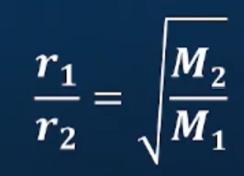
graham’s law of effusion
M = molar mass, r = effusion rate.
vaessen’s law
the forcefulness in which you fart out your butt is proportional to the likelihood that you shit your pants