Biology U4 AOS1
 Call Kai
 Learn
Learn Practice Test
 Spaced Repetition
 Match
Match Flashcards
 Knowt Play
1/68

There's no tags or description
Looks like no tags are added yet.
Name | Mastery | Learn | Test | Matching | Spaced | Call with Kai | Chat |
|---|
No analytics yet
Send a link to your students to track their progress
69 Terms
Gene pool + allele frequency
Gene pool
A gene pool is the collection of all the genes and alleles within a specific population
Allele frequency
Allele frequencies refer to the proportion of a particular allele appearing at a certain gene locus in a gene pool
Mutations
Mutations involve permanent changes to the DNA sequence
They can occur either spontaneously or be induced
Mutation categories
Mutations can be categorised as either
Point mutations - single nucleotide changes in a gene
Block mutations - changes to large sections of DNA
Types of mutations
Silent mutation
A single base is substituted by another
Called silent or neutral mutations and produce little or no change in the phenotype
Missense mutation
A single base is substituted by another
Usually results in coding for a new amino acid in the polypeptide chain
Nonsense mutation
This results in a new triplet that does not code for an amino acid
The resulting triplet may be an instruction to terminate the synthesis of the polypeptide chain
Reading frame shift
A reading frame shift results in all new amino acids in the polypeptide chain from the point of insertion or deletion onwards
The resulting protein will most likely be non-functional due to the change
Block mutations
Block mutations involve changes to larger sections of DNA
These alter the structure of a chromosome by deleting, duplicating, inverting or translocating sections of DNA
This usually occurs during prophase I of meiosis
Aneuploids
Aneuploidy refers to a chromosomal abnormality in which an organism possesses an incorrect number of total chromosomes caused by the addition or loss of an individual chromosome
Examples include
Down syndrome, Klinefelter syndrome
Polyploidy
Polyploidy refers to a chromosomal abnormality in which an organism has an incorrect number of sets of each chromosome - there is an entire set of chromosomes added or missing
This can be common in plants, but is often fatal in animals
Evolutionary significance
Mutations can create and introduce new alleles into a population, thereby increasing genetic diversity
However, for the mutation to be heritable, it must occur in an individuals germline cells
Most mutations are either neutral or harmful.
Enviromental selection pressures
Factors within the environment that influence the survivability of a species
through these factors allele frequencies can change and the process of natural selection can occur
Natural selection steps
Natural selection involves the selection of the phenotype most suited to overcome the environmental selection pressure
Organisms more suited to an environment are said to have a higher fitness due to their advantageous phenotype(s)
Over time, the fitter organisms have a selective advantage and are more likely to survive, reproduce, and pass their alleles on to the next generation, increasing the allele frequency of the advantageous phenotype
The effect of selection pressures
Enviromental selection pressures can reduce the genetic diversity of a gene pool
Advantageous traits will become more common in a population, and the allele frequencies shift in favour of these alleles
High + low genetic diversity
High genetic diversity
The survivability of a species increases as large genetic diversity increases. The more variation, the higher the chance of individuals possesing favourable alleles that will help the population survive if there is a change in selection pressures.
Low genetic diversity
Low genetic diversity can lead to the risk of extinction due to an inability to adapt to changing environmental selection pressures
When populations reduce, inbreeding becomes more common and disadvantageous phenotypes can result from usually hidden alleles
gene flow
Gene flow
Gene flow is the movement of alleles from one population to another
This occurs due to interbreeding because of immigration
occurs with close proximity populations / no more geographical barriers
Greg taylor
Shoots 3’s like a madman
Genetic drift
A change in populations allele frequencies due to sudden and random occurences
Why does genetic drift occur
Bottleneck effect
Founder effect
Bottleneck effect
The bottleneck effect occurs when a large portion of a population of a population is wiped out by a random and sudden event, such as a natural disaster.
This results in reductions in population size, impacting allele frequencies
Founder effect
The founder effect occurs when a small unrepresentative sample of individuals separates from a larger population to colonise a new region and start a new population
(think dale curtis going from bairnsdale to melbourne to shoot his load into sange and make the worst child of all time)
Gene flow on diversity
When individuals enter a population, their alleles are added to the gene pool of that population, increasing the diversity
The opposite happens when individuals emigrate out
Impact of genetic drift on small populations
Smaller populations are more susceptible to the effects of genetic drift, as they generally have a lower genetic diversity to begin with
Impact on genetic diversity - image summary

The risks of reduced diversity
Two major risks involves with reductions in genetic diversity include
Inbreeding can occur, which can promote harmful alleles
It can lower adaptive potential, so populations are more vunerable to selection pressures
Speciation
Speciation is the process by which populations genetically diverge until they become distinct species
There are two types of speciation:
Allopatric speciation
Sympatric speciation
Factors affecting speciation
Factors such as mutations, natural selection, selection pressures, genetic drift, and gene flow all influence the frequency of alleles within a population
As genetic differences accumulate within populations, speciation can occur
Defining species
Individuals are recognised as different species when they can no longer interbreed with another to produce offspring that is viable (able to survive to maturity) and fertile (having the ability to produce offspring)
Allopatric speciation
involves the formation of a new species because of a geographical barrier
these barriers prevent gene flow and allow genetic differences to accumulate due to exposure to different selection pressures
Sympatric speciation
involves the formation of a new species in populations located in the same region
this occurs through selection pressures acting on different phenotypes causing a divergence from others and forming a new species
Example of speciation - Howea palms
On Lord Howe Island there are two species of palms called Howea forsteriana and Howea belmoreana that shared a common ancestor
It has been determined H. belmoreana inhabits neutral and acidic soils, whilst H. forsteriana inhabits more basic soils
Soil pH impacts different flowering times
This results in reproductive isolation where the flowering of the two species doesn’t occur at the same time and they don’t cross pollinate
Over time differences accumulated and they could no longer interbreed to produce viable and fertile offspring
Sympatric speciation and polyploidy
Polyploidy can result in sympatric speciation as the new polyploid will have a different of chromosomes from the rest of the species
This can result in reproductive isolation as the gametes may no longer be able to produce viable, fertile, offspring
Selective breeding
The process by which humans can select or remove traits from a population by directly controlling the breeding of the animal or plants
Selective breeding vs natural selection
Selective breeding shares similarities with natural selection including the requirement for variation, the presence of a selection pressure, and the heritability of the trait.
The key differnece lies in the origin of the selection pressure
Selective breeding is human induced for a desired trait rather than enviromental
Effect on genetic diversity
Selective breeding will reduce genetic diversity and overexpress deleterious alleles (through inbreeding), which can reduce adaptability and fitness within a population
This can lead to a human-induced bottleneck effect, as only a small percentage of individuals naturally express traits desired by humans
Wild captive populations
Wild populations will maintain higher levels of genetic diversity and have higher adaptive potential compared to their captive bred populations
Antibiotics DEF
Antibiotics are medicines that treat bacterial infections
Resistence and natural selection
Antibiotic resistant bacteria forming is a result of the process of natural selection, where the exposure to antibiotics is the selection pressure
Bacteria can exchange genetic material through bacterial conjugation, spreading the alleles for antibiotic resistance
Viral antigenic drift and shift
Viruses constantly adapt and modift their antigens through the process of antigenic drift and antigenic shift
By changing their antigens, viruses can evade the adaptive immune system due to the specificity of immunological memory cells
Antigenic drift
occurs through small and gradual changes (mutations) in the genes encoding for viral surface antigens
Initially, previous memory cells will be capable of recognising these mutated surface antigens but as mutations accumulate new viruses can form
Antigenic shift
Occurs through sudden and significant changes in the genes encoding for viral surface antigens
This commonly occurs when two or more different strains of a virus combine when infecting the same host at the same time
natural immunity to new virus is unlikely making it more infectious
Fossil succession
The principle that one fossil succeeds another in a predictable order within the rock strata
If the fossil is higher it is a newer fossil and was born after, if a fossil is lower it is an older fossil and was born before - this is known as relative dating
Fossilization process
Death of an organism
Burial and decomposition
Sediments covering the organism protects it from scavengers and slows decomposition due to a lack of light, O2 and H2O
Petrification
Hard material (e.g. bones and teeth) remain and form into the fossil
Exposure
Uplift or erosion brings the fossil to the earths surface
Types of fossils
Body fossil
the actual body parts of the plant or animal
Permineralized fossil
When groundwater deposits minerals into the organic spaces turning them into stone
Mould and cast fossil
A mould is when a hollow is formed in sediment after an organism decays away, a cast can then form if this hollow is filled with minerals
Trace fossils
Indirect evidence of behaviour such as nests, footprints, teeth marks, and burrows
Insights into behaviour being analysed
Index fossils
fossils used for relative dating as they are known to have only existed for some time
If a target fossil is found in the same strata as the index, an estimated range of age can be determined from that fossil
Transitional fossils
Transitional fossils are intermediaries between an ancesteral species and its descendant species
They exhibit traits common to both groups, so they can provide evidence to the evolution of the descendant species
Dating fossils
To date fossils is to determine the age of them using two seperate techniques
relative dating
absolute dating
Relative dating
Using the law of fossil succession, we can asign a relative age based on the position of the fossil compared other fossils
Absolute dating
gives a more exact age of the fossil
radioactive dating is used
this involves comparing the ratio of radioactive isotopes found inside the fossil to the relatively stable amount found in the atmosphere
Radiocarbon dating steps
All living things contain carbon
This carbon exists as a ratio of two isotopes - 12C (a stable isotope) and 14C (a radioactive isotope)
The ratio of these two isotopes will be the same as the ratio in the atmosphere, given that carbon is constantly being cycled between the organism and its environment while it is alive
Because your not getting any new carbon your carbon 14 will decay, this is then measured and compared to the environment to figure out how old the fossil is
When the organism dies, its 14C will begin to decay and breaks down into 14N (a stable isotope)
While this decay occurs, the carbon in the dead organism will not be replaced by existing carbon in the atmosphere
So levels of 12C will remain the same, while 14C decays at a known rate - causing the ratio between the two isotopes to change
Pros and cons of carbon dating
Pros | Cons |
Its better than relative dating as it gives an exact age in years | It has a limited time range and cant be used for fossils older than about 50,000 years |
It is very effective for dating anything that was once living e.g. bone, wood, charcoal | Does not work on non-living |
It is very reliable as the decay predictions | Easy to contaminate |
Structural morphology
One method to assess relatedness is through structural morphology, which involves looking for similarities between the physical features of different species
this can be in the form of homologous and vestical structures
Homologous structures
Features found in different species that may look and function differently from one another but are derived from a common ancestor
Similar structure → different function (gives evidece of relatedness)
Vestigal structures
structures found within organisms that once served a purpose for their ancestors but due to changing selection pressures have lost their original function and arent required anymore
e.g.
The tail bone in humans
Molecular homology - amino acids
there are many common proteins found in different species, when analysed the amino acid shows differences
The fewer differences provides an indication that these species are more closely related to eachother
DNA sequence similarity
DNA sequences can also be used to determine the relatedness between different organisms
Just like amino acid sequences, a higher similarity in DNA sequence implies a closer level of relatedness between different organisms
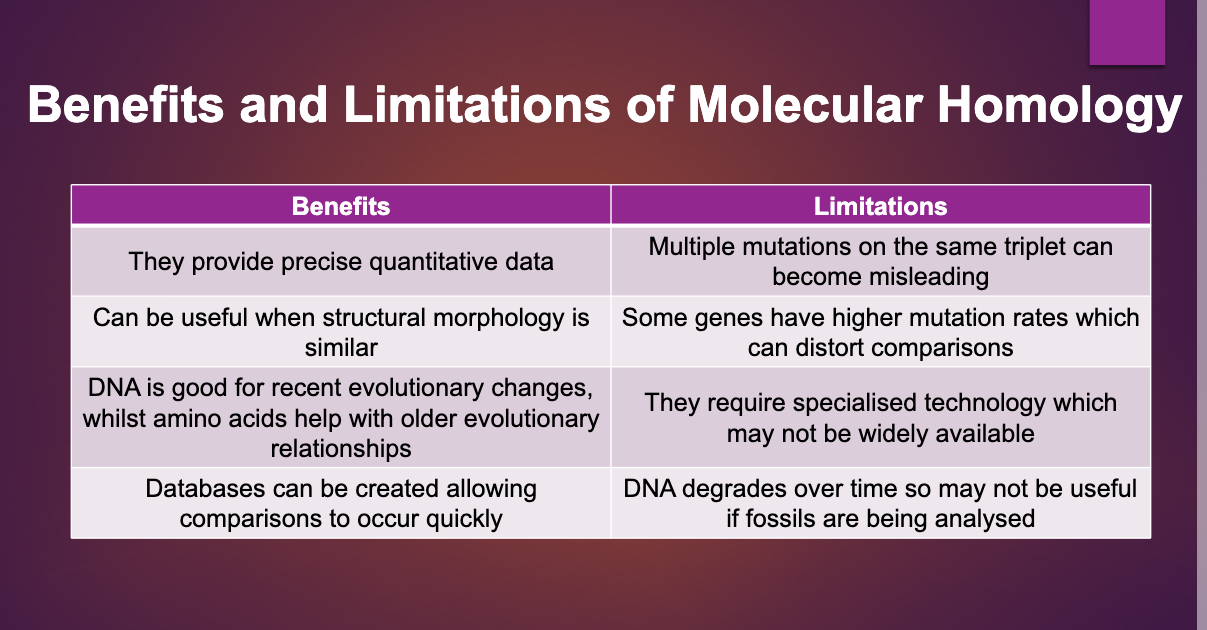
Benefits and limitations of molecular homology
Phylogenetic trees
A diagram that shows the evolutionary relationships between different species
Interpreting phylogenetic trees
Phylogenetic trees can be read backwards to determine the most closely related species to a particular taxonomic group
For example, you can trace back from the human line to reach node A, which splits humans from monkeys, showing that monkeys are the closest relative to humans on this tree
Further back, node B separates humans and monkeys from dolphins and sheep, showing that humans are more closely related to monkeys than they are to dolphins and sheep
Its important to note that the most recent common ancestor of humans and monkeys occurs at node A
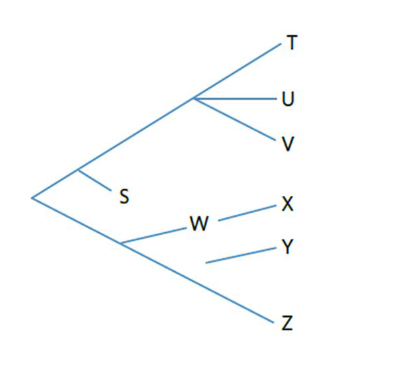
Other features (reference image)
The lack of a node between species (E.g. Y and Z) means that the exact divergence point is unknown (due to lack of fossil or molecular evidence)
A break between species (e.g. W and X), means that W is possibly an ancestor of X but there is no evidence of transitional fossils between the two species to support this hypothesis
The branch with species S does not reach the end of the tree, indicating that it is extinct
Nodes usually only split into two lineages, but sometimes they can split into three or more (e.g. T, U, and V)
This means that it is unclear which species diverged from the others first
This occurs if there is insufficient data or if two speciation events occurred closely together
exchange of genetic material
Sometimes genetic material is passed between groups after they have diverged
for example, there is strong evidence that groups of humans interbred with neanderthals causing parts of their genomes to be passed around
Taxonomy
a system used to categorise all living organisms based on shared charecteristics and evolutionary relationships
Domain
Kingdom
Phylum
Class
Order
Family
Genus
Species
remember
(Dumb Kids Playing Catch On Highways Get Squashed)
Human taxonomy
The only categories required are mammals, primates, hominoids, hominins
Mammals all have mammary glands, hair or fur and three middle ear bones
Primates have grasping hands, stereoscopic vision and large complex brains
Charecteristics of primates
3D colour vision and forward facing binoculars eyes
A large number of touch receptors in the hands
A large cranium relative to body weight
Grasping hands and feet
Hands and feet can be described as prehensile if they grasp and hold objects
Fully opposable refers to the ability to move the thumb to freely touch the tip of the other fingers
Power grips wrap around and hold tightly while precision grips use fingertips to pick up and hold small objects
Hominoids
within the order of primates, humans are further classified into the superfamily hominoids
species belonging to this group are called hominoids (or apes) and include:
Great apes - orangutans, chimpanzees gorillas and humans
Lesser apes - many different species of gibbons
Charecteristics of hominoids
Have no tail
Increased cranium size
Y5 pattern on lower haw molars
Broader rib cage
The key characteristics of hominins
Bipedal locomotion
Increased brain size
Smaller teeth than other primates
Highly developed hands with fully opposable thumbs
Applications for bipedalism
Centralised foramen magnum - allows skull to balance on spine
S-shaped curvature of the spine - provides shock absorbance and maintains centre of gravity
Bowl-shaped pelvis - supports organs
Valgus angle of the femur bone - centres knees under body
Foot arch with non-grasping aligned big toe - allows for spring and forward thrust
Advantages of bipedalism
Very energy efficient for long distance travel
Carrying tools, infants, food etc while moving
Better thermal regulation
Disadvantages of bipedalismCirculatory issues
Circulatory issues
Childbirth complications