IB Biology - Respiration
 Call Kai
 Learn
Learn Practice Test
 Spaced Repetition
 Match
Match Flashcards
 Knowt Play
1/135

There's no tags or description
Looks like no tags are added yet.
Name | Mastery | Learn | Test | Matching | Spaced | Call with Kai | Chat |
|---|
No analytics yet
Send a link to your students to track their progress
136 Terms
ATP name
adenosine triphosphate
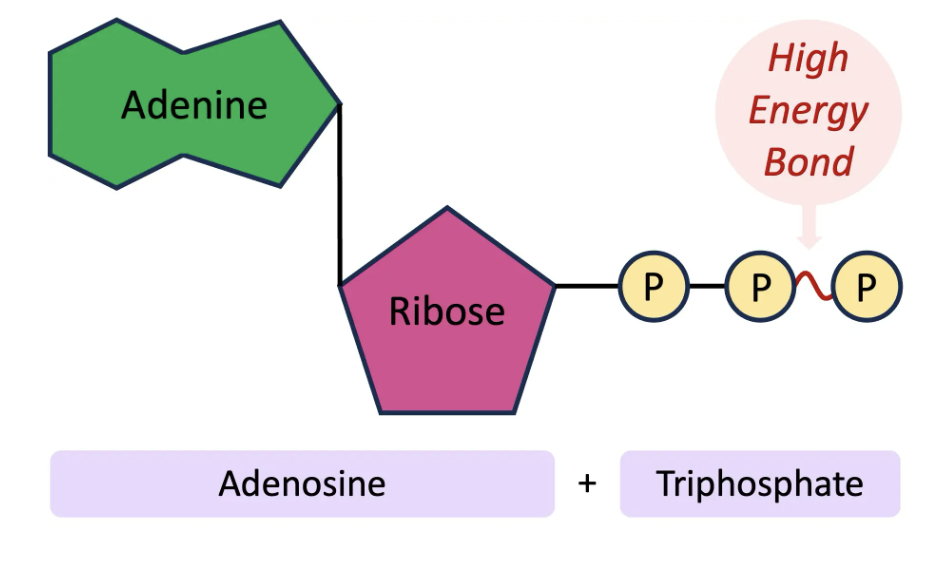
ATP
a molecule that functions to distribute energy within cells → acts as an immediate source of chemical energy that is used to power cellular processes
ATP structure
ribonucleotide consisting of an adenine base + 3 phosphate groups attached to the central ribose sugar → 3 covalently linked phosphate groups → store potential energy in their bonds

When ATP is hydrolysed
hydrolysed to release the outermost phosphate → the energy stored in the phosphate bond is released to be used by the cell
Life processes within cells that ATP supplies with energy
biosynthesis
active transport
movement
Life processes within cells that ATP supplies with energy - biosynthesis
The synthesis of macromolecules requires ATP → ATP provides energy for anabolic reactions that build large, complex molecules from smaller molecules
Life processes within cells that ATP supplies with energy - active transport
ATP provides energy to move substances against their concentration gradient across membranes → e.g. nerve cells use ATP to establish a resting potential → e.g. ATP is also used in vesicular transport (endocytosis + exocytosis)
Life processes within cells that ATP supplies with energy - movement
TP provides energy for the movement of whole cells or cell components → e.g. moving chromosomes during mitosis + meiosis → e.g. contraction of muscle cells
What processes require energy in cells?
Building mRNA
Moving chromosomes during mitoses
Active transport
Forming polypeptides during translation
Phosphorylation
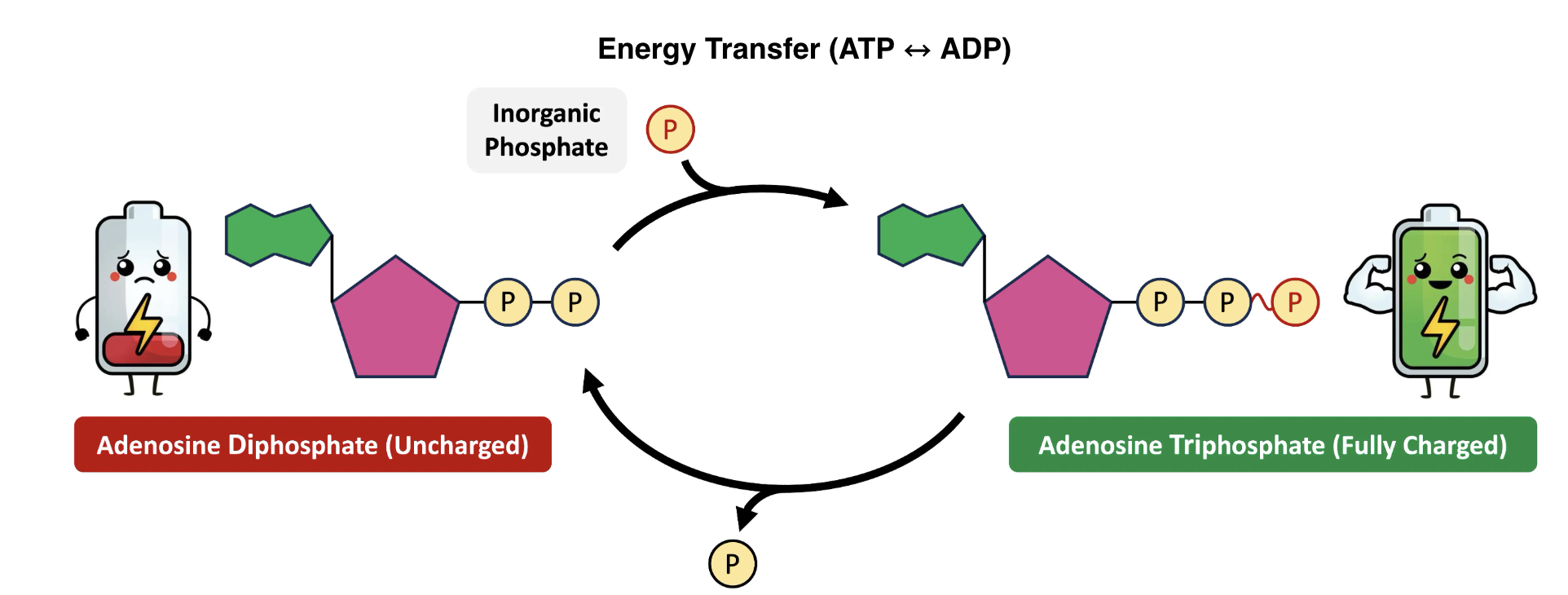
The addition of a phosphate group to a molecule → during ATP synthesis, a phosphate is added to ADP to form ATP → energy is stored during ATP synthesis + released during ATP hydrolysis

ATP hydrolysis
ATP + H₂O → ADP + phosphate + energy
A water molecule is added to break off the 3rd phosphate from ATP → an exergonic reaction (energy is released) → the released energy is used for work/processes within the cell
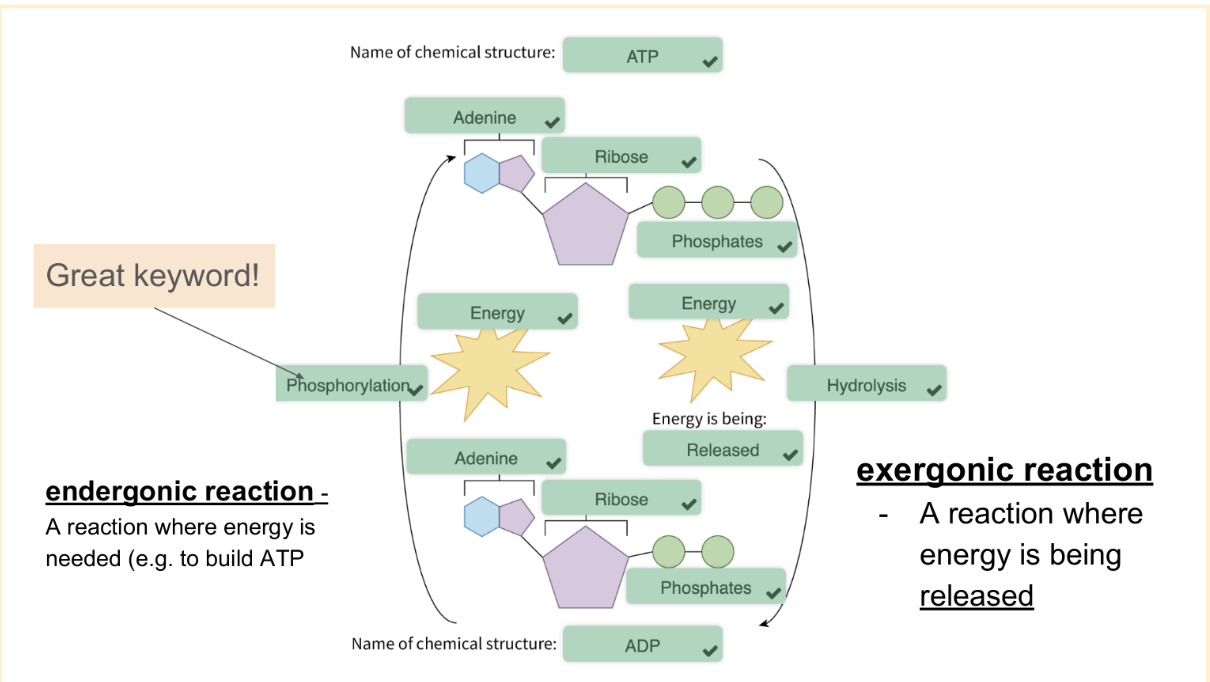
ATP synthesis
ADP + phosphate + energy → ATP
Energy is required to add a phosphate to ADP to form ATP → an endergonic reaction (energy is required) → energy is temporarily stored in ATP
Respiratory substrate
Any organic molecule that can be broken down during cell respiration to release energy for ATP production
Examples of respiratory substrates
Glucose + fatty acids are the principal respiratory substrates → other organic compounds → e.g. amino acids, can also be used
Cell respiration
metabolic processes within cells that break down organic compounds to release energy + produce ATP
Gas exchange
movement of respiratory gases between an organism + its environment → e.g. oxygen enters the blood + carbon dioxide leaves the blood
Aerobic respiration
Aerobic respiration → uses oxygen to release energy from glucose + produce ATP
glucose + oxygen → carbon dioxide + water (+ ATP)
Anaerobic respiration
releases energy from glucose without oxygen + produces ATP
In humans:
glucose → lactate (+ ATP)
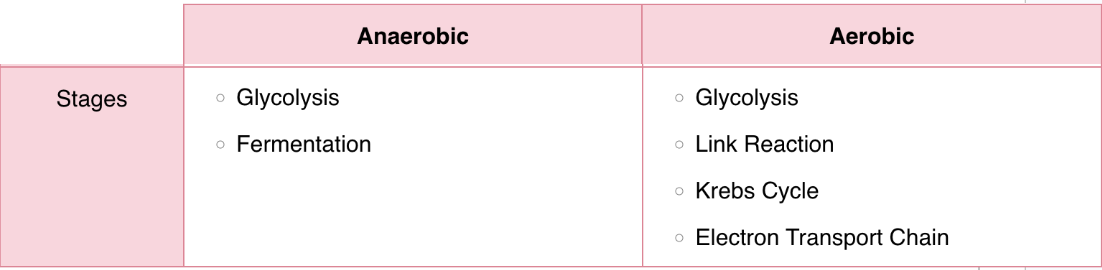
Differences between aerobic and anaerobic respiration
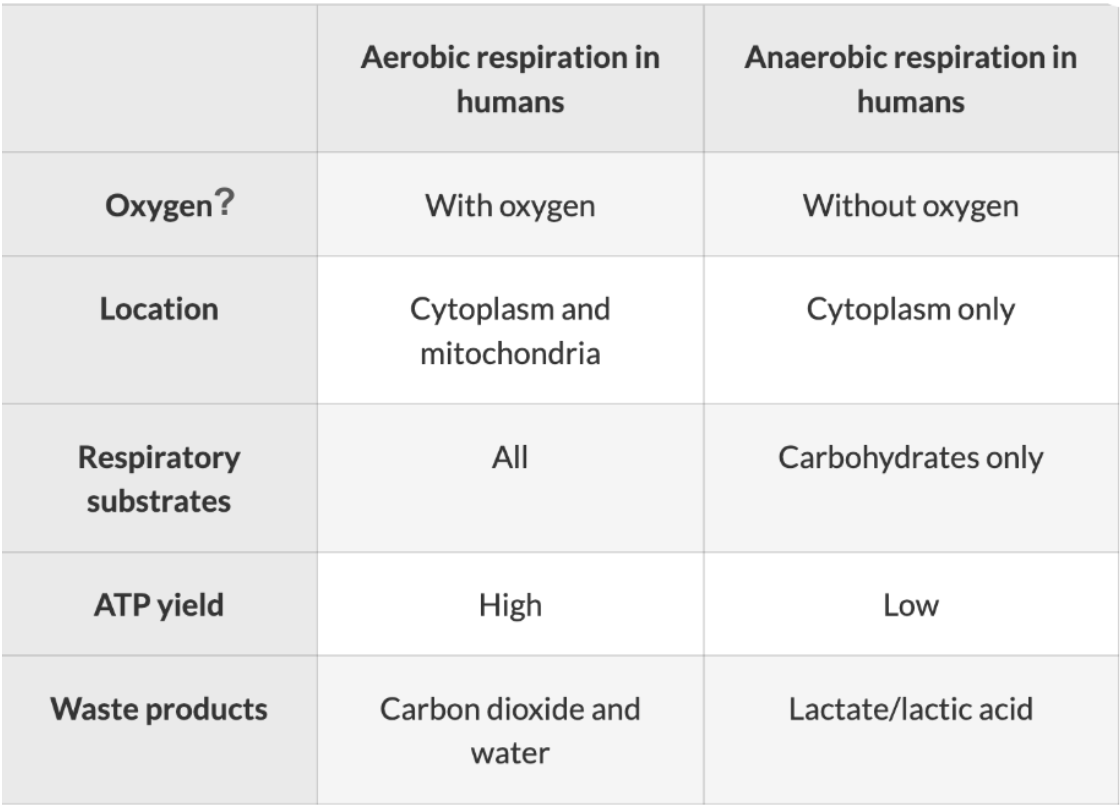
Anaerobic vs aerobic stages
Factors affecting the rate of cell respiration
Temperature → affects the activity of enzymes involved in respiration
pH → affects enzyme activity
Inhibitors → can reduce enzyme activity
Glucose availability → glucose is a major respiratory substrate
Oxygen availability → required for aerobic respiration
Respirometer
A respirometer measures the rate of aerobic respiration by measuring oxygen consumption
A living organism → e.g. germinating seeds/invertebrate, is placed in a sealed container
Soda lime/another alkali absorbs the CO₂ produced
As O₂ is consumed + CO₂ is absorbed → the gas pressure decreases
This causes the liquid in the manometer to move
Greater movement over a given time → higher rate of respiration

Why is CO₂ absorbed in a respirometer?
CO₂ is absorbed by an alkali → e.g. soda lime so that any decrease in gas volume/pressure is due to oxygen consumption → the change can be used to determine the rate of aerobic respiration
Controls in a respirometer experiment
Water bath → keeps temperature constant
Glass beads → control with the same volume/mass as the living organisms
Sealed apparatus → prevents outside gases entering or leaving
Calculating rate of cell respiration
rate of respiration = change in measurement ÷ time
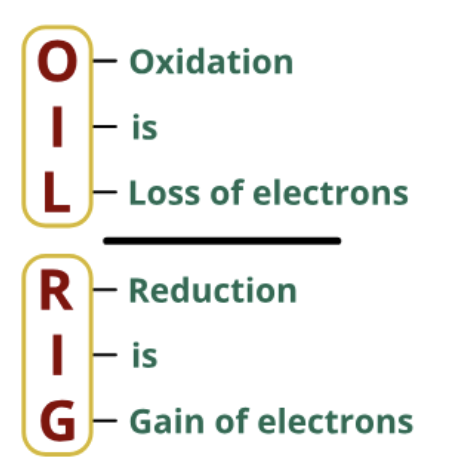
Redox reaction
Respiration involves the movement of electrons (oxidation + reduction; always together)
Dehydrogenation
The removal of hydrogen from a substrate
Hydrogen carries electrons, so removing hydrogen causes the substrate to lose electrons → substrate is oxidized
Electron carrier
they carry electrons from place to place → electron carriers accept/give up electrons as required → linking oxidations + reductions in cells

NAD
NAD is an electron carrier that transfers hydrogen + electrons during cell respiration.
NAD accepts hydrogen/electrons from a substrate
When NAD gains hydrogen → reduced to form reduced NAD (NADH)
NADH can later give up the hydrogen/electrons

The reason why we need electron carriers

Where does glycolysis occur
in the cytoplasm of the cell (outside the mitochondria) → first stage of aerobic and anaerobic respiration
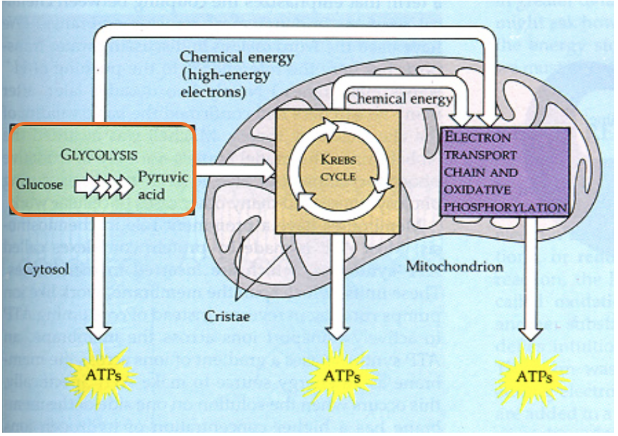
Glycolysis
converting glucose to pyruvate
Glycolysis end products
2 pyruvate (3C)
net yield of 2 ATP
2 reduced NAD (NADH)

Stages in glycolysis
Phosphorylation → 2 ATP are used to add phosphates to glucose
Lysis → the phosphorylated glucose is split into two 3-carbon molecules
Oxidation → the 3-carbon molecules lose hydrogen/electrons
NAD is reduced → hydrogen/electrons are accepted by NAD, forming reduced NAD (NADH)
ATPx formation → ADP is phosphorylated to form ATP
2x pyruvate are formed

Why must NAD be regenerated during anaerobic respiration?
During glycolysis, NAD accepts hydrogen/electrons → becoming reduced NAD (NADH)
Without oxygen, reduced NAD cannot be oxidised by the electron transport chain → NAD must be regenerated so it can continue accepting hydrogen/electrons → allows glycolysis to continue
Conversion of pyruvate to lactate
In anaerobic respiration in humans: pyruvate → lactate
Reduced NAD (NADH) gives its hydrogen/electrons to pyruvate → pyruvate is converted into lactate → reduced NAD is oxidised → regenerating NAD → allows glycolysis to continue without oxygen → continues producing ATP
ATP production during anaerobic respiration
net yield is 2 ATP per glucose
Anaerobic respiration in yeast
In the absence of oxygen, yeast carries out anaerobic respiration
Glucose → ethanol + carbon dioxide + ATP
Similarities between anaerobic respiration in humans and yeast
Use glycolysis to convert glucose → pyruvate
Regenerate NAD so glycolysis can continue
Produce a net yield of 2 ATP per glucose
Difference between anaerobic respiration in humans and yeast
Humans: pyruvate → lactate
Yeast: pyruvate → ethanal → ethanol + carbon dioxide
Stages of anaerobic respiration in yeast
Glycolysis:
glucose → 2 pyruvatenet 2 ATP
reduced NAD (NADH) produced
Pyruvate → ethanal
Decarboxylated → CO₂ is removed from pyruvate
Ethanal → ethanol
reduced NAD (NADH) gives hydrogen/electrons to ethanal
NAD is regenerated
regenerated NAD allows glycolysis to continue
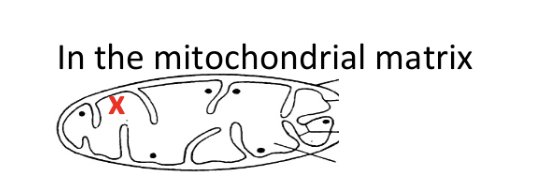
Wheres does the link reaction take place
In the mitochondria’s matrix
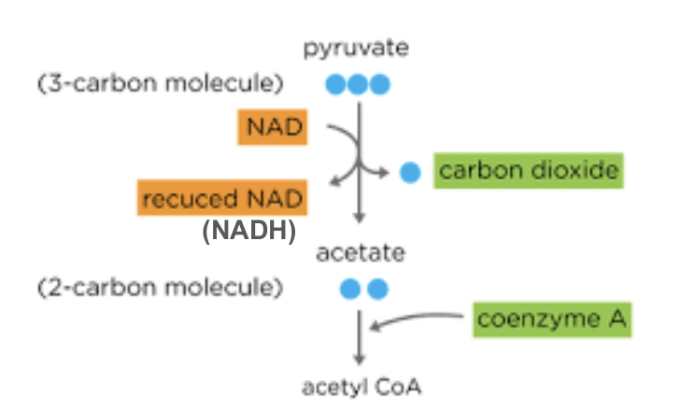
Steps of the link reaction
Pyruvate (3C) enters the mitochondrial matrix
Pyruvate is oxidised → hydrogen/electrons are removed
NAD accepts the hydrogen/electrons → forming reduced NAD (NADH)
Pyruvate is decarboxylated → CO₂ is removed
An acetyl group (2C) is formed
Acetyl group joins coenzyme A → forming acetyl-CoA
Acetyl-CoA carries the acetyl group to the Krebs cycle
How many times does the link reaction happen
twice per glucose because glycolysis produces 2 pyruvate
Role of coenzyme A in the link reaction
Coenzyme A attaches to the acetyl group (2C) → forming acetyl-CoA.
Coenzyme A carries the acetyl group into the Krebs cycle
Starting materials for link reaction
pyruvate (3C)
NAD⁺
coenzyme A (CoA)
End products of link reaction
Per glucose:
2 acetyl-CoA
2 reduced NAD (NADH)
2 CO₂
0 ATP
Where does the Kerb Cycle take place
In the mitochondria’s matrix
Stages of the Kerb cycle
Acetyl CoA (2C) from link reaction combines with a 4 carbon compound (oxaloacetate), making a 6 carbon compound (citrate)
Citrate (6C) is oxidized (NAD+ is reduced to NADH) and decarboxylated (carbon dioxide is released) to form a 5 carbon compound
The 5 carbon compound is oxidized and decarboxylated to form a 4 carbon compound. This forms carbon dioxide and another NADH
The 4 carbon compound is further oxidised
a. FAD to reduced FAD/FADH2
b. NAD to reduced NAD/NADH
ATP is produced by the phosphorylation of ADP

Every 1 glucose molecule produces per Kerb cycle:
6x NADH (reduced NAD) (oxidation + reduction)
4x CO2 (decarboxylation)
2x FADH2 (reduced FAD) (oxidation and reduction)
2x ATP (phosphorylation)
How many time oxidisation and decarboxylation happen in the Kerbs Cycle
Per turn of the Krebs cycle → 4 oxidations (dehydrogenation) + 2 decarboxylations
Oxaloacetate (4C) is regenerated so the cycle can repeat
Where is the electron transport chain
inner mitochondrial membrane → inner membrane is arranged into folds (cristae) → increases the surface area available for the transport chain

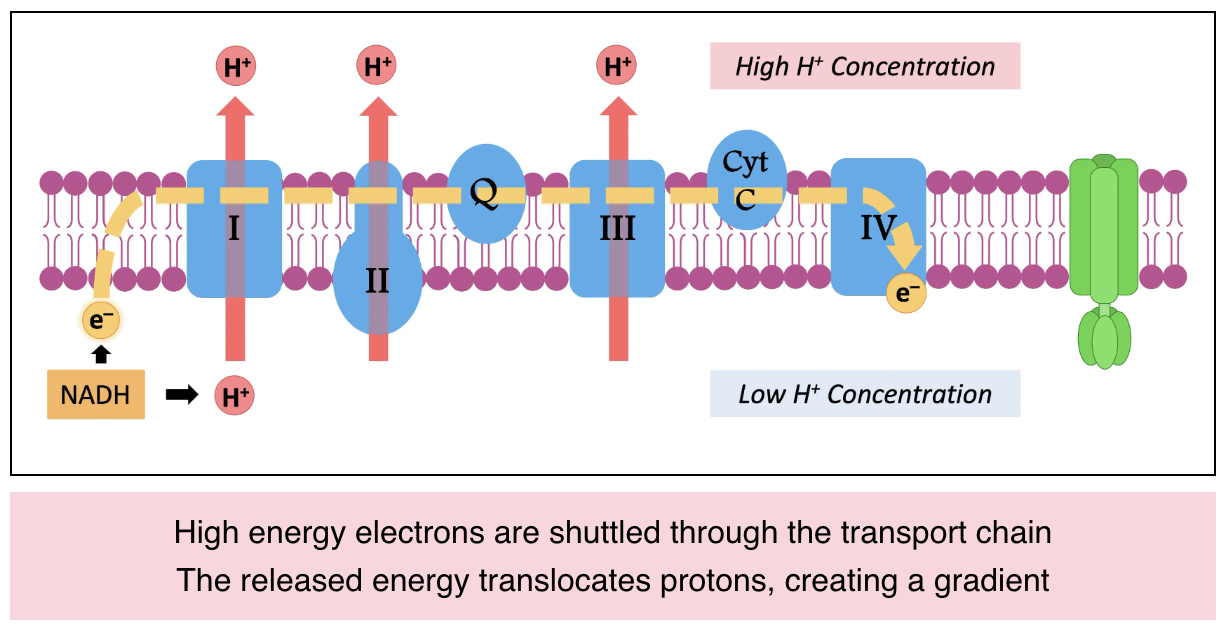
How does reduced NAD transfer energy to the electron transport chain?
Reduced NAD (NADH) + reduced FAD (FADH) is oxidised back to NAD + FAD → both return to the matrix
Both H atoms split into H+ and e-
The electrons move down the electron transport chain via electron carriers (membrane proteins), losing energy at each one
The electrons transfer energy to the electron transport chain
Where does the reduced NAD used in the electron transport chain come from?
Glycolysis
Link reaction
Krebs cycle
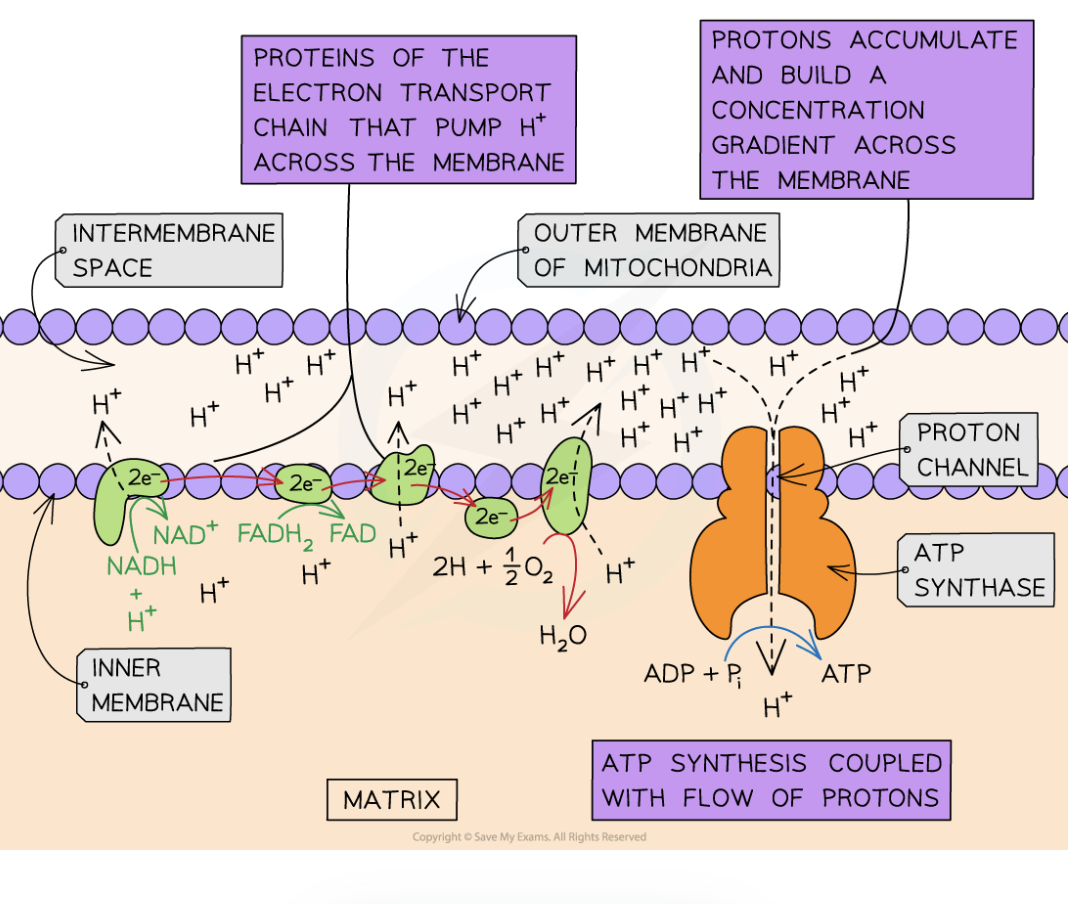
How is a proton gradient formed in the electron transport chain
As electrons pass through the chain, they lose energy
This energy is used to provide the carriers with energy to pump protons (H+) into the intermembrane space from the matrix
A concentration gradient of protons builds up
Chemiosmosis
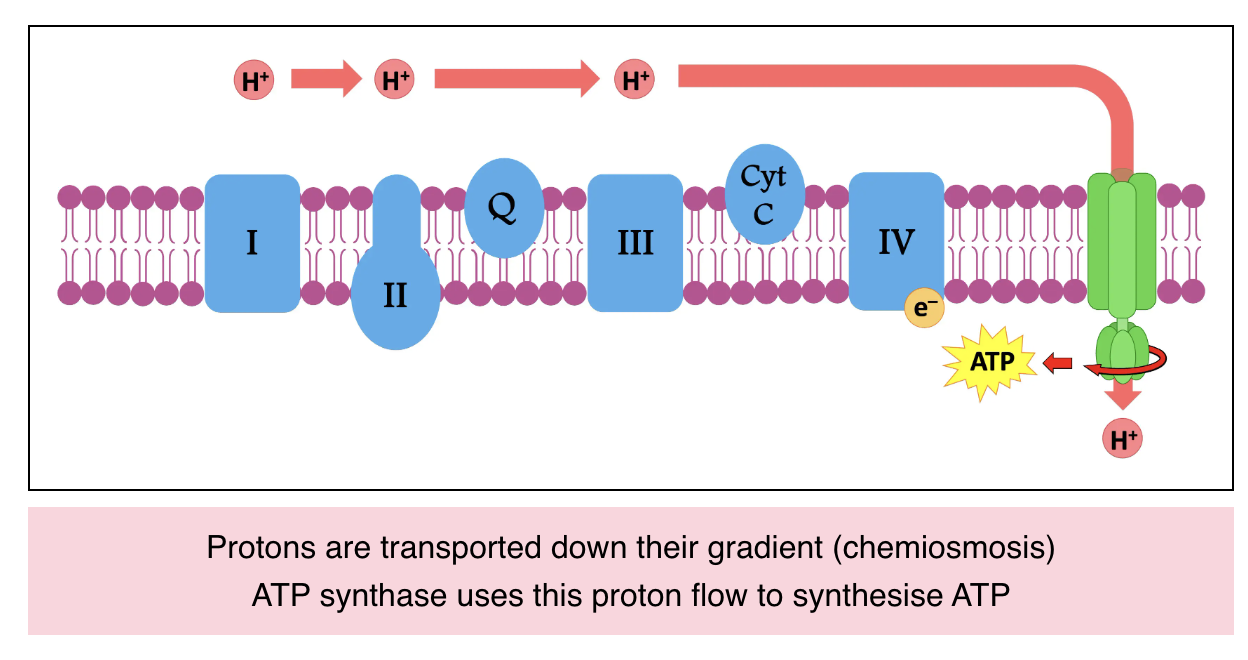
The movement of H⁺ through ATP synthase:
H⁺ ions move down their electrochemical gradient from the intermembrane space into the mitochondrial matrix
H⁺ can only cross the inner mitochondrial membrane through ATP synthase
How does chemiosmosis produce ATP?
H⁺ ions move through ATP synthase down their electrochemical gradient
This releases energy → causes ATP synthase to rotate/change shape
ATP synthase uses this energy to phosphorylate ADP → creates ATP
What is the role of oxygen in the electron transport chain?
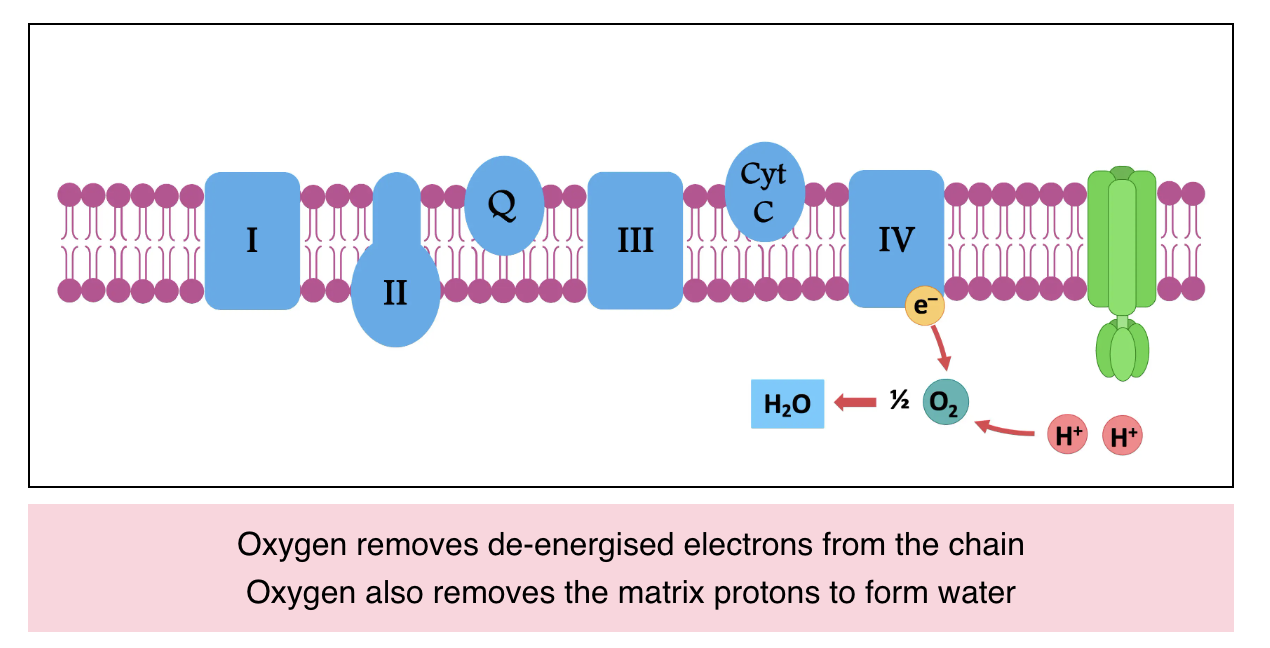
Oxygen acts as the terminal electron acceptor → accepts de-energised electrons from the electron transport chain → allows electrons to continue flowing along the electron transport chain

How is water formed during aerobic respiration?
Oxygen accepts electrons from the electron transport chain
Oxygen combines with H⁺ (protons) from the mitochondrial matrix → forms water (H₂O)
Why do lipids produce more energy per gram than carbohydrates
Lipids contain less oxygen + more oxidizable hydrogen and carbon than carbohydrates → more oxidation can occur → releases more energy per gram
How are carbohydrates used in cell respiration
Carbohydrates are broken down into monosaccharides → e.g. glucose
Glucose enters glycolysis
Carbohydrates can be used for both aerobic + anaerobic respiration
Glycolysis and anaerobic respiration only occur when carbohydrate is the respiratory substrate
How are lipids used in cell respiration
Fatty acids are broken down into 2C acetyl groups
Forms acetyl-CoA → enters the respiration pathway at the Krebs cycle
This bypasses glycolysis → lipids cannot be used for anaerobic respiration
Pho
the process by which cells synthesise organic compounds → e.g. glucose from inorganic molecules → CO2 + H2O in the presence of sunlight and chlorophyll

What organisms photosynthesize
plants
algae
cynobacteria
How chemical energy is used
Photosynthetic organisms contain pigments that capture the light energy from the sun to create chemical energy (ATP) → used to synthesise organic compounds via anabolic reactions for life processes
What happens to water during photosynthesis
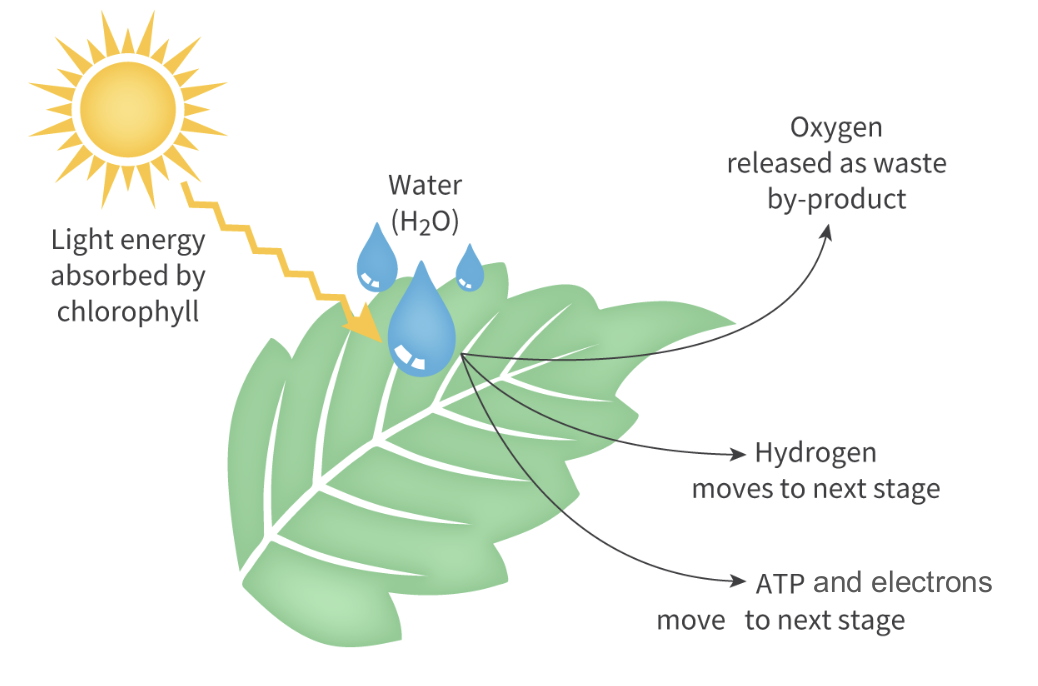
Water is split during the light-dependent reactions, providing hydrogen that is carried by NADPH → photolysis
NADPH later used to help convert carbon dioxide into glucose
Where does the oxygen produced during photosynthesis come from
Photolysis → oxygen comes from the splitting of water during photosynthesis
What is the by-product of photosynthesis
Oxygen → is released from the chloroplast
Chromatography
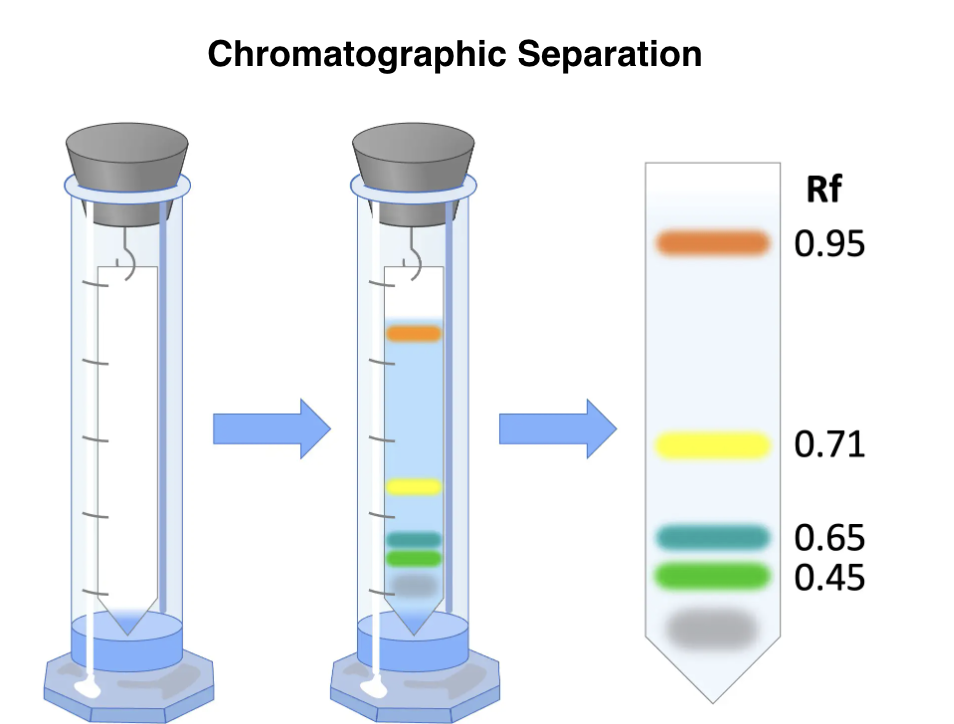
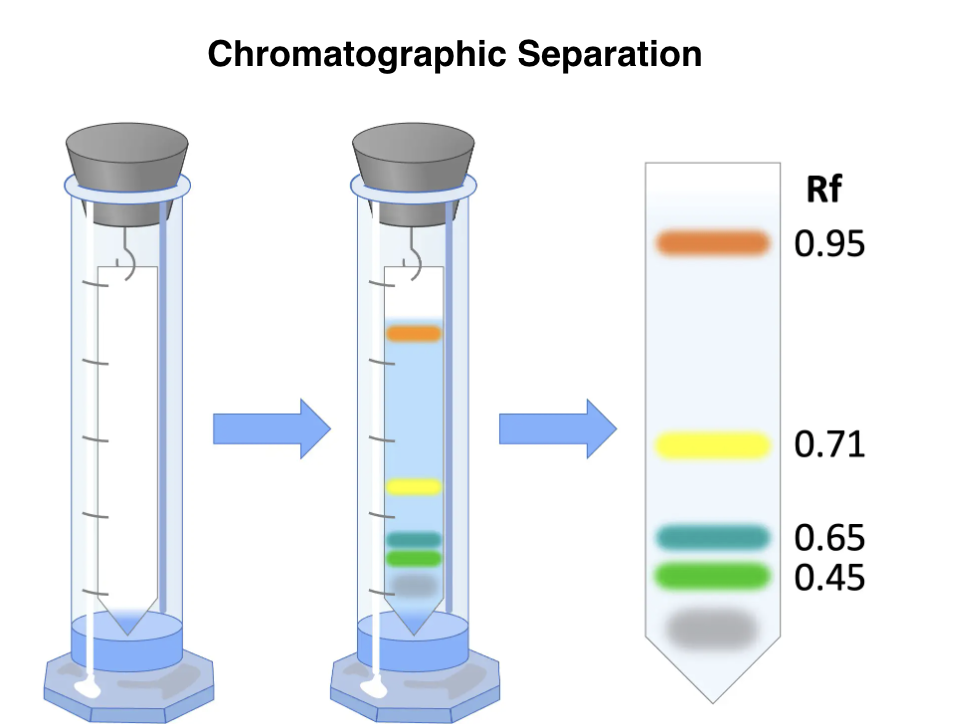
technique used to separate and identify different components in a mixture → e.g. photosynthetic pigments
Formula for Rf value
Rf = distance travelled by pigment ÷ distance travelled by solvent front
Types of photosynthetic pigment:
Chlorophyll
Xanthophyll
Carotenoid
Anthocyanin
Photoactiviation
the absorption of light energy (photons) by photosynthetic pigments → e.g. chlorophyll in a photosystem → boosts their electrons to a higher energy level
Why do photosynthetic pigments only absorb specific wavelengths of light
Electrons in each pigment have specific energy levels → they can only absorb wavelengths of light that provide the correct amount of energy to excite them
What happens when a photosynthetic pigment absorbs light?
Light energy is absorbed by the pigment
Electrons within the pigment become excited to a higher energy level
The energy from the excited electrons is used to produce chemical energy (ATP) → photophosphorylation
How is light energy transformed into ATP in photosynthesis?
Light is absorbed by photosynthetic pigments → photoactivation occurs, where electrons become excited to a higher energy level → the energy from these excited electrons is used to produce chemical energy (ATP)
Absorption spectrum
how much light a photosynthetic pigment absorbs at different wavelengths
x-axis: wavelength of light (nm) + corresponding colour
y-axis: amount of light absorbed by the pigment
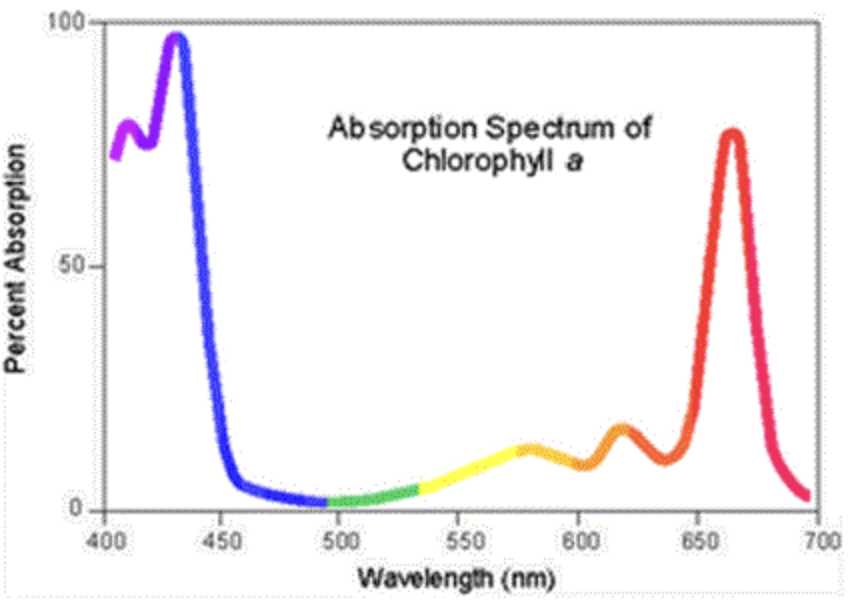
Which wavelength does chlorophyll a absorb the most
Blue
Red
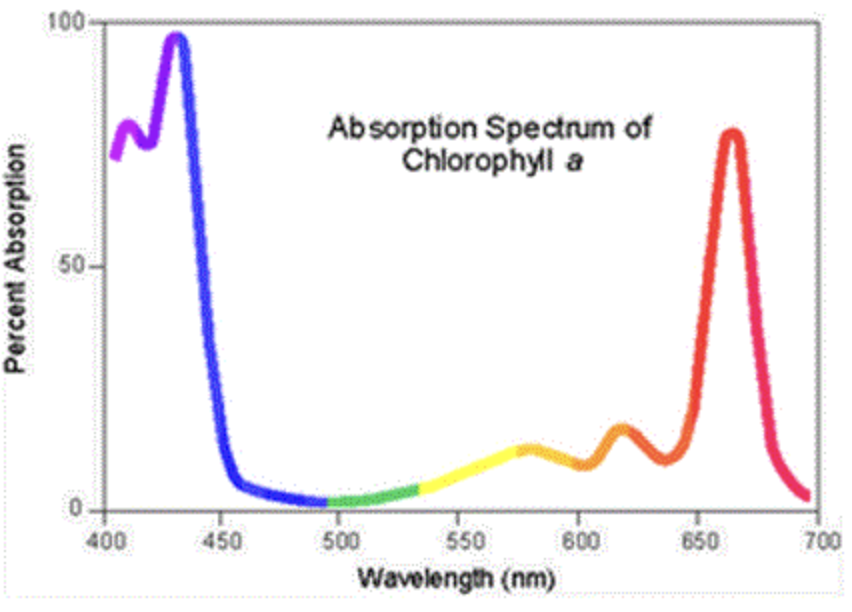
Red wavelength
(600 - 700 nm) → most abundant
Blue wavelength
(400 - 500 nm) → most energy
Action spectrum
Shows the rate of photosynthesis at different wavelengths of light

How can the rate of photosynthesis be measured for an action spectrum
By measuring:
rate of O₂ production
rate of CO₂ consumption
The similarities between absorption and action spectra
Both vary with wavelength of light
Both generally have high values in the blue + red regions
Both generally have low values in the green/yellow region
Why are absorption + action spectra similar
Wavelengths that are strongly absorbed by photosynthetic pigments provide more energy for photosynthesis → produce a higher rate of photosynthesis
Main limiting factors of photosynthesis
CO₂ concentration
Light intensity
Temperature
How can CO₂ concentration be varied experimentally
Use different concentrations of sodium bicarbonate solution → provides CO₂
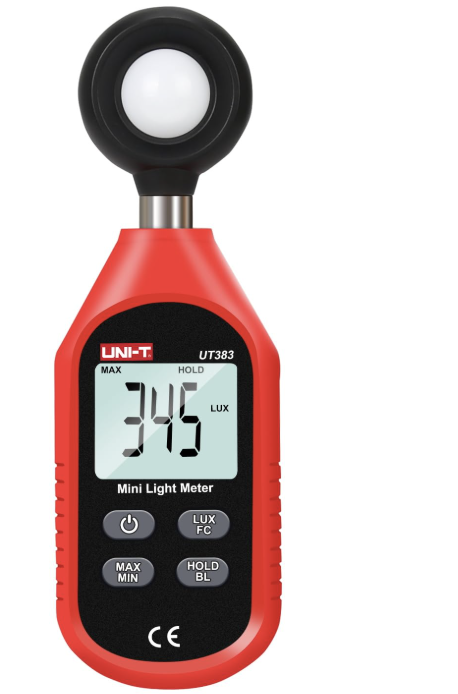
How can light intensity be measured
using a lux meter
CO₂ enrichment
Experimentally increasing the CO₂ concentration above normal atmospheric levels to investigate its effect on photosynthesis + plant growth
Why CO₂ enrichment experiments are carried out
Predicts how future increases in atmospheric CO₂ may affect:
Rate of photosynthesis
Plant growth
Types of CO₂ enrichment experiments
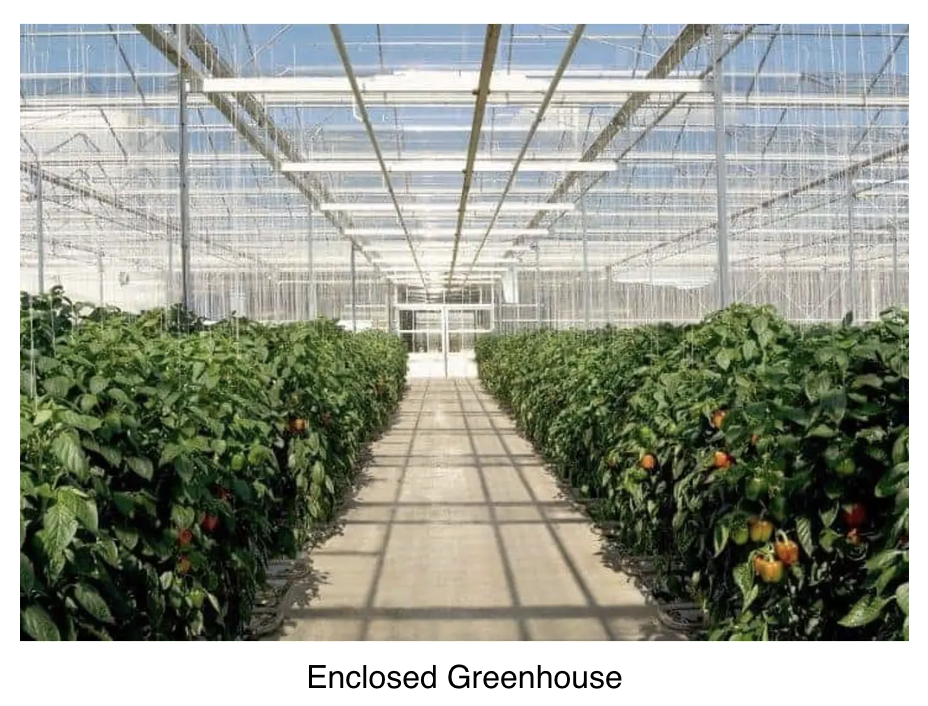
Enclosed greenhouse experiments
Free-Air CO₂ Enrichment (FACE) experiments
How are enclosed greenhouse CO₂ enrichment experiments carried out
CO₂ concentration is artificially increased inside an enclosed greenhouse → its effects on photosynthesis + plant growth are measured

Advantage and disadvantage of enclosed greenhouse CO₂ enrichment experiments
Advantage: Variables → e.g. temperature + light can be carefully controlled
Disadvantage: Conditions are less representative of the natural environment
How are FACE experiments carried out
Pipes release CO₂ around plants in an open, natural environment → sensors monitor CO₂ concentration + adjust its release
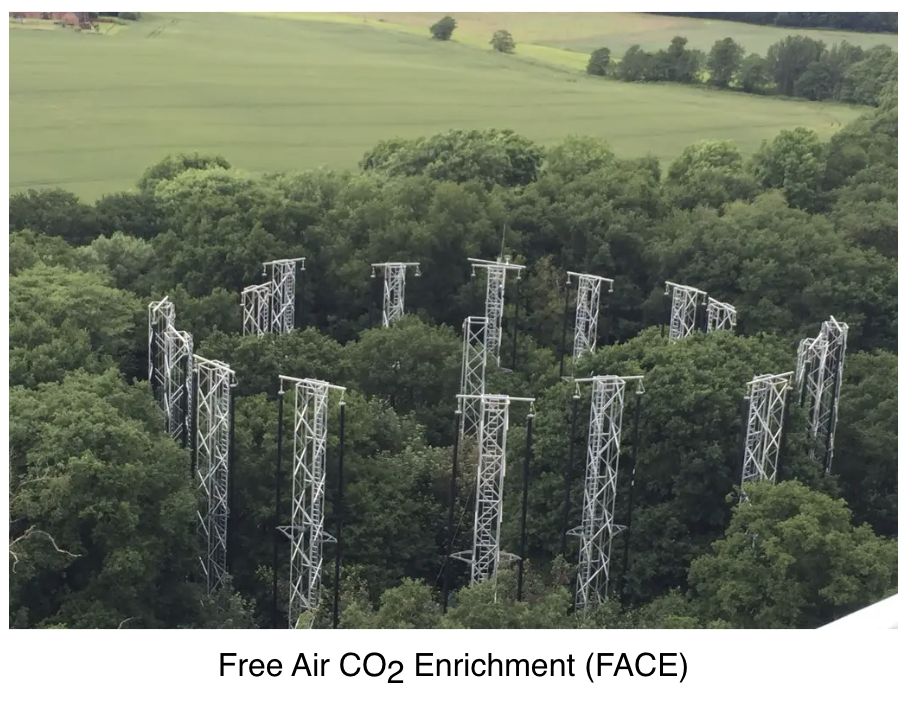
Advantage and disadvantage of FACE experiments
Advantage: More representative of natural conditions → can study larger plants/ecosystems
Disadvantage: Environmental variables → e.g. temperature, rainfall + light are harder to control

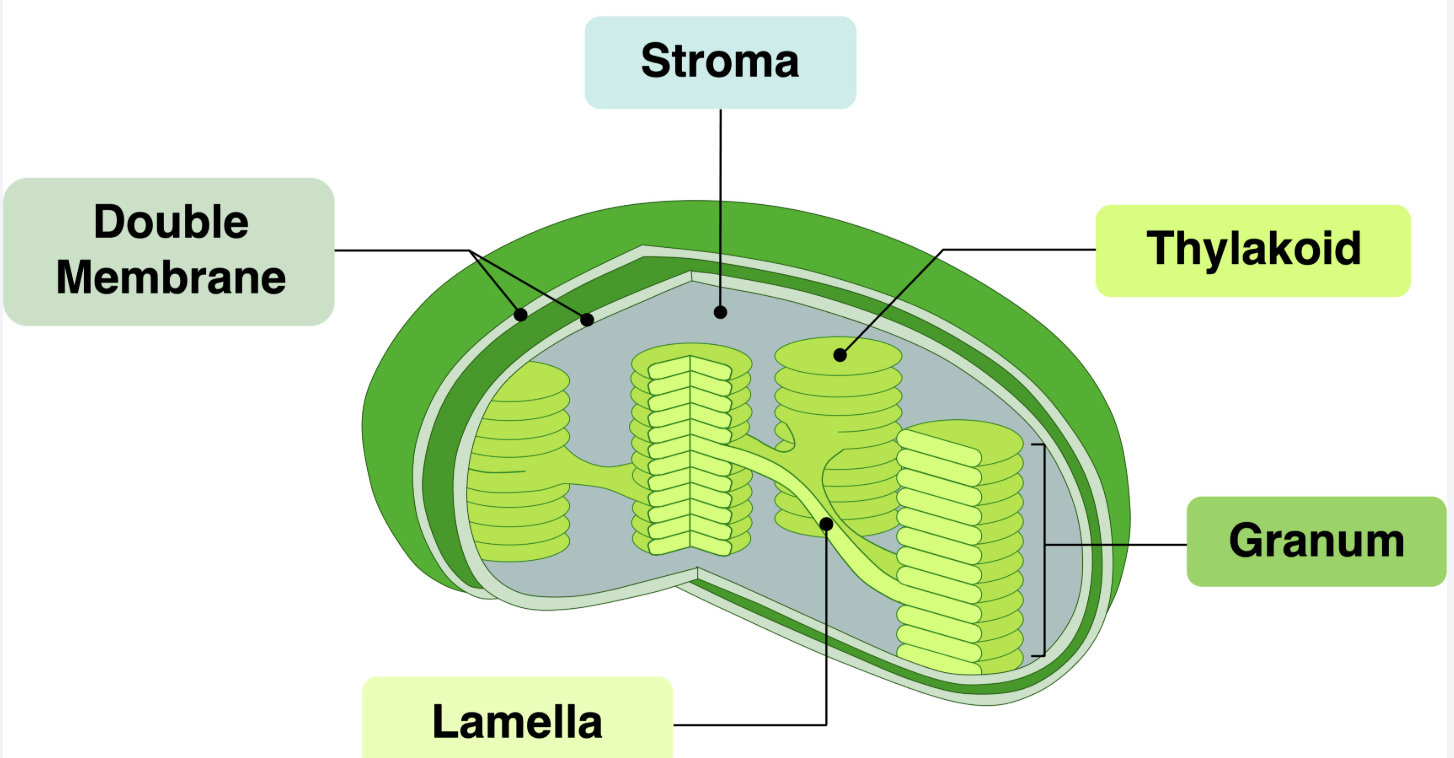
Diagram of chloroplast
Photosystem
A molecular array of chlorophyll + accessory pigments pigments with a special chlorophyll as the reaction centre that absorb light energy + emit excited electrons during photosynthesis
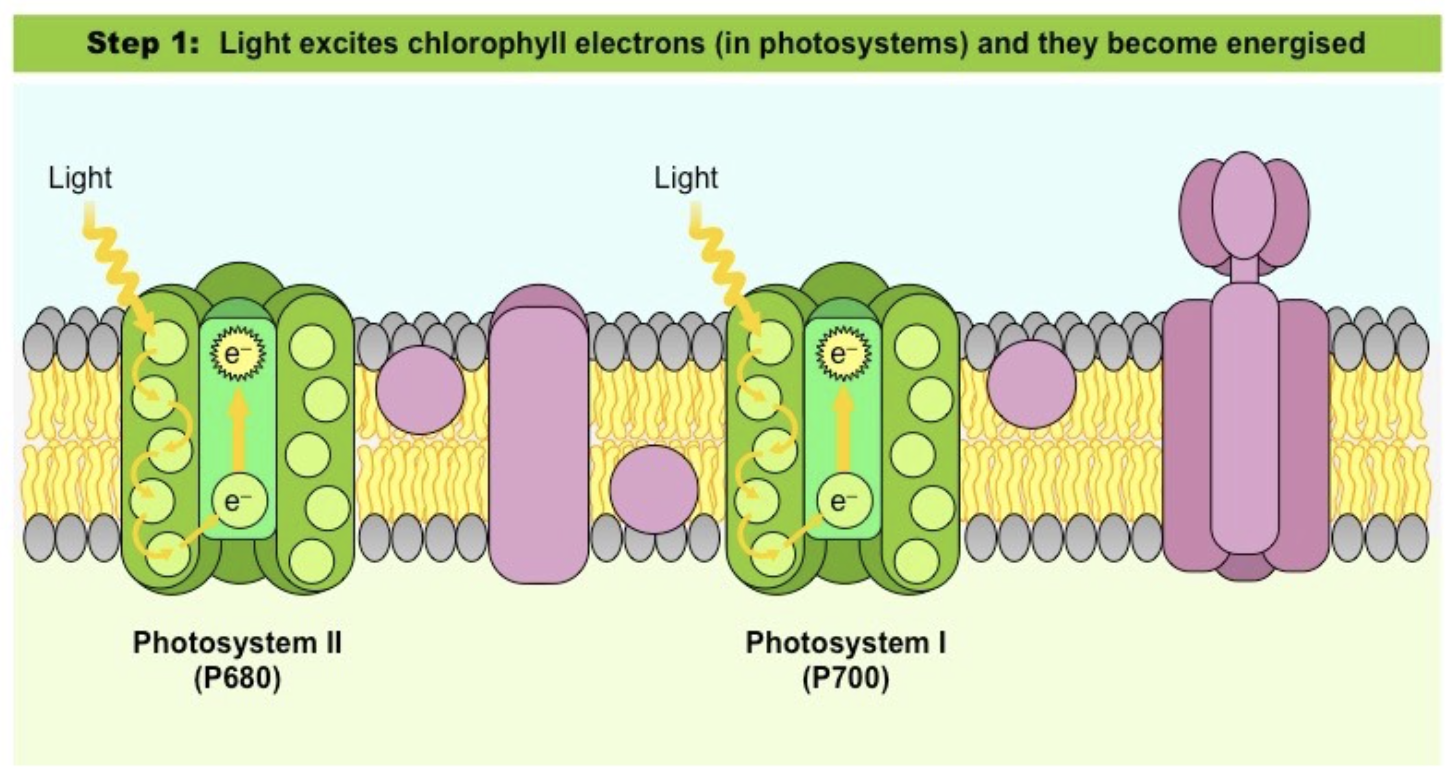
Where are photosystems located
In the thylakoid membranes of chloroplasts
In the membranes of cyanobacteria
Why do photosystems contain different pigments
Different pigments absorb different wavelengths of light → grouping them together allows the photosystem to absorb a wider range of wavelengths
Types of photosystems
Photosystem I (PSI) → 700nm
Photosystem II (PSII) → 680nm

Can a single pigment molecule perform photosynthesis
No → a single molecule of chlorophyll or any other pigment cannot perform any part of photosynthesis on its own
Why is the structured arrangement of pigments important
Allows energy absorbed by pigments to be transferred towards the reaction centre → enabling sufficient energy transfer for photosynthesis