102 final
 Call Kai
 Learn
Learn Practice Test
 Spaced Repetition
 Match
Match Flashcards
 Knowt Play
1/140

There's no tags or description
Looks like no tags are added yet.
Name | Mastery | Learn | Test | Matching | Spaced | Call with Kai | Chat |
|---|
No analytics yet
Send a link to your students to track their progress
141 Terms
solubility
max quantity of a substance that can dissolve, concentration of saturated solution
insoluble = less than 0.01 M at saturation
Ksp - solubility in terms of equilibrium
K “solubility product”
rate equation
Rate = k[A]2[B]
zero order half life
t ½ = [A]0/2K
first order half life
t ½ = ln2/k
second order half life
1/k[A]0
reaction order units

effect of reaction manipulation on K
double coefficients? K —> K2
multiply by 1/2? K—> K1/2
reverse reaction? K —> 1/K
finding Kc from elemantary reactions
Kc = K1*K2
effect of an intert gas on K
no effect
inert = nonreactive, usually bc full valence shell (noble gases)
remember, only temp change affects K, not pressure volume or concentration of products or reactants
relation between acid/base strenght and conjugate strength
the stronger the acid, the weaker its conjugate base
Pka, pH, and concentration of acid and base
when [acid] = [base], pH = ppka (1/2 V at the equivalence point)
ideal buffer
when [acid] < [base], pH > pka
when [acid] > [base] pH < pka
relationship between intermolecular forces and Pvap
weaker IMF = greater Pvap
change in mass of cathode v anode
anode loses mass
cathode gains mass
Q and K at standard conditions
Q = K
pH at equivalence point for
SA, SB
WA, SB
WB, SA
SA SB - 7
WA SB >7
why? no more weak acid or strong base, just conjugate base and H2O
WB SA <7
at equilibrium, what is K and ΔG
K =1, ΔG = 0
what does it mean whne a solution is saturated?
it is at equilibrium
to find ksp, jsut plug in values
formation of soluble complex ion can…
increase solubility
Q
solubility concentration quotient, for any state that is not equilibrium
Qsp same as Ksp
when Q > K, should precipitate
Qsp < Ksp unsaturated solution
spontaneous reaction
process that proceeds without external energy input
water flowing down hill
salt dissolving in water
iron rusting
Zinc reacting with HCl
thermodynamics, system? surroundings?
study of energy transfer between the reaction system and the surroundings
system = chemicals reacting
surroundings = everything else (container, stir bar, bench, air, etc)
1st law of thermodynamics
energy cant be created/destroyed, only transferred
energy transfers as either…
work: action of force through a distance (piston)
w = -PΔV
1 L*atm = 101.325 J
for all reactions not in gas phase, work is negligible (considering enthalpy of rxn)
Heat. (q): temp difference between system and surroundings - joules
heat released from syst, -q = exothermic
heat absorbed by syst, +q = endothermic
E of system is U
ΔU = q + w
enthalpy
state function fir the thermodynamics of a reaction, at constant pressure
ΔH > 0 = +q = endothermic
ΔH < 0 = -q = exothermic
irreversible processes
spontaneous, unidirectional
burning paper
scrambling an egg
when spontaneous process occurs, system and surroundings cannot return to exact original state
all natural processes are in a sense irreversible — universe irreversibly changed
entropy
quantification of number of microscopic options (microstates) we have that fullfill certain criteria overall (macrostate)
count of how many possible microstates can fullfill a given macrostate
higher entropy = more options for macrostates
positive for processes that increase the number of possible microstates
always increasing - surroundings = the universe
positive — spontaneous
extensive property - value depends on the size or amount of matter in a sample
must increase overall
microstate
a specific arrangement of locations and energies of atoms or molecules that make up a system
macrostate
macroscopic, thermodynamic state defined by parameters like pressure, temp, volume
when is it spontaneous (toward products)? ΔG and ΔSsys
when ΔG is negative
when ΔSsys positive
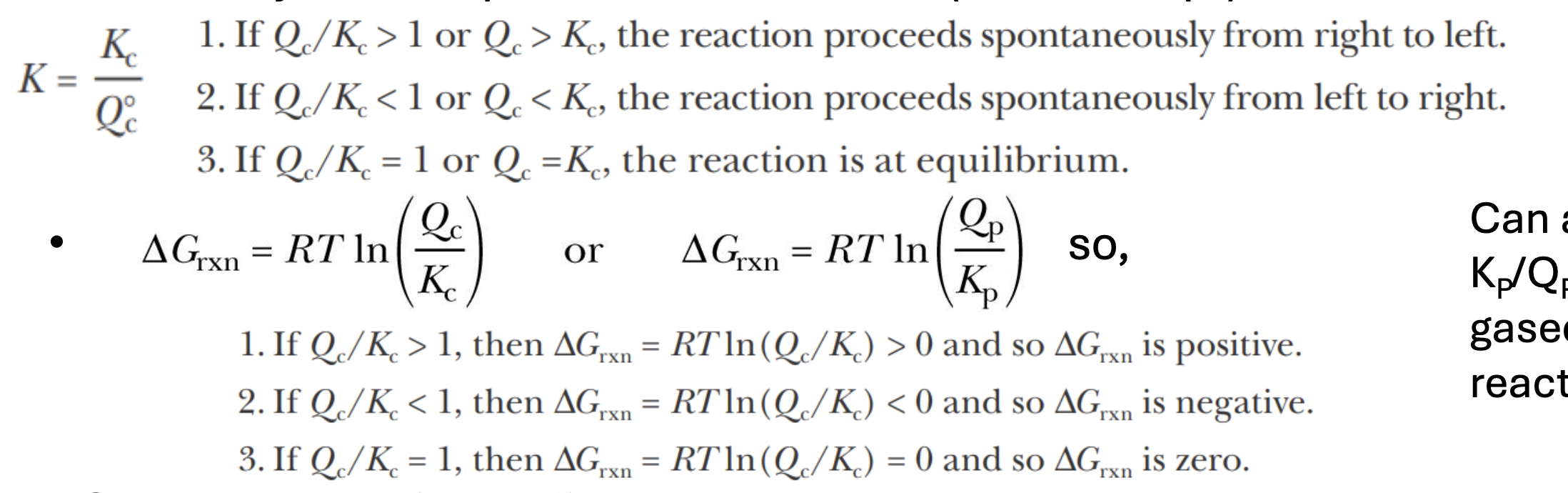
relationship between K, Q, G
redox reactions: reduction, oxidation, oxidizing agent, reducing agent
gain elections
lose electrons
what is reduced
what is oxidized
Van’t Hoff Equation: what does it show? what can be translated to?
shows dependence on temperature
assume H and S dont change much with temp
Equilibrium is compromise between minimum H and maximum S

oxidation state
charge that results when electrons of a bond are assigned to the more electronegative atom
charge an atom would possess if the bonding were ionic
(#valence e on each free atom) - (#valence e in bond (?))
what is electricity
the movement of electrons
galvanic cell v. electrolytic cell
reaction produces electricity spontaneously (ΔGrxn < 0)
run electricity through cell to produce a reverse reaction
electrode — cathode v anode
solid, surface of which is where redox reactions occur
cathode: where reduction occurs
reduction — red colored nob
where electrons are consumed, positive charge
anode: electrode where oxidation occurs
a and o vowels
where electrons enter, negative charge.
electrons move toward cathode to be consumed, current in wire = current via ions in salt bridge
salt bridge
two solutions connected via solution/gel through which ions can flow to maintain current
maintains ion balance
external circuit
metal leads (wires) connect cell to deliver electric current to external circuit'
drawing a cell diagram
single bar = boundary of phases
solid electrode | aqueous ions
double bar = salt bridge, boundary of half reactions
aqueous oxidant || aqueous reductant
oxidation on left, reduction on right
voltage
electrical potential difference
driving force of electricity, measured in volts (V)
drives reactions forward, electromotive force (Ecell) = driving force, related to spontaneity
depends on K,T, and concentrations of products and reactants via Q
Ecell < Eocell shift toward reactants
electrical energy units, measurement
U
measured in voltage (V) x charge (z)
charge units and measurement
z
measured in coulombs
represents charge transferred in cell reaction as written
Current
I
flow of charge over time
measured in amperes (A) = 1 C/s
Nernst equation
walther nernst
how concentration of reductant and oxidant, size of electrodes, concentration of ions, etc. affect voltage
Faraday’s constant
charge on proton x Avogadro’s number
Eocell
cell voltage at standard conditions
Q = 1
total cell potential, spontaneity
Eocell = Ered + Eox
for the same half reaction, Eoox = -Eored
when Eocell > 0, ΔG < 0, therefore is spontaneous
reduction potentials,,,what does it mean
more positive = more powerful oxidizing agent (more easily reduced, readily accepts electrons)
more negative reduction potential = more powerful reducing agent (more easily oxidized)
What is the goal of kinetics?
to deduce the rate of reaction an d how it depends on the concentration of reactants
Instantaneous rate of concentration change
change in concentration at some particular instant of time
slope of tangent line at t
general rate equation
aA + bB —> cC + dD
rate of rxn = -1/a (Δ [A]/Δt) = -1/b (Δ[B]/Δt) = 1/d(Δ[D]/Δt)
rate law
rate of reaction = k[A]0x[B}0y
second order reaction rate law
rate of run 1/rate of run 3 = (k[A]1/k[A]3 )
rate equation for first order reaction + slope
- Δ[A]/Δt = k[A]
ln [A] = [A]0 - kt
y= b + mt, m= -k, b = [A]0
y-axis: ln [ ]
[A] = [A]oe-kt
![<p>- Δ[A]/Δt = k[A]</p><p>ln [A] = [A]<sub>0</sub> - kt</p><ul><li><p>y= b + mt, m= -k, b = [A]<sub>0</sub></p></li><li><p>y-axis: ln [ ]</p></li></ul><p>[A] = [A]<sub>o</sub>e<sup>-kt</sup></p>](https://knowt-user-attachments.s3.amazonaws.com/a80888fa-89e2-4120-a61b-c2e050d019df.png)
rate equation + slope for 2nd order reaction
1/[A] = 1/[A]0 + kt
y = b + mt, m=k
to graph:
y-axis = 1/[A]
x-axis = time
![<p>1/[A] = 1/[A]<sub>0</sub> + kt</p><p>y = b + mt, m=k</p><p>to graph: </p><p>y-axis = 1/[A]</p><p>x-axis = time</p>](https://knowt-user-attachments.s3.amazonaws.com/729017cd-38dc-4758-8804-b34b3b0db3a5.png)
half life
time required for 50% of initial reactant to react
[A] = (1/2)n[A0]
n = number of half lives
nuclide
single type of nucleus, each element can have multiple (isotopes are a type)
band of stability
nuclei w/ 1:1 or higher ratio of neutrons to protons
1;1 stable below Z = 20
most stable isotopes, compare to periodic table mass
nuclear decay
spontaneous emission of particles
mass number
number of neutrons + protons
isobar
different elements with the same mass number
isotopes
atoms of an element with different number of neutrons and therefore different masses
ions
atoms can gain or lose electrons to change charge
radioactive decay
directly proportional to the amount of radiactive material (N) present: first order
ln N/N0 = -(0.693/t1/2)t
carbon-dating
carbon-14 used ofr radiodating archeological finds less than 30,000 yrs due to its ½ life:
t1/2 = 5,730 yrs
half life of second order reactions
t1/2 = 1/k[A]0
mechanism
sequence of steps called “elementary reactions” that add up to the overall reaction
catalysts
substance that increases the rate of a chemical reaction w/o being consumed
enzymes = biological ones
lowers Ea
in beginning and end of reaction — is not consumed (?) used up then reformed in products of overall reaction
can be included in rate law
bimolecular interaction
elementary reactions w/ 2 reactants
monomolecular reactions
elementary reactions with only 1 reactant
ex/ radioactive decay
3 requirements for a reaction
rate of reaction = (collision frequency)(fraction of collisions w/ the required energy)(fraction of collisions in which molecules have the required relative orientation)
ONLY collision frequency depends on the concentration of reactants
activation energy
amount of energy required for reactants to react
fraction of collisions w/ enough energy to react increases with temperature
activated complex
state with the least amount of additional energy needed to pass from reactants to products
cannot be isolated
as soon as have activated complex — have product
arrhenius equation
k = Ae-Ea/RT
ln k2/k1 = Ea/R (ΔT/T1T2)
rate-determining step
overall rate = rate slowest step
equilibrium
rate forward reaction = rate reverse reaction
homogeneous catalyst
catalyst is in the same phase as the reaction mixture
heterogeneous catalyst
catalyst is in a different phase than the reaction mixture
enzyme
protein molecules that catalyze specific biochemical reactions
substrate
reactant molecule enzyme acts on
active site
region of protein where the reaction takes place
only a small portion of the whole molecule
rate law of enzyme-catalyzed reaction
rate of reaction = R = Δ[P]/Δt = k[S]/[S] + Km
[S] = concentration of substrate
[P] = concentration of product
k and KM are constants
steady-state approximation
ES is consumed as fast as it is formed
k1[E][S] = (k-1 + k2)[ES]
dynamic equilibrium
reactions aren’t being paused/frozen, no net change in [products] and [reactants] because being formed + reacted at same rate
for any reaction at chemical equilibrium…
[product]xeq /[reactant]yeq = Kc
kc =. equil. constant in terms of concentrations
decay particles, ordered in terms of mass
alpha - emission of helium nucleus
minus 4 at the top (mass number), 2 from atomic number
beta - emission of electron from the nucleus
gamma - high energy electromagnetic photon emission by nucleus - photon has no mass
positrons: anti-matter of electrons, particle with negligible mass and positive charge, beta + particles emitted by nucleus
Reaction quotient, Qc. What does relationship between Qc and kc tell you about direction in which reaction should shift?
same expression as Kc, but for any state that is not at equilibrium
Q >K shift to reactants
Q<K shift to products
homogeneous catalyst
catalyst is in the same phase as the mixture
heterogeneous catalyst
catalyst is in a different phase than the reaction mixture
lineweaver-burk plot
When R = 1/2Rmax, [S] = Km
if 1/R is plotted against 1/[S], we get a straight line
Le Chatlier’s Principle
if reaction at equilibrium is subject to change in conditions that displaces it from equilibrium, then the reaction adjusts toward a new equilibrium state. The reaction proceeds in the direction that offsets the change in conditions
at equilibrium, high pressure and low temperature is best
what quantities affect equilibrium?
concentration of reactant or product
reaction volume or applied pressure
temperature — only temperature can change the value of k
if there is the same number of moles on both sides of the reaction, volume wont change equilibrium
affect of temperature on k
increase in temperature (exothermic) —> shift from right to left, k decreases
endothermic- left to right as sustem absorbs heat, increasing concentration of products
consider which direction reaction has to go in order to absorb heat
exo v. endothermic
q < 0 = exothermic
q > 0 = endothermic
heat capacity
amount of energy required to raise temperature of a sample by 1 K
Heat of fusion? Opposite?
qfus = nΔHfus
melting (solid to liquid)
freezing
heat of vaporization? opposite?
qvap = nΔHvap
liquid to gas
sublimation? opposite?
Energy required to melt 1 mole of a substance
qvap = nΔHsub
solid to gas
gas to solid
Variation of heat capacity (h2o)
C liquid > C solid > C gas
Intermolecular forces
ion-ion
strongest
not just 1 atom + 1 atom, expanding crystals of repeating units
solid at room temp
dipole-dipole
polar molecules attract one another via dipole-dipole
hydrogen bonds (subset of dipole-dipole)
partial pos on hydrogen and partial neg on N,O,F
hydrogen so small that partial pos is concentrated —> strogner than other partial positives
why ice floats
london - dispersion forces
momentary instantaneous asymmetry for weak dipoles
everything has
stronger intermolecular forces = higher bp
= higher surface tension
= lower vapor pressure