PSYCH 1.1-1.3
 Call Kai
 Learn
Learn Practice Test
 Spaced Repetition
 Match
Match Flashcards
 Knowt Play
1/73

There's no tags or description
Looks like no tags are added yet.
Name | Mastery | Learn | Test | Matching | Spaced | Call with Kai | Chat |
|---|
No analytics yet
Send a link to your students to track their progress
74 Terms
Evolutionary Perspective
the study of how psychological traits and behaviors have evolved over time to enhance survival and reproductive success.(Seeks to understand universal human behaviors and mental processes through the lens of evolutionary principles)
Natural Selection
the process by which organisms with traits that are better suited to their environment are more likely to survive and reproduce, passing on those advantageous traits to future generations.(It explains how psychological traits and behaviors have evolved over time in response to environmental pressures.)
Nature “Genes”
are the inherent biological and genetic factors that influence an individual's psychological development, traits, behaviors, and cognitive abilities.
Traits inherited from parents (like eye color)
How our brain is structured
Our natural temperament (like being shy or outgoing)
How smart we are
Our chances of having certain mental health conditions
Basic instincts we're born with (like crying when we're hungry)
Genetic disorders that affect our behavior or thinking
Nurture “Environment”
the environmental influences and experiences that shape an individual's psychological development, behaviors, and cognitive processes.
Early childhood experiences
Parenting styles and methods
Social relationships (friendships, family dynamics)
Surrounding culture (cultural norms, societal expectations)
Educational opportunities and experiences
Socioeconomic status and access to resources
Exposure to media and technology
Life events and significant experiences
Twin Studies
Examines similarities and differences between identical (monozygotic) and fraternal (dizygotic) twins to assess the relative influence of genetics and environment on traits and behaviors.
Adoption Studies
Investigates similarities between adopted children and their biological and adoptive families to assess the impact of genetics versus environment on various traits and behaviors.
Family Studies
Analyzes similarities and differences among family members, including parents and siblings, to understand the interplay of genetics and environment in shaping traits and behaviors within a family unit.
Heredity
the transmission of genetic information from biological parents to offspring.
Heritability in psychology helps us figure out how much of our traits come from our genes and how much comes from our environment.
Genetic Predisposition
the inherited likelihood of developing specific traits or conditions due to genetic factors from biological parents.
Here's a list of some traits and behaviors that research suggests people may have a genetic predisposition for:
Anxiety disorders
Depression
Attention-deficit/hyperactivity disorder (ADHD)
Bipolar disorder
Schizophrenia
Alcoholism and substance use disorders
Autism spectrum disorders
Intelligence
Personality traits (e.g., introversion/extroversion)
Aggression or impulsivity
Obesity and body weight regulation
Risk-taking behavior
Chronic pain conditions
Sleep disorders (e.g., insomnia)
Sensory processing sensitivity (e.g., sensitivity to sounds or textures)
Eugenics
the belief in improving the genetic quality of a human population by controlling reproduction to increase desirable traits and decrease undesirable ones.
This concept has historically been associated with discriminatory practices, including forced sterilization and selective breeding, based on flawed ideas of racial superiority and genetic determinism.
central nervous system
houses the brain and spinal chord, its job is to interpret all the info that comes in and send out orders to the body. “Control Center”!! Once the message is sent from your cntral nervous system, it goes into the peripheral nervous system(PNS).
the brain and spinal cord
peripherial nervous system(PNS)
acts as your messanger. it carries info in and out of your central nervous sytem. it includes 2 importante systems.
sensory and motor neurons
1-Somatic nervous system
controls voluntary movements of muscles like typing and walking.
the division of the PNS that controls skeletal muscles.
2- Autonomic nervous system
controls autonomic(involuntary) Functions like breathing, heartbeat, disgest.
division of the PNS that controls automatic functions such as breathing and your heart
Automomic nervous system has 2 systems in it
sympathic and parasympathetic nervous system
Synpathetic nervous system
prepares your body for action, stress, or emergencies
*fight or flight response.
fight or flight; arouses the body, mobilizing its energy
Parasympathic nervous system
calms your body down
*stores homostaisis
rest and digest; calms the body, conserving its energy
Neurons
transmit info
the basic unit in which the entire brain and nervous system are built.
Gilial cells
provide help with structure, insulation, communication, and waste transport.
provide nutrition and help protect neurons
reflex
A dedicated neural pathway that controls your reflex movements
Sensory, motor, interneurons ( the three types of neurons cluster into working networks)
Sensory Neurons( afferent)
carry incoming info from sense receptors to the brain and spinal cord.
neurons that carry incoming information from the body's tissues and sensory receptors to the brain and spinal cord.
Moton Neurons
carry info from the brain and spinal chord out to the muscles and glands.
neurons that carry outgoing information from the brain and spinal cord to the muscles and glands.
Interneurons
communicate within the brain and spinal cord and process info b/w the sensory inputs and motor outputs.
neurons within the brain and spinal cord; they communicate internally and process information between the sensory inputs and motor outputs
how can a signal be fired
to be fired- an action potential must be reached
resting potential
postive ions waiting to enter a polarized neuron
when and outside stimulus, like banging your leg occurs the positive ions go in the neuron then action potential occurs
what is depolarization
for another action potential to occur you have to wait.
a brief resting pause that occurs after a neuron has fired
where a neuron cannot fire. prevents one signal from combining with another
refractory period
dendrites
recieve signals from previous neurons.
branching extensions that recieve messages from other cells.
soma
houses the nucleus of the cell.
which it signals into axon
axon
bits of myelin shealth, that’s what’s its insulating.
passes messages away from the cell body to other neuron muscles or glands
Nodes of Ranvier
groups b/w myelin sheaths »».
axon terminal
the small, swollen end of a nerve fiber where an electrical signal is converted into a chemical message to communicate with other cells.
signals release a neurotransmitter
NEUROTRANSMITTER——-pushes neuron’s “accelorator”, makes a neuron more likely to reach action potential or pushes neuron’s “brakes”, makes a neuron less likely to reach action potential
dopamine - neurotransmitter
movement, learning, attention, and emotion
oversupply → schizophrenia
undersupply → parkinsons
when there is reward, motivation
serotonin- neurotransmitter
mood, hunger, sleep, and arousal
90% found in stomach
undersupply → depression
norepinephrine-neurotransmitter
alertness and arousal
releases glucose
undersupply → depressed mood
found in adrenal glands
endorphins- nerotransmitter
natural pain relievers and mood enhancers.natural pain relievers and mood enhancers
myelin sheath
a fatty tissue layer that covers the axon of some neurons and helps speed neural impulses
nervous system
the body's speedy, electrochemical communication network, consisting of all the nerve cells of the PNS and CNS
a neural impulse; a brief electrical change travels down an axon
action potential
threshold
a level of stimulation required to trigger a neural impulse
all-or-none-response
a neurons’ reaction of either firing or not firing

dendrites
what is structure A?
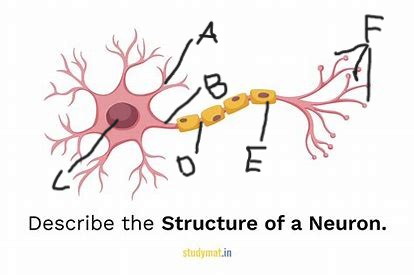
axon
what is structure B?
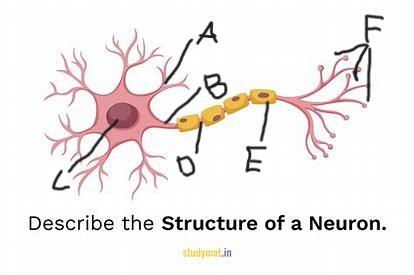
cell body
what is structure C?

node of ranvier
what is structure D?
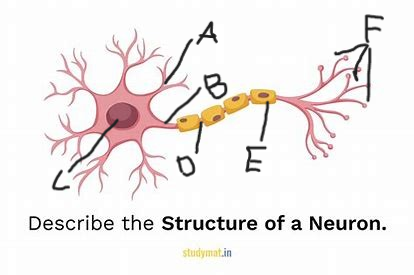
myelin sheath
what is structure E?
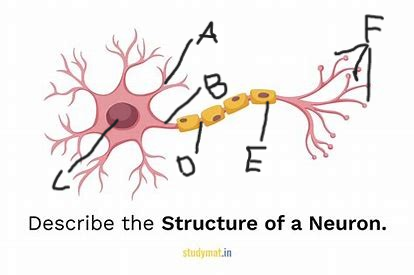
terminal branches
what is structure F?
excitatory signal/neurotransmitter
pushes neuron’s “accelorator”, makes a neuron more likely to reach action potential
inhibitory signal/neurotransmitter
pushes neuron’s “brakes”, makes a neuron less likely to reach action potential
synapse
the junction between the axon tip of the sending neuron and the dendrite or cell body of the receiving neuron
Acetylcholine (Ach)- NT
enables muscle movement and memory
enables muscle action, learning, and memory
undersupply → Alzheimer’s
dopamine- NT
when there is reward, motivation
movement, learning, attention, and emotion
oversupply → schizophrenia
undersupply → parkinsons
serotonin-NT
regulates mood, sleep and appetite
mood, hunger, sleep, and arousal
90% found in stomach
undersupply → depression
epinephrine-NT
energy and memory formation
fight or flight
in adrenal gland
norepinephrine-NT
alertness and arousal
releases glucose
undersupply → depressed mood
found in adrenal glands
GABA-NT
the main inhibitory neurotransmitter
major inhibitory neurotransmitter
calms the CNS
natural tranquilizer
undersupply→ seizures
Glutamate-NT
the main excitatery neurotransmitter. its important for learning and memory
major excitatory neurotransmitter
opposite of GABA
oversupply → migraines
Substance P-NT
carries pain messages
pain perception
oversupply→ chronic pain
depressants
drugs that reduce neural activity
alcohol, sedatives, benzodiazepines, opiates
barbituates
drugs that suppress the CNS; reduce anxiety and impair memory and judgement
opioids
depress neural activity, temporarily reducing pain and anxiety
stimulants
drugs that excite neural activity and speed up body functions
caffeine, nicotine, cocaine, amphetamines, methamphetamines
hallucinogens
drugs that distort perception and evoke sensory images w/o sensory input
LSD & marijuana
agonist
binds to receptor sites and mimics the effects of a specific neurotransmitter
antagonist
antagonist
reuptake inhibitors
block reabsorption of neurotransm leaving more neurtranmitters in the synpatic cleft. .
Hormones
are similar to neurotransmitters except they travel through the bloodstream
adrenline
triggers fight or flight by increasing heart rate and energy
leptin
signals safety and reduces appetite
Ghrelin
stimulate hunger
melatonin
regulates sleep-wake cycles
oxyton
promotes bonding, trust, and social connection