4 - Blood Chemistry
 Call Kai
 Learn
Learn Practice Test
 Spaced Repetition
 Match
Match Flashcards
 Knowt Play
1/116

Earn XP
Description and Tags
Proverbs 16:3
Name | Mastery | Learn | Test | Matching | Spaced | Call with Kai | Chat |
|---|
No analytics yet
Send a link to your students to track their progress
117 Terms
b. 7.35 – 7.45
Normal pH in Blood
a. 7.15 – 7.25
b. 7.35 – 7.45
c. 7.45 – 7.55
d. 7.00 – 7.10
Blood Urea Nitrogen (BUN)
[BLOOD CHEMISTRY]
This is increased in the blood through:
● Renal Dysfunction
● High Protein Intake
● Upper GI Bleeding
b. 8-18 mg/dL
[BLOOD CHEMISTRY]
Normal value for Blood Urea Nitrogen (BUN):
a. 5-15 mg/dL
b. 8-18 mg/dL
c. 10-20 mg/dL
d. 15-25 mg/dL
a. Blood Urea Nitrogen (BUN)
End product of protein metabolism
a. Blood Urea Nitrogen (BUN)
b. Creatinine
c. Uric Acid
d. Ammonia
a. Liver ; blood
Blood Urea Nitrogen (BUN) is produced in the ______ and transported in the _______
a. Liver ; blood
b. Kidney ; blood
c. Liver ; urine
d. Kidney ; urine
a. Glomerulus
Blood Urea Nitrogen (BUN) is renally excreted and freely filtered in the ________
a. Glomerulus
b. Proximal tubule
c. Loop of Henle
d. Distal tubule
Hepatic impairment
Protein malnutrition
Blood Urea Nitrogen (BUN) will DECREASE IN ________ [2]
a. Renal dysfunction
[BLOOD CHEMISTRY]
Cystatin C is increased in the blood through ______.
a. Renal dysfunction
b. Hepatic dysfunction
c. Cardiac dysfunction
d. Pulmonary dysfunction
b. 0.62-1.15 mg/L
[BLOOD CHEMISTRY]
Normal value for Cystatin C:
a. 0.50-1.00 mg/L
b. 0.62-1.15 mg/L
c. 0.70-1.20 mg/L
d. 0.80-1.30 mg/L
a. 0.6-1.2 mg/dL
[BLOOD CHEMISTRY]
Normal value of Creatinine
a. 0.6-1.2 mg/dL
b. 1.2-2.0 mg/dL
c. 0.3-0.6 mg/dL
d. 2.0-3.0 mg/dL
b. Creatinine
[BLOOD CHEMISTRY]
Product of muscle metabolism
a. Urea
b. Creatinine
c. Uric Acid
d. Bilirubin
a. Glomerulus
[BLOOD CHEMISTRY]
Creatinine is renally excreted and freely filtered in the ______
a. Glomerulus
b. Proximal tubule
c. Loop of Henle
d. Distal tubule
c. Renal impairment
[BLOOD CHEMISTRY]
Creatinine will increase in _____
a. Decreased muscle mass
b. Protein malnutrition
c. Renal impairment
d. Overhydration
c. Both a and b
Decreased muscle mass
Protein malnutrition
[BLOOD CHEMISTRY]
Creatinine will decrease in _________
a. Decreased muscle mass
b. Protein malnutrition
c. Both a and b
a. True
[BLOOD CHEMISTRY]
In renal dysfunction:
Creatinine increases in the blood
Creatinine Clearance decreases
Estimated Glomerular Filtration Rate (eGFR) decreases
a. True
b. False
a. Glomerular filtration rate
[BLOOD CHEMISTRY]
Creatinine Clearance is also known as:
a. Glomerular filtration rate
b. Tubular reabsorption rate
c. Renal plasma flow
d. Filtration fraction
a. Creatinine Clearance
[BLOOD CHEMISTRY]
Provides close approximate of how kidneys work
a. Creatinine Clearance
b. Blood Urea Nitrogen (BUN)
c. Serum Creatinine
d. Cystatin C
a. Creatinine Clearance
[BLOOD CHEMISTRY]
This is used for dose adjustment in renally impaired patients.
a. Creatinine Clearance
b. Blood Urea Nitrogen (BUN)
c. Serum Creatinine
d. Cystatin C
a. Cockroft-Gault Equation
[BLOOD CHEMISTRY]
Creatinine Clearance is computed using ________
a. Cockroft-Gault Equation
b. MDRD Equation
c. CKD-EPI Equation
d. Schwartz Equation
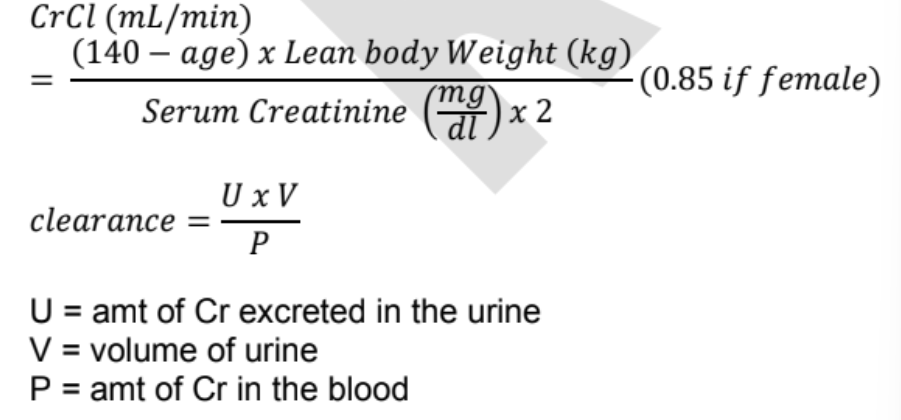
[BLOOD CHEMISTRY]
Cockroft-Gault Formula:
a. Renal dysfunction
[BLOOD CHEMISTRY]
↓ CrCl (Creatinine Clearance) + ↑ SCr (Serum Creatinine) → ______
a. Renal dysfunction
b. Hepatic dysfunction
c. Cardiac dysfunction
d. Pulmonary dysfunction
a. Creatinine kinase (CK)
[BLOOD CHEMISTRY]
________-
This catalyzes transfer of phosphate groups
This is primarily found in tissues that consume high ATP
This increases in biliary obstruction, Paget's disease, hyperparathyroidism, osteomalacia.
a. Creatinine kinase (CK)
b. Alkaline phosphatase (ALP)
c. Aspartate aminotransferase (AST)
d. Alanine aminotransferase (ALT)
Biliary obstruction
Paget's disease
Hyperparathyroidism
Osteomalacia
[BLOOD CHEMISTRY]
Creatinine kinase (CK) increases in ______ [4]
a. Creatinine kinase (CK)
[BLOOD CHEMISTRY]
This catalyzes transfer of phosphate groups.
a. Creatinine kinase (CK)
b. Alkaline phosphatase (ALP)
c. Aspartate aminotransferase (AST)
d. Alanine aminotransferase (ALT)
a. Creatinine kinase (CK)
[BLOOD CHEMISTRY]
This is primarily found in tissues that consume high ATP.
a. Creatinine kinase (CK)
b. Alkaline phosphatase (ALP)
c. Aspartate aminotransferase (AST)
d. Alanine aminotransferase (ALT)
a. Creatinine kinase (CK)
[BLOOD CHEMISTRY]
This enzyme is increased in biliary obstruction, Paget's disease, hyperparathyroidism, and osteomalacia.
a. Creatinine kinase (CK)
b. Alkaline phosphatase (ALP)
c. Aspartate aminotransferase (AST)
d. Alanine aminotransferase (ALT)
a. 40-150 U/L
[BLOOD CHEMISTRY]
Normal value for Creatinine Kinase in females
a. 40-150 U/L
b. 60-400 U/L
c. 30-120 U/L
d. 50-200 U/L
b. 60-400 U/L
[BLOOD CHEMISTRY]
Normal value for Creatinine Kinase in males
a. 40-150 U/L
b. 60-400 U/L
c. 30-120 U/L
d. 50-200 U/L
a. CK-BB (CK1)
[BLOOD CHEMISTRY]
CK Isoenzyme found in:
Brain
Bladder
a. CK-BB (CK1)
b. CK-MB (CK2)
c. CK-MM (CK3)
b. CK-MB (CK2)
[BLOOD CHEMISTRY]
CK Isoenzyme found in Cardiac muscles
a. CK-BB (CK1)
b. CK-MB (CK2)
c. CK-MM (CK3)
c. CK-MM (CK3)
[BLOOD CHEMISTRY]
CK Isoenzyme found in Skeletal Muscle
a. CK-BB (CK1)
b. CK-MB (CK2)
c. CK-MM (CK3)
a. CK-BB (CK1)
[BLOOD CHEMISTRY]
CK Isoenzyme for CEREBROVASCULAR ACCIDENTS
a. CK-BB (CK1)
b. CK-MB (CK2)
c. CK-MM (CK3)
CK-BB (CK1)
[BLOOD CHEMISTRY]
CK Isoenzyme for STROKE
a. CK-BB (CK1)
b. CK-MB (CK2)
c. CK-MM (CK3)
CK-MB (CK2)
[BLOOD CHEMISTRY]
CK Isoenzyme for MYOCARDIAL INFARCTION
a. CK-BB (CK1)
b. CK-MB (CK2)
c. CK-MM (CK3)
c. CK-MM (CK3)
[BLOOD CHEMISTRY]
CK Isoenzyme for RHABDOMYOLYSIS
a. CK-BB (CK1)
b. CK-MB (CK2)
c. CK-MM (CK3)
a. Rhabdomyolysis
[BLOOD CHEMISTRY]
Side Effect of Statins
a. Rhabdomyolysis
b. Myopathy
c. Hepatotoxicity
d. Nephrotoxicity
a. Lactate dehydrogenase (LDH)
[BLOOD CHEMISTRY]
______-
This is rarely measured because of the lack of tissue specificity
This is often elevated in damages to the liver, skeletal muscle and kidneys, megaloblastic and immune hemolytic anemias, and in intravascular hemolysis as seen in thrombic thrombocytopenic purpura and paroxysmal nocturnal hemoglobinuria
a. Lactate dehydrogenase (LDH)
b. Creatinine kinase (CK)
c. Aspartate aminotransferase (AST)
d. Alanine aminotransferase (ALT)
a. Lactate dehydrogenase (LDH)
[BLOOD CHEMISTRY]
This is rarely measured because of the lack of tissue specificity.
a. Lactate dehydrogenase (LDH)
b. Creatinine kinase (CK)
c. Aspartate aminotransferase (AST)
d. Alanine aminotransferase (ALT)
a. Lactate dehydrogenase (LDH)
[BLOOD CHEMISTRY]
This is often elevated in damages to the liver, skeletal muscle and kidneys, megaloblastic and immune hemolytic anemias, and in intravascular hemolysis.
a. Lactate dehydrogenase (LDH)
b. Creatinine kinase (CK)
c. Aspartate aminotransferase (AST)
d. Alanine aminotransferase (ALT)
● Liver
● Skeletal Muscle
● Kidneys
● Megaloblastic Anemia
● Immune Hemolytic Anemia
● Intravascular Hemolysis
[BLOOD CHEMISTRY]
Lactate dehydrogenase is often elevated in damages to the _____ [6]
a. True
[BLOOD CHEMISTRY]
Lactate dehydrogenase (LDH) is an intracellular enzyme
a. True
b. False
a. Lactate dehydrogenase (LDH)
[BLOOD CHEMISTRY]
This is used in the diagnosis of MI, hepatic disease, and lung disease
a. Lactate dehydrogenase (LDH)
b. Creatinine kinase (CK)
c. Aspartate aminotransferase (AST)
d. Alanine aminotransferase (ALT)
b. 90-100 U/L
[BLOOD CHEMISTRY]
Normal value for lactate dehydrogenase:
a. 80-100 U/L
b. 90-100 U/L
c. 100-120 U/L
d. 90-110 U/L
a. Heart
LDH 1 and 2 are found in the
a. Heart
b. Lungs
c. Liver
d. Skeletal muscles
b. Lungs
LDH 3 is found in the
a. Heart
b. Lungs
c. Liver
d. Skeletal muscles
c. Liver and skeletal muscles
LDH 4 and 5 are found in the
a. Heart
b. Lungs
c. Liver and skeletal muscles
d. Brain
a. MI
[BLOOD CHEMISTRY]
High LDH1 and LDH2 is associated with
a. MI
b. Acute Leukemia
c. Malignancies
d. Damage to liver or skeletal muscle
b. Acute Leukemia
[BLOOD CHEMISTRY]
High LDH2 and LDH3 is associated with
a. MI
b. Acute Leukemia
c. Malignancies
d. Damage to liver or skeletal muscle
c. Malignancies
[BLOOD CHEMISTRY]
High LDH3 is associated with
a. MI
b. Acute Leukemia
c. Malignancies
d. Damage to liver or skeletal muscle
d. Damage to liver or skeletal muscle
[BLOOD CHEMISTRY]
High LDH5 is associated with
a. MI
b. Acute Leukemia
c. Malignancies
d. Damage to liver or skeletal muscle
a. Troponin I and T
[BLOOD CHEMISTRY]
______-
These are regulatory proteins that control the calcium-mediated interaction between actin and myosin in cardiac muscle
This is comparable in diagnostic and prognostic efficacy and the local decision may be a balance between cost and specific assay performance
a. Troponin I and T
b. Creatinine kinase (CK)
c. Lactate dehydrogenase (LDH)
d. Aspartate aminotransferase (AST)
a. Troponin I and T
[BLOOD CHEMISTRY]
This is comparable in diagnostic and prognostic efficacy and the local decision may be a balance between cost and specific assay performance
a. Troponin I and T
b. Creatinine kinase (CK)
c. Lactate dehydrogenase (LDH)
d. Aspartate aminotransferase (AST)
a. Troponin I and T
[BLOOD CHEMISTRY]
These offer extremely high cardiac tissue specificity and clinical sensitivity for myocardial necrosis.
a. Troponin I and T
b. Creatinine kinase (CK)
c. Lactate dehydrogenase (LDH)
d. Aspartate aminotransferase (AST)
a. Troponin I and T
[BLOOD CHEMISTRY]
This is the gold standard for myocardial infarction.
a. Troponin I and T
b. Creatinine kinase (CK)
c. Lactate dehydrogenase (LDH)
d. Aspartate aminotransferase (AST)
● Aspartate Transferase (AST)
● Alanine Transferase (ALT)
[BLOOD CHEMISTRY]
________ [2]
These enzymes are raised in all forms of viral/ non-viral, acute/ chronic liver disease; acute viral, drug-induced, alcohol related and ischemic liver damage; non-alcoholic fatty liver disease.
● Viral / Non-viral Liver Disease
● Acute / Chronic Liver Disease
● Acute Viral Liver Disease
● Drug-Induced Liver Damage
● Alcohol-Related Liver Damage
● Ischemic Liver Damage
● Non-alcoholic fatty liver disease
[BLOOD CHEMISTRY]
Aspartate transferase (AST) and Alanine Transferase (ALT) are raised in all forms of ____ [7]
● Aspartate transferase (AST)
● Alanine Transferase (ALT)
[BLOOD CHEMISTRY]
These enzymes are found in hepatitis [2]
a. Bilirubin
[BLOOD CHEMISTRY]
_______-
This is a breakdown product of hemoglobin
This is transported bound to albumin and conjugated in the liver
Levels above 50 µmol/L may indicate “jaundice."
a. Bilirubin
b. Creatinine
c. Uric Acid
d. Ammonia
a. Bilirubin
[BLOOD CHEMISTRY]
This is a breakdown product of hemoglobin
a. Bilirubin
b. Creatinine
c. Uric Acid
d. Ammonia
a. True
[BLOOD CHEMISTRY]
Bilirubin is transported bound to albumin and conjugated in the liver.
a. True
b. False
c. 50 µmol/L
[BLOOD CHEMISTRY]
Levels of bilirubin above ____ µmol/L may indicate jaundice.
a. 30 µmol/L
b. 40 µmol/L
c. 50 µmol/L
d. 60 µmol/L
Haemolysis
Ineffective erythropoiesis
[BLOOD CHEMISTRY]
Increased production of bilirubin is caused by _____
a. Haemolysis and ineffective erythropoiesis
b. Impaired transport into hepatocytes
c. Decreased excretion
d. Cirrhosis
a. Rifampicin
[BLOOD CHEMISTRY]
Bilirubin uptake inhibitors include
a. Rifampicin
b. Methyltestosterone
c. Penicillin
d. Aspirin
a. Rifampicin or as a result of hepatitis
[BLOOD CHEMISTRY]
Impaired transport of bilirubin into hepatocytes may be caused by:
a. Rifampicin or as a result of hepatitis
b. Haemolysis
c. Ineffective erythropoiesis
d. Tumours
a. Rifampicin and methyltestosterone
[BLOOD CHEMISTRY]
Decreased excretion of bilirubin is caused by drugs such as ______
a. Rifampicin and methyltestosterone
b. Penicillin and amoxicillin
c. Aspirin and ibuprofen
d. Metformin and glipizide
a. Decreased excretion of bilirubin
[BLOOD CHEMISTRY]
Intrahepatic obstruction caused by cirrhosis and tumours leads to
a. Decreased excretion of bilirubin
b. Increased production of bilirubin
c. Impaired transport into hepatocytes
d. Unconjugated bilirubinemia
a. Unconjugated bilirubinemia
[BLOOD CHEMISTRY]
The condition caused by increased unconjugated bilirubin
a. Unconjugated bilirubinemia
b. Jaundice
c. Haemolysis
d. Cirrhosis
a. Bilirubinemia
[BLOOD CHEMISTRY]
The condition caused by increased conjugated bilirubin
a. Bilirubinemia
b. Unconjugated bilirubinemia
c. Jaundice
d. Haemolysis
a. Alkaline phosphatase (ALP)
[BLOOD CHEMISTRY]
______-
This is an enzyme found in the bile ducts, bone, placenta, and kidneys
This is used to assess conditions such as biliary obstruction (e.g., gallstones), vitamin D deficiency, and bone disorders like Paget's disease."
a. Alkaline phosphatase (ALP)
b. Aspartate aminotransferase (AST)
c. Alanine aminotransferase (ALT)
d. Gamma-glutamyl transferase (GGT)
Biliary obstruction (e.g., gallstones)
Vitamin D deficiency
Bone disorders like Paget's disease."
[BLOOD CHEMISTRY]
Alkaline phosphatase (ALP) is used to assess conditions such as ______ [3]
a. Acid Phosphatase (ACP)
[BLOOD CHEMISTRY]
This enzyme is used in forensic medicine as a presumptive test for the presence of semen.
a. Acid Phosphatase (ACP)
b. Alkaline Phosphatase (ALP)
c. Creatinine Kinase (CK)
d. Lactate Dehydrogenase (LDH)
a. Prostate-specific antigen (PSA)
[BLOOD CHEMISTRY]
______-
This is a protein secreted by the prostate gland into seminal fluid
Elevated levels may be seen in benign prostatic hyperplasia (BPH), prostatitis, and prostate cancer.
a. Prostate-specific antigen (PSA)
b. Acid phosphatase (ACP)
c. Alkaline phosphatase (ALP)
d. Creatinine kinase (CK)
Benign prostatic hyperplasia (BPH)
Prostatitis
Prostate cancer
[BLOOD CHEMISTRY]
Prostate-specific antigen (PSA) elevated levels may be seen in _______ [3]
a. Acid Phosphatase (ACP)
[BLOOD CHEMISTRY]
This enzyme is commonly involved in investigating sexual assault or rape.
a. Acid Phosphatase (ACP)
b. Alkaline Phosphatase (ALP)
c. Creatinine Kinase (CK)
d. Lactate Dehydrogenase (LDH)
● Amylase
● Lipase
[BLOOD CHEMISTRY]
Pancreatic enzymes synthesized primarily in the pancreas and salivary glands
a. Amylase and Lipase
b. Trypsin and Chymotrypsin
c. Pepsin and Renin
d. Lactase and Sucrase
serum amylase
urine amylase
[BLOOD CHEMISTRY]
Amylase can be measured in _____ [2]
a. Amylase
[BLOOD CHEMISTRY]
This is the most important test in cases of suspected acute pancreatic disease.
a. Amylase
b. Lipase
c. Bilirubin
d. Creatinine
a. Acute pancreatic disease
[BLOOD CHEMISTRY]
Amylase is the most important test in cases of suspected _______.
a. Acute pancreatic disease
b. Liver disease
c. Renal disease
d. Cardiac disease
a. Lipase
[BLOOD CHEMISTRY]
This enzyme may be released in blood in large amounts due to the destruction of pancreatic cells.
a. Lipase
b. Amylase
c. Trypsin
d. Chymotrypsin
a. Albumin
______-
This is a protein produced in the liver
This is used to assess liver and kidney health.
a. Albumin
b. Globulin
c. Fibrinogen
d. Hemoglobin
a. Hypoalbuminemia
[BLOOD CHEMISTRY]
This is caused by liver disease, malnutrition, or protein-wasting nephropathy, and may result in edema and ascites
a. Hypoalbuminemia
b. Hyperalbuminemia
c. Hypoproteinemia
d. Hyperproteinemia
Liver disease
Malnutrition
Protein-wasting nephropathy
[BLOOD CHEMISTRY]
Hypoalbuminemia can be cause by ____ [3] and may result in edema and ascites
Edema
Ascites
[BLOOD CHEMISTRY]
Hypoalbuminemia can be caused by liver disease, malnutrition, or protein-wasting nephropathy, and may result in______ [2]
b. Ascites
[BLOOD CHEMISTRY]
Excess fluids in the peritoneal cavity
a. Edema
b. Ascites
c. Effusion
d. Anasarca
b. Spironolactone, paracentesis
[BLOOD CHEMISTRY]
Treatment for Ascites
a. Furosemide, thoracentesis
b. Spironolactone, paracentesis
c. Mannitol, dialysis
d. Hydrochlorothiazide, paracentesis
b. Hyperalbuminemia
[BLOOD CHEMISTRY]
This can be caused by liver disease, hemolysis, kernicterus
a. Hypoalbuminemia
b. Hyperalbuminemia
c. Hypoproteinemia
d. Hyperproteinemia
● Liver Disease
● Hemolysis
● Kernicterus
[BLOOD CHEMISTRY]
Hyperalbuminemia can be caused by ____ [3]
a. Dose adjustments should be considered
[BLOOD CHEMISTRY]
Important consideration in therapeutic monitoring of drugs and electrolytes that are protein bound
a. Dose adjustments should be considered
b. No dose adjustments needed
c. Drug levels are not affected
d. Electrolytes are not affected
c. 8-12 hours
[BLOOD CHEMISTRY]
Fasting blood sugar (FBS) (<100 mg/dL) is measured after _____ hours of fasting to assess blood glucose levels and aid in the diagnosis of diabetes or prediabetes.
a. 4-6 hours
b. 6-8 hours
c. 8-12 hours
d. 12-14 hours
a. <100 mg/dL
[BLOOD CHEMISTRY]
Normal value for Fasting blood sugar (FBS):
a. <100 mg/dL
b. <120 mg/dL
c. <140 mg/dL
d. <160 mg/dL
a. Glycated Hemoglobin
[BLOOD CHEMISTRY]
HbA1C is also known as _______.
a. Glycated Hemoglobin
b. Glycosylated Hemoglobin
c. Hemoglobin A
d. Hemoglobin F
b. 2-3 months
[BLOOD CHEMISTRY]
Hemoglobin A1C (HbA1C) (<5.7%) reflects average blood glucose over the past ______ months and is used for the diagnosis and monitoring of diabetes
a. 1-2 months
b. 2-3 months
c. 3-4 months
d. 4-5 months
a. <5.7%
[BLOOD CHEMISTRY]
Normal value for Hemoglobin A1C (HbA1C)
a. <5.7%
b. <6.0%
c. <6.5%
d. <7.0%
b. <200 mg/dL
[BLOOD CHEMISTRY]
Normal value for Total Cholesterol:
a. <150 mg/dL
b. <200 mg/dL
c. <130 mg/dL
c. <130 mg/dL
[BLOOD CHEMISTRY]
Normal value for Low-Density Lipoprotein (LDL):
a. <150 mg/dL
b. <200 mg/dL
c. <130 mg/dL
a. Statins
[BLOOD CHEMISTRY]
These are commonly used to lower elevated levels of total cholesterol and low-density lipoprotein (LDL).
a. Statins
b. Fibrates
c. Bile acid sequestrants
d. Niacin
● Male: >40mg/dL
● Female: >50 mg/dL
[BLOOD CHEMISTRY]
Normal value for High-Density Lipoprotein (HDL):
a. <150 mg/dL
b. <200 mg/dL
c. <130 mg/dL
d. >40 mg/dL (M) and >50 mg/dL (F)
Niacin
Fibrates
[BLOOD CHEMISTRY]
______ [2]
These are commonly used to raise High-Density Lipoprotein (HDL).
a. Niacin and Fibrates
b. Statins and Bile acid sequestrants
c. Ezetimibe and PCSK9 inhibitors
d. Metformin and Sulfonylureas
a. <150 mg/dL
[BLOOD CHEMISTRY]
Normal value for Triglycerides:
a. <150 mg/dL
b. <200 mg/dL
c. <130 mg/dL
d. >40 mg/dL (M) and >50 mg/dL (F)
● Statins
● Fibrates
● Niacin
[BLOOD CHEMISTRY]
These are commonly used to reduce elevated levels of triglycerides.
a. Statins, Fibrates, and Niacin
b. Statins and Fibrates only
c. Fibrates and Niacin only
d. Statins and Niacin only