Brain Structures, planes and mechanisms
 Call Kai
 Learn
Learn Practice Test
 Spaced Repetition
 Match
Match Flashcards
 Knowt Play
1/51

There's no tags or description
Looks like no tags are added yet.
Name | Mastery | Learn | Test | Matching | Spaced | Call with Kai | Chat |
|---|
No analytics yet
Send a link to your students to track their progress
52 Terms
CNS and what it consists of
Central Nervous System: primary processing center of the body that controls all conscious and unconscious actions, thoughts, and bodily functions.
Cerebral Hemisphere
Brainstem
Cerebellum
Spinal Cord
PNS and what it consists of
Nerves:
Cranial
Spinal
Ganglia (nerve clusters)
What is encased in bone, CNS or PNS
CNS
Anatomical Planes: Anterior
Front
Anatomical Planes: Posterior
Back
Anatomical Planes: Superior
Above (up)
Anatomical Planes: Inferior
Below (down)
Anatomical Planes: Medial
Toward midline (middle)
Anatomical Planes: Lateral
Away from midline (away from middle)
Anatomical Planes: Dorsal
The back of the body and top of the head
Anatomical Planes: Ventral
Bottom surface (Belly) of the brain
Anatomical Planes: Rostral
Upper front of brain (where beak/nose would be)
Anatomical Planes: Caudal
Tail-end of brain (brainstem/spinal cord)
Sagittal (or median) plane
Divides left/right hemispheres
Transverse or horizontal plane
Divides top/bottom of the brain
Coronal or frontal plane
Divides front and back of brain
Ipsilateral
(same side of body)
Contralateral
opposite side - contradictory of body
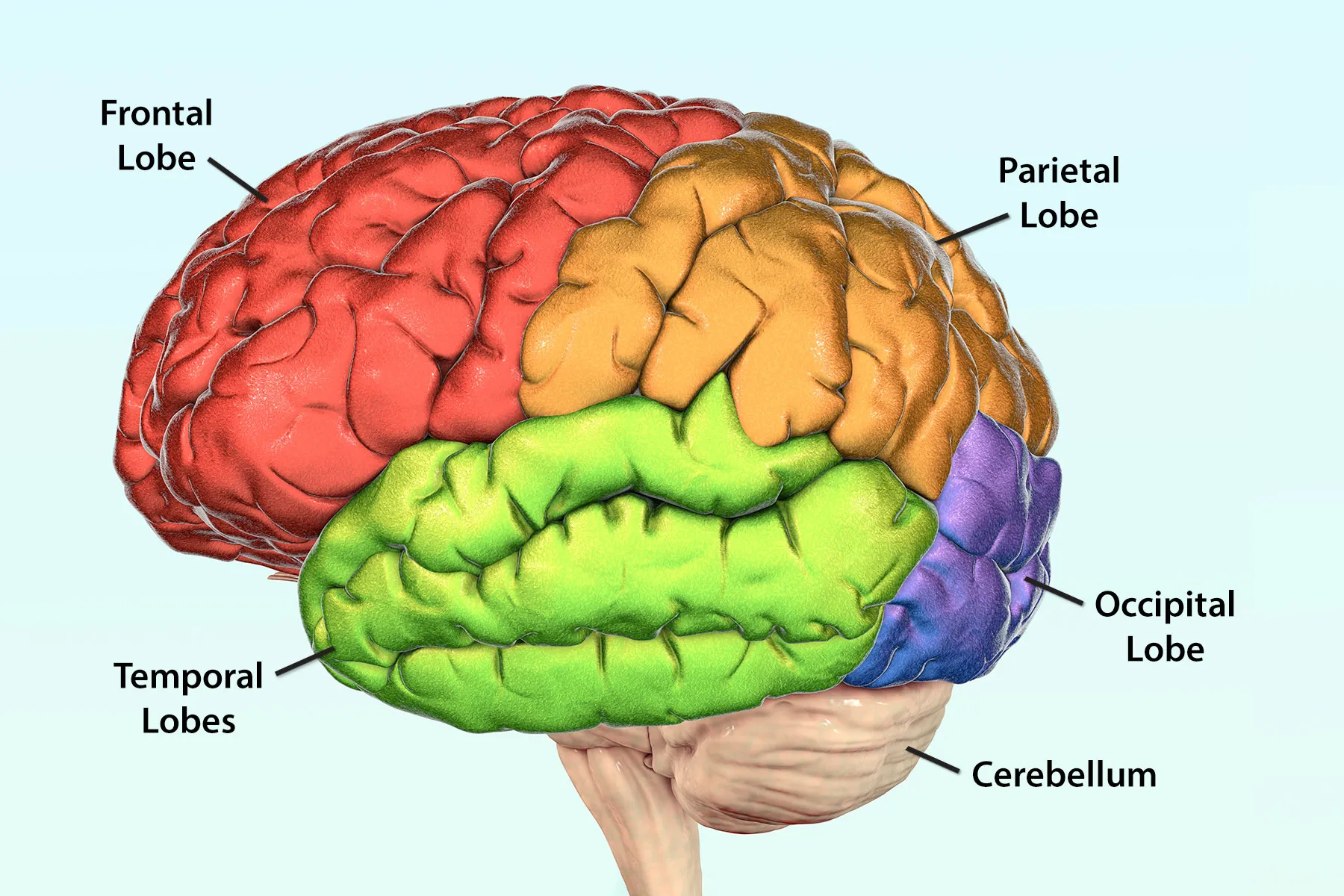
Frontal Lobe
speech and decision-making (planning, emotion, cognitive function)
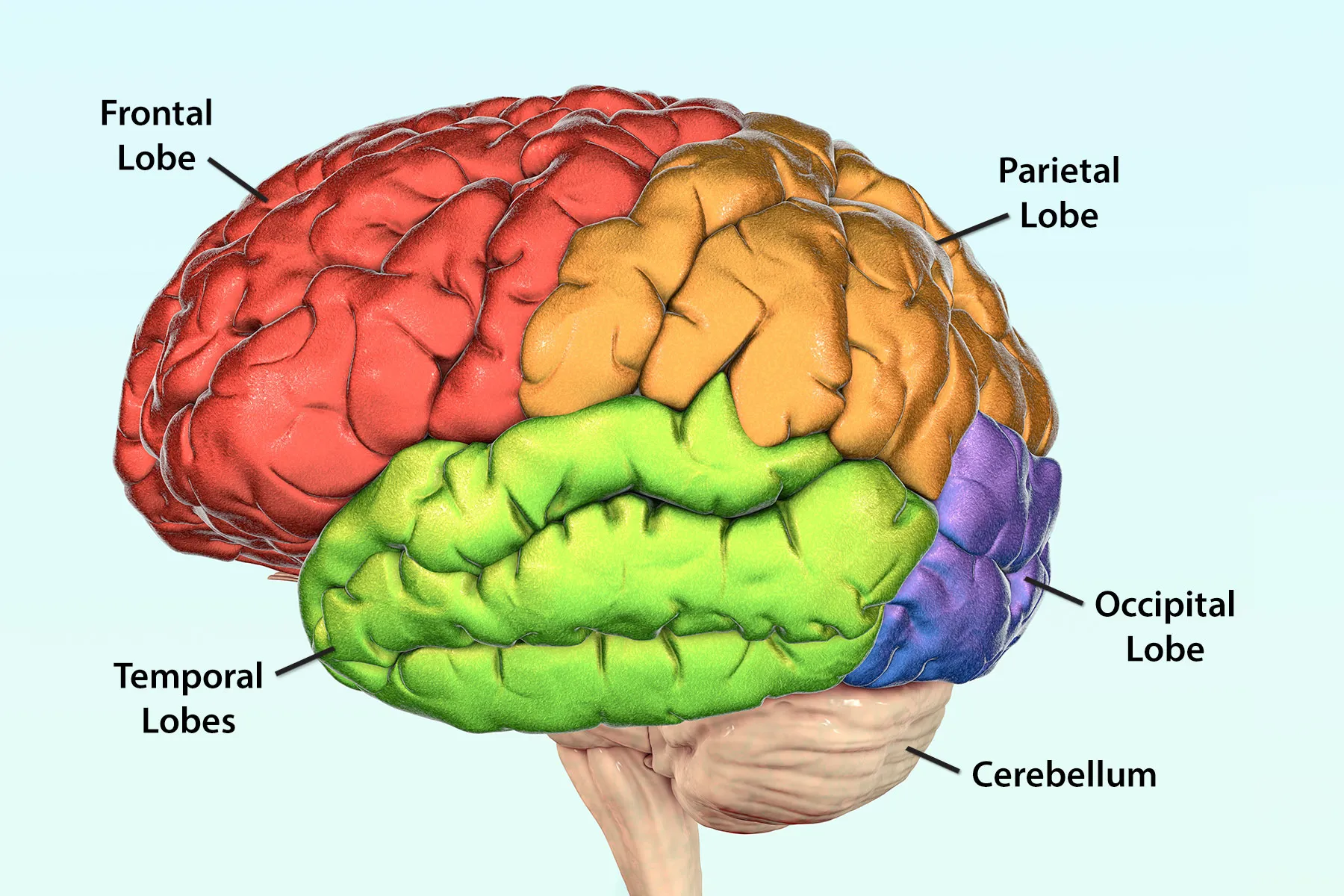
Parietal Lobe
Speech and sensory integration →
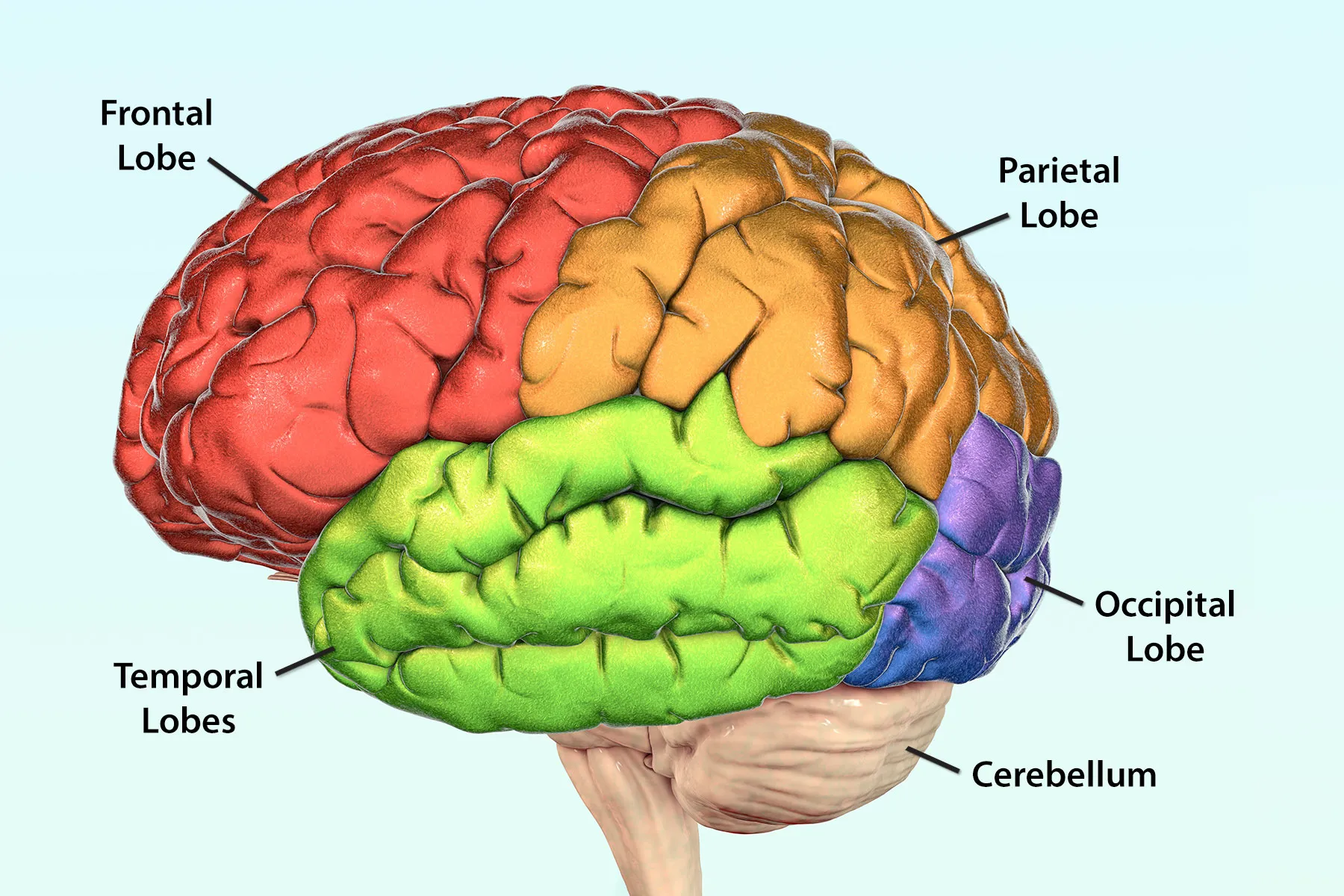
Temporal Lobe
Hearing
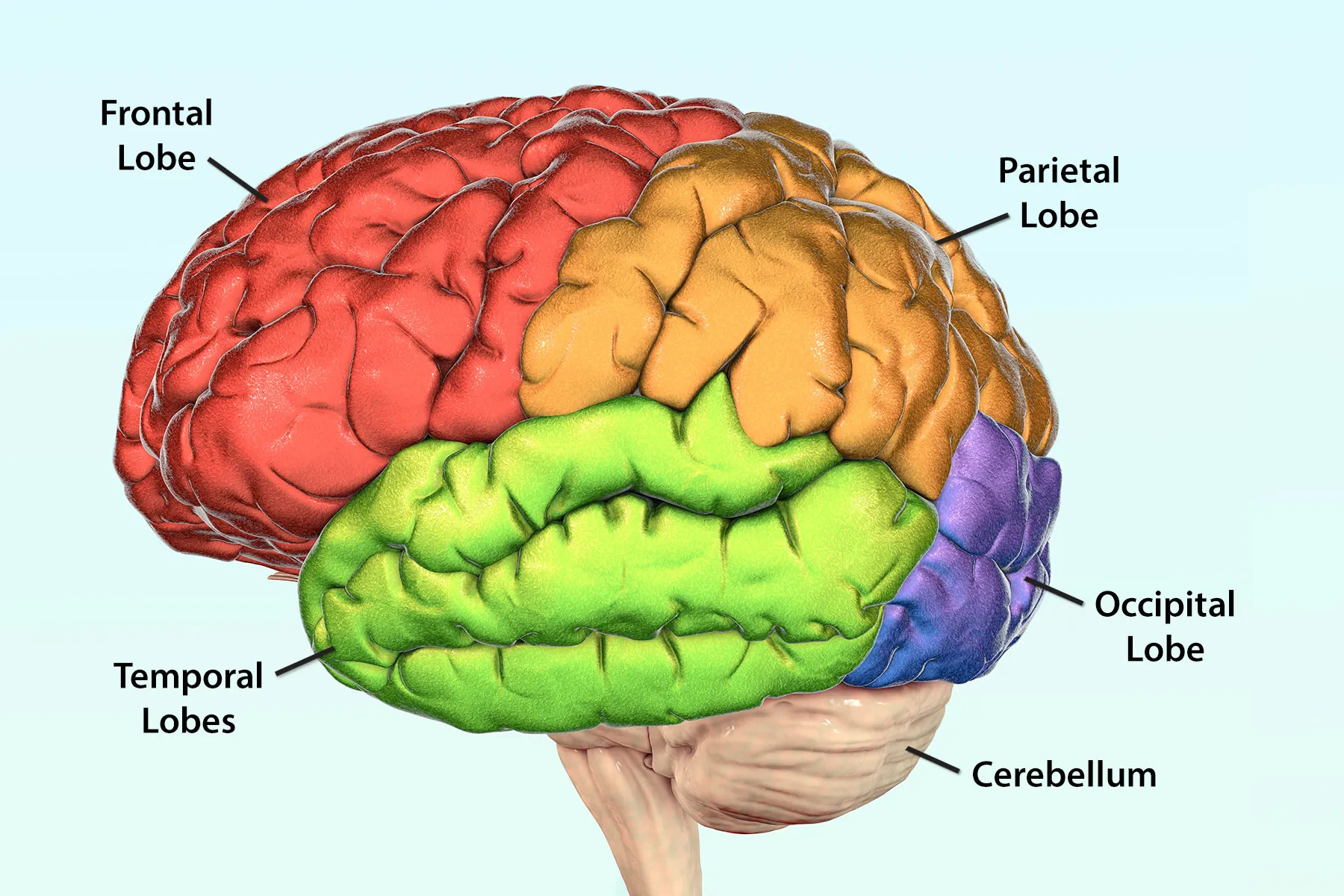
Occipital Lobe
Vision
Insula
Considered the 5th lobe! (also called insular cortex)
Located beneath the Sylvian fissure
Processes visceral emotions
Involved in consciousness (including some speech)
Some homeostasis
Some motor control (some swallowing)
Body awareness & ownership (sense of self) - somatoparaphrenia
Gyri and Sulci
Hills (gyri) and valleys (sulci)
More wrinkles → more surface area → more grey matter
Sylvian Fissure (Lateral sulcus)
separates temporal from frontal and anterior parietal lobes
Central Sulcus
separates frontal + parietal lobe (one continuous sulcus)
Longitudinal Fissure
deep groove separating the brain’s left and right cerebral hemispheres.
Transverse Fissure
Separates the cerebrum from the cerebellum
White Matter
myelinted neuronal axons (a neuron’s wire that carries electrical signal away from the cell body)
Grey matter
cell bodies (main part of neuron containing the nucleus)
Tract
Many axons traveling together in the CNS
One major tract is the ____ (+ describe it)
corpus callosum - a huge bundle of myelinated axons (white matter) connecting the left and right cerebral hemispheres. (info from one hemisphere goes to other)
Corpus - body
Callosum - tough, like callous
Functional Mapping
Grey matter cells organized in relation to function of region (different locations are arranged according to what the process or control
Example of Somatotopic functional mapping
body parts organized spatially in the brain:
Precentral Gyrus or “Motor Strip” within Frontal Lobe
Motor strip
Example of Tonotopic functional mapping
Auditory cortex (organ of corti)
Retinotopic
Visual cortex
Nerves
long neuronal axons that travel together
Like a tract, BUT it’s in the PNS
i.e., cranial and spinal nerves
Ganglion
a cluster of nerve cells (which would be in PNS)
Afferent Nerves
Info coming from outside to the brain
Efferent Nerves
Information coming from the brain to the effectors
Dorsal root ganglia
afferent sensory nerves
Spiral ganglion in auditory nerve
first neurons to fire an action potential
Lateralization/Specialization
Specialization = different brain areas have specialized functions.
Lateralization = a function is primarily associated with one cerebral hemisphere.
Speech/language → usually left hemisphere.
Motor control is contralateral → left brain controls right side of body and vice versa.
Frontal Lobe Subdivisions (5)
Broca’s area: speech/language PRODUCTION (coordination of tongue and other parts of the vocal apparatus)
Prefrontal Cortex: executive functioning
Premotor cortex: could be direct control/motor planning
Primary motor: main area to generate motor impulses
Supplementary motor area: sequencing and planning, connected to basal ganglia
Primary Motor Cortex
@ precentral gyrus
Filled with motor neurons that extend to brain stem & spinal cord for muscle contractions
Timing, strength, speed on contractions
Somatotopic organization
Ventral portion important for speech control
Parietal Lobe
Somatosensory cortex = touch, temperature, vibration, proprioception;
posterior parietal = sensory association/integration
Angular gyrus – high-level language (metaphor), math, memory, spatial cognition, written language
Supramarginal gyrus – Relating speech to words, actions, somatosensation, motor planning (possibly integrating feedback)
Temporal Lobe
Primary auditory cortex/Heschl's gyrus = basic auditory processing; superior temporal gyrus = higher-level auditory/speech perception; Wernicke's area = language comprehension Planum temporale – Lateralized, speech perception (L), music perception (R), central Wernicke’s, less asymmetric in dyslexics Middle temporal gyrus – Name of objects & actions |
Broca’s area
speech and gesture production (In/between/below prefrontal and premotor (though often considered premotor)
Inferior , posterior portion of frontal lobe
Lateral surface of left hemisphere (usually)
Speech expression
Speech comprehension (esp. complex sentences)
Production and processing of speech-like gestures
Damage of Broca’s area leads to:
Stuttering – subactive Broca’s
Broca’s/expressive aphasia
Arcurate Fasciculus
(Curved bundle) TRACT (bundle of axons) b/w Broca’s and Wernicke’s, damage leaves typical B. and W. function, but impairs mimicry
Wernicke’s Aphasia and Where it is
Posterior superior portion if temporal lobe (back towards top)
Lateral surface (usually left) of cerebellum
Speech recognition
Damage of Wernicke’s
words sound fluent and has syntax, but makes no sense: Fluent/Wernicke’s aphasia
Hard time understanding speech/language