Exam 3
0.0(0)
Studied by 1 person Call Kai
 Learn
Learn Practice Test
 Spaced Repetition
 Match
Match Flashcards
 Knowt Play
Card Sorting
1/126

Earn XP
Description and Tags
Last updated 3:51 PM on 4/6/23
Name | Mastery | Learn | Test | Matching | Spaced | Call with Kai | Chat |
|---|
No analytics yet
Send a link to your students to track their progress
127 Terms
1
New cards
Coupled transcription and translation
Ribosomes bind mRNA while mRNA is still being created, so that translation begins while transcription is still occurring
- Advantage of lacking a nucleus
- Advantage of lacking a nucleus
2
New cards
Translation initiation
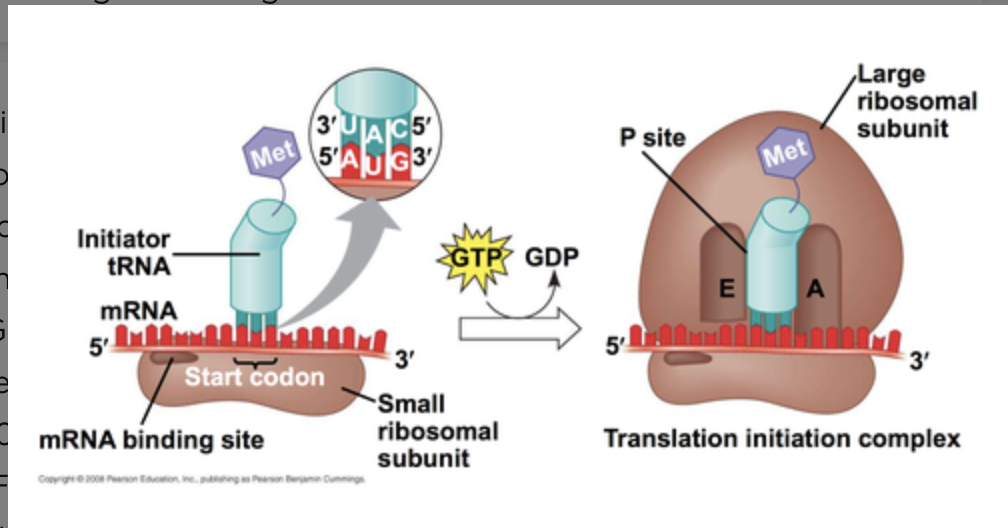
- Initiation factors bind ribosome to the ribosome binding site known as the Shine Delgarno sequence (AGGAGG)
- Begins at start codon
1. 30s subunit binds mRNA
2. IF2 interacts with initiator tRNA
3. fMet-tRNA binds to start codon
4. Association of initiator tRNA with 30s mRNA releases IF3 and allows IF1 to bind
5. 50s subunit binds to 30s complex and GTP hydrolysis occurs
- Begins at start codon
1. 30s subunit binds mRNA
2. IF2 interacts with initiator tRNA
3. fMet-tRNA binds to start codon
4. Association of initiator tRNA with 30s mRNA releases IF3 and allows IF1 to bind
5. 50s subunit binds to 30s complex and GTP hydrolysis occurs
3
New cards
Translation elongation
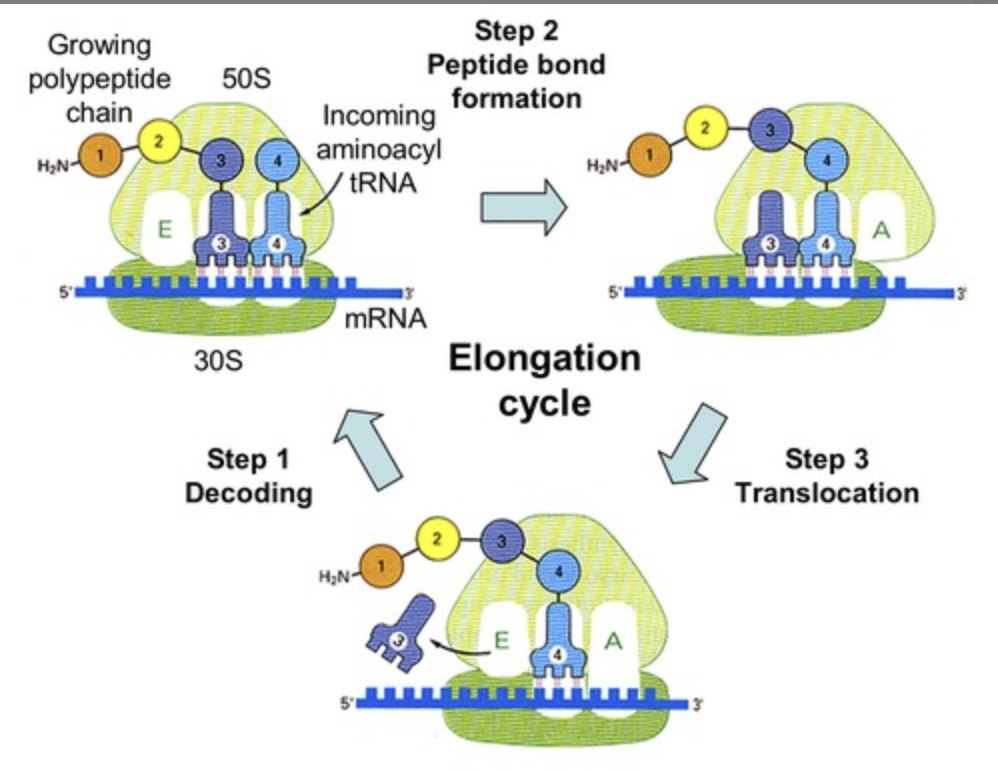
- A site: charged tRNA entry site
- P site: peptidyl site
- E site: uncharged tRNA exit site
- tRNA binds at A site and peptide bond between amino acid in P and A site
- P site: peptidyl site
- E site: uncharged tRNA exit site
- tRNA binds at A site and peptide bond between amino acid in P and A site
4
New cards
Translation termination
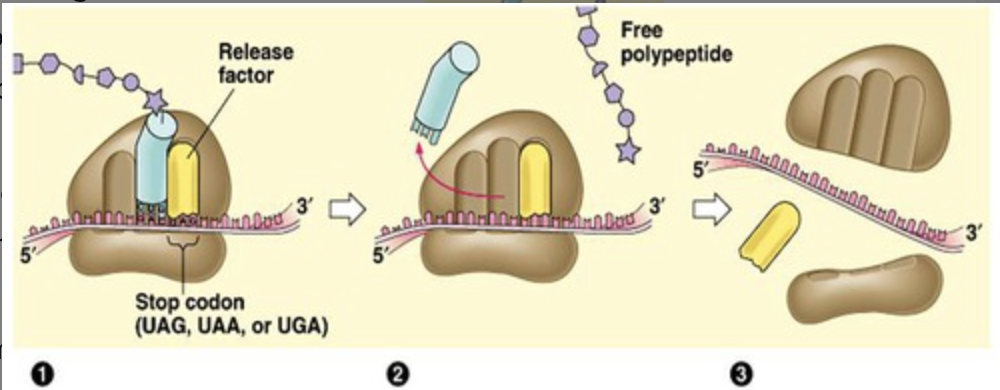
- Uncharged tRNA leaves ribosome
- Stop codon enters the A site and protein release factor enters site
- Binding of release factor releases completed protein from tRNA in P site and causes complex to dissociate
- Stop codon enters the A site and protein release factor enters site
- Binding of release factor releases completed protein from tRNA in P site and causes complex to dissociate
5
New cards
Protein folding
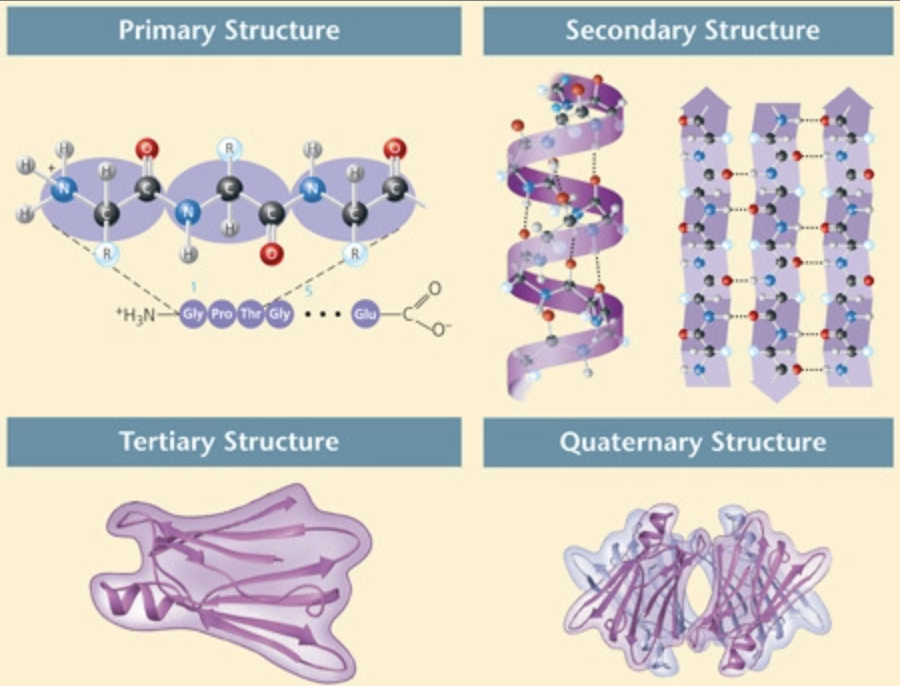
- Primary structure: sequence of amino acids as dictated by gene; ribosome generates primary structure
- Secondary structure: coils and folds in the polypeptide chain; hydrogen bonding of the polypeptide backbone between amine groups
- Tertiary structure: determined by interactions among various side chains (R groups); 3D shape due to R group interactions
- Quaternary structure: results when a protein consists of multiple polypeptide chains
- Secondary structure: coils and folds in the polypeptide chain; hydrogen bonding of the polypeptide backbone between amine groups
- Tertiary structure: determined by interactions among various side chains (R groups); 3D shape due to R group interactions
- Quaternary structure: results when a protein consists of multiple polypeptide chains
6
New cards
Operon
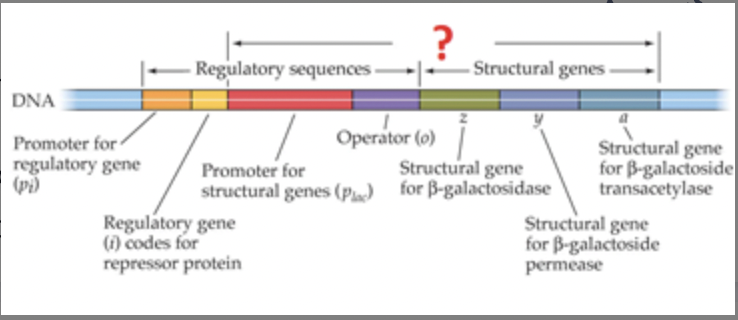
Unit of genetic material that functions in a coordinator manner by means of an operator, promoter, and one or more structural genes
7
New cards
Promoter
Specific region of a gene that binds RNA polymerase and indicates where to start transcribing RNA
8
New cards
Regulon
System of genes, formed by one or more operons, that have a common regulatory element
9
New cards
Reasons why cells do not express every gene at maximum level functioning
- Physical space limitations
- Energy and resource conservation
- Contradicting functions
- Energy and resource conservation
- Contradicting functions
10
New cards
Constitutive proteins
Proteins made all the time at a constant rate and are needed at the same level all the time
11
New cards
Post-transcriptional regulation
Control of activity of preexisting enzymes; protein is modified to change its activity
12
New cards
Homodimeric
Protein composed of two identical polypeptides
13
New cards
Negative regulator/repressor
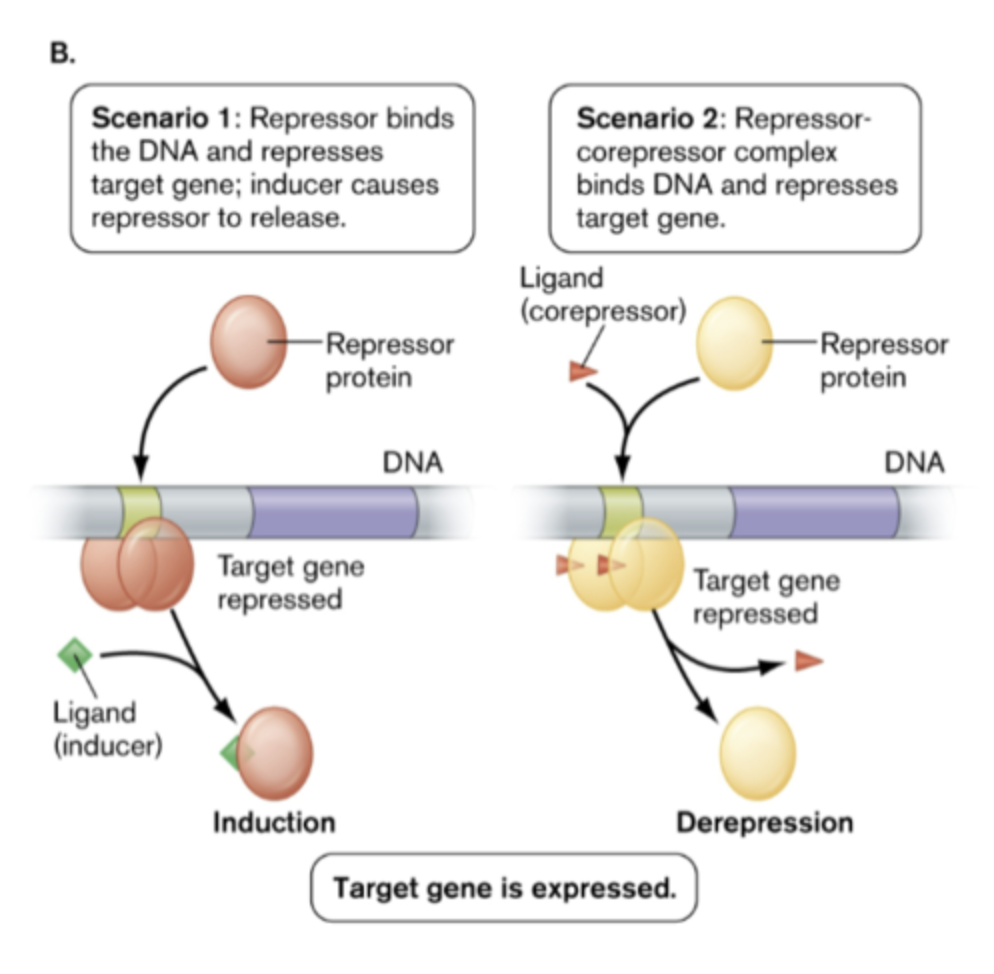
Binds to regulatory sequences in the DNA and prevents transcription of target genes
- Often they block sigma factors of RNA polymerase from binding promoter
- Bind DNA at sequence called operator sequence
- Repressors can require co-factors to repress or be released from binding site
- Often they block sigma factors of RNA polymerase from binding promoter
- Bind DNA at sequence called operator sequence
- Repressors can require co-factors to repress or be released from binding site
14
New cards
Positive regulator/activator
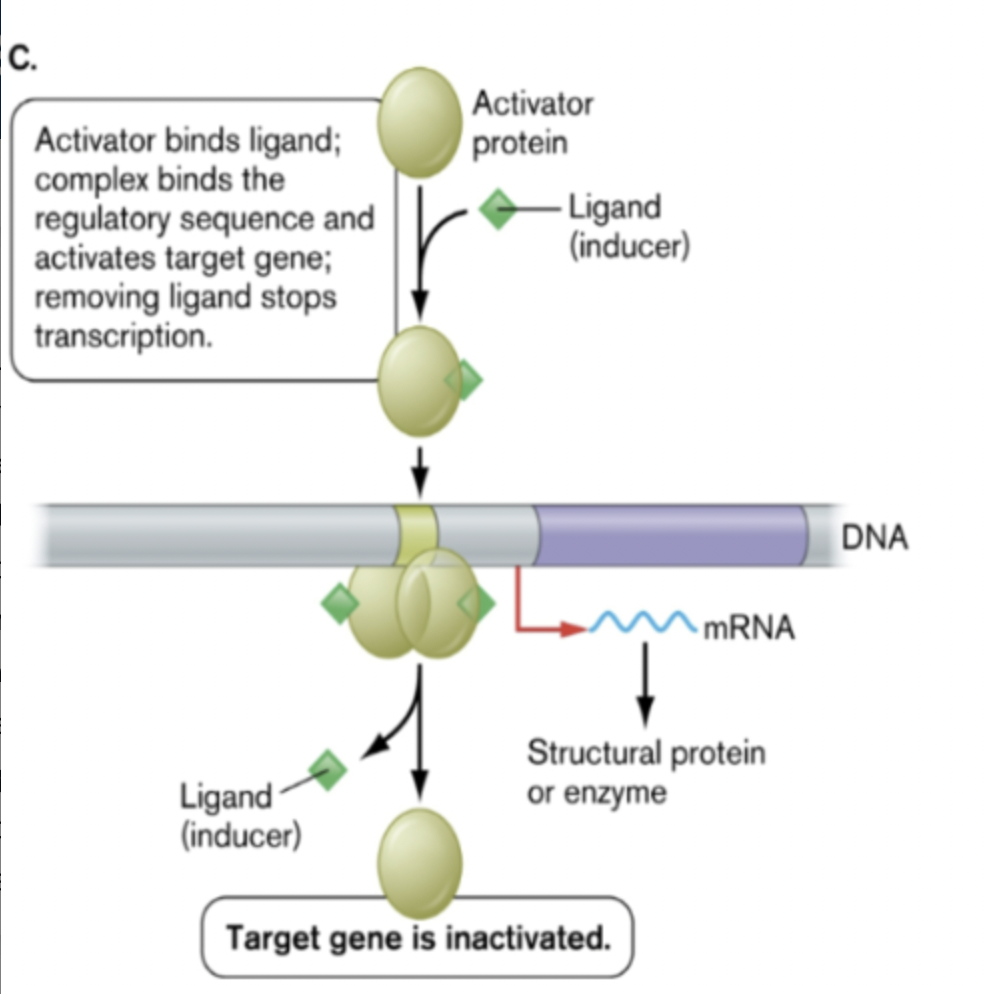
Binds to regulatory sequences in the DNA and promotes transcription of target genes
- Often acts to recruit or stabilize sigma factor interaction with a promoter
- Binding site is generally upstream of -35, -10 sequence (activator binding site)
- Interacts with alpha subunit RNA polymerase.
- Can also alter DNA structure to allow binding of sigma factor
- Activators can require co-factors to bind DNA
- Often acts to recruit or stabilize sigma factor interaction with a promoter
- Binding site is generally upstream of -35, -10 sequence (activator binding site)
- Interacts with alpha subunit RNA polymerase.
- Can also alter DNA structure to allow binding of sigma factor
- Activators can require co-factors to bind DNA
15
New cards
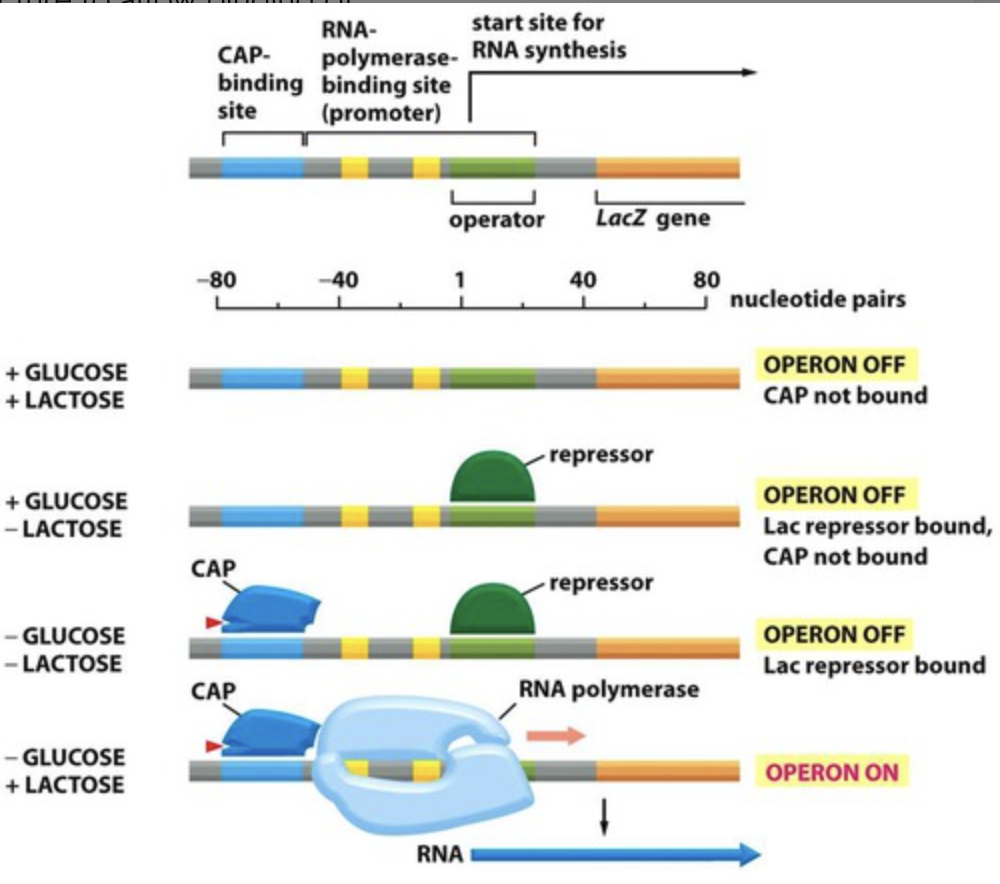
Organization of lac operon
- lacZ: B-Galactosidase; converts lactose to glucose and galactose, can also convert lactose to allolactose (an inducer)
- lacY: Lactose permease; membrane protein that imports lactose from the extracellular environment
- lacI: Lac repressor; protein blocks transcription of the lac operon
- lacO: lac operator; DNA sequence that binds LacI
- lacY: Lactose permease; membrane protein that imports lactose from the extracellular environment
- lacI: Lac repressor; protein blocks transcription of the lac operon
- lacO: lac operator; DNA sequence that binds LacI
16
New cards
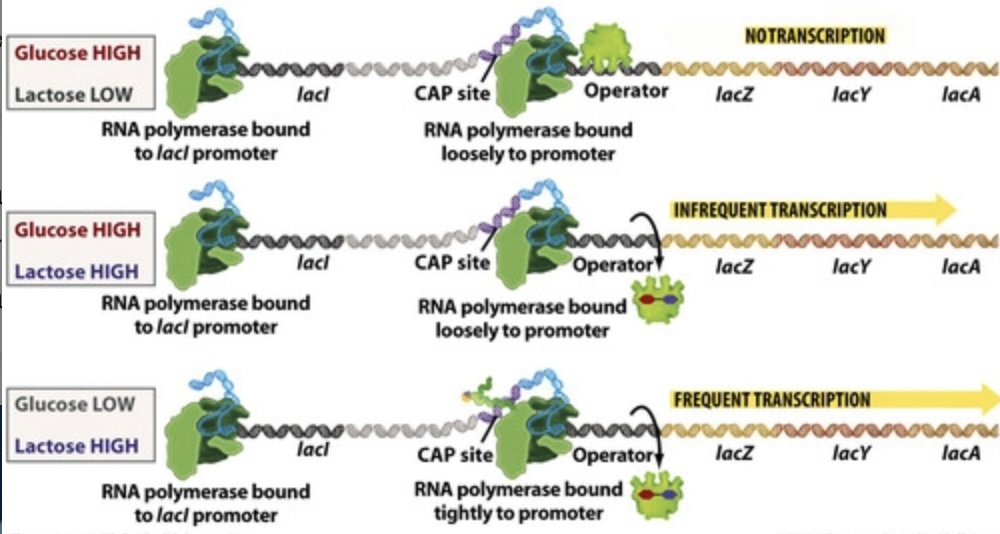
In the absence of lactose
LacI binds to the operator region and represses the lac operon by preventing open complex formation by RNA polymerase
17
New cards
In the presence of lactose
- B-galactosidase (LacZ) cleaves and rearranges lactose to make the inducer allolactose
- Allolactose binds to LacI, reducing its affinity to the operator and thus allowing induction of the operon
- Allolactose binds to LacI, reducing its affinity to the operator and thus allowing induction of the operon
18
New cards
Catabolite repression
- Presence of glucose affects signal inside the cell called cyclic adenosine monophosphate (cAMP)
- Concentrations of cAMP are assessed via cAMP Receptor Proteins (CRP)
- CRP responds to the presence of cAMP
- Concentrations of cAMP are assessed via cAMP Receptor Proteins (CRP)
- CRP responds to the presence of cAMP
19
New cards
Cyclic adenosine monophosphate (cAMP)
Intracellular second messenger in the signaling cascade synthesized from ATP by adenylate cyclase
- Nutrient sensor
- Nutrient sensor
20
New cards
cAMP Receptor Proteins (CRP)
Activator protein/ transcription factor
- Binds next to promoter, stimulates open complex
- Increases transcription of lac and other operons
- Responds to the presence of cAMP
- Acts as activator only when bound to cAMP
- High glucose -\> low cAMP levels -\> CRP inactive
- Binds next to promoter, stimulates open complex
- Increases transcription of lac and other operons
- Responds to the presence of cAMP
- Acts as activator only when bound to cAMP
- High glucose -\> low cAMP levels -\> CRP inactive
21
New cards
Lac operon expression
22
New cards
Bacterial response to environment
- Bacteria sense the environment; sense levels of nutrients
- Bacteria change gene expression
- Bacteria change gene expression
23
New cards
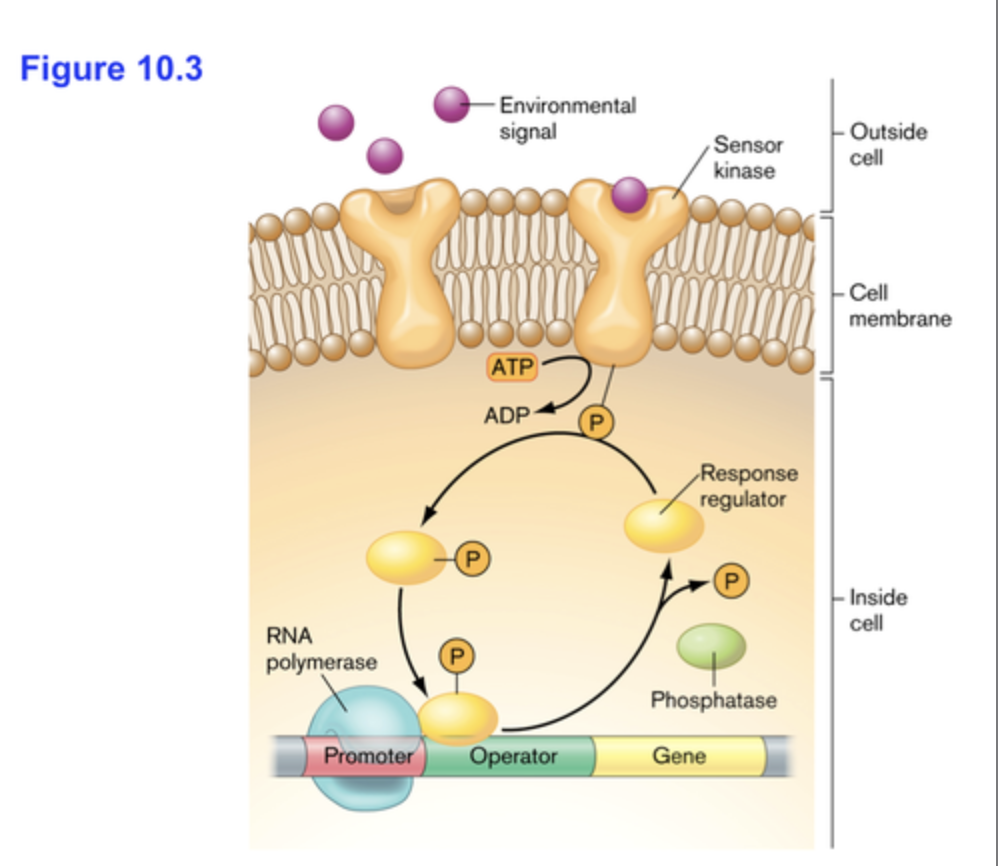
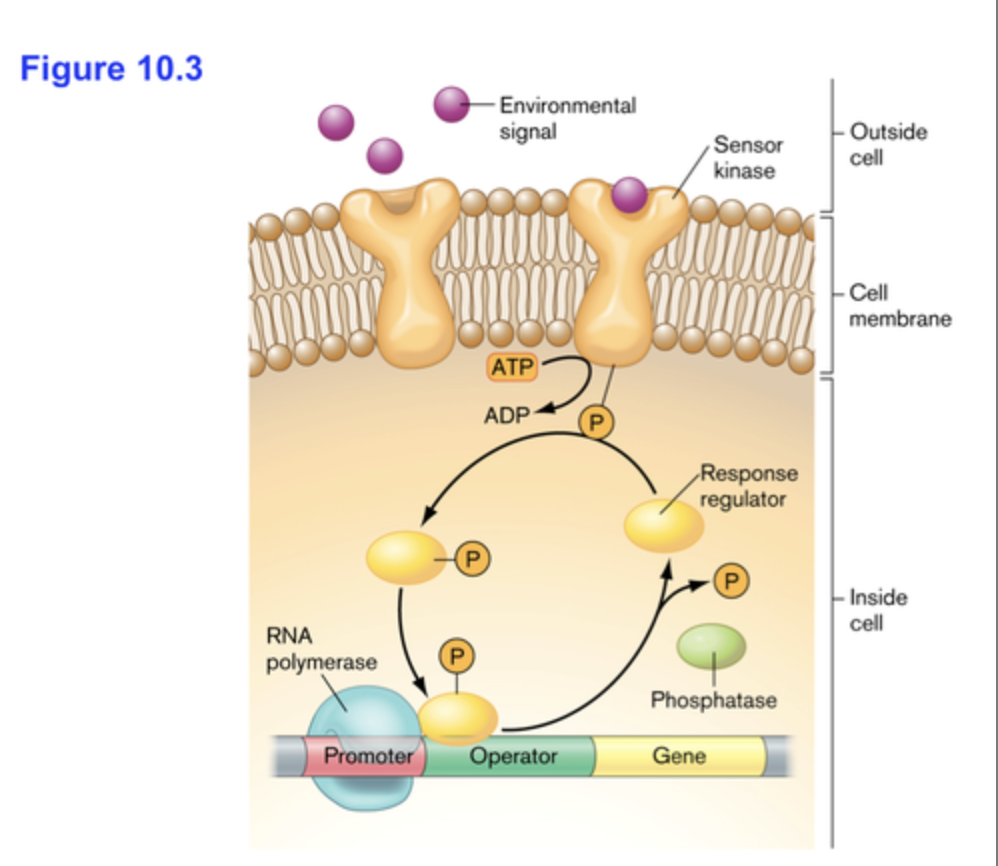
Two-component signal transduction system
Message relay system composed of a sensor kinase protein and a response regulator protein that regulates gene expression in response to a signal (usually an extracellular signal)
24
New cards
Sensor kinase
- Extracellular receptor for metabolite
- Intracellular communication pathway
- Binds to environmental signal and self-activates via phosphorylation
- Intracellular communication pathway
- Binds to environmental signal and self-activates via phosphorylation
25
New cards
Response regulator
- DNA-binding protein that regulates transcription
- Activated via phosphorylation by sensor kinase
- Mediates response by altering gene transcription
- Activated via phosphorylation by sensor kinase
- Mediates response by altering gene transcription
26
New cards
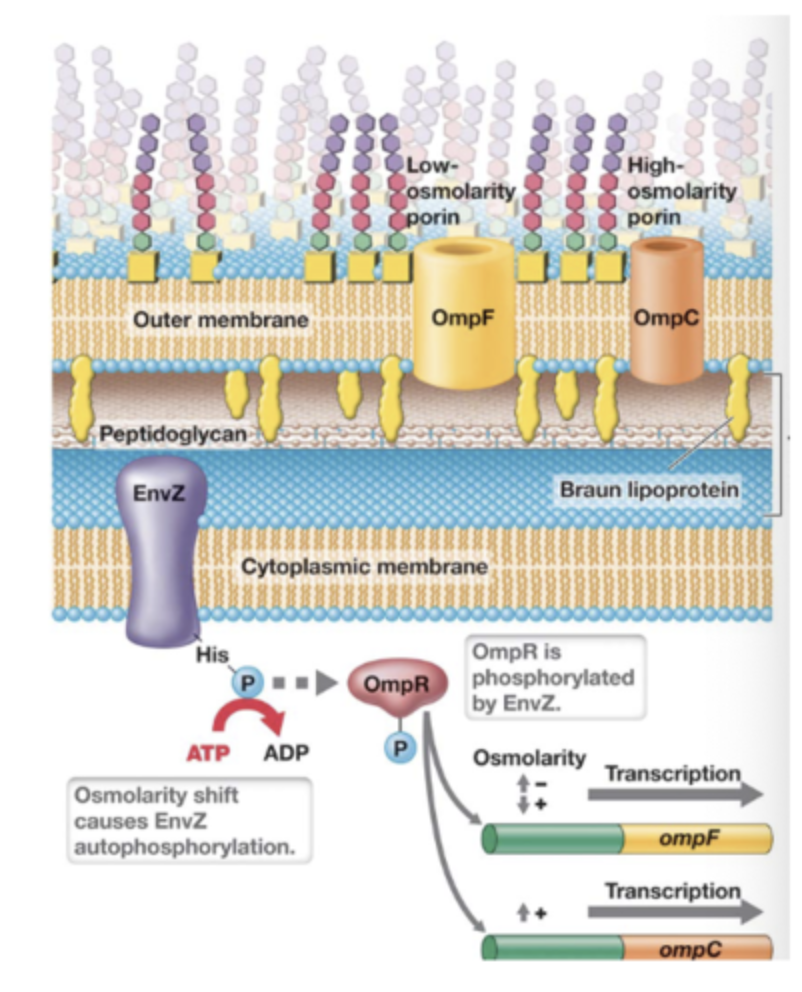
EnvZ-OmpR System
Two-component system that helps bacteria maintain osmotic homeostasis
- Inner membrane kinase EnvZ self phosphorylates under changes in osmotic pressure
- EnvZ binds OmpR and transfers P
- OMpR-P binds upstream of ompF operon; activates transcription of ompF in cases of low osmolarity; represses transcription of ompF in cases of high osmolarity
- OmpR-P binds upstream of the ompC operon activating transcription in the case of high osmolarity
- Inner membrane kinase EnvZ self phosphorylates under changes in osmotic pressure
- EnvZ binds OmpR and transfers P
- OMpR-P binds upstream of ompF operon; activates transcription of ompF in cases of low osmolarity; represses transcription of ompF in cases of high osmolarity
- OmpR-P binds upstream of the ompC operon activating transcription in the case of high osmolarity
27
New cards
Sigma factors
Regulate transcription of all genes
- S70 initiates transcription of most genes
- S70 initiates transcription of most genes
28
New cards
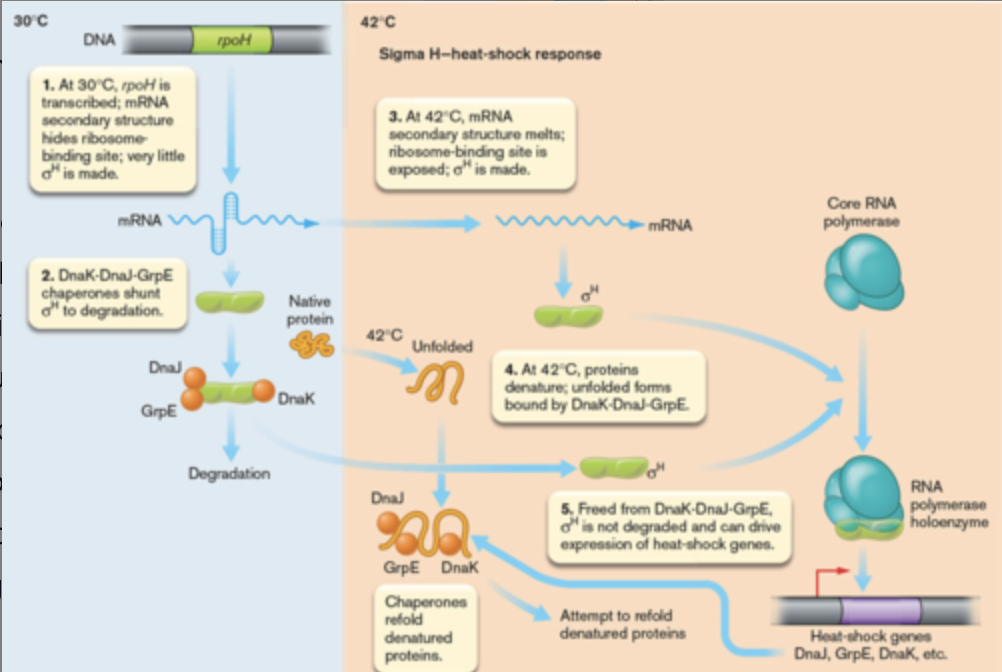
Heat-shock response
Coordinated response of cells- changes in the membrane and expression of heat-shock genes- to higher than-normal temperatures
- At 30ºC, secondary structures at the 5 ́-end of rpoH mRNA obscure access to ribosome-binding sites resulting in little RpoH being produced; small amount of RpoH produced is bound by chaperones and degraded
- At 42ºC, heat melts the secondary structure allowing access of the ribosome and translation of the of more rpoH mRNA; heat draws chaperones away from the protein RpoH, allowing them to accumulate and bind RNA polymerase
- At 30ºC, secondary structures at the 5 ́-end of rpoH mRNA obscure access to ribosome-binding sites resulting in little RpoH being produced; small amount of RpoH produced is bound by chaperones and degraded
- At 42ºC, heat melts the secondary structure allowing access of the ribosome and translation of the of more rpoH mRNA; heat draws chaperones away from the protein RpoH, allowing them to accumulate and bind RNA polymerase
29
New cards
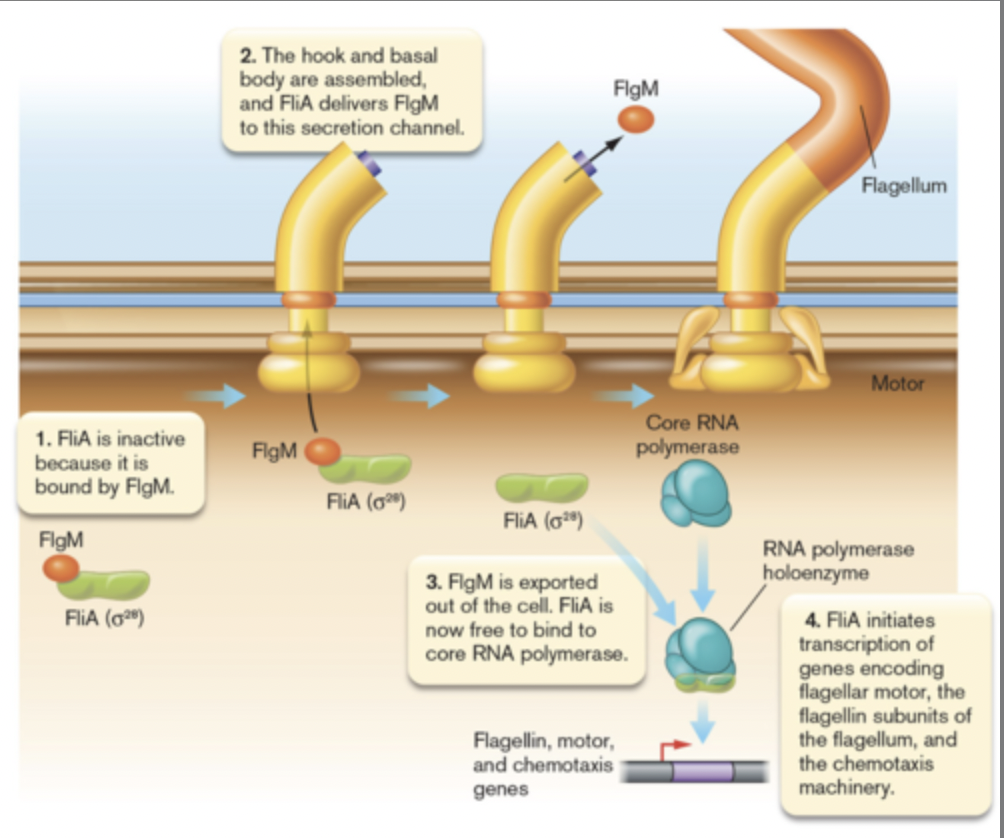
Anti-sigma factors
Proteins that bind to sigma factors and inhibit their function by blocking their access to the RNA polymerase
30
New cards
Secondary Messangers
Small molecules like cAMP that have regulatory functions
- Can change the activities of regulatory proteins and regulatory RNAs
- Can change the activities of regulatory proteins and regulatory RNAs
31
New cards
Guanosine tetraphosphate (ppGpp)
Second messenger that allows cells to handle abrupt changes in nutrient availability
32
New cards
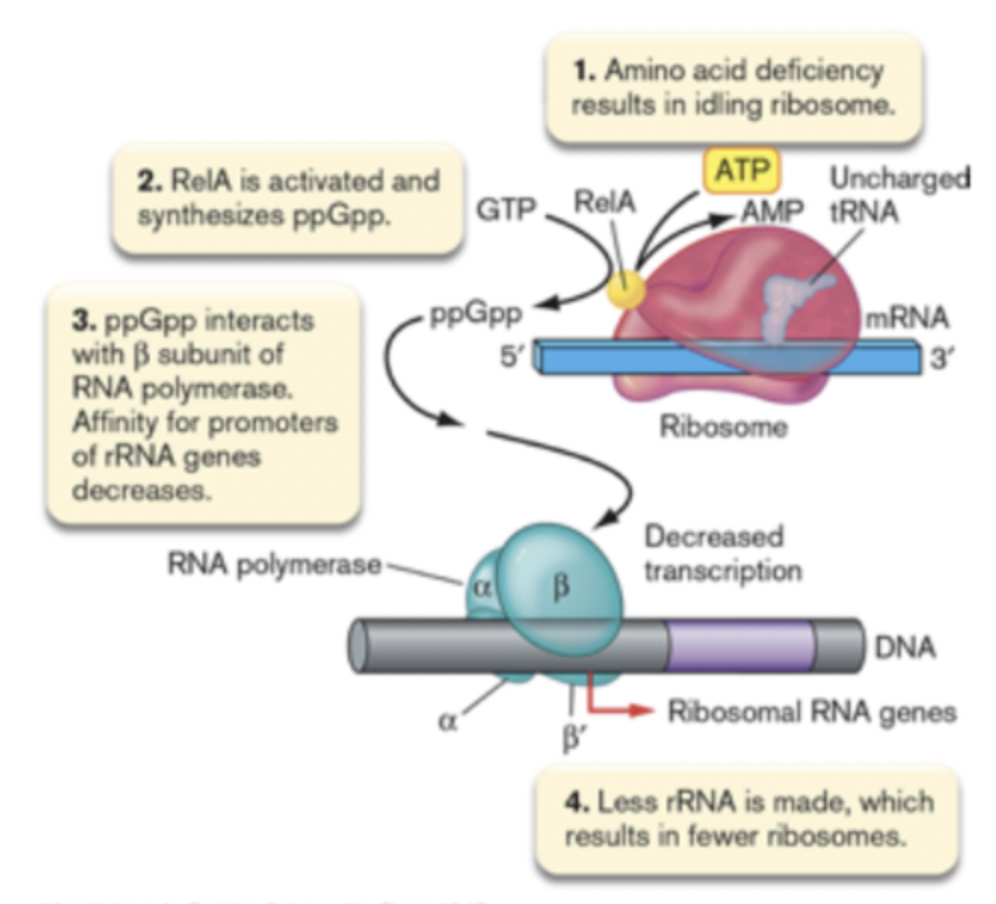
Stringent response
Regulatory mechanism that detects nutrient or environmental stresses and antibiotics
- Allows switching from rapid growth to slower growth
- Nutrient scarcity leaves many ribosomes idle
- Idling ribosomes trigger the synthesis ofppGpp; ppGpp binds RNA polymerase and lowers its ability to transcribe ribosomal RNA (rRNA)genes
- Response causes a decrease in rRNA transcripts made for ribosome assembly, leading to fewer ribosomes and an overall decrease in growth
- Allows switching from rapid growth to slower growth
- Nutrient scarcity leaves many ribosomes idle
- Idling ribosomes trigger the synthesis ofppGpp; ppGpp binds RNA polymerase and lowers its ability to transcribe ribosomal RNA (rRNA)genes
- Response causes a decrease in rRNA transcripts made for ribosome assembly, leading to fewer ribosomes and an overall decrease in growth
33
New cards
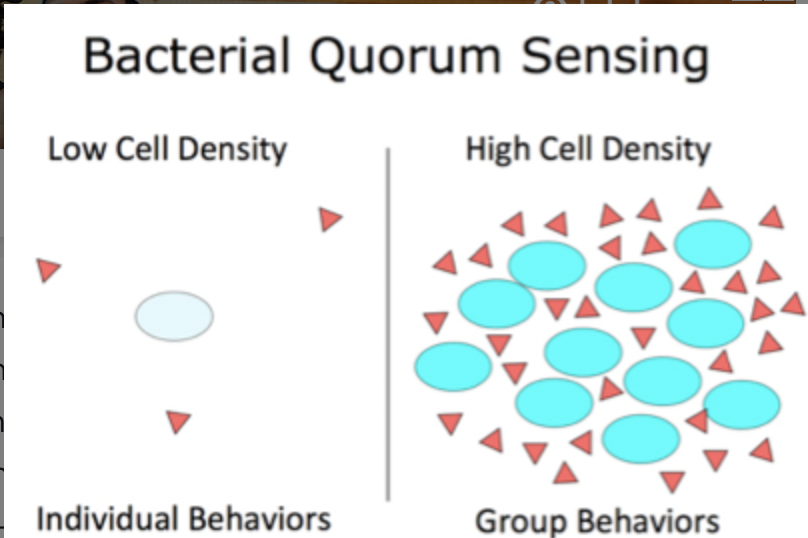
Quroum sensing
Regulation of gene expression in response to fluctuations in cell-population density
- Quorum-sensing bacteria produce and release chemical signal molecules (autoinducers) that increase in concentration as a function of cell density
- Gram-positive -\> small peptides
- Gram-negative -\> homoserine lactones
- Once a certain number of autoinducers is reached, they bind to receptors that regulate gene transcription
- Quorum-sensing bacteria produce and release chemical signal molecules (autoinducers) that increase in concentration as a function of cell density
- Gram-positive -\> small peptides
- Gram-negative -\> homoserine lactones
- Once a certain number of autoinducers is reached, they bind to receptors that regulate gene transcription
34
New cards
Virus
Non-cellular infectious agent that has genetic material (ss or ds RNA or DNA) inside a protective protein coat and requires a host cell for metabolism and replication
- Lack ribosomes and plasma membrane
- Lack ribosomes and plasma membrane
35
New cards
Viral properties
- Obligate intracellular parasites
- Completely dependent on host cell for energy acquisition, protein synthesis, and metabolic intermediates
- Acellular, genetic entities
- Can infect prokaryotic cells (bacteriophages) and eukaryotic cells (plant and animal viruses)
- Completely dependent on host cell for energy acquisition, protein synthesis, and metabolic intermediates
- Acellular, genetic entities
- Can infect prokaryotic cells (bacteriophages) and eukaryotic cells (plant and animal viruses)
36
New cards
Chemical composition of viruses
- Structural Viral Proteins: facilitate transfer of viral genome; protect the viral genetic material; participate in attachment to a susceptible cell; provide structural symmetry; antigenic characteristics
- Viral Enzymes: not structural, but essential for replication; RNA Polymerase; reverse transcriptase
- Viral Enzymes: not structural, but essential for replication; RNA Polymerase; reverse transcriptase
37
New cards
Regression hypothesis
Viruses are small cells that lost their biologic processes
38
New cards
Escape hypothesis
Viruses are retrotransposons that obtained genes encoding capsids
39
New cards
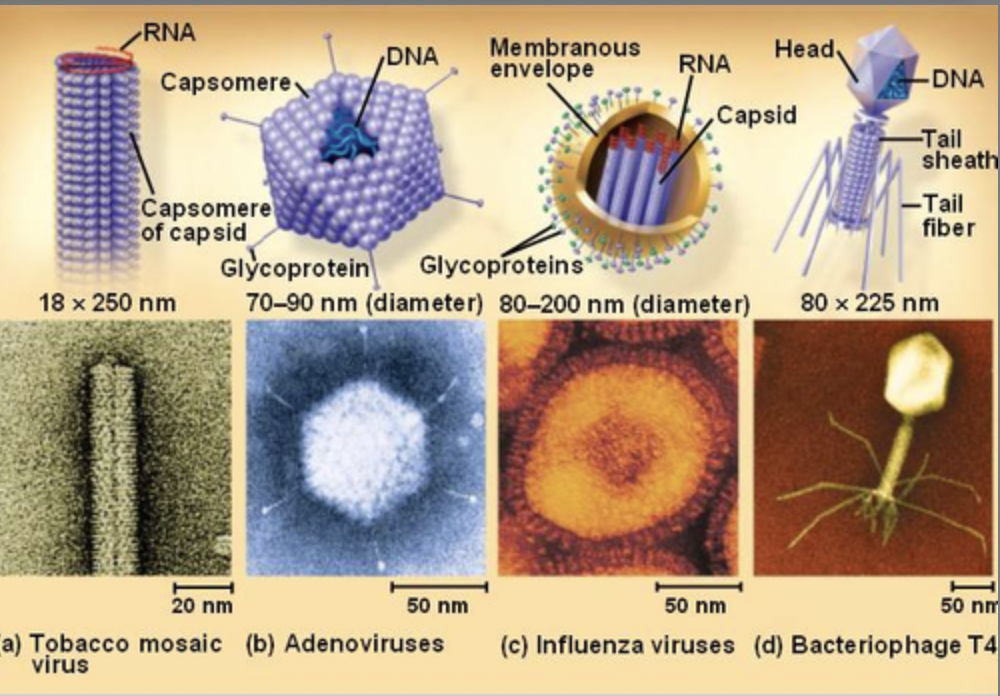
Capsid
Protein coat that encloses a viral genome
- Built from protein subunits (capsomeres)
- Can have various structures
- Built from protein subunits (capsomeres)
- Can have various structures
40
New cards
Viral envelope
Membrane, derived from membranes of the host cell, that encloses the capsid, which in turn encloses the viral genome
41
New cards
Virus capsid structure
- Icosahedral: 20 triangular sides; each triangle made up of at least 3 identical capsid proteins; allows small protein to cover a large volume
- Filamentous/helical: long tube of protein, with genome inside; tube made up of hundreds of identical protein subunits arranged in a helical symmetry; tube length reflects size of viral genome
- Complex: mixture of icosahedral and filamentous symmetry
- Asymmetrical (irregular): capsid proteins arranged without symmetry; often have an irregular shape.; tend to be larger viruses
- Filamentous/helical: long tube of protein, with genome inside; tube made up of hundreds of identical protein subunits arranged in a helical symmetry; tube length reflects size of viral genome
- Complex: mixture of icosahedral and filamentous symmetry
- Asymmetrical (irregular): capsid proteins arranged without symmetry; often have an irregular shape.; tend to be larger viruses
42
New cards
Virus envelope structure
- Viruses may have lipid envelope
- Allows fusion to host cell, organelle membrane if host cell is not covered by cell wall
- Not encoded by viral genome
- Proteins embedded in envelope may be coded by virus
- Coats viral capsid as virus leaves cell or organelle
- Allows fusion to host cell, organelle membrane if host cell is not covered by cell wall
- Not encoded by viral genome
- Proteins embedded in envelope may be coded by virus
- Coats viral capsid as virus leaves cell or organelle
43
New cards
Viral attachment proteins
Protein expressed by virus used for attachment by host cell and interacts with host cell receptor
44
New cards
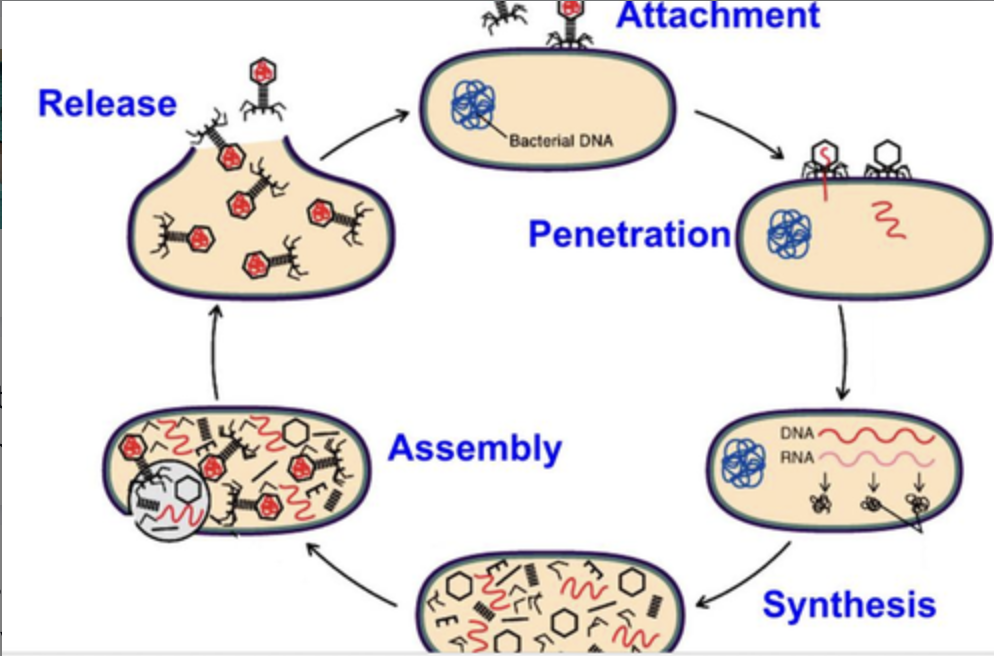
Viral life cycle
Absorption- attachment of the virus to the host cell
Penetration: viral entry into the cell via fusion of envelope to the plasma membrane, endocytosis, or direct injection
Uncoating: removal of capsid from the genome
Viral genome replication and viral protein synthesis
Virion assembly: packaging of the viral nucleic acid into capsid protein; viral particle is assembled in the cytoplasm of the host
Release: mature virions are released from the host cell via lysis (naked virus) or budding (enveloped virus)
Penetration: viral entry into the cell via fusion of envelope to the plasma membrane, endocytosis, or direct injection
Uncoating: removal of capsid from the genome
Viral genome replication and viral protein synthesis
Virion assembly: packaging of the viral nucleic acid into capsid protein; viral particle is assembled in the cytoplasm of the host
Release: mature virions are released from the host cell via lysis (naked virus) or budding (enveloped virus)
45
New cards
Viral protein synthesis
Viral transcript is translated to produce structural components of the virus
- All viral mRNA's are translated by host cell ribosomes
- All viral mRNA's are translated by host cell ribosomes
46
New cards
Polyprotein protein synthesis strategy
Entire, large, multiprotein can be translated all at once; whole genome translated
47
New cards
Splicing strategy
Virus can choose which genes need to be translated; genome is spliced as needed
48
New cards
Segmented genome strategy
Genome is carried in multiple segments; virus can choose which genes are translated
- Can lead to under or over expressing of genes
- Can lead to under or over expressing of genes
49
New cards
Viral taxonomy
Based on shape, nucleic acid content, sequence analysis, antibodies, where its located, and/or site of replication
50
New cards
Classification of viruses- biological properties
Host range, mode of transmission, pathogenicity, pathology, vector relationships, and tissue tropisms
51
New cards
Syndrome
Set of physical signs and symptoms that occur together
52
New cards
Latent period
Eclipse: period where the virus copies its genome and produces proteins
Maturation: assembly of viral particle (assembling the capsid around the genome, and incorporating any other required protein)
Maturation: assembly of viral particle (assembling the capsid around the genome, and incorporating any other required protein)
53
New cards
Burst size
Number of virions released
- Viruses that lyse the cell will be released all at once
- Viruses that bud may be released over a longer period of time
- Viruses that lyse the cell will be released all at once
- Viruses that bud may be released over a longer period of time
54
New cards
Plaque assay
Method used to measure the number of viral particles present in a sample
55
New cards
Bacteriophage
Virus that infects bacteria
56
New cards
Bacteriophage classes
- Virulent: infection results in cell lysis and the production of many progeny phage (ex. T4)
- Temperate: infection can be virulent or can lead to the maintenance of the virus within the cell in a dormant state, called lysogeny (ex. Lambda)
- Pseudotemperate: infection establishes a permanent relationship with the host; virus is produced and secreted continuously without host cell lysis (ex. SP10)
- Temperate: infection can be virulent or can lead to the maintenance of the virus within the cell in a dormant state, called lysogeny (ex. Lambda)
- Pseudotemperate: infection establishes a permanent relationship with the host; virus is produced and secreted continuously without host cell lysis (ex. SP10)
57
New cards
Virulent phage (T4)
- Infects E. coli
- Only has a lytic life cycle
- Linear double-stranded DNA
- Complex capsid symmetry
- Only has a lytic life cycle
- Linear double-stranded DNA
- Complex capsid symmetry
58
New cards
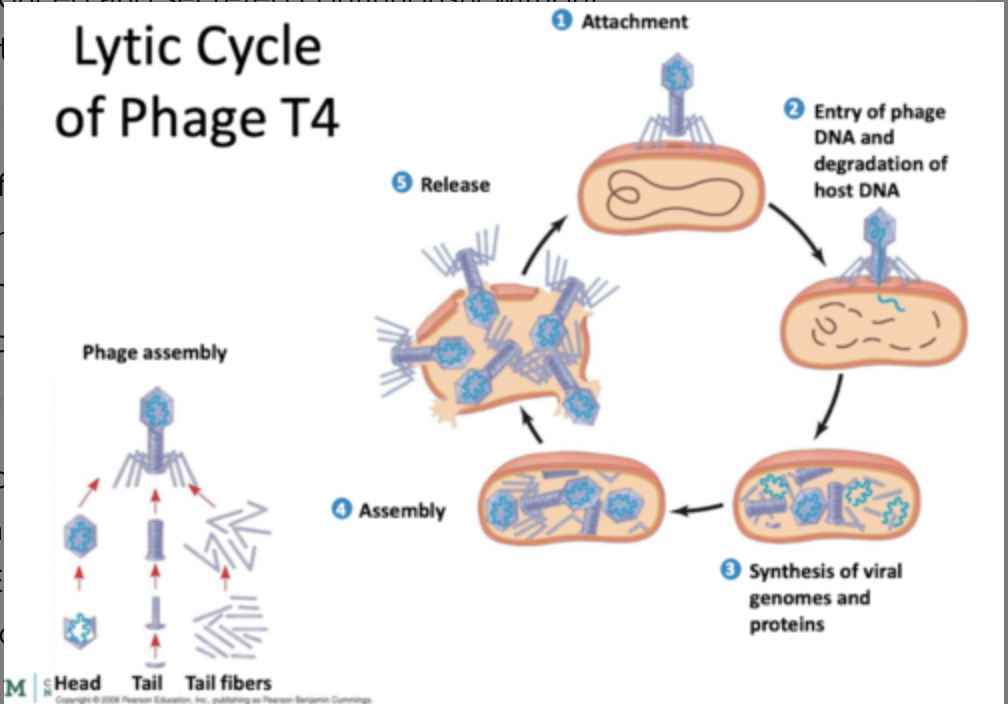
T4 life cycle
- Absorption and penetration: tail fibers bind to E. coli LPS during absorption; tail pins make contact with E. coli outer membrane; tail sheath contracts, pushing the tail tube through the outer membrane; T4 Lysozyme makes a small hole in the peptidoglycan and the DNA is injected
- Assembly and release: packaging motor is assembled; dsDNA is pumped into capsid head under pressure using ATP; after head is filled with DNA, tail, tail fibers, and other components are added; once enough virions are assembled, the cell will lyse (burst size is about 100 virions)
- Assembly and release: packaging motor is assembled; dsDNA is pumped into capsid head under pressure using ATP; after head is filled with DNA, tail, tail fibers, and other components are added; once enough virions are assembled, the cell will lyse (burst size is about 100 virions)
59
New cards
T4 genes and gene expression
Large, linear genome divided into genes that are transcribed at early, middle and late time points during infection
- Early genes: nucleases (digest host genome), replication proteins, sigma factors (ensure viral genes are expressed), RNA polymerase modifying proteins
- Middle genes: RNA polymerase modifying proteins
- Late genes: capsid proteins, assembly proteins, release proteins
- Early genes: nucleases (digest host genome), replication proteins, sigma factors (ensure viral genes are expressed), RNA polymerase modifying proteins
- Middle genes: RNA polymerase modifying proteins
- Late genes: capsid proteins, assembly proteins, release proteins
60
New cards
Temperate phage (λ)
- Uses both/can switch between lytic and lysogenic cycles
- dsDNA genome; linear, with complimentary single-stranded ends; circularizes upon cell entry
- Complex capsid symmetry
- dsDNA genome; linear, with complimentary single-stranded ends; circularizes upon cell entry
- Complex capsid symmetry
61
New cards
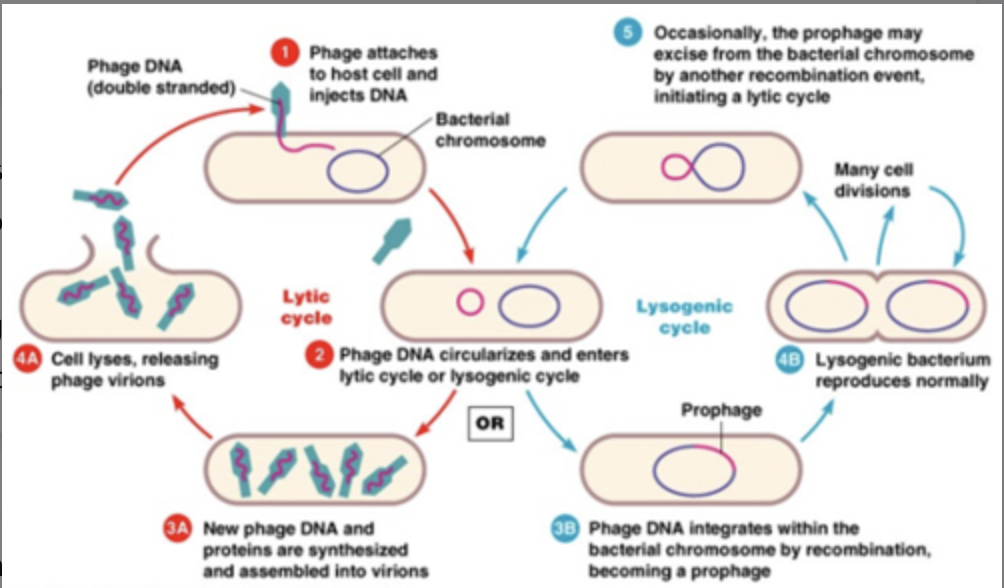
λ life cycle
- Lambda absorbs to the LamB porin of E coli; after injecting its genome it can take on one of two pathways: lytic pathway or lysogenic pathway
- Attachment and injection: λ attaches at LamB, a porin involved in maltose transport; utilizes the cell's Mannose transporter system to facilitate entry into the cytoplasm
- λ makes a critical decision: lytic or lysogenic
- Assembly and release: capsid proteins self assemble into viral particles; viral; DNA is packaged in "head full" manner; tails are assembled to full heads; makes protein to depolymerize peptidoglycan; bursts host cell to release progeny phage
- Attachment and injection: λ attaches at LamB, a porin involved in maltose transport; utilizes the cell's Mannose transporter system to facilitate entry into the cytoplasm
- λ makes a critical decision: lytic or lysogenic
- Assembly and release: capsid proteins self assemble into viral particles; viral; DNA is packaged in "head full" manner; tails are assembled to full heads; makes protein to depolymerize peptidoglycan; bursts host cell to release progeny phage
62
New cards
λ genome and gene expression
- Early: initiates at PL and PR and terminates after N and Cro; N promotes expression of middle genes
- Middle: initiates from PL and PR; leftward transcription proceeds through the int gene and produces Int (integrase), Xis (excisionase), and regulatory protein CIII; rightward transcription proceeds through the Q gene and produces DNA replication proteins (O, P), and regulatory protein CII; CII vs CIII determine lytic vs lysogenic decision
- Late gene expression: initiates from PR'/Plate; late genes encode phage structural components and lysis enzymes
- Middle: initiates from PL and PR; leftward transcription proceeds through the int gene and produces Int (integrase), Xis (excisionase), and regulatory protein CIII; rightward transcription proceeds through the Q gene and produces DNA replication proteins (O, P), and regulatory protein CII; CII vs CIII determine lytic vs lysogenic decision
- Late gene expression: initiates from PR'/Plate; late genes encode phage structural components and lysis enzymes
63
New cards
λ lytic vs lysogenic decision
Lytic vs Lysogenic Switch made up of 3 proteins: CI (represses λ phage gene expression), CII, and CIII (assess cell nutrition)
- CII is a positive regulator and promotes the expression of CI (repressor)
- CIII is an inhibitor of host cell protease that cleaves CII, but is only effective against low levels of protease
- Poor nutrition \= lysogeny; good nutrition \= lytic
- Poor growth media \= high cAMP \= low level of host cell protease that degrades CII
- CIII inhibits remaining protease; CII promotes expression of CI repressor; CI repressor prevents further λ gene expression and lysogeny is favored
- Rich growth media \= low cAMP \= higher level of protease \= less CII; CI repressor is not made and lytic cycle favored
- CII is a positive regulator and promotes the expression of CI (repressor)
- CIII is an inhibitor of host cell protease that cleaves CII, but is only effective against low levels of protease
- Poor nutrition \= lysogeny; good nutrition \= lytic
- Poor growth media \= high cAMP \= low level of host cell protease that degrades CII
- CIII inhibits remaining protease; CII promotes expression of CI repressor; CI repressor prevents further λ gene expression and lysogeny is favored
- Rich growth media \= low cAMP \= higher level of protease \= less CII; CI repressor is not made and lytic cycle favored
64
New cards
Establishing lysogeny
- CI represses transcription of all λ genes, except CI
- λ Integrase (Int) and Integration Host Factor (IHF) recognize the attP sequence on phage DNA and attB sequence on the bacterial chromosome and integrate the λ genome into the bacterial chromosome
- After integration, λ is termed a prophage/lysogen
- λ Integrase (Int) and Integration Host Factor (IHF) recognize the attP sequence on phage DNA and attB sequence on the bacterial chromosome and integrate the λ genome into the bacterial chromosome
- After integration, λ is termed a prophage/lysogen
65
New cards
Prophage induction
- CI repressor must be inactivated in order for λ prophage to become lytic
- Only occurs under conditions of DNA damage
- DNA damage activates the bacterial protein RecA; RecA binds CI and stimulates autocleavage of the protein; transcription of phage genes occurs; Int and Excission protein (XIS) act to recombine λ genome out of the chromosome
- Only occurs under conditions of DNA damage
- DNA damage activates the bacterial protein RecA; RecA binds CI and stimulates autocleavage of the protein; transcription of phage genes occurs; Int and Excission protein (XIS) act to recombine λ genome out of the chromosome
66
New cards
λ DNA replication
- λ genome is circularized vis "sticky ends" called cos sites upon entering the host cell
- DNA is replicated via a rolling circle mechanism producing a long concatemer
- The concatemer is cut by a restriction enzyme, creating the sticky ends
- A single unit genome is packaged into the λ capsid
- DNA is replicated via a rolling circle mechanism producing a long concatemer
- The concatemer is cut by a restriction enzyme, creating the sticky ends
- A single unit genome is packaged into the λ capsid
67
New cards
Restriction
Prokaryotic destruction of foreign DNA through the activity of restriction endonucleases (enzymes that cleave DNA at specific sites)
- Host cell protects its own DNA
- Host cell protects its own DNA
68
New cards
Mosaic nature of genomes
Result of heavy horizontal gene transfer, recombinations, and a variety of mutagenic and DNA repair strategies
- Genomes have mutations (deletions, insertions, duplications, inversions, prophages, and homologs)
- Genomes have mutations (deletions, insertions, duplications, inversions, prophages, and homologs)
69
New cards
Genotype
Nucleic acid sequence of genes an organism carries
70
New cards
Phenotype
Observable characteristics of an organism that are influenced both by its genotype and by the environment
71
New cards
Mutation
Heritable change in genotype that can lead to a change in phenotype
- Most are silent (no effect on organism); mutations in regions between genes, change in 3rd base of a codon, change of one amino acid into a similar one, or change in protein not needed for growth
- Most are silent (no effect on organism); mutations in regions between genes, change in 3rd base of a codon, change of one amino acid into a similar one, or change in protein not needed for growth
72
New cards
Conditional mutation
Change in phenotype of an organism only under certain environmental conditions
73
New cards
Induced mutation
Mutation that occurs due to agents in the environment or deliberate manipulation by humans (i.e., radiation or chemicals)
74
New cards
Spontaneous mutation
Mutation that occurs without external intervention
- Generally result of errors made by DNA polymerase during base pairing
- Generally result of errors made by DNA polymerase during base pairing
75
New cards
Selectable mutation
Mutation that gives the mutant a growth advantage under certain conditions (ex. antibiotic resistance)
76
New cards
Nonselectable mutation
Mutation that has neither an advantage nor disadvantage over parents
77
New cards
Auxotroph
Organism that is unable to synthesize a particular organic compound required for growth
78
New cards
Wild type
Organism with typical genotype found in nature
79
New cards
Mutant
Strain of any cell or virus that differs from parental strain in genotype
80
New cards
Silent mutation
Mutation that changes a single nucleotide, but does not change the amino acid sequence
81
New cards
Missense mutation
Mutation that changes the amino acid sequence to another
82
New cards
Nonsense mutation
Mutation that changes an amino acid sequence to a stop codon, resulting in a shorter and usually nonfunctional protein
83
New cards
Frameshift mutation
Mutation that shifts the open "reading" frame of the gene, by inserting or deleting a nucleotide
84
New cards
Reversion
DNA mutates back to original sequence; return to normal phenotype
85
New cards
Revertant
Organism that returns to wildtype phenotype
86
New cards
Same site revertant
Mutation is at the same site as original mutation
87
New cards
Second site revertant
Mutation is at a different site in the DNA
88
New cards
Suppressor
Mutation that compensates for the effect of the original mutation
89
New cards
Mutation rates
- Mutations tend to occur at a frequency of 10^-9 per base pair replication event
- Proof reading ability of DNA polymerase lowers error rate to 10^-6 to 10^-7
- DNA repair systems (come in after DNA polymerase) reduce rate of mutation to 10^-9
- Mutation in RNA genomes is typically larger than DNA genomes (due to no RNA repair mechanisms)
- Proof reading ability of DNA polymerase lowers error rate to 10^-6 to 10^-7
- DNA repair systems (come in after DNA polymerase) reduce rate of mutation to 10^-9
- Mutation in RNA genomes is typically larger than DNA genomes (due to no RNA repair mechanisms)
90
New cards
Mutagen
Chemical or physical agent that interacts with DNA and causes a mutation
91
New cards
Ames test
Procedure using bacteria to identify potential carcinogens
- Uses bacterial strain auxotrophic for histidine- bacteria cannot grow unless histidine is supplied due to frameshift mutation in hisG gene
- Bacteria is placed on medium with mutagen
- Mutagen causes reversion- bacteria can grow in absence of histidine
- More colonies \= stronger mutagen
- Uses bacterial strain auxotrophic for histidine- bacteria cannot grow unless histidine is supplied due to frameshift mutation in hisG gene
- Bacteria is placed on medium with mutagen
- Mutagen causes reversion- bacteria can grow in absence of histidine
- More colonies \= stronger mutagen
92
New cards
Error proof repair
High fidelity repair mechanisms for non-catastrophic damage
93
New cards
Direct reversal
Mutated base is still recognizable and can be repaired without referring to other strand
94
New cards
Repair of single strand DNA
Damaged DNA is removed and repaired using opposite strand as template
95
New cards
Error prone repair
Low-fidelity repair mechanisms for large-scale DNA damage that interferes with DNA replication
- Cell may use an Error Prone System called the SOS Response
- Wide-scale DNA damage activates RecA; RecA cleaves the LexA repressor protein
- LexA represses genes; in the absence of LexA, repair proteins are transcribed so DNA can be repaired
- Cell may use an Error Prone System called the SOS Response
- Wide-scale DNA damage activates RecA; RecA cleaves the LexA repressor protein
- LexA represses genes; in the absence of LexA, repair proteins are transcribed so DNA can be repaired
96
New cards
Error-prone repair pathways
- Light repair: photolyase excise thymine dimers; DNA polymerase I fills the gap; DNA ligase links the new DNA with the old
- Excision Repair: excision repair enzymes remove a section of the DNA that has been damaged (by radiation or mutagen); DNA polymerase I fills the gap; DNA ligase links the new DNA with the old
- Mismatch Repair: mismatch repair enzyme removes the un-methylated new base of the DNA; DNA polymerase I fills the gap; DNA ligase links the new DNA with the old
- Excision Repair: excision repair enzymes remove a section of the DNA that has been damaged (by radiation or mutagen); DNA polymerase I fills the gap; DNA ligase links the new DNA with the old
- Mismatch Repair: mismatch repair enzyme removes the un-methylated new base of the DNA; DNA polymerase I fills the gap; DNA ligase links the new DNA with the old
97
New cards
Recombination
Process by which genetic material is broken and joined with other genetic material
- Allows for pieces of DNA from an outside source to be incorporated into a cell's genome
- Allows for pieces of DNA from an outside source to be incorporated into a cell's genome
98
New cards
Homologous/generalized recombination
Exchange of genetic information between homologous DNA molecules
- Requires that 2 recombining molecules have a considerable stretch of homologous DNA sequences
- Requires that 2 recombining molecules have a considerable stretch of homologous DNA sequences
99
New cards
Site specific recombination
Requires very little sequence homology between the recombining DNA molecules
- Require a specific short sequence recognized by a specific recombination enzyme
- Require a specific short sequence recognized by a specific recombination enzyme
100
New cards
Generalized recombination
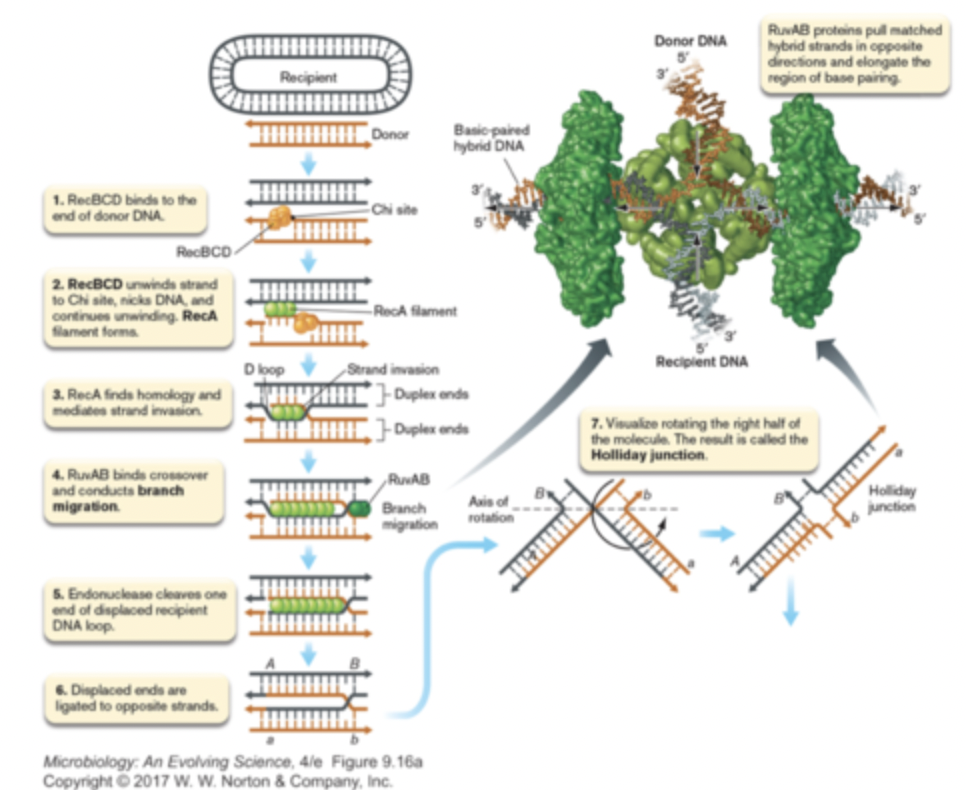
1. RecBCD binds to the end of donor DNA
2. RecBCD unwinds strand until Chi site, where it nicks the DNA and continues unwinding; then RecA filament forms
3. RecA finds homology and mediates strand invasion
4. RuvAB binds at the crossover and carries out branch migration, which extends base paring between donor and recipient strands
5. Endonuclease cleaves one end of displaced recipient DNA loop
6. Displaced ends are ligated to opposite strands
2. RecBCD unwinds strand until Chi site, where it nicks the DNA and continues unwinding; then RecA filament forms
3. RecA finds homology and mediates strand invasion
4. RuvAB binds at the crossover and carries out branch migration, which extends base paring between donor and recipient strands
5. Endonuclease cleaves one end of displaced recipient DNA loop
6. Displaced ends are ligated to opposite strands