9.5 Protein-Ligand Interactions
 Call Kai
 Learn
Learn Practice Test
 Spaced Repetition
 Match
Match Flashcards
 Knowt Play
1/46

There's no tags or description
Looks like no tags are added yet.
Name | Mastery | Learn | Test | Matching | Spaced | Call with Kai | Chat |
|---|
No analytics yet
Send a link to your students to track their progress
47 Terms
Function of hemoglobin
transports molecular oxygen from lung to tissue, then transports CO2 from tissue to lung
Function of myoglobin
stores molecular oxygen in tissue
Similarities of Myoglobin and Hemoglobin in structures
similar tertiary structure but different primary structures
Myoglobin and hemoglobin are what kind of proteins that bind to…
heme-proteins; oxygen
Protoporphyrin
Organic ring structure bound to Fe2+ (Binds to O2)
Where are the 6 bonds with Fe in protoporphyrin
4 from main structure, 2 from perpendicular structure; proximal His and O2
Fe2+ vs Fe3+
Binds O2 vs irreversibly; some small molecules can bind to Fe2+ with greater affinity (CO & NO)
Myoglobin and each hemoglobin monomer is a
single polypeptide composed of 8 helices (Called globin fold)
In each polypeptide chain, a heme group is bound between helix (Include which His)
E7 (His 64) and F8 (His 93)
4 types of globin in mammals
Myo, hemo, neuro (Stores O2 for brain), cyto (Regulates NO); All monomeric (Except hemo which is tetrameric)
Myoglobin is a single polypeptide chain of ___ amino acid residues
153
Tertiary structure of 8 right-handed a-helices with a hydrophobic pocket, which forms a
protective sheath for a heme group with iron atom in the middle
CO binds to heme ______ times better because it binds to heme _________ to plane
20,000x; perpendicular
Heme iron bonded to HIs on helix _, with an open O2 binding site between iron and His on helix _
E7; F8
Monomeric heme protein found mainly in ____ tissue; serves as
muscle; an intracellular storage site for oxygen
Each heme contains
one central, coordinately bound, iron atom that is normally in the Fe2+, or ferrous oxidation state
Oxygen carried by heme-proteins (both myoglobin and hemoglobin) is bound directly to
ferrous iron atom of the heme prosthetic group
Heme groups is located in a crevice between
E and F helices, except for non-polar R groups surround the heme
Fe2+ covalently bonded to the
imidazole group of histidine 93 (F8)
O2 is held on the other side by
histidine 64 (E7)
Heme protein conjugate is strongly stabilized by
hydrophobic interactions between the heme tetrapyrrole ring system and hydrophobic R groups on the interior of the cleft in the protein
Heme protein conjugate is stabilized further by
coordination of the iron atom with the nitrogen atom of the histidine R group, located above the plane of the heme ring on the F-helix
In oxygen-bound myoglobin (oxy-Mb) or oxygen-bound hemoglobin (oxy-HB), the remaining bonding site on the iron (6th coordinate position) is occupied by
the oxygen O2
O2 binding is stabilized by ________________ on the E-helix
second histidine residue (distal His)
Heme and protein protect Fe2+ from
irreversible oxidation to Fe3+
T/F Carbon monoxide binds to heme iron more strongly than oxygen
TRUE
Preferential binding of carbon monoxide to heme iron is largely responsible for
the asphyxiation in carbon monoxide poisoning
O2 binds to free heme at ____, but CO binds to free heme ____ to the heme plane
an angle; perpendicular
When O2 binds to the heme in Mb or Hb, binds at _____ ________, because the perpendicular arrangement is blocked by ___ ___
slight angle; His E7
Hemoglobin is tetramer of
four polypeptide chains
Hemoglobin consists of two identical a chains (___ AA residues) and two idential B chains (___ AA residues)
141, 146
Each chain has a ___ group, hence ___ O2 can bind to each Hb
heme, four
Each subunit of a hemoglobin tetramer has a
heme prosthetic group identical to that described for myoglobin
The quaternary structure of hemoglobin leads to physiologically important ____ interactions between the subunits. Property lacking in monomeric myoglobin, which is otherwise very similar to a subunit of hemoglobin
allosteric
α1β1 (and α2β2) interface involves ______ residues
α1β2 (and α2β1) interface involves ______ residues
> 30; 19
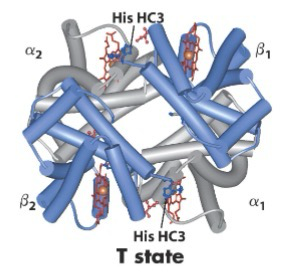
T state is stabilized by many _______ pairs. When it switches to R state, some of them break, a ______ in subunits occur, and new ______ pairs are formed
ion, shift, ion
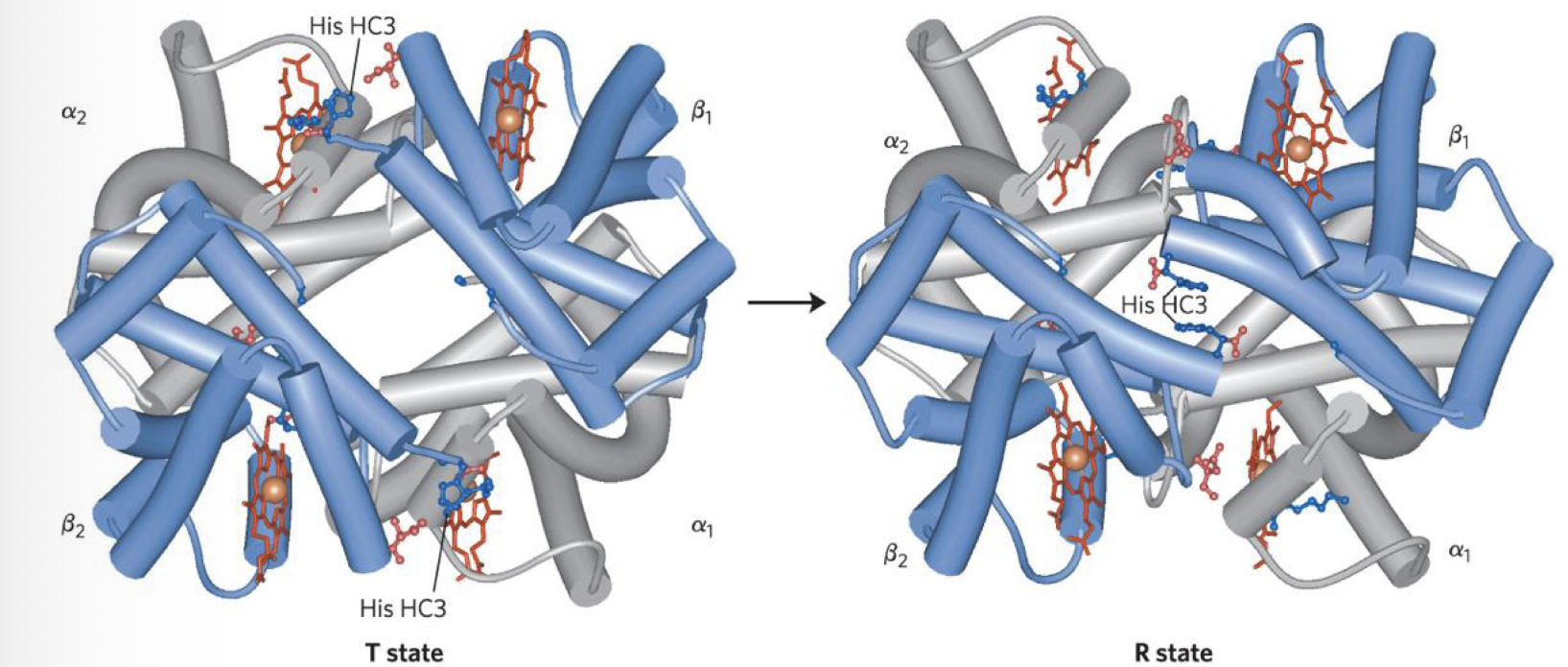
Two conformations of hemoglobin
R (relaxed) and T (Tense) state; Higher affinity for O2 vs lower affinity
What causes the switch from T to R Hb state
O2 binding causes conformational change to R state, weaker interactions shift and certain areas narrows/rotate; O2 causes Fe2+ to pull into plane of heme
_______ binds cooperatively to O2
Hemoglobin; Is able to transition from high to low affinity states
Hb also carries end products of ________ _________
Cellular respiration; H+ and CO2; T state favors these end products
Bohr Effect
Describes the affect of pH and CO2 on the binding and release of O2 by Hb
Effect of pH on O2 binding
High pH: O2 binds more, H+ released; Low pH: O2 released, H+ binds more
CO2 binding to Hb is ________ related to binding of O2
Inversely
How does CO2 bind to Hb
To the N-term of a residue rather than the Fe+2
BPG
2,3-bisphosphoglycerate; heterotrophic allosteric modulation; binds to site distant from O2 site; reduces affinity for O2 (Oxygen releases faster); Stabilizes T state
Sickle Cell Anemia
glu is changed to val; produces hydrophobic patch on Hb; causes Hbs to aggregate and create polymers; makes it harder to travel through capillaries
Hill Plot
Measures cooperativity; No cooperativity means plot shows 1 (ex. Mb); Only tells you if it’s cooperative, it doesn’t tell you about amount of subunits or binding spots