L1 Introduction To Developmental Psychology and Research Methods
 Call Kai
 Learn
Learn Practice Test
 Spaced Repetition
 Match
Match Flashcards
 Knowt Play
1/40

There's no tags or description
Looks like no tags are added yet.
Name | Mastery | Learn | Test | Matching | Spaced | Call with Kai | Chat |
|---|
No analytics yet
Send a link to your students to track their progress
41 Terms
What Is Development?
Systematic continuities and changes between conception and death
What contributes to development?
Maturation: hereditary influences on aging process.
Learning: change in behavior due to experience
are changes systematic or developmental or just an opinion/observational?
Goals of Developmentalists
Describe development
Normative development
Ideographic development
Explain development
Why do individuals develop differently?
Optimize development
Apply research findings to “real world”
Role of cultural context
dev psychologists look at patterns + shared characteristics across groups of people
Nature of Development
Continual, lifelong process
Holistic
Physical, cognitive, psychosocial aspects of a human
Plasticity - depends on resilience level/adaptation levels (how much they can change based on the env)
Historical/cultural context (e.g., political conflicts)
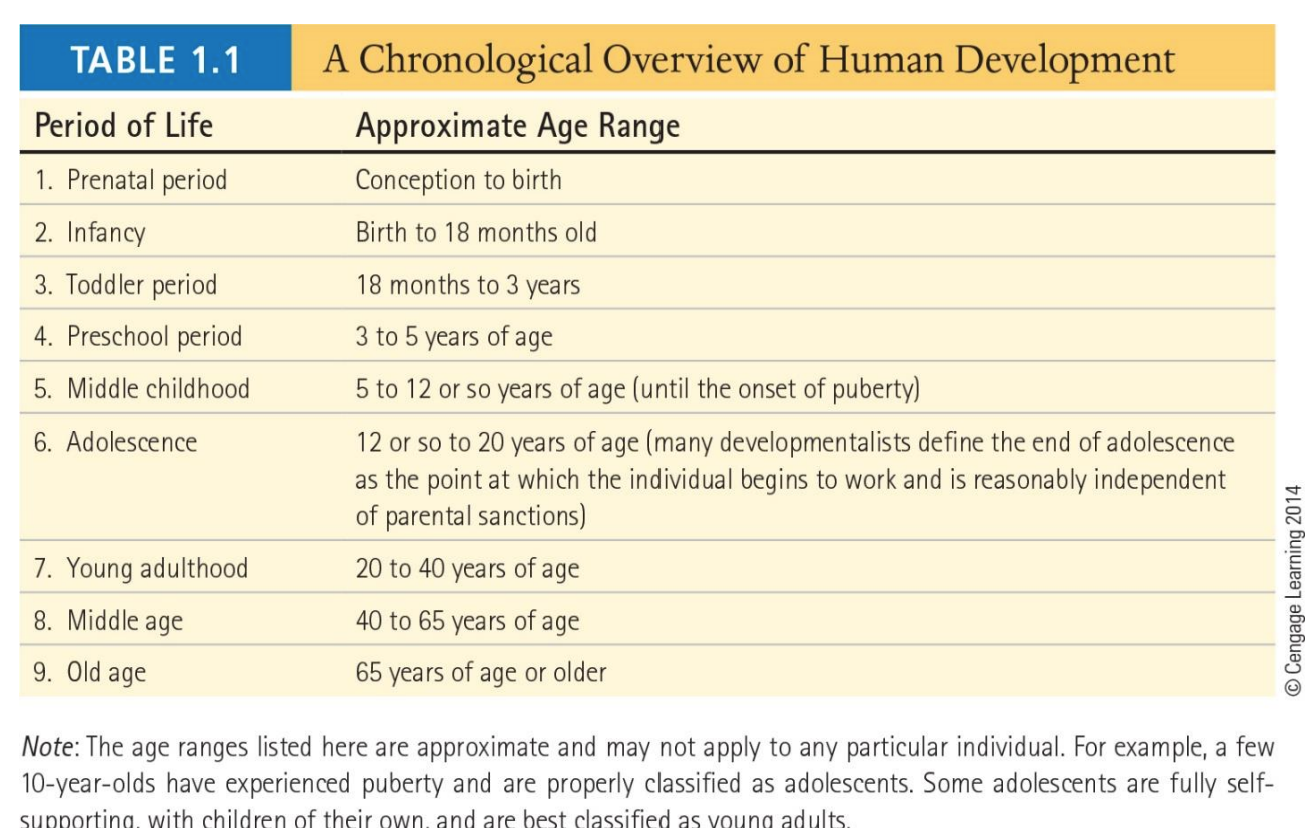
Chronology of Development
adolescence (during puberty) - changes in PFC, amygdala, all the brain changes
primary periods are also important but not as significant
Early Philosophical Perspectives on Childhood
17th and 18th century philosophers
not scientific, philosophical but strongly influenced later childhood theories
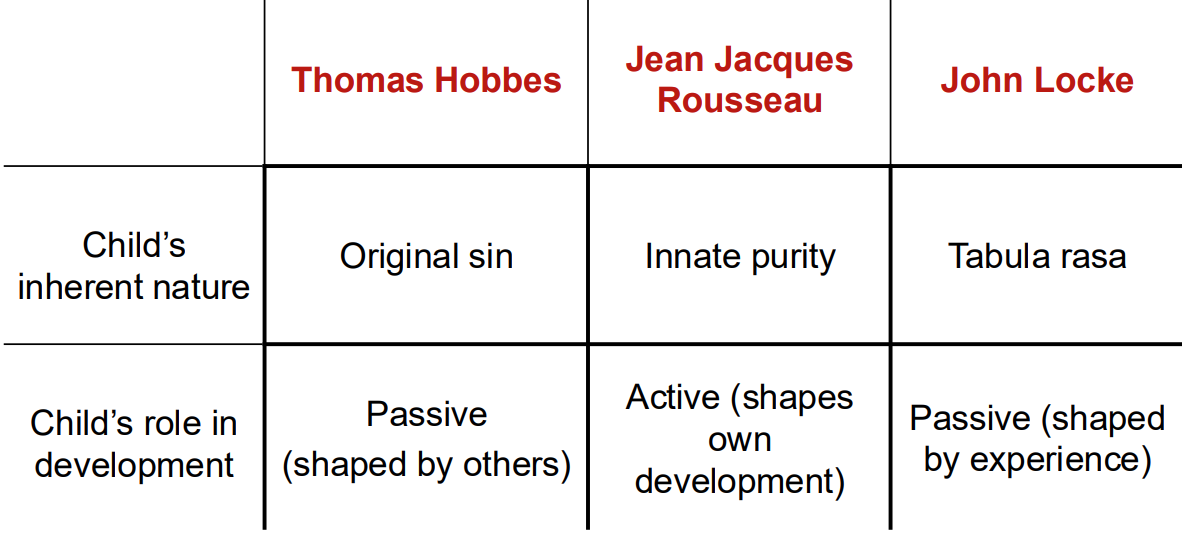
Thomas - adults take part in shaping children’s behaviour
Jean - children are naturally good, learn by exploring + interacting w env, play an active role in their own development
John - blank slate, children born w/o any innate ideas, and experience shapes who they become, passive role b/c they are shaped by experience rather than environment
Children as Subjects of Study
The baby biographies and diaries
Recorded development of own children
Charles Darwin, Clara and William Stern, Jean Piaget
Problems with this method
Subjective → bias
Lack of generalizability; often only one or a small number of children studied
Example of Early Child Diaries: William and Clara Stern (Children’s Talk)
The diaries William and Clara Stern recorded for their children led to the publication of Die Kindersprache (Children’s Talk), which became a classic in the language acquisition literature.
early important work on language dev
Research Methods in Developmental Psychology
Theories lead to hypotheses
Scientific method is followed
Investigators must be objective and replicable
Data determine merits of theory; Scientists don't collect evidence to prove themselves right, they collect evidence to test whether their ideas are correct.
if data doesn’t support theory, it must be revised or rejected
Basic Fact-Finding Strategies
Is a particular test a good measure of development?
Must be both reliable and valid
Reliability: Does the test give consistent outcomes each time? (consistency - administering measure under the same conditions should yield the same results)
Validity: Does the test really measure what it purports to measure? (assesses what you’re interested in)
Contemporary Methods of Measuring Development
Self-report methods
Observational methods
Case studies
Ethnography
Psychophysiological methods
Self-Report Methods
Self-report methods (relies on participants and their own thoughts/feelings)
Structured interviews: researcher asks set series of questions
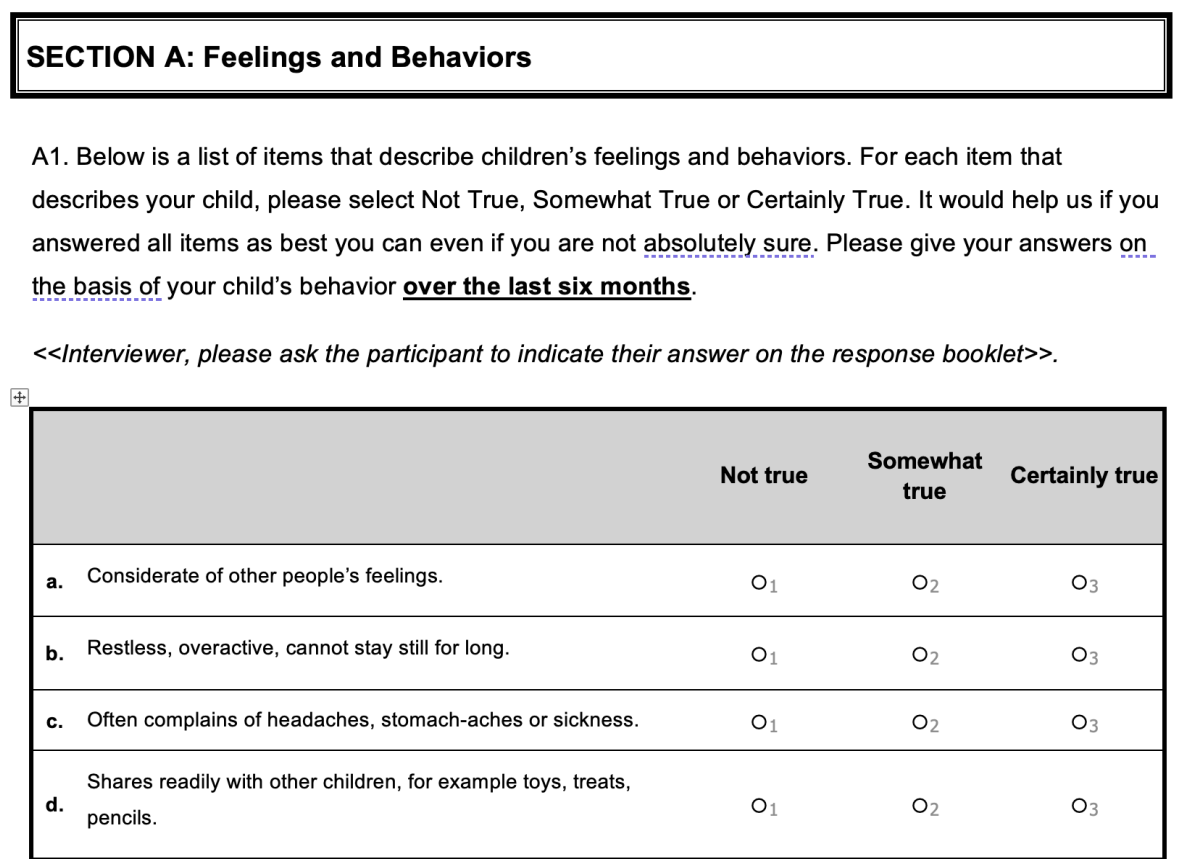
Structured questionnaires: questions/answers are written (e.g., strengths/difficulties questionnaire SDQ)
Clinical method: free-form interview (questions are asked to gain more info)
Limitations
Not useful with very young children
Honesty/accuracy?
Interpretation of question
pros: easy to administer
parents often overrate their children
Example of Self-Report Methods: ParentReport on the Child
Strengths and difficulties Questionnaire (SDQ)
SDQ often administered in longitudinal studies to see changes during different environments (e.g., changing schools, etc.)
Observational Methods
Observational methods
Naturalistic: observing children in natural surroundings (e.g., home, school)
Structured observation: a laboratory situation designed to elicit specific behavior (controlled setting to illicit certain behaviours like exposure to toys, objects, etc. and to see their responses)
Time-sampling: frequency of behaviour recorded in brief observation intervals
Limitations
Observer influence; Children may behave differently simply because they know someone is watching them
May be difficult to determine cause of behaviour (although it provides effective observations?)
Case Studies Method
Case studies
Detailed record of an individual/group’s development
Interviews
Observations
Generally not standardized
Limitations
Difficult to make comparisons
Generalizability
methods used not always standardized
good for providing insight into development, especially rare conditions
small sample size makes it difficult to compare
Ethnography Method
Ethnography
Common method in anthropology
Researcher lives in community for period of time
Goal is to understand effect of culture on development
Limitations
Highly subjective
Generalizability to other cultures
Psychophysiological Methods
Psychophysiological methods
Goal to understand biological processes involved in perception, cognition, emotion
Measures used include (heart rate; ERPs event related potential; fMRI; eye tracking.)
Limitations
Expensive
May be difficult to determine which aspect of stimulus drives biological response
Susceptible to interference from other biological processes
Detecting Relationships
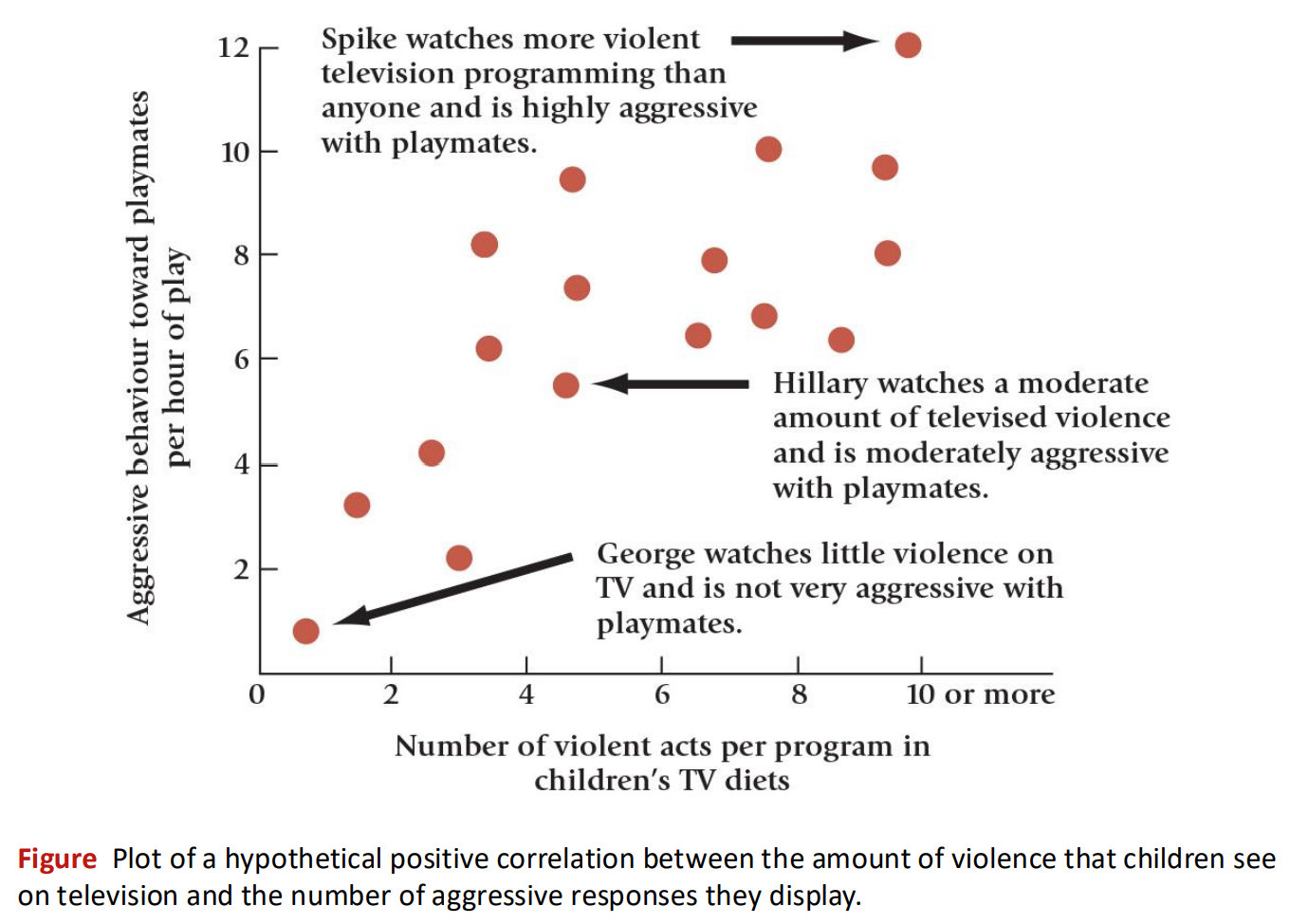
Correlational design
Goal: to determine whether two things/variables are related
Is viewing violence on TV related to aggressive behaviour in children?
1. Gather data: interview about TV habits, make observations of aggressive behaviours
2. Calculate correlation coefficient, r
Detecting Relationships
What is r?
Index of strength and direction of relation
Varies from −1.00 → +1.00
Strength indicated by absolute value – +0.70 and −0.70 are equally strong, and both are stronger than +0.35 and −0.35
Which is stronger: +0.25 or −0.64?
r = 0.0 means no relationship exists.
Cross-sectional design
People of different ages studied at the same point in time
One task; multiple age groups participate
Disadvantages:
• Is there a difference between age groups? Cohort effects?
how diff age groups respond to different measures
gives data simultaneously w/o having to wait for children to grow
cohort effect - specific groups may be more advantaged/outperform other groups due to their experiences (may not be due to age)
Longitudinal design
Same participants observed repeatedly over time
Time period may be brief (6 months–1 year)
Some have lasted decades.
Disadvantages: Practice effects? Selective attrition? Nonrepresentative sample? Cohort effect?
tracks dev changes + provide valuable insight into how people evolve over time
practice effect - participants become habituated to the measure (so some measures are age-specific to follow w the same measure but increasing difficulty based on age)
selective attrition - cannot maintain the sample size over time → leads to nonrepresentative sample that may not effectively represent the broader population
cohort effect - sample size may be too small to be representative in certain studies
Sequential design
Combination of cross-sectional and longitudinal
Participants of different ages selected at outset (like cross-sectional)
All participants observed repeatedly for a period of time (like longitudinal)
identifying age-related effects + cohort effects
Ethical Considerations
All children who participate in research have the right to:
protection from harm (physical/psychological)
informed consent (from the parent/guardian as well as child themself if they are a youth)
confidentiality
debriefing (explanation of research)
knowledge of results
also ensuring incentive doesn’t influence their participation
Nature of Scientific Theories
A set of concepts and propositions that describe, organize, and explain a set of observations
What makes a theory good?
Must be parsimonious - simple as possible while also still explaining observations
Must be falsifiable - should be possible to prove it wrong, allows possibility for testing + challenging theory through research/observations
Must have heuristic value - supports future research (e.g., Paget theory of cog development inspired many studies + future developments, it is foundational and still referred to as of today)
Sigmund Freud’s Psychoanalytic Theory
Conflict of individual’s instinctual impulses and societal norms for behaviour
Role of the unconscious (most behaviours influenced by unconsciousness)
Sexual and aggressive drives
emphasized significance of early childhood experiences in adulthood
Three components of personality
Id: innate, compelled by drives (operates pleasure principle) - hunger, sex, aggression, seek immediate gratification of impulses without thinking of consequences
Ego: conscious, rational (reality principle) - balances needs of id with reality and what is socially acceptable (context)
Superego: internalized moral standard (Perfection) - societal values + moral rules, judging actions + thoughts → often leads to feelings of pride or guilt
Freud’s stages of psychosexual development
Concept of “sex” very broad
Stages propose shifts in focus on parts of body
1. Oral (birth–1 year)
2. Anal (1–3 years) (bowel - potty control)
3. Phallic (3–6 years) (awareness of body parts)
4. Latency (6–11 years) (sexual impulses are dormant, but social relationships emerge here)
5. Genital (12 years onward) (sexual interests, relationships)
Fixation (can occur if a stage is not properly resolved, leading to issues in adulthood) - conflicts during one stage remains unresolved which may influence child’s personality later in life in adulthood
e.g., excessive feeding (oral) or ignoring during a stage → may develop personality or behaviour related to mouth in adulthood (smoking, overeating, nail biting as an example)
pleasure shifts to different parts of body during development
Psychosocial Theory - Freud’s psychosexual theory
Contributions
Idea of unconscious motivation - much of behaviour influenced by unconscious desires + conflicts
Focus on later consequences of early experiences (e.g. childhood abuse may shape behaviour in adulthood)
Criticisms
No empirical evidence of early conflicts affecting adult personality
Erik Erikson’s psychosocial development - expanded Freud’s legacy
A neo-Freudian - expanded on Freud’s ideas but introduced significant changes
Viewed children as more active and adaptive in developmental process than Freud
Far less emphasis on sexual urges
More emphasis on social and cultural influences on development
Lifespan perspective of development (not just childhood experiences)
More accepted + popular than Freud’s theory
Learning Theory - John B. Watson’s behaviourism
Only overt behaviours should be measured and analyzed. (rather than internal states like thoughts + feelings, as they are difficult to measure)
Strong emphasis on environmental influences in shaping behaviour
Recall Locke’s tabula rasa - we’re born as blank slates and we learn from environmental experiences
Development is continuous and based on learning.
“Little Albert” experiment - conditioned response (loud noise) to neutral stimulus (rat)
Learning Theory - B. F. Skinner’s radical behaviourism
Outlined principles of operant conditioning (method of learning focusing on consequence of behaviour)
Focus on outcome of behaviour for predicting future occurrences of that behaviour (repeated behaviours)
Reinforcers ↑ probability of behaviour occurring again. (praising for hw)
Punishers ↓ probability of behaviour occurring again.
Learning Theory - Albert Bandura’s cognitive social learning theory
More emphasis on cognitive processes
“Bobo experiment” - show adult punching the toy to child, adult exits, and child carried out the same action
Observational learning stressed
Learning by observing others (models) - through imitation (siblings doing hw)
Not dependent on reinforcement
Proposed reciprocal determinism
• Environment <-> Child (2-way interaction) - env influences child’s behaviour and vice versa
Learning Theories - Contributions + Criticisms
Contributions
Precise and testable
Knowledge about basic learning from well-controlled tests
Practical applications (behaviour modification)
Criticisms
Oversimplified - focuses exclusively on observations and doesn’t consider cognitive development, genetic influences, and ecological context (social/cultural factors that influence behaviour), cognitive changes over time (how thinking, memory, problem solving develops)
Ignores genetic contributions to behaviour
Ignores ecology
Ignores changes in cognitive abilities
Cognitive-Developmental Theories - Jean Piaget
Schemes become more complex with development. (mental framework to understanding the world)
An organized pattern of thought or action a child uses to make sense of experience (schemes become increasingly complex)
Create new schemes to adapt to disequilibriums experienced in the environment and in response to biological maturation (diseq do not fit in current schemes - brain would make a new scheme or make one adapt to the env)
Interpretation of the world changes with age.
Cognitive-Developmental Theories - How do children use schemes?
Assimilation
Using an existing scheme to interpret a novel experience (observing a dog vs cat → stored in same memory “folder”)
Accommodation
Modifying an existing scheme to incorporate new experiences (dog barks, cat meows/is more quiet, dog bigger, cat smaller, etc.)
Cognitive-Developmental Theories - Overview of Piaget’s stages of cognitive development
Cognitive dev stored in 4 stages:
Sensorimotor / Birth–2 years / Exploration using senses, motor coordination improves
Preoperational / 2–7 years / Usage of symbols → not fully logical and still struggle with perspectives outside of their own
Concrete Operations / 7–11 years / Logical thought - mental operations on concrete objects + events
Formal Operations / > 11 years / Abstract thought
Cognitive-Developmental Theories - Piaget’s cognitive-developmental theory
Contributions
Focus on how children think
Field of social cognition (diff behaviours toward parents, peerds)
Educational applications
Strong influence on other theories
Criticisms
Underestimates abilities of children - may perform well at younger ages
Children can be trained. - to develop certain skills earlier than Piaget’s predictions
Cognitive-Developmental Theories - Kohlberg’s Stage Theory of Moral Development
Lawrence Kohlberg
Applied Piaget’s cognitive-developmental approach to moral development
Formulated a stage theory of moral development
interested in how people develop right/wrong + how this develops w age
expanded on Piaget’s ideas - huge impact on psychology + education
Sociocultural Theories - Vygotsky’s sociocultural perspective
Children acquire their culture’s values, beliefs, and problem-solving strategies through interacting with knowledgeable members of society. (parents, teachers, peers, etc. help them internalize tools + ways of thinking to develop cognitively)
highlights that learning is a deeply social process, and that the development of higher mental functions is rooted in the cultural context in which a child is raised.
important of social interactions + culture on development
Vygotsky’s sociocultural perspective - Contributions + Criticisms
Contributions
Cognitive development varies across cultures
Culture influences every aspect of development
Criticisms
Heavy emphasis on role of language in instruction (will underestimate role of individual cognitive processes, ignores that every child is unique)
Difficult to test empirically. (due to dependence on cultural context)
Theories are Not Facts, They are Lenses
Why does behavior change with age?
Theory → explanation
Freud → Early conflicts
Erikson → Social challenges
Behaviorism → Reinforcement history
Bandura → Models + cognition
Piaget → Cognitive restructuring
Vygotsky → Social + cultural mediation
Same behaviour, multiple possible causes
photo - July 3rd
use of theories through different lenses/perspectives
which theory/combination of theories effectively explains behaviour based on evidence → and how do you collect evidence? through interviews, valid + reliable measures, etc.
good to look at all perspectives