Ch V : role of proteolysis in cycle regulation

0.0(0)
Studied by 0 people
call kaiCall Kai
Locked
learnLearn
examPractice Test
spaced repetitionSpaced Repetition
heart puzzleMatch
flashcardsFlashcards
GameKnowt Play
Card Sorting

1/6

flashcard set

Earn XP

Description and Tags

cellular biology

Last updated 8:13 PM on 10/19/25
Name
Mastery
Learn
Test
Matching
Spaced
Call with Kai
Chat

No analytics yet

Send a link to your students to track their progress

7 Terms

1
New cards

why is cyclin proteolysis regulation necessary

allows proper cell cycle porgression
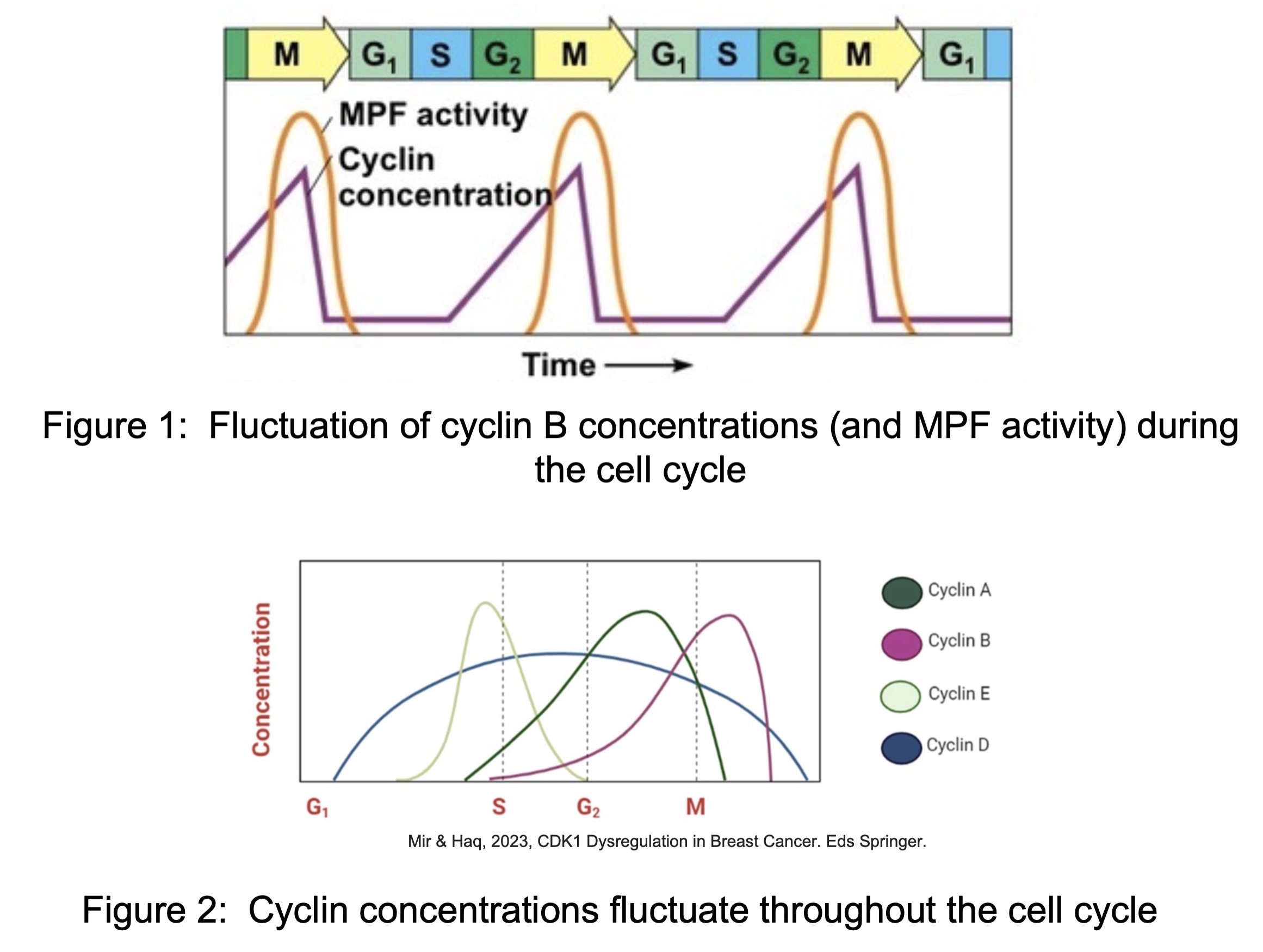

<p>allows proper cell cycle porgression</p><p></p>
2
New cards

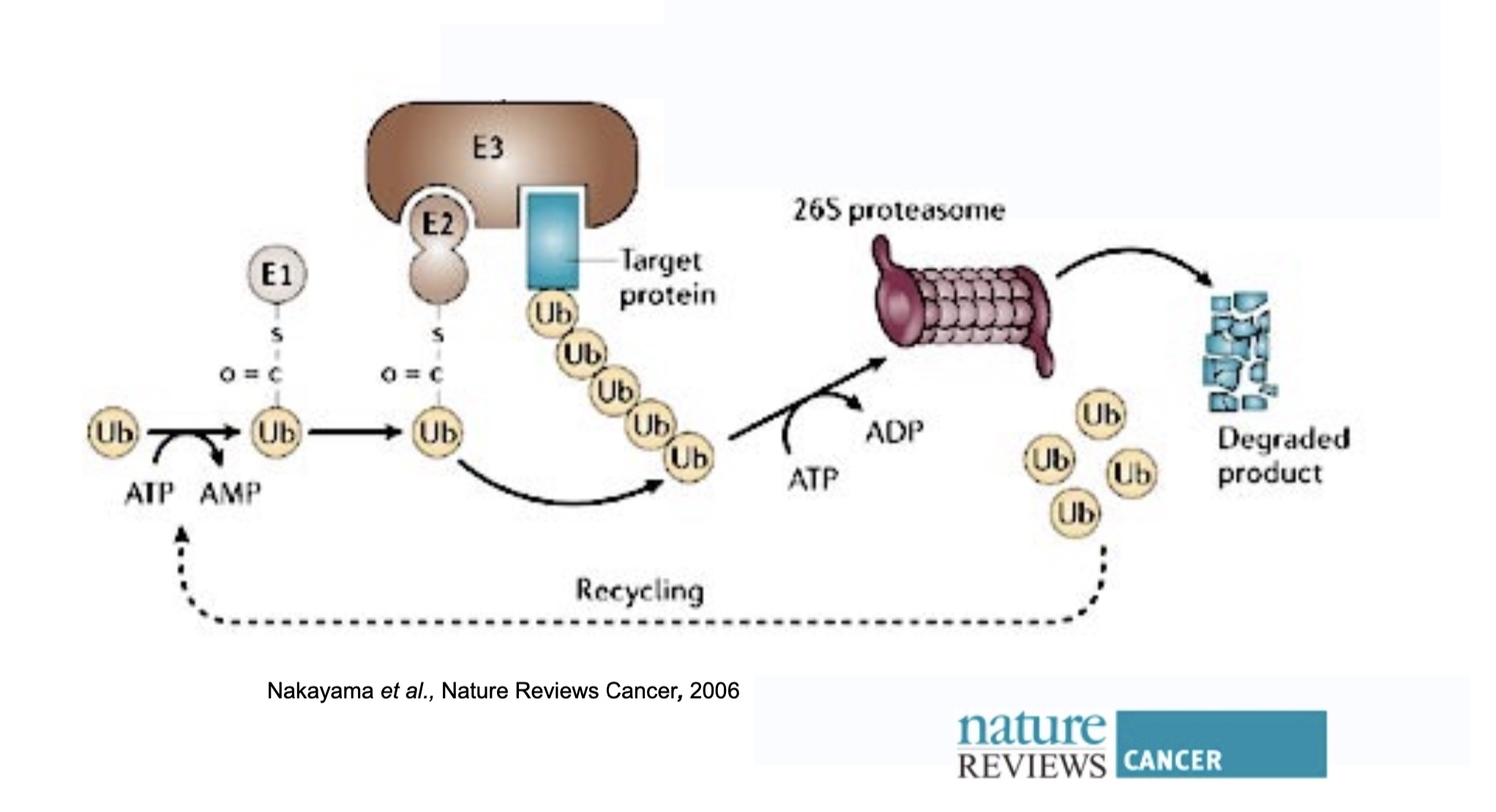
how does ubiquitiniation and recognition of proteasome induce proteolysis

Ub + ATP → Enzyme1 binds to Ub → Ub activated

activated Ub transferred to E2

E2 (w/ Ub) interacts w/ E3 and brings together Ub and target protein (which binds to other BS on E3)

1st Ub binds to Lys on target protein (repeated)

when Ub tail long enough the 26S proteasome recognises it → target protein degraded and Ub released (recycled)
<p>Ub + ATP → Enzyme1 binds to Ub → Ub activated </p><p>activated Ub transferred to E2</p><p>E2 (w/ Ub) interacts w/ E3 and brings together Ub and target protein (which binds to other BS on E3)</p><p>1st Ub binds to Lys on target protein (repeated)</p><p>when Ub tail long enough the 26S proteasome recognises it → target protein degraded and Ub released (recycled)</p>
3
New cards

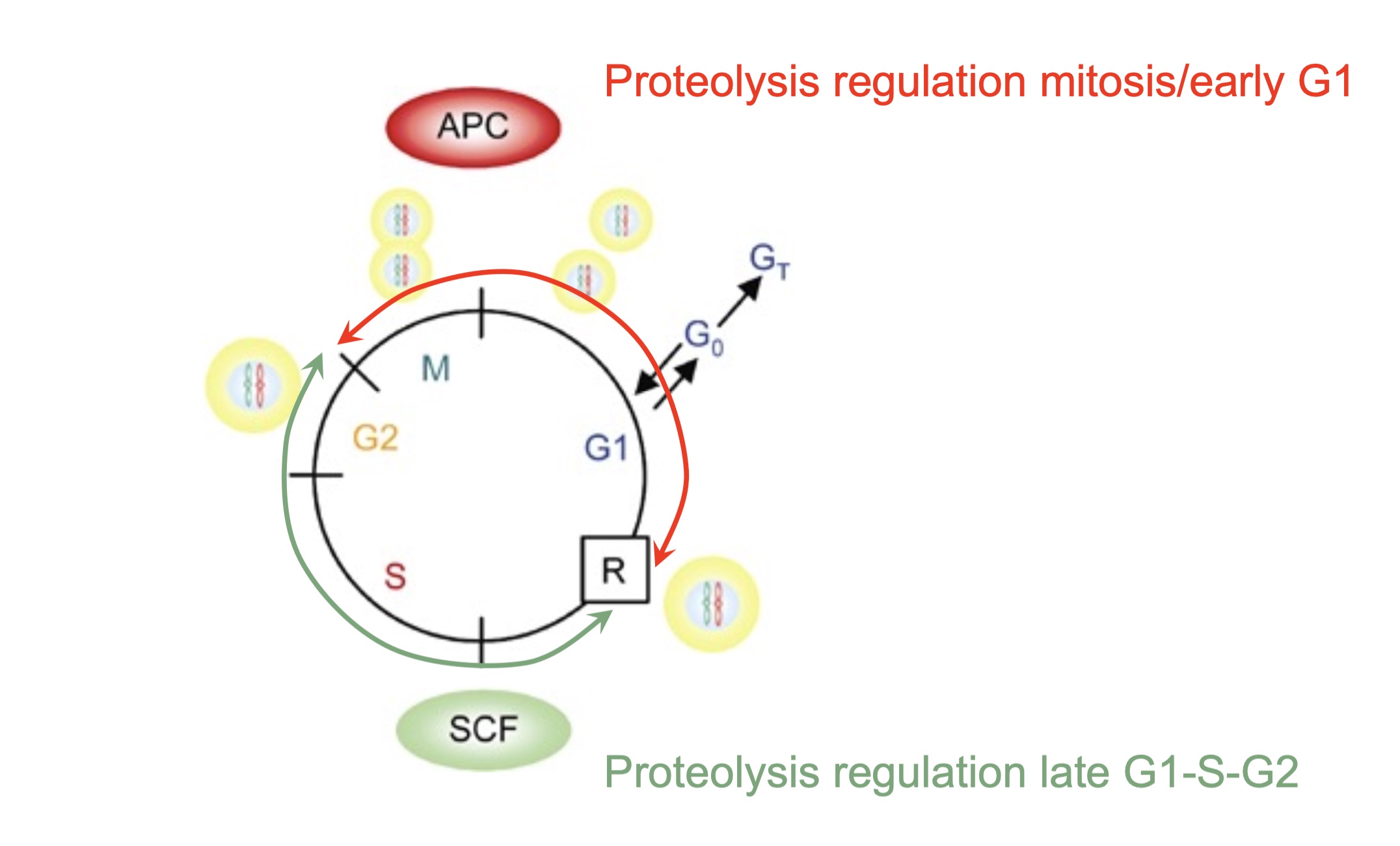
what are the two types of E3 ligase and how are they implicated in cell cycle control

APC/C = Anaphase Promoting Complex/cyclostome (mitosis/early G1)

  • active in early G1

  • trigger anaphase by degrading securin (allow chromatin separation) and cyclin A/B (to exit mitosis)

=> control M and reset into G1

SCF = Skip 1 Cullin F box protein complex (G1→S→ G2)

  • active from late G1 to G2

  • prevents DNA replication by degradation of CKIs, targeting TFs (EIIF) and Wee1 for degradation 

=> controls progression through interphase

<p><strong>APC/C = Anaphase Promoting Complex/cyclostome (mitosis/early G1)</strong></p><ul><li><p>active in early G1</p></li><li><p>trigger <strong>anaphase</strong> by <strong>degrading securin</strong> (allow chromatin separation) and <strong>cyclin A/B </strong>(to exit mitosis)</p></li></ul><p>=&gt; control M and reset into G1</p><p><strong>SCF = Skip 1 Cullin F box protein complex (G1→S→ G2)</strong></p><ul><li><p>active from late G1 to G2</p></li><li><p>prevents DNA replication by <strong>degradation of CKIs</strong>, <strong>targeting TFs</strong> (EIIF) and <strong>Wee1 for degradation&nbsp;</strong></p></li></ul><p>=&gt; controls progression through interphase</p><p></p>
4
New cards

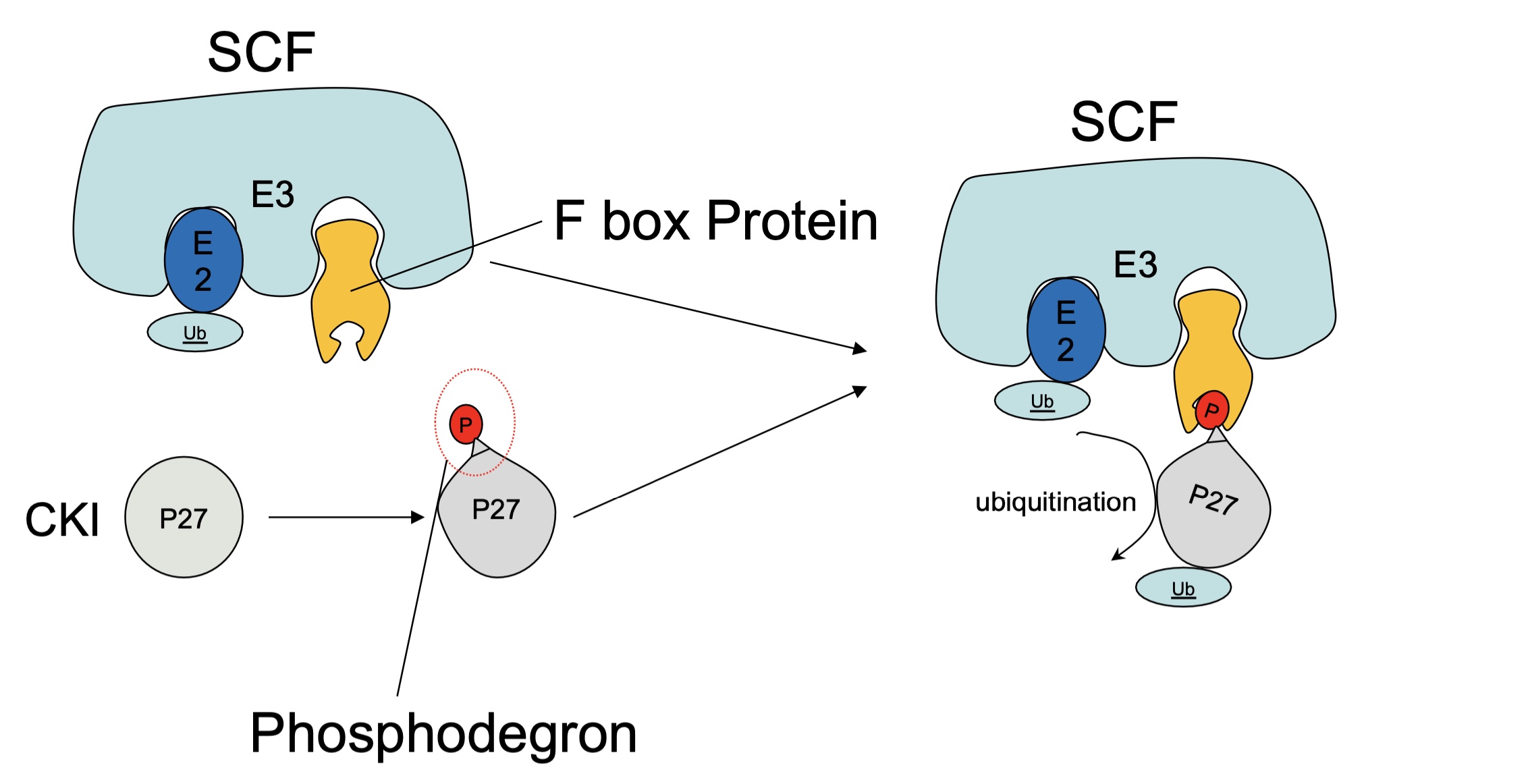
role of Fbox proteins (SCF) as substrate receptors/SCF

SCF key substrate = F box protein

when substrates/protein (e.g CKI) are phosphorylated (= phosphodegron) it signifies a  signal for degradation

F box bound to E3 SCF will recognise the phosphodegron and induce Ub by E2 → target protein (e.g CKI) degradation 
<p>SCF key substrate = F box protein </p><p>when substrates/protein (e.g CKI) are <strong>phosphorylated (= phosphodegron)</strong> it signifies a&nbsp; signal for degradation</p><p>F box bound to E3 SCF will recognise the phosphodegron and induce <strong>Ub</strong> by E2 → target protein (e.g CKI) degradation&nbsp;</p><p> </p>
5
New cards

role od CDC20 and CDH1 as substrate receptors of APC/C

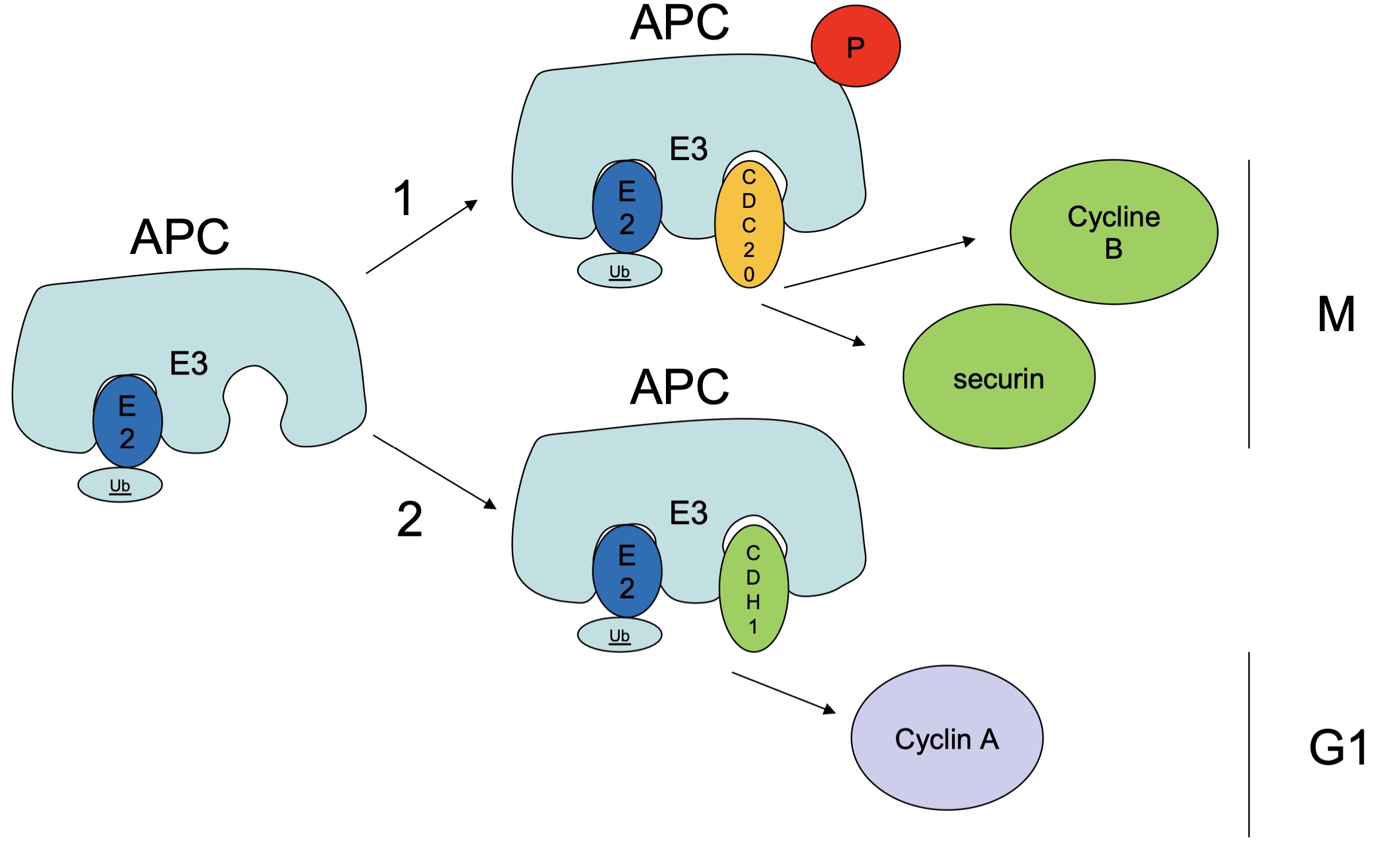
APC E3 1st pocket corresponds to E2 BS and the 2nd pocket binds either cdc20 or cdh1

Metaphase → anaphase :  APC phosphorylated will allow interaction w/ cdc20degradation of cyclin B and securin by Ub 

G1 : APC not phosphorylated will interact w/ cdh1degradation of cyclin A by Ub


cdc25 and cdh1 recognise specific AA sequence = D box or Ken box on target proteins 
<p>APC E3 1st pocket corresponds to E2 BS and the 2nd pocket binds either cdc20 or cdh1</p><p><strong>Metaphase → anaphase</strong> :&nbsp; APC <strong>phosphorylated</strong>  will allow interaction w/ <strong>cdc20</strong> → <strong>degradation</strong> of <strong>cyclin B</strong> and <strong>securin</strong> by Ub&nbsp;</p><p><strong>G1 </strong>: APC <strong>not</strong> phosphorylated will interact w/ <strong>cdh1</strong> → <strong>degradation</strong> of <strong>cyclin A</strong> by Ub</p><p></p><p>cdc25 and cdh1 recognise specific AA sequence = <strong>D box or Ken box</strong> on target proteins&nbsp;</p>
6
New cards

how does MPF (cyclinB/CDK1) regulate APC/cdc20 and APC/cdh1 to mediate proteolysis

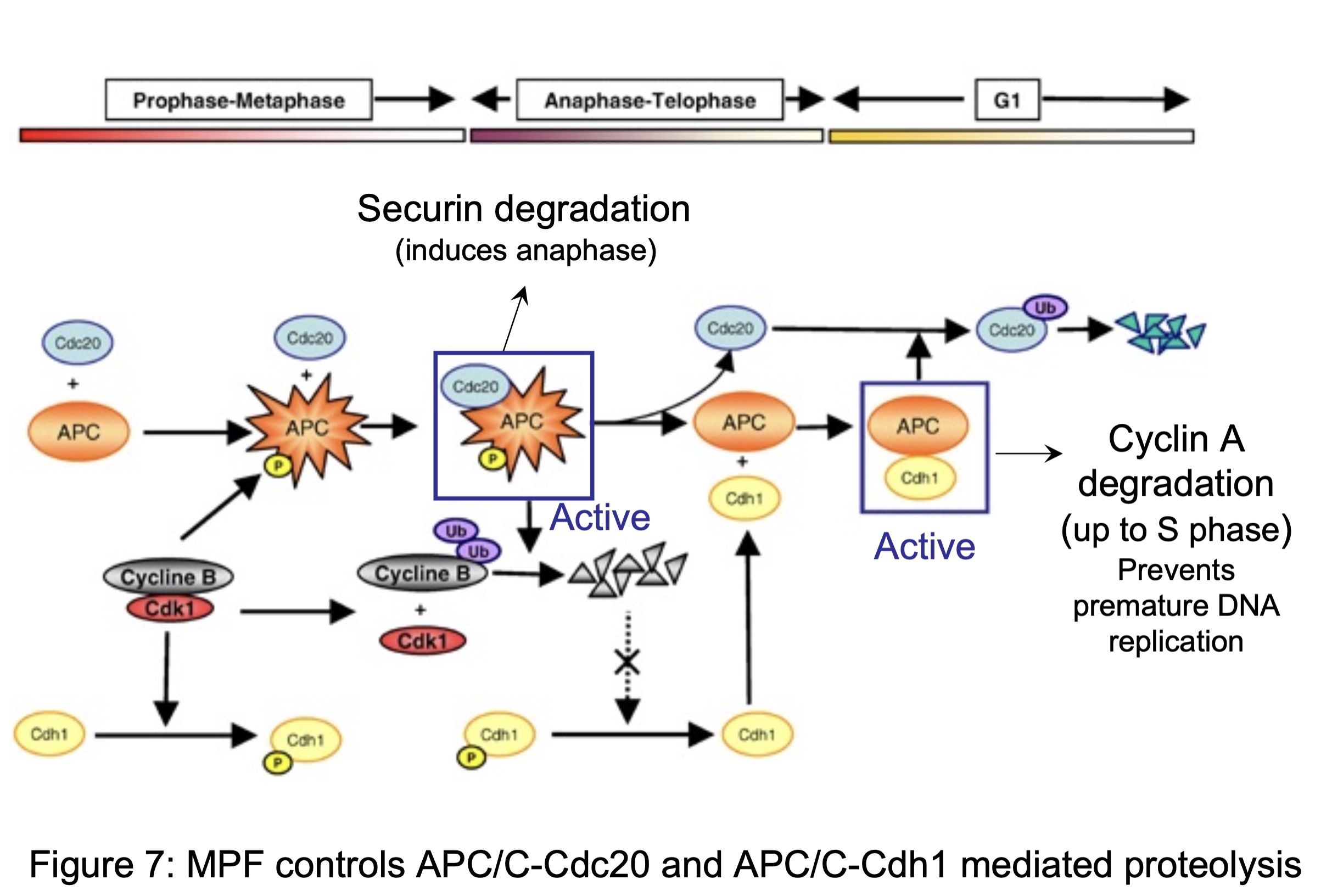
MPF will phosphorylate cdh1 and phosphorylate APC —

  • P-APC interacts w/ cdc20 → degradation of securin (induces anaphase) and degradation of cyclin B → dissociation of cyclin B from CDK1 (no longer MPF)

  • inactive MPF increases phosphatase activity → de-phosphorylation of APC/cdc2o and cdh1

  • P-APC dissociates from cdc20

  • APC (now un-phosphorylated) can interact w/ cdh1

  • APC/cdh1 complex active to degrade cyclin A and cdc20

<p>MPF will phosphorylate cdh1 and phosphorylate APC — </p><ul><li><p>P-APC interacts w/ cdc20 → degradation of <strong>securin</strong> (induces anaphase) and degradation of cy<strong>clin B </strong>→ dissociation of cyclin B from CDK1 (no longer MPF)</p></li><li><p><strong>inactive MPF</strong> <strong>increases</strong> <strong>phosphatase activity</strong> → de-phosphorylation of APC/cdc2o and cdh1</p></li><li><p>P-APC dissociates from cdc20 </p></li><li><p>APC (now un-phosphorylated) can interact w/ cdh1</p></li><li><p>APC/cdh1 complex active to <strong>degrade cyclin A</strong> and <strong>cdc20</strong></p></li></ul><p></p>
7
New cards

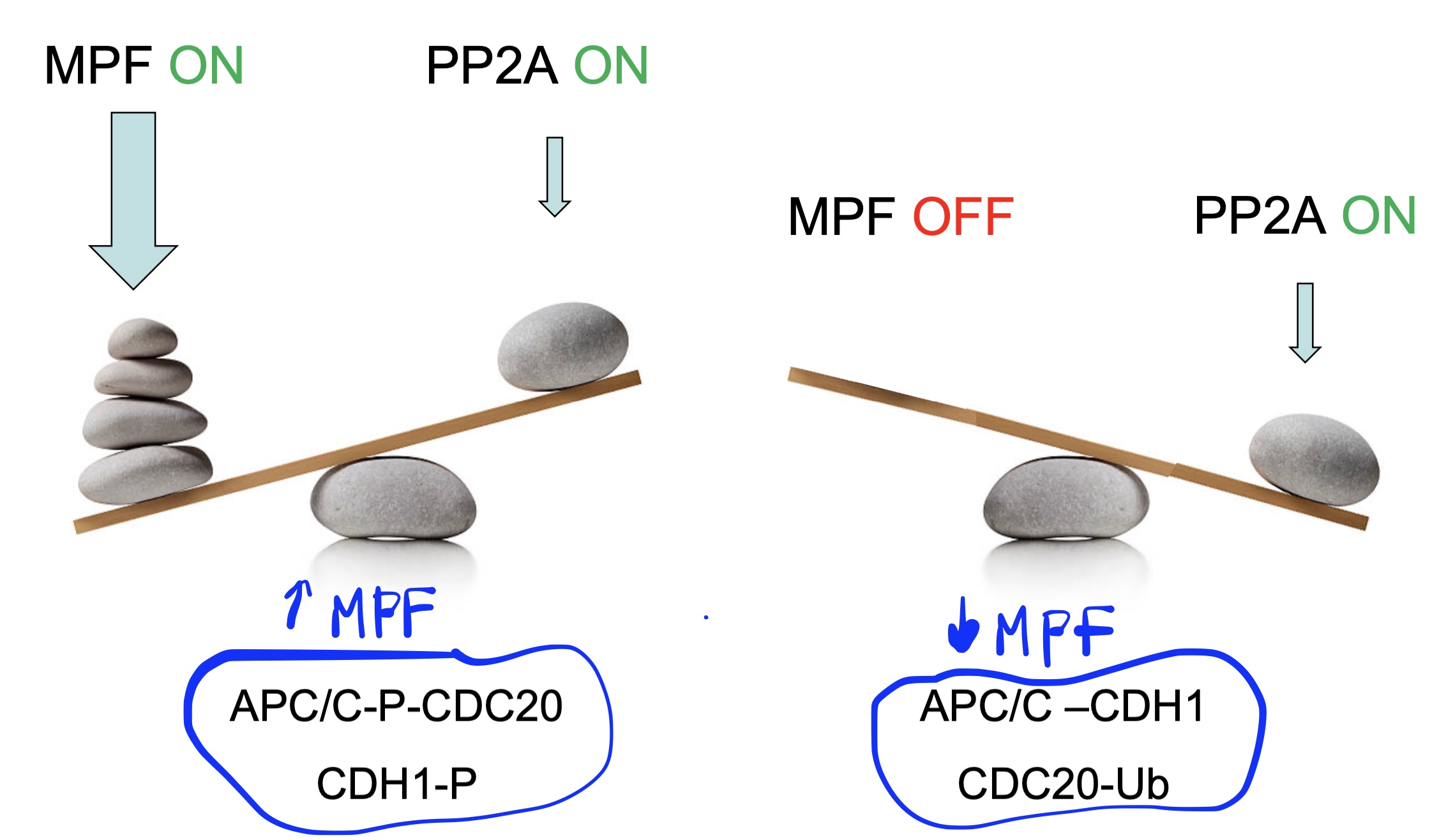
what is the relationship between MPF and phosphatase (PP2A)
knowt flashcard image



