Week 4 - microbial growth & bioprospecting
 Call Kai
 Learn
Learn Practice Test
 Spaced Repetition
 Match
Match Flashcards
 Knowt Play
1/88

There's no tags or description
Looks like no tags are added yet.
Name | Mastery | Learn | Test | Matching | Spaced | Call with Kai | Chat |
|---|
No analytics yet
Send a link to your students to track their progress
89 Terms
What is a microbial culture?
Method of growing microbes in the lab
Controlled environment
What are the parameters controlled in microbial cultures
Temperature
Nutrients (C. N, P, etc.) & water
Agitation (mixing)
pH
O2
Time (most crucial e.g. time to grow/ produce)
How do microbes grow/replicate?
Main mode in prokarya (bacterial & archea): Binary fission
Exponential growth
Aesexual - daughter cells are clones
Mutations can still occur!
What are the significance of mutations and their impact on microbes
This is a source of genetic variation
Often are neutral/ deleterious but sometimes can be advantageous
Beneficial traits selected for adaptation
Describe the process of binary fission
Circular chromosome has an ORI - replication bubble opens and DNA polymerase begins replicating
Replication fork expands
Simulatenously, both the old and new strand are attached at separate points of the membrane (anchored here)
Growth of cell wall (new proteins) and plasma membrane (new phospholipids) between attachement points
Chromosomes separate
Fstz stimulate plasma membrane and cell wall to grow inward (starts to separate cell into two halves)
Fstz (filamenting temperature sensitive mutant z)
Two daughter cells (Ea. Have chromosome, and roughly half cytoplasm - virtually same)
repat cycle
Describe Fstz discover, function y & what organisms its found in
Fstz (filamenting temperature sensitive mutant z)
function: Fstz stimulate plasma membrane and cell wall to grow inward (starts to separate cell into two halves)
discovered: in E.colu in 1960s as a temp. sensitive protein
organisms: later found to be universal across all(ish) bacteria, most archea, plant chloroplast, mitochondria (of unicellular - lesser eukaryotes)
How long does one binary fission cycle take?
generation time (or doubling time, tD, DT, td)
Time taken to double during balanced growth (in optimal conditions)
Differ between species (even in optimal)
Why does generation time differ between species even in optimal conditions
Complexity
e.g. bigger chromosome will generally take longer
Speed of metabolic steps
e.g. if evolved to withstand rougher environemnt, steps will take a long time, even in optimal
Can vary between 20minutes (e.coli) to 12-14 days (Mycobacterium leprae)
What is the growth curve?
curve that descrives microbial growth
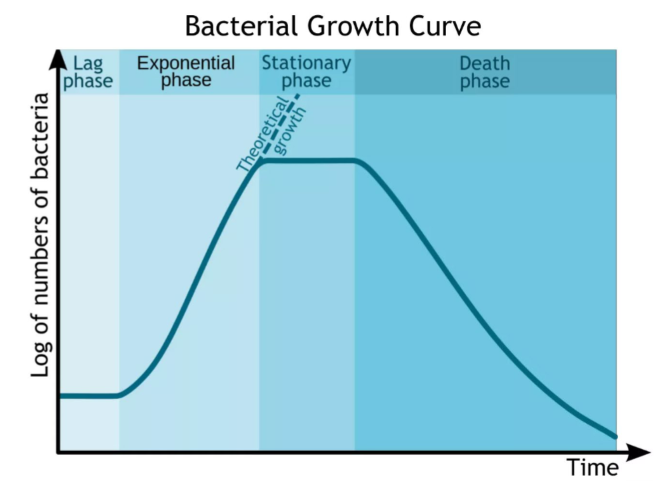
Describe the trend/shape of the growth curve
If no limiting factors -> exponential
However, this is theoretical.
Slowly nutrients deplete, waste accumulates in medium -> cells become stressed -> slows growth/ death
Exponential growth is temporary
What organisms follow the growth cuve?
Growth curve universal shape in microbes; only thing that differs is time in each stage
What is the specific growth rate & symbol
Mu - μ -> specific growth rate
How fast population increase per time unit
How can we calculate specific growth rate at a given time? - formula
μ= 1/N * dN/dt
N = number of cells
Cell concentration (cells/mL) or biomass concentration (g/L)
dN = change in cell number
Dt = change in time
Explain how the formula is obtained?
μ= 1/N * dN/dt
How fast population increase per time unit
dN/dt = gives rate but does not account for disparity in cell numbers
e.g. very different for 100 cells to produce 1 vs 1 cell to produce 1
thus divide by N
What are the three methods to measure biomass / number of cells? Describe the two basic/rare ones (process, limitations/pros) - and name the most common method.
Classic/traditional method:
Process:
Take aliquot of cells in flask
Take small known volume (e.g. 1μL)
Put under microscope and physically count
Cons: very tedious and boring (take long time)
Flow cytometry
Process:
Has capillary with very very small diameter (only lets one cell throught at a time)
Beam of light shines + counts
Cons: very expensive, not all have acess
Spectrophotometry (OD600) (most common)
What are the pros of spectrophotometry
Benefits:
Small and sits on bench
Cheaper
Quick - data given in seconds
Describe process of spectophotometry
Measure OD600 of sample
Has optical density - light wavelength of 600
Put sample in cuvette + machiene
Light goes through
Fresh medium is clear - all light passes
The more biomass, the more cloudy - greater turbidity
Light asborbed by fluid or scatters (optical density) + recorded by dector
Amount scattered gives us a OD600 value
Calibration curve:
Do experiement with known samples and measure their OD600
Plot the ratio of OD600:cells/mL on curve -> calibration curve
Calculate :
Take OD600 of our unknown sample + find its corresponding cell number in the curve
Why is calculating cell number important in industry?
In bioreactors/fermentation tanks need to carefully regulate and monitor conditions - this method offers a quick way
Describe the lag phase of growth curve
No growth
Physiological adaptation i.e. cells metabolising to prepare for growth
Length dependent on:
Species
History of culture (e.g. if from -80C tank may take more time)
Preservation method
State of cell (is it damaged, death phase, etc.)

Describe the log phase of growth curve

Exponential growth here
Maximal growth rate (if perfect optimal conditions) is μmax
Unique to species and conditions
May approach it, but rarely sustained as:
Limting conditions of rate:
Grow rate limited by nutrient, toxic waste, temperature, or pH
Biotech aims to maximise for industry
Describe Stationary phase of growth curve
Growth rate balanced by death (net 0)
Due to depleated essential nurtrients, waste inhibiting growth
Normal cell functions remain
e.g. energy metabolism, metabolite biosynthesis
Describe death phase of growth curve
If incubation continued, cell death exceeds growth
Sometimes includes cell lysis
Rate of death of often slower than rate of growth (in exponential phase)

If goal is to produce biomass quickly what phase of growth curve must be sustained?
sustain exponential phase
Industry cares - money
If goal is to produce primary metabolite production what phase of growth curve must be sustained?
exponential phase
Industry cares - money
If goal is to produce secondary metabolite production what phase of growth curve must be sustained? What is an example of them?
(e.g. antibiotics) -> stationary phase
Industry cares - money
What are the types of microbial culture compositions?
Pure cultures
Mixed cultures
What are pure cultures? Why are they used?
Single organism present
Why are they used?
For specific product e.g. one metabolite or one organism
e.g. e.coli for insulin; l.baccilis for yakult
What are mixed cultures? Why are they used?
Multiple organism present - community of microbes
Why are they used?
For tougher jobes, several steps + complex; need more robustness
e.g. wastewater treatment (lecture 3)
What is required to scale up from lab to industry?
Scale up is from flask (mLs) to bioreactor (1000sL)
Need to control environment to maximise growth/production:
Volume increases dramatically making this harder
use a bioreactor for this
What is the problem with lack of O2 delivery in industry cultures
slow growth as 99% are aerobic (may even lead to death + mean we have to restart whole process)
What is the problem with lack of mixing in industry cultures
uneven growth & production - clump
What is the problem with lack of heat removal in industry cultures
death/product loss
What is the problem with lack of waste removal in industry cultures
toxicty/death
What is a bioreactor
A vessel that maximises conditions for microbe
What conditions do bioreactors control?
O2
Nutrients
Temperature
Waste
pH
What do bioreactors maximise?
Maximise growth rate, product yield
Prevent stress/death
What are features/components of bioreactors?
Pump
to add nutrients, etc. (note sometimes this is a closed system - no pump)
Aggitation system (mix)
Submerged aerator
To disperse O2
Thermal jackets
Control heat (as microbes produce lots)
Probes
Monitor waste, O2, pH
How is insulin produced using the bioreactors and microbes?
What are the microbes most commonly used?
E.coli (most common) in large bioreactors
Can also use yeast - sacromyces (S. cerevisiae)
How is insulin produced using the bioreactors and microbes?
What temperature is ideal for growth and production?
Growth (exponential/log phase) - 37C
Once enough biomass made:
Production - 25-30C - less stressful temperature
How is insulin produced using the bioreactors and microbes?
What are the three carbon sources we may provide, and their pros/cons?
Glucose
Most common
In between both
E.coli are very adapted to using this
Glucose enters metabolism quickly
But when excess glucose, some is used for fermentation -> lactate (toxic) - death; making our product/culture dirty
Glycerol
Better option for cleaner product (no lactate)
Takes more effort to use this for energy (as not adapted for this)
However, very slow
Mollases
very cheap and quick (lots of sugar - bacteria love it)
But, very dirty product
Choose based on resource + desired quality
Mollases < glucose < glycerol
How is insulin produced using the bioreactors and microbes?
Why do we provide nitrogen, and from what sources?
Nucleotide, amino acid production
Sources: ammonium (NH3), ammonium salts (NH4+), yeast extract (for E.coli), peptone
How is insulin produced using the bioreactors and microbes?
What is the ideal pH?
pH 7
How is insulin produced using the bioreactors and microbes?
What is an inducer, and why is it needed?
Lactose (from milk) - stimulates production of insulin
As cells not adapted to be producing it need to induce them
How is insulin produced using the bioreactors and microbes?
How do we extract the insulin precursor from our cells?
Need to extract as insulin is INSIDE the cells - need to get it into the medium to harvest
Centrifuge -> remove supernatant (liquid) - collect biomass (collected as precipitate) -> cell lysis (need
How is insulin produced using the bioreactors and microbes?
How do we correctly refold insulin once extracted from the cells?
Add denaturants (e.g. urea) to unfold/solubilise protein
Remove urea - allows them to refold correctly based on natural affinites
Purify
What are the expression systems that can be used in industry? Applications, benefits and cons?
When are prokaryotes used?
No post-translational modifications
Usually refolding is required after
Yeast
Can do post-translational
May require refolding
Insect
Proper folding
Can do post-translational
Mammals
Proper folding
Can do post-translational
if i need to produce Large complex proteins with post-transcriptional/translational modifications (e.g. acetylation, glycosylation, etc.)
what expression system?
eukaryotes
if i needed to produce simple proteins with no post-translational/transcriptional modifications - what expression system?
prokaryotes
Describe resources/equipment acess needed for expression systems (bacteria, yeast, mammals, insects)
Bacteria/yeast - cheap, little acess
Insect, mammals, are more expensive, more sophisticated equipment, greater media control
Mammalian cells specficially have not evolved to survive unicellularly
Need to impose this which is complicated + lots of resources
What are types of cultivation strategies?
batch
fed-batch
continous
Applications/example of batch culture
Commonly preffered for beer, wines
Use sacromyces - s. cerevisiae
Product: ethanol (metabolite; not enzymes/microbe)
Cells die as ethanol is toxic
pros/cons of batch culture
Advantages:
simple, easy to operate
Low contamination risk as closed system
Limitations:
Nutrients become limiting
Waste accumulates
Growth eventually stops
What is batch culture
All nutrient added at start
Until harvest, no input or output during culture
What is fed-batch culture?
Fresh medium slowly pumped into bioreactor from feed tank during culture
Volume of cell culture increases over time
Dilutes waste and enables prolonged exponential growth
No effluent is removed
Why is fed-batch effective? What are things it minimises?
Substrate inhibition
Some substrates added at once in excess (e.g. methanol, ethanol, acetic acid) inhibit growth
Fed-batch slowly pumps in
Reduces inhibition as time given for nutrients to be used
Maintains concentration at optimal levels
Extends log phase
High cell density
Large amounts of nutrients may be required to reach high cell density; however can become inhibitory
Means must gradually feed to do this
Glucose effect
Undesireable byproducts may form when nutrients in high concentrations
e.g. baker's yeast -> if excess glucose - ferment -> ethanol (toxic)
When adding fresh media - dilutes waste
What are application/example of fed-batch
Preffered for insulin, industrial enzymes, antibiotics, culturing microbes - common in industry
e.g. detergents - industrial enzyme
Product: Peptidase/amylase from Baccilus sp.
pros/cons fed-batch
Advantages:
Higher cell density and product yield (as exponential growth maintained)
Better nutrient control
Limitations
Complex
cost
What is continous culture
Fresh media added from feed tank
Equal volume waste removed and pumped into effluent tank (means no waste, no death - healthier microbes)
Occurs continously & continously harvesting
This means, can reach a steady state
Note stead state NOT stationary state
Here, growth is steadily at umax/exponential (sustain log phase)
Is it at umax or just a u that is steady (former not mentioned)
distinguish between stationary state and steady state
open system (continous batch) means, can reach a steady state
Note stead state NOT stationary state
Here, growth is steadily at umax/exponential (sustain log phase)
Is it at umax or just a u that is steady (former not mentioned)
pros/cons continous batch
Advantages:
Constant productivity
Stable conditions
Limitations
Difficult to control
Higher cost (as need to continously mointor + operate)
Greater contamination risk
Open system
Very expensive to scrap if contamination occurs - need to basically restart whole batch
common continous batch application example
Vaccines, recombinant proteins, wastewater treatment (lecture 3)
e.g. vaccines
Virus part -> molecular cloning -> bioreactor -> produce antigens -> inject into patients
Product: recombinant protein
Enables large-scale + consistent production
By E.coli or sacromyces
compare batch, fed-batch, continous culture applications
batch: Commonly preffered for beer, wines
fed-batch :Preffered for insulin, industrial enzymes (e.g. detergents), antibiotics, culturing microbes - common in industry
continous: Vaccines, recombinant proteins, wastewater treatment (lecture 3)

What is the bioprospecting pipeline?
Explore nature
Sample into lab - isolate and characterise different microbes
Screen for useful traits (testing them)
Cell culture & scale-up
Commercial product (takes years, and a very small fraction reach here)
What is bioprospecting?
Systematic search for bioproducts with useful (financially) biological properties
What are some bioproducts?
Anything - enzymes, genes, microbes
Bioactive componds (molecule interacts with + produces effect on biological systems)
Why is bioprospecting important?
Microbes can do chemistry we struggle with,
Antibiotics, industrial enzymes, food ingrediants, bioactive, genes for biotech
Describe Phase 1: exploring nature of bioprospecting
go into nature - take samples
What are some locations we can search, and what things are typically found there?
Rainforest soil
Antibiotics
High biodiversity so microbes must compete with each other
Developed antibiotics to kill competitors of nutrients
Hot springs
Heat tolerant enzymes (e.g. Taq polymerase for PCR)
Cold springs
Cold tolerant enzymes
e.g. for cold washes in laundary for delicate items
Oil contaiminated soil
Microbes for hydrocarbon bioremediation
Insect gut
One of the toughest environments for microbes
Biofuel enzymes (cellulose digestion)
Antibiotics (found in gut as again high biodiversity to outcompete)
Salt lakes
Food/industrial fermentation - enzymes/microbes resistant to salt
e.g. for soy sauce
What is found in rainforest soil (bioprospecting)
Antibiotics
High biodiversity so microbes must compete with each other
Developed antibiotics to kill competitors of nutrients
What is found in hot springs (bioprospecting)
Heat tolerant enzymes (e.g. Taq polymerase for PCR)
What is found in cold springs (bioprospecting)
Cold tolerant enzymes
e.g. for cold washes in laundary for delicate items
What is found in Oil contaiminated soil (bioprospecting)
Microbes for hydrocarbon bioremediation
What is found in Insect gut (bioprospecting)
One of the toughest environments for microbes
Biofuel enzymes (cellulose digestion)
Antibiotics (found in gut as again high biodiversity to outcompete)
What is found in Salt lakes (bioprospecting)
Food/industrial fermentation - enzymes/microbes resistant to salt
e.g. for soy sauce
Describe Phase 2: isolation & characterisation
Take microbes into lab and culture in various conditions
Manipulate temperature, carbon concentration, N, P, etc.
Try to maximise growth
Get a community of microbes in conditions -> isolate
If a novel + unknown microbe is found can proceed
Describe Phase 3: screening for useful traits
Put into various media that are selective for specific traits e.g.
If in search of cellulases -> cellulose-rich media
If survive efficicently - indicates can digest cellulose
If sufficient levels of cellulase present can optimise for use
e.g. cellulase for paper industry
If in search of proteases -> protein-rich media
e.g. for jean production need proteases/amylases
If need antibiotics -> media with bacteria
If kill +outcompete others
In Phase 3: screening for useful traits
what would you do if in search of cellulases (+ application)
cellulose-rich media
If survive efficicently - indicates can digest cellulose
If sufficient levels of cellulase present can optimise for use
e.g. cellulase for paper industry
In Phase 3: screening for useful traits
what would you do if in search of proteases (+ application)
protein-rich media
e.g. for jean production need proteases/amylases
protein-rich media
indicates can digest protein
In Phase 3: screening for useful traits
what would you do if in search of antibiotics
If need antibiotics -> media with bacteria
If kill +outcompete others
Describe Phase 4: culture and scale-up - what need to happen by this point
By this point:
DNA sequenced
Compound of interest is characterised
Computational biology - model + compare against others
e.g. test the antibiotic against various bacterial protein targets
Test in lab
Paperwork
For drugs takes years of test before human trials (FDA/TGA approval)
For industry - quicker usually
What is signficiance of phase 5: commercial product ?
Yay you may make billions !!!
Only small fraction arrive here
Who does bioprospecting?
Universities, environmental scientises, government - to understand biology, discover new molecules; study biodiversity, ecosystem function; conservation, CSIRO - manage resource sustainably
Pharmaceutical and biotech companies for new meds; enzymes, food, industrial product for profit
Describe antibiody timeline history for discovery
had first discovery by alexander felmming - penicillin in 1920s
golden era - boom of several prodced (basically all classes discovered here)
discovery void - scientists concerned about this new drug poorly understood - implementing tests to control + basically only 1-2 classes approved
antibiotic-resistence rise

What facilitates a new era of bioprospecting - finding a target?
omics era - helps with inspecting molecular cells
help decide which antibiotics to use
synthetic biology - (lecture 2) - vombining CRISPR + molecular cloning + computational biology - to design new biological systems (E.g. alter metabolic pathways, combine genes) - achieve our perfect all from one microbe
AI - analyse lots of omics to predict enzyme function/ identify gene clusters/ help determine canditates to then test
these methods reduce need to go into nature + isolate from 1000s
instead can choose only a few to test - quicker

What facilitates a new era of bioprospecting - culturing the unculturable?
iChip - isolation chip - discovered 2009-10
cannot grow 99% microbes in lab - as so finely tuned to specific environment
collect environmental sample, dilute + pipette onto chip (has several microscopic chambers - only one cell per chamber), put back into environment (where it can grow)
can therefore culture
Describe a discovery iChip has made
teixobactin (one of the only new class of antibiotics in 2015)
active against several gram-positive bacteria (E.g. M. tuberculosis)
Describe ethics in bioprospecting

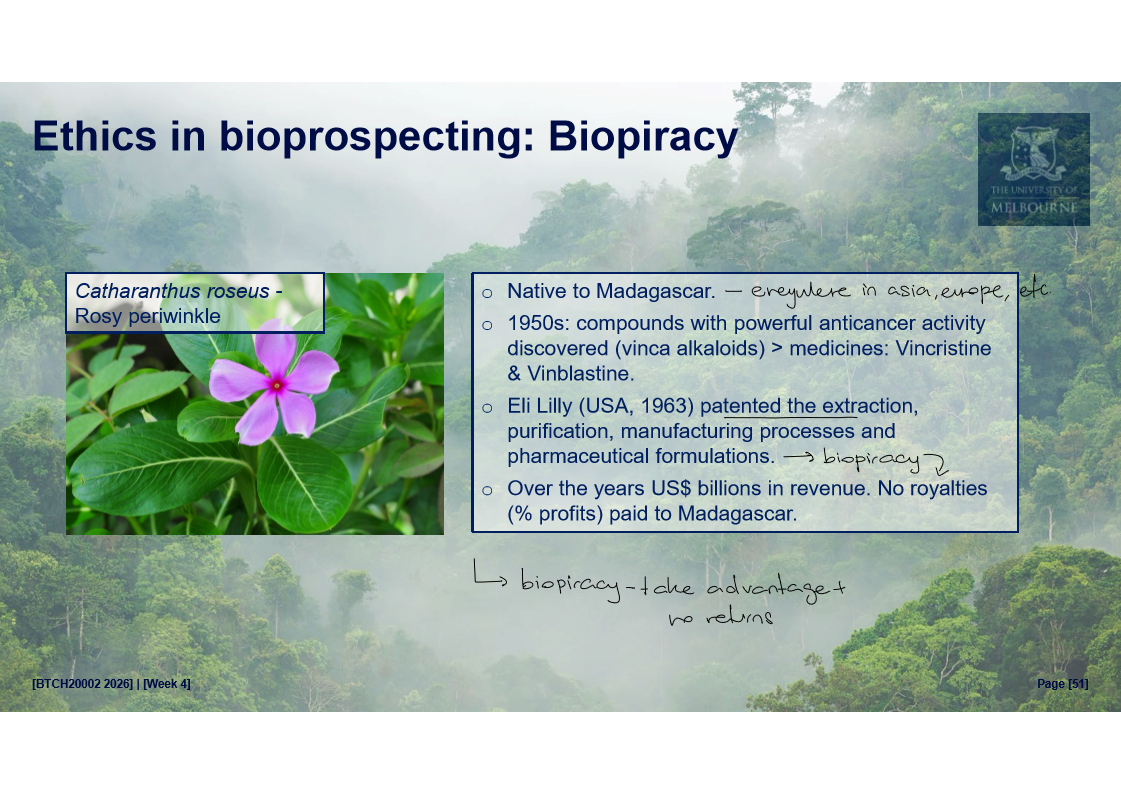
What is biopiracy
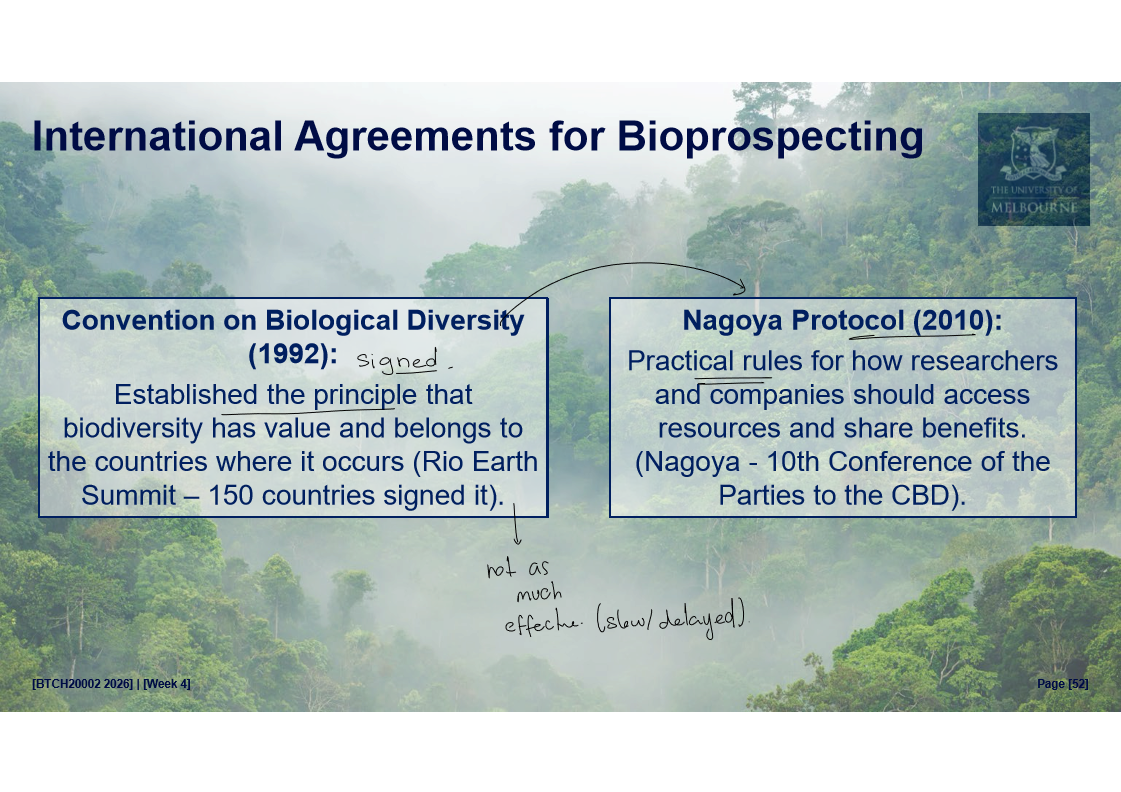
Descrive conventions to prevent biopiracy (bioprospecting)