Ranney Economics Final Exam
 Call Kai
 Learn
Learn Practice Test
 Spaced Repetition
 Match
Match Flashcards
 Knowt Play
1/167

Earn XP
Description and Tags
All terms except topic 5+ Study Guide included
Name | Mastery | Learn | Test | Matching | Spaced | Call with Kai | Chat |
|---|
No analytics yet
Send a link to your students to track their progress
168 Terms
What are the 4 factors of Production?
Land, labor, capital, entrepreneurs
What is the basic problem of economics?
People cannot have everything they need/want, but people’s needs are unlimited.
How do marginal cost and benefit affect our economic decisions
It’s the extra cost of adding one unit. We make incremental decisions by asking: "Is the value of one more unit worth the extra cost?"
What is opportunity cost and how does it affect our economic decisions?
It’s most desirable alternative somebody gives up as the result of a decision. Because resources like time, money, and labor are limited (scarcity), choosing one option means sacrificing the potential benefits of the next most valuable option.
What are monetary incentives, and how can they affect people’s behaviors?
It’s the hope of reward or a fear of penalty that encourages a person to behave in a certain way. They strongly influence behavior through immediate gratification and goal alignment, but they can sometimes diminish internal drive if overused.
How does private property affect people’s behaviors in a market economy?
It provides an incentive for property owners to use property wisely and conserve resources.
Are most economic systems pure or mixed?
Mixed
What are the differences between command and market economic systems.
Command economies oppose private property, competition, and consumer choice, while markets do the opposite.
How are the 3 mixed economic systems similar to, and different from, a command or market system?
Mixed economic systems are hybrids that sit between pure command and pure market models, leaning closer to one or the other depending on the degree of government intervention. Government control is present, but individuals are able to make their own decisions
What is the relationship between price and quantity, according to the law of demand.
The law of demand states that there is an inverse (or negative) relationship between the price of a good and the quantity demanded, assuming all other factors remain constant (ceteris paribus)
What three economic concepts help explain the law of demand, and how does each work?
Income Effect: Changes in price alter a consumer's purchasing power. When the price of a good drops, you can buy the same amount for less money, freeing up "real income" to buy more. Conversely, a price increase shrinks your purchasing power, forcing you to buy less.
Substitution Effect: When a good's price rises, it becomes relatively more expensive than its alternatives. Consumers will naturally switch to cheaper substitutes, decreasing the quantity demanded for the original, higher-priced item.
Diminishing Marginal Utility: This principle states that the satisfaction (utility) a consumer gets from each additional unit of a good decreases as they consume more. Because later units provide less joy, consumers are only willing to buy more if the price drops to match that lower value.
What events can cause an increase of decrease in demand?
Inflation, inferior goods, changes in income etc
What is the relationship between price and quantity according to the law of supply?
Producers offer more of a good/service as its price increases and less as its price falls.
What events or outside factors can cause an increase or decrease in supply
Government policies, input costs, global economy, expectations about prices/supply
How would the scarcity of a product affect its equilibrium price?
It would cause prices to increase.
What are the main features of the free enterprise (market) system?
Opportunity
Incentives
Profit Motive
Competition
Legal equality
Private Property Rights
How do prices contribute to the allocation of goods and services in a market economy?
Prices act as signals of supply/demand.
What happens among buyers and sellers when an equilibrium market price exists
Competition+ lower prices cause quality to rise/fall
Give some examples of price ceilings and price floors
An example of price ceiling is the rent control system in New York City. An example of a price floor is the minimum wage.
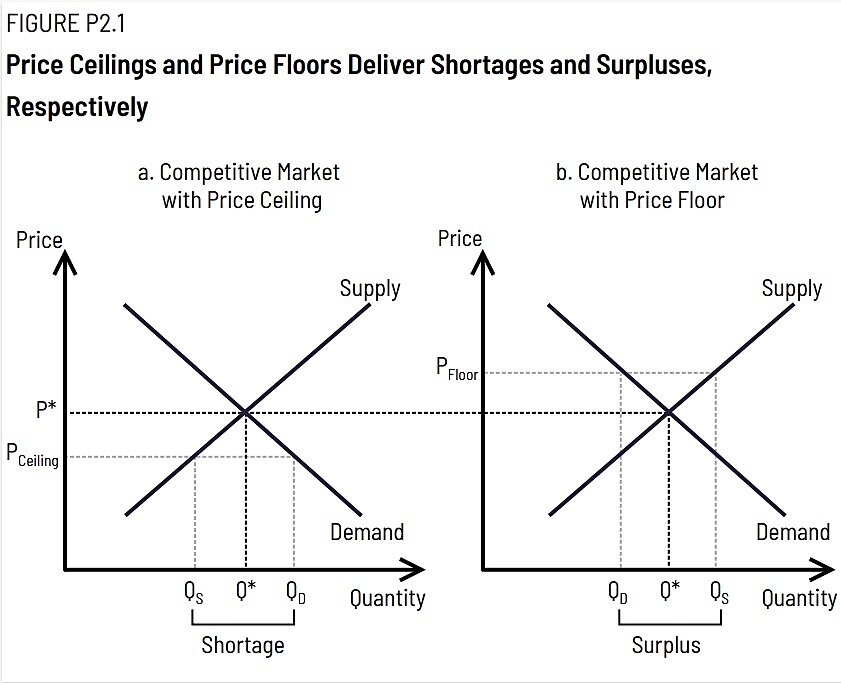
How are surpluses and shortages related to price controls?
Surpluses cause prices to fall, shortages cause prices to rise.
How can governments, suppliers, and consumers all have an affect on the quantity, quality, and price of toys in America?
The toy market in America is a classic example of supply and demand, where governments (regulators/policymakers), suppliers (manufacturers/retailers), and consumers (parents/gift-buyers) continuously interact to shape product availability, safety, and retail costs
According to Adam Smith: what motivates producers? How is self interest related to the concept of the “invisible hand?”?
Adam Smith posited that producers are fundamentally motivated by self-interest—the desire for personal gain and profit.
This motivation drives the "invisible hand," a metaphor describing how individuals unintentionally benefit society as a whole while pursuing their own private interests.
What is the difference conceptually and graphically, between a change in demand and a change in quantity demanded.
A change in quantity demanded is a reaction to a price change of the good itself, resulting in a movement along an existing demand curve. A change in demand is caused by external factors (like income or trends), resulting in a shift of the entire curve
What effect does a change in the price have on its substitute good?
A change in the price of a product causes a direct, same-direction change in the demand for its substitute. Because they serve a similar purpose, consumers switch between substitute goods based on their relative prices.
What factors cause a good to have elastic or inelastic supply?
If they’re essential or not.
What factors cause a good to have elastic or inelastic demand?
Gov policies, demand, competitors etc.
What are some examples of positive and negative externalities?
Industrial Pollution
Second-hand smoke
Traffic
Education/training
Expansion of job market.
What are public goods?
Public goods are products or services that are both non-excludable and non-rivalrous. Because one person's use doesn't diminish their availability and people can't be stopped from using them, the free market often fails to provide them, prompting government funding through taxation.
What is the difference between variable and fixed costs?
The core difference is that fixed costs remain constant regardless of your production or sales volume, while variable costs increase or decrease directly based on your level of output
What is the purpose of antitrust legislation?
They keep firms from controlling the price and supply of important goods.
Which price setting methods are illegal?
Price Fixing
Collusions
Cartels
Predatory Pricing
What non-monetary incentives should be considered when trying to get a jog?
Quality of Life
Identify the different types of trade barriers.
Tariffs
VERS
Subsidies
What is the purpose of purchasing stocks?
Primarily to build long-term wealth, outpace inflation, and share in the success of profitable companies.
List the categories on which the federal government spends money.
Mandatory spending
Discretionary Spending
Entitlements
Social Security
Medicare
Identify the various income tax rates
Progressive tax
proportional tax
regressive tax
sales tax
individual income tax
corporate income tax
property tax
What actions can be taken to reduce the money supply under fiscal policy?
Budgeting, sending proposals, and debates.
What are the goals of government spending under fiscal policy?
To determine how much they should spend on certain things.
What is the goal of monetary policy?
To increase real GDP and decrease the rate of inflation in the economy.
What are the tools of monetary policy?
Reverse adjustments, interest rates, etc
When is an easy money policy used?
When the economy is experiencing a rapid expansion that may cause high inflation.
Why did labor unions develop?
They arose largely in response to changes in working conditions brought by the industrial revolution.
What are the tactics that unions may use?
Strikes, negotiations and injunctions.
What are some responses management could use?
Bargaining, layoffs, legal processes.
Discuss the effects of unionization
Better working conditions, job security, etc
What is derived demand?
Demand for another good/service
How does derived demand affect the labor market?
It increases productivity of labor
How does technology effect the labor market
It increased offshoring
Describe the relationship between education and income level.
Higher Education=Higher Income level.
How do countries benefit from specialization?
They export more, therefore earn more.
What is the difference between comparative and absolute advantage
Absolute advantage is the ability of an entity to produce a greater quantity of a good using the same resources, or to produce it at a lower absolute cost. Comparative advantage is the ability to produce a good at a lower opportunity cost.
What influences the business cycle?
Business investment, interest rates/credit, consumer expectations, external shocks.
What is GDP
Gross domestic product; the sum of a nation’s goods
What is real GDP?
Gross domestic product; the sum of a nation’s goods, adjusted for inflation/deflation
Define the unemployment rate.
The percentage of the nations labor force that is unemployed.
How are individuals classified as unemployed?
If they don’t have a job, but are currently looking for one.
What will high levels of employment cause?
upward pressure on wages, increased consumer spending, and potential inflationary pressures
Define wage-price spiral
When minimum wage increases, price increases
Why is economic growth important?
It allows the overall quality of life within a country to increase
When does a nation have a trade surplus?
When they are importing more than they are exporting.
Discuss the arguments for protectionism.
Protecting jobs
Protecting infant industries
Safe-guarding national security
Define foreign exchange rate.
The value of a nation’s currency in relation to a foreign currency
Explain how the value of a nation’s currency relates to its exports
The more they export, the more valuable it is.
What are the goals for fiscal policy and government spending?
To influence the economy to shrink/grow (break pedal, gas pedal.)
Restrictive and expansionary Fiscal Policy are:
Making the economy grow (Gas pedal), making the economy shrink (Break pedal)
What is the difference between Budget Surplus and Budget Deficit.
A budget deficit occurs when spending exceeds revenue, requiring entities to borrow money to cover the shortfall. Conversely, a budget surplus happens when revenue exceeds spending, leaving extra funds. Both apply to governments, businesses, and households to measure financial health over a given period.
Define globalization.
The increasingly tight interconnection of producers globally.
What contributes to the unequal distribution of wealth?
Differences in skills/education
Field of work
Taxes
aggregate demand
the amount of goods and services in the economy that will be purchase at all possible price levels
Aggregate Supply
the total amount of goods and services in the economy available at all possible price levels
capital deepening
the process of increasing the amount of capital per worker
cyclical unemployment
unemployment that rises during economic downturns and falls when the economy improves
consumer price index
a price index determine by measuring the price of a standard group of goods meant to represent the ¨market Basket¨ of a typical urban consumer
contraction
an economic decline marked by falling real GDP
discouraged worker
someone who wants a job by has given up cooking
depression
a deep recession with feaatures such as high unemployment and low economic output
depreciation
the loss of the value of capital equipment that results from normal wear and tear
economic growth
a steady, long-term increase in real gdp
frictional unemployment
type of unemployment that occurs when people take time to find a job
full employment
the level of employment reached when there is no cyclical unemployment
globalization
the increasingly fight interconnection of producers consumers, and financial systems around the world
gross national product
the annual income earned by a nations company and people
hyperinflation
inflation that is out of control
income distribution
the way in which a nations total income is distributed among its populations
inflation
a general increase in price across an economy
inflation rate
the percentage rate of change in price level over time
leading indicators
a set of economic variables that economists use to predict future tends in a business cycle
Lorenz curve
the curve that illustrates income distribution
National GDP
total market value of all final goods and services produced with a country borders
national income accounting
a system economists use to collect and organize macroeconomic statistics on production, income, investment, and savings
peak
the height of an economic expansion
price level
the average of all prices in the economy
purchasing power
the ability to purchase goods and services
quanitiy theory o
the theory that too much money in the economy causes inflation
real GDP
GDP expressed in constant, or unchanging prices
real GDP per capita
real GDP divided by the toal population of a country
recession
a prolonged economic contraction
seasonal unemployment
type of unemployment that occurs as a result of harvest schedules, vacations, or when industries make seasonal shifts in their production schedule
stagflation
a decline in real GDP (output) combined with a rise in the price level (inflation)
trough
the lowest point in an economic contraction