Stupid Gym Class
 Call Kai
 Learn
Learn Practice Test
 Spaced Repetition
 Match
Match Flashcards
 Knowt Play
1/171

There's no tags or description
Looks like no tags are added yet.
Name | Mastery | Learn | Test | Matching | Spaced | Call with Kai |
|---|
No analytics yet
Send a link to your students to track their progress
172 Terms
Five components for Physical Fitness:
1. cardio-respiratory endurance (fitness)
2. muscular strength
3. muscular endurance
4. flexibility
5. body composition
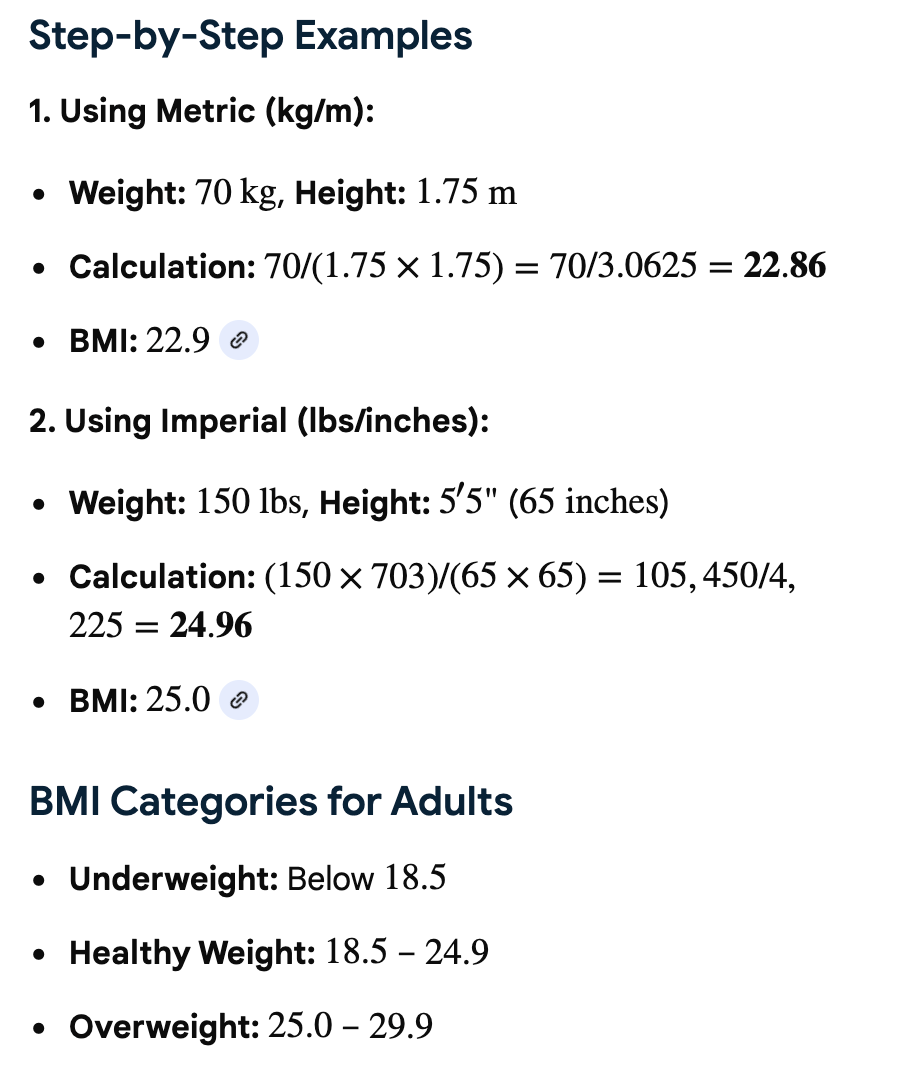
Calculate BMI:
Physical Fitness
means the various systems of the body are healthy and function efficiently so one can engage in activities of daily living, recreational pursuits and leisure activities
Wellness
a state of healthy living, which includes eight interacting components:
1. physical health
2. emotion health
3. intellectual health
4. spiritual health
5. social health
6. environmental health
7. financial health
8. occupational health
FITT
1. Frequency
2. Intensity: (Aerobic Zone 70-80%)
3. Time/duration
4. Type- either aerobic or anaerobic exercise
Training Principles
1. Overload- in order to improve physical fitness, the body or specific muscles must be stressed against a heavier work load than normal
2. Specificity- exercise training is specific to those muscles involved in the activity
3. Progression- overload should be increased gradually during the course of a fitness program
4. Recuperation- the body requires recovery periods between exercise training sessions in order to adapt to the exercise stress
5. Reversibility- what you don’t use, you lose
overload
in order to improve physical fitness, the body or specific muscles must be stressed against a heavier work load than normal
Specificity
exercise training is specific to those muscles involved in the activity
Progression
1. overload should be increased gradually during the course of a fitness program
Recuperation
1. the body requires recovery periods between exercise training sessions in order to adapt to the exercise stress
Reversibility
1. what you don’t use, you lose
Dynamic warm-up:
A. a brief period of low-intensity (50% intensity) dynamic exercise that precedes a workout (5-15 minutes)
Cool-down
a 5-15 minute period of low-intensity exercise immediately following exercise
DOMS
Delayed Onset Muscle Soreness: it’s that distinctive muscle pain and weakness that nearly everyone experiences after intense exercise.
Exercise and how it effects the body’s pH
Exercise, particularly high-intensity activity,
causes a temporary decrease in the body's pH, creating a more acidic environment in muscles and blood due to metabolic acid buildup (such as ions from ATP hydrolysis and lactic acid).
This reduction in pH is linked to muscle fatigue. The body compensates by using buffers and increasing breathing to remove CO2
Running form:
Knees, Feet, Cadence
Aerobic exercise:
rhythmic, continuous movement—often called "cardio"—that increases heart rate and oxygen consumption to improve cardiovascular health, endurance, and overall fitness
Anaerobic exercise
high-intensity, short-duration activity—such as sprinting, lifting weights, or HIIT—that breaks down glucose for energy without using oxygen. These workouts boost metabolism, build muscle mass, increase strength, and improve cardiovascular endurance.
Aerobic exercise and Lactic acid:
Lactic acid is produced during exercise as a byproduct of glucose metabolism (glycolysis), providing a vital fuel source that helps cells work during high-intensity effort
Even during aerobic exercise, the body produces lactic acid (often referred to as lactate). It is actually used as a fuel source by muscles, the heart, and the brain.
During low-intensity aerobic exercise, lactic acid is cleared as fast as it is produced. As intensity increases above the "lactate threshold," the rate of production exceeds clearance, forcing the body to rely more on anaerobic energy sources.
The burning sensation (acidosis) is not caused by lactic acid itself, but rather by the accumulation of hydrogen ions (H+) in the muscles during intense, anaerobic efforts.
T/F: lactic acid build-up is the cause of muscle soreness?
FALSE! Soreness is caused by microscopic tears in muscle fibers and resulting inflammation from new or intense activity. These tears are normal and trigger a repair process that builds stronger muscles
T/F: Consistent training increases the body's aerobic capacity, allowing athletes to work at higher intensities for longer before lactic acid accumulates
true!
Cardio-respiratory endurance:
A. a measure of the heart’s ability to pump oxygen-rich blood to the working muscles
Heart rate
A. number of heart beats per minute
Heart rate monitoring sites:
A. radial artery and carotid artery
Heart rate resting:
ideally, taken immediately after waking for 60 seconds
Heart rate exercising:
A. taken within 15 seconds of reducing intensity for 10 seconds x 6 = beats per minute
Heart rate aerobic zone:
: the range of heart rates that corresponds to an exercise intensity of approximately 70-80% that results in improvements in aerobic capacity
Training zones:
Zones 1-5
PMHR:
A. predicted maximum heart rate: 211
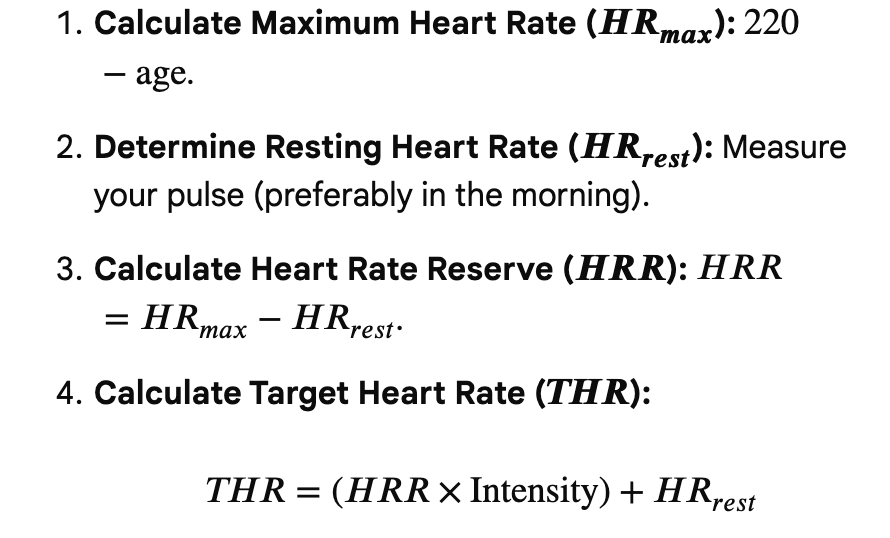
HRR
heart rate reserve: maximum heart rate minus age, minus RHR (resting heart-rate)
RHR
resting heart rate: taken imediately after waking for 60 secs
Training variations:
A. fartlek, tempo, intervals, strides
Flexibility:
the ability to move joints freely through their full range of motion
Static stretching:
A. stretching that slowly lengthens a muscle by holding for a period of time (10-30 seconds)
PNF:
: proprioceptive neuromuscular facilitation stretching with a partner offer resistance
Stretch reflex:
involuntary contraction of a muscle that occurs due to rapid stretching of that muscle
Stroke Volume:
Each contraction of the heart results in an ejection of blood termed the stroke volume.
Calculating the Target Heart Rate Zone (Karvonen Formula):
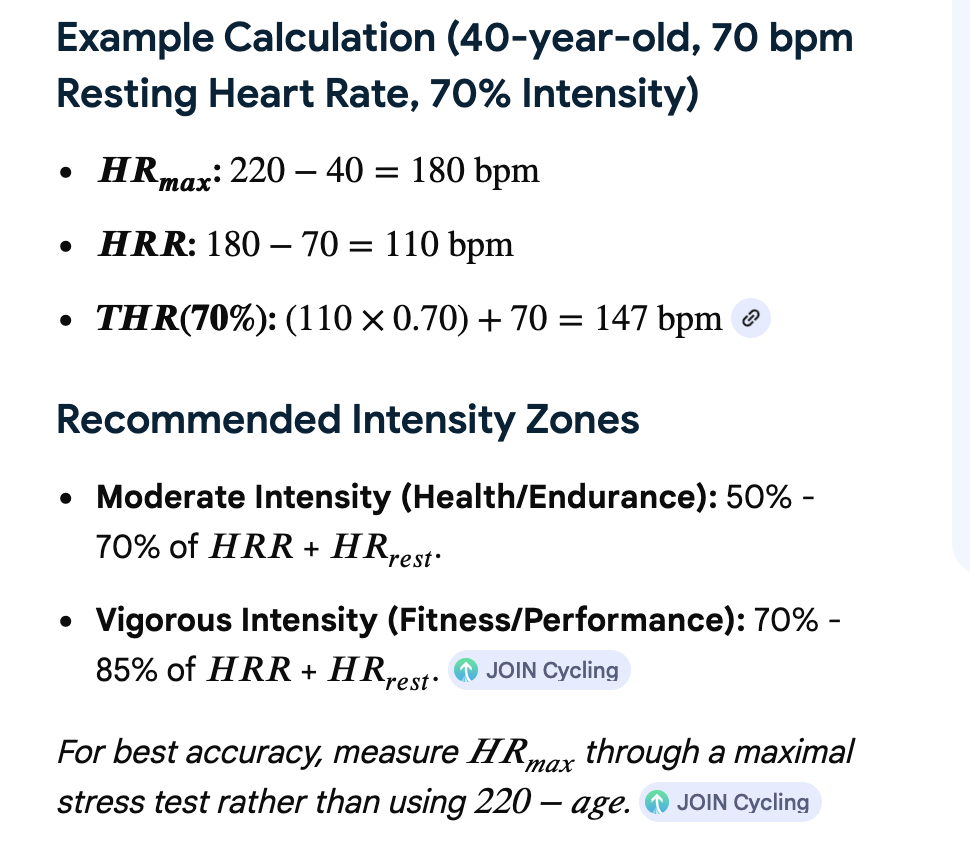
Calculating the Target Heart Rate Zone (Karvonen Formula): Example
Muscular strength
: the maximal ability of a muscle to generate force
Muscular endurance:
A. the ability of a muscle to generate force over and over again
Flexion
decrease the angle of the joint
Extension:
increase the angle of the joint
Adduction:
Movement toward the midline of the body
Abduction
movement away from the midline of the body
Rotation:
: movement around the vertical axis of the body
Hypertrophy
an increase in muscle fiber size
Isometric
refers to muscle contractions in which muscular tension is developed BUT no movement of a body part
Isotonic:
refers to muscle contractions in which there is movement of a body part
Concentric
isotonic muscle contractions that result in muscles shortening
Eccentric
isotonic contractions in which the muscle exerts force while the muscle lengthens
Agonist
prime mover
Antagonist
the muscle on the opposite side of the joint you’re working
Repetition:
refers to one complete movement of an exercise
Set
refers to some number of repetitions performed consecutively
Valsalva maneuver
holding breath during an intense muscle contraction, which can reduce blood flow to the brain and cause dizziness or fainting
Body Condition
the relative amounts of fat and lean body tissue found (muscle, organs, bone) on your body
Exercise prescription:
a dosage of exercise to effectively promote physical fitness
Skinfold test:
a test to estimate body composition by using calipers
Osteoporosis:
the loss of bone mass and strength
Sprains vs Strains:
Back pain causes
RICE
Rest, Ice, Compression, Elevation
Heat illnesses
Convection
heat loss by movement of air/water around the body
Evaporation:
heat loss due to conversion of sweat to gas (water vapor)
Radiation:
: transfer of heat through electromagnetic waves through space
Conduction
such as heat loss from solid objects (i.e., sleeping on the cold ground)
Cold illnesses
Goal Setting:
•1. Set Appropriate Goals (what are the needs)
•2. Develop Goal Commitment (social support & rewards)
•3. What are the Barriers (identify & strategies to overcome)
•4. Action Plan (plan to implement)
•5. Obtain Feedback (determine method for feedback, i.e., numbers)
•6. Goal Attainment (evaluate periodically for motivation)
•7. Reinforce Goal Achievement (reassess, encourage)
T/F: Begin to lose 1% of muscle mass per year after 25
true! Maintains working capacity during aging
What are exercise snacks?
breaking up physical activity in short vigorous bursts of 3 minutes throughout the day (i.e., air squats, high knees, etc.) for a total of 9 minutes can be impacting.
What should be labeled as a disease?
physical inactivity
What causes hypertension, cardiovascular disease, and diabetes?
Physical inactivity
Zone 1:
•recovery, aerobic, warm-up (50-60% of Maximum Heart Rate)
Zone 2
• endurance, aerobic, tempo challenging but comfortable (60-70% of MHR or max HR)
Zone 3
• training, aerobic, challenging & uncomfortable (70-80% of MHR)
Zone 4
threshold, anaerobic, breathless but not maximum (80-90%)
Zone 5
• speed, anaerobic, interval training (90-100% of MHR)
Strides
•(Zone 4): also known as a pick-up or a strider, is a short acceleration during which you over-exaggerate your running form
Intervals:
involves periods of high intensity running alternated with low intensity running, walking or resting.
Fartlek Training:
Helps to train specific muscle groups and the lungs for a VARIETY of paces. For example, 3 minute jog followed by 4 minute up-tempo pace.
Interval training
Involves repetition training that alternates INTENSE segments ranging from 30 seconds to 5 minutes followed by recovery.
Tempo work
Runs at a STEADY intensity that are 25-30 secs slower than your usual race pace.
Strides:
Strides are 25-35 sec "pick me ups" faster than race pace that runners typically do just before speed work. The reasons for doing strides before a bout of fast running are multiple: muscles need to be flooded with blood, fast-twitch muscle fibers need to be recruited, and race pace must be briefly simulated to get the body and mind ready to run fast.
Hill work?
•Another means to add intensity and variety. Also, prepares you for races with hills. Can be done similar to intervals.
Lat pulldown:
–Wide pronated grip (slightly wider than shoulder width)
–Sitting upright with a slight angle in the waist and knees secured beneath the knee pads.
–The bar should be pulled down slightly below the chin area but not necessarily to the sternum with a controlled movement.
VO2 max
is the maximum rate of oxygen consumption attainable during physical exertion.
The name is derived from three abbreviations: “V” for volume, “O2” for oxygen, max for maximum
Lactate Threshold:
the point during exercise when lactate builds up in the blood faster than the body can remove it
3 items for a long and healthy life:
•It is often stressed what to avoid versus what is NEEDED for HealthSPAN vs Lifespan:
–1. Increased VO2 maximum (accomplished via intensive movement for shorter durations)
–2. Maintaining or increasing STRENGTH (accomplished via resistance of 80% of maximum and set(s) to failure)
–3. Muscle Mass (begin to lose ~25ish years of age and continues through aging)
Study:
A.Limping at 60; using a cane at 70
B.Cane at 60; walker at 70
C.Walker at 60; wheelchair at 70
Warm-up
–5-15 minutes light “dynamic” activity, specific to exercise at 50% of intensity
–Elevates muscle temperature and increase blood flow
–Some light stretching
Cool down:
–5-15 minute period of low intensity exercise (50%) and “static” stretching (holding 10-60 seconds)
Heart rate counts:
–Resting: Ideally taken before you get out of bed in the morning
–Exercise:
•During exercising (Taken within 15 seconds of reducing intensity)
•Immediately Post-exercising (Taken within 15 seconds of reducing intensity)
•Pulse check (for 10 seconds)
Heart rate at exercise:
Maximum Heart Rate: 211 minus (.64 x AGE) =
Example: 20 year old
211 minus (.64 x 20): 211 – 13 = 198 MHR
X Intensity (60%, 70%, 80%, 90%)
198 x .6 = 119 for a min ( 19 for 10 secs)
198 x .7 = 139 for a min (23 for 10 secs)
198 x .8 = 158 for a min (26 for 10 secs)
Aerobic (his definition):
large muscle groups, rhythmic and continuous movement keeping HR consistently elevated for extended period of time. ENDURANCE running.
Anaerobic:
explosive, stop & start activities where exercise last less than 60-90 seconds. SPRINTING.
T/F: Exercise improves the respiratory system by increasing the amount of oxygen that is inhaled and distributed to body tissue
true
Cardiorespiratory System Functions:
–Transport oxygenated blood from lungs to tissues and deoxygenated blood back to lungs
–Nutrient Distribution: glucose, amino acids, etc.
–Removal of metabolic waste
–Regulation of pH controls acidosis and alkalosis
–Transportation of hormones & enzymes
–Maintenance of fluid volume to prevent dehydration
–Maintenance of body temperature by absorbing & redistributing heat
Improved Cardiorespiratory Endurance
•Decrease in resting heart rate and exercise heart rate
•Increase in: heart size, stroke volume, blood volume, capillary density
•Stroke Volume: how much blood is pumped per heartbeat

