#1 Nuclear Organization
 Call Kai
 Learn
Learn Practice Test
 Spaced Repetition
 Match
Match Flashcards
 Knowt Play
1/11

Earn XP
Description and Tags
Biochem I - #1 Nuclear Organization
Name | Mastery | Learn | Test | Matching | Spaced | Call with Kai | Chat |
|---|
No analytics yet
Send a link to your students to track their progress
12 Terms
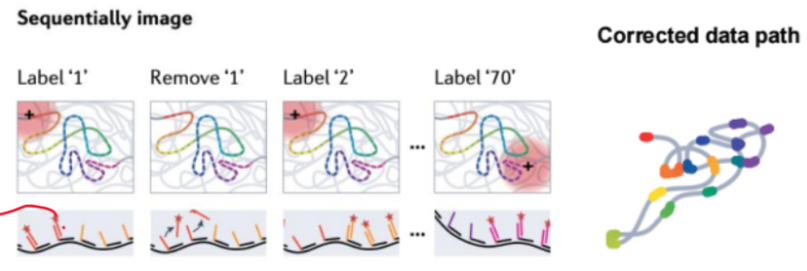
FISH
fluorescence in situ hybridization, sequential hybridization with series of barcoded probes then sequential imaging with multiple antibody rounds, "chromosome tracing"
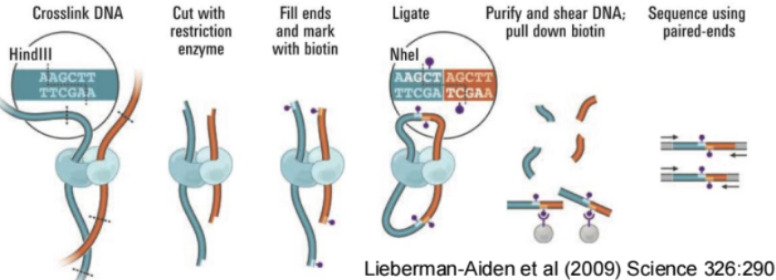
3C
"use crosslinking to capture spatial proximities of the genome
Hi-C, Micro-C, SPRITE, HiChIP, ChIPSeq"
Chromosome territories
"chromosomes occupy discrete territories in interphase, often have preferred positions (conserved between humans/primates)
central gene rich, periphery gene poor"
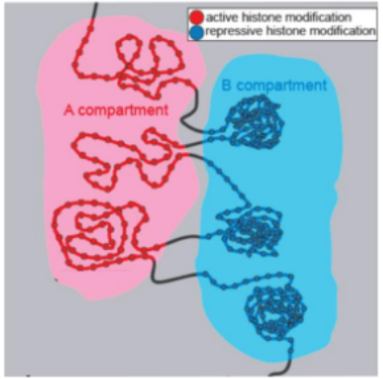
Chromosome compartments
"ternating regions on chromosomes that preferentially interact with themselves, driven by strong attractions between B regions and tethering to nuclear structures, not generally conserved between cell types, made up of multiple TADs
A - gene rich, transcriptionally active, B - low gene density, transcriptionally silent"
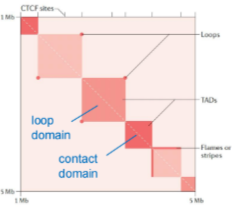
TAD
Topologically associated domains (TADs): large genomic regions (~1Mb) display high levels of chromatin interactions, similar across different cells, partially conserved across species, may provide framework for chromatin interactions (promoters + enhancers)
CTCF
rchitectural protein that binds CTCF motifs in DNA, can bind cohesion to stop it/slow it down as it extrudes the DNA loop
Cohesion
protein complex that forms a ring around DNA, forming DNA loops (extrusion mechanism)
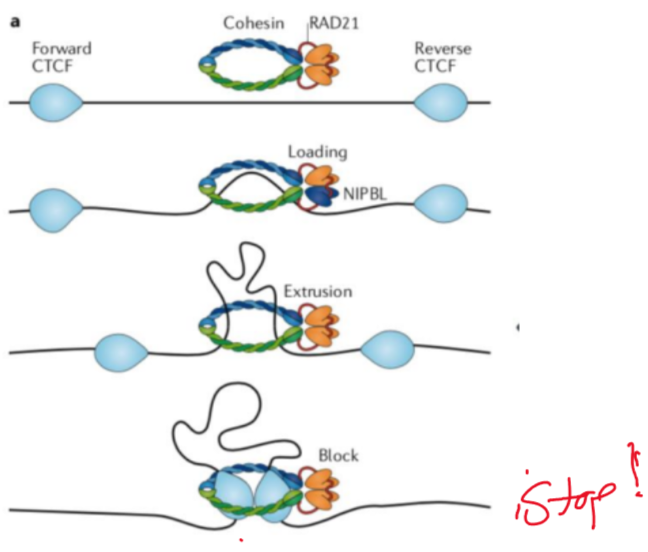
Chromatin confirmation loops
folding of DNA to allow interaction of distant stretches of DNA, architectural loops, bring enhancers/promoters into proximity, gene loops, poly-comb mediated
Nuclear lamina
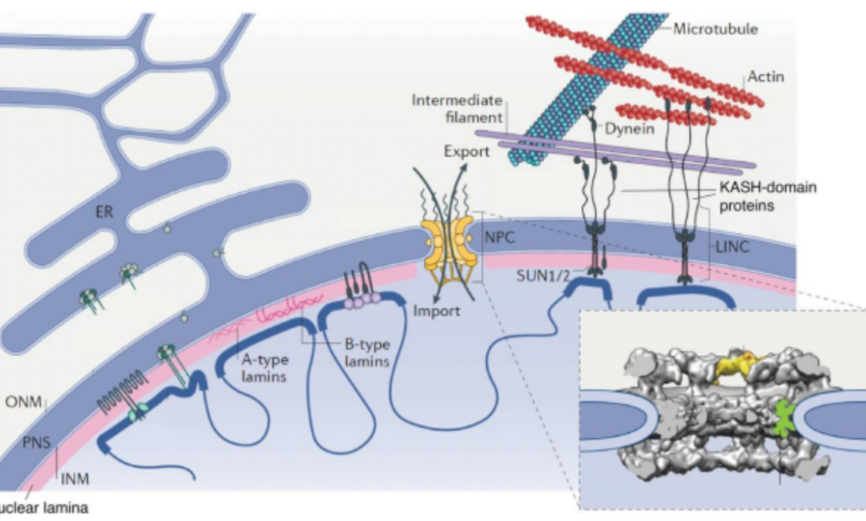
network of intermediate filaments associated with inner nuclear membrane and chromatin, made of A/B lamin proteins, helps with stability of nucleus
LADs
Lamin-associated domains (LADs): chromatin regions interacting with lamins, large genomic regions (0.1-10 Mb) with few genes, high enrichment of repressive histone marks
Biomolecular condensates
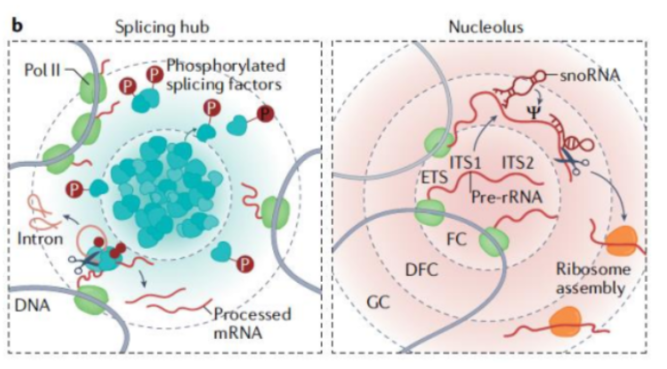
membrane-less, micron-scale compartments, concentrate proteins/nucleic acids, involved in cellular processes, formation driven by multivalent macromolecular interactions (protein:RNA, protein:protein), contributes to A/B compartment self-interactions
Nuclear speckles
condensates in nuclear bodies, enriched in splicing factors