Part 4.3 -CNS-MOOD DISORDERS
 Call Kai
 Learn
Learn Practice Test
 Spaced Repetition
 Match
Match Flashcards
 Knowt Play
1/100

Earn XP
Description and Tags
Proverbs 16:3
Name | Mastery | Learn | Test | Matching | Spaced | Call with Kai | Chat |
|---|
No analytics yet
Send a link to your students to track their progress
101 Terms
b. Mood Disorder
[MOOD DISORDERS]
Mental health problem that mainly affects the person's emotional state
a. Anxiety Disorder
b. Mood Disorder
c. Personality Disorder
d. Psychotic Disorder
a. Mood Disorder
[MOOD DISORDERS]
It is a disorder characterized by long period of extreme happiness, extreme loneliness, or both
a. Mood Disorder
b. Panic Disorder
c. Schizophrenia
d. Obsessive-Compulsive Disorder
a. Serotonin (5-HT), Dopamine, Norepinephrine (NE)
[MOOD DISORDERS]
NT for Mood regulation
a. Serotonin (5-HT), Dopamine, Norepinephrine (NE)
b. Histamine, Acetylcholine, GABA
c. Cortisol, Insulin, Glucagon
d. Calcium, Sodium, Potassium
a. Bipolar disorder
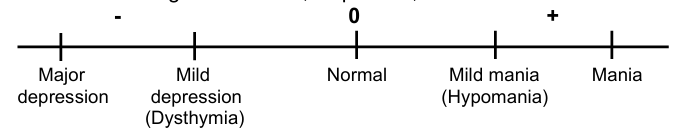
[MOOD DISORDERS: Mixed Disorders]
Mania and Major depression
a. Bipolar disorder
b. Cyclothymia
b. Cyclothymia
[MOOD DISORDERS: Mixed Disorders]
Dysthemia and Hypomania
a. Bipolar disorder
b. Cyclothymia
a. Bipolar disorder
[MOOD DISORDERS: Mixed Disorders]
Formerly known as manic-depressive illness or manic depression
a. Bipolar disorder
b. Cyclothymia
a. Bipolar disorder
[MOOD DISORDERS: Mixed Disorders]
A mental disorder that causes unusual shifts in mood
a. Bipolar disorder
b. Cyclothymia
a. Bipolar I disorder
[MOOD DISORDERS: Classification of Bipolar Disorder]
At least one manic episode, which may have been preceded by and may be followed by hypomanic or major depressive episodes
a. Bipolar I disorder
b. Bipolar II disorder
c. Cyclothymic Disorder (Cyclothymia)
b. Bipolar II disorder
[MOOD DISORDERS: Classification of Bipolar Disorder]
At least one hypomanic episode and a current or past major depressive episode
a. Bipolar I disorder
b. Bipolar II disorder
c. Cyclothymic Disorder (Cyclothymia)
c. Cyclothymic Disorder (Cyclothymia)
[MOOD DISORDERS: Classification of Bipolar Disorder]
Defined by periods of hypomanic symptoms as well as periods of depressive symptoms lasting for at least 2 years
a. Bipolar I disorder
b. Bipolar II disorder
c. Cyclothymic Disorder (Cyclothymia)
a. Major Depressive Episode
[MOOD DISORDERS: Clinical Presentation of Bipolar Disorder]
Delusions, hallucinations and suicide attempts are more common in bipolar depression than in unipolar depression
a. Major Depressive Episode
b. Manic Episodes
c. Hypomanic Episodes
b. Manic Episodes
[MOOD DISORDERS: Clinical Presentation of Bipolar Disorder]
Acute mania usually begins abruptly, and symptoms increase over several days.
a. Major Depressive Episode
b. Manic Episodes
c. Hypomanic Episodes
b. Manic Episodes
[MOOD DISORDERS: Clinical Presentation of Bipolar Disorder]
Bizarre behavior, hallucinations, and paranoid or grandiose delusions may occur.
a. Major Depressive Episode
b. Manic Episodes
c. Hypomanic Episodes
b. Manic Episodes
[MOOD DISORDERS: Clinical Presentation of Bipolar Disorder]
There is marked impairment is functioning.
a. Major Depressive Episode
b. Manic Episodes
c. Hypomanic Episodes
b. Manic Episodes
[MOOD DISORDERS: Clinical Presentation of Bipolar Disorder]
Manic episodes may be precipitated by stressors, sleep deprivation, antidepressants, central nervous system
a. Major Depressive Episode
b. Manic Episodes
c. Hypomanic Episodes
c. Hypomanic Episodes
[MOOD DISORDERS: Clinical Presentation of Bipolar Disorder]
There is no marked impairment in social or occupational functioning, no delusions, and no hallucinations.
a. Major Depressive Episode
b. Manic Episodes
c. Hypomanic Episodes
c. Hypomanic Episodes
[MOOD DISORDERS: Clinical Presentation of Bipolar Disorder]
Some patients may be more productive than usual, but 5% to 15% of patients may rapidly switch to a manic episode
a. Major Depressive Episode
b. Manic Episodes
c. Hypomanic Episodes
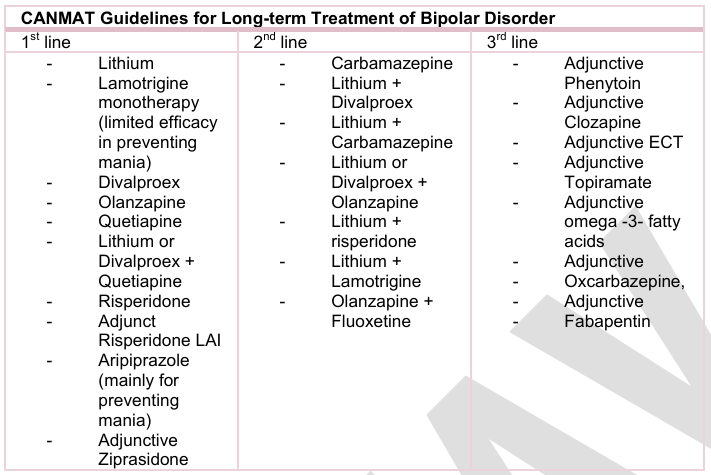
[MOOD DISORDERS]
CANMAT Guidelines for Long-term Treatment of Bipolar Disorder
(Basahin nalang)
b. Adjunctive flupentixol
c. Monotherapy with Gabapentin, Topiramate or Antidepressants
[MOOD DISORDERS]
Not Recommended for Long-term Treatment of Bipolar Disorder
(Multiple Answers)
a. Lithium, Divalproex, Lamotrigine
b. Adjunctive flupentixol
c. Monotherapy with Gabapentin, Topiramate or Antidepressants
d. Benzodiazepines and antipsychotics
b. Lithium
[MOOD DISORDERS]
DOC for euphoric mania
a. Divalproex
b. Lithium
c. Gabapentin
d. Topiramate
c. Divalproex
[MOOD DISORDERS]
Has better efficacy for mixed states, dysphoric mania and rapid recycling
a. Lithium
b. Flupentixol
c. Divalproex
d. Antidepressants
b. Lithium carbonate
[MOOD DISORDERS: Antimania]
A first-line agent for acute mania and acute bipolar depression is ________.
a. Carbamazepine
b. Lithium carbonate
c. Haloperidol
d. Clonazepam
b. IP₂ → IP₁
[MOOD DISORDERS: Antimania]
Lithium carbonate works by inhibition of phosphoinositide (PI) recycling through inhibition of conversion of ________.
a. IP₁ → IP₂ → Inositol
b. IP₂ → IP₁ → Inositol
c. Dopamine → GABA
d. GABA → glutamate
c. Dopamine
Dopamine:
↑ mania
↓ depression
[MOOD DISORDERS: Antimania]
Lithium carbonate helps manage mania by inhibition of ________ neurotransmission, which is elevated in mania.
a. Serotonin
b. GABA
c. Dopamine
d. Acetylcholine
c. Glutamate
[MOOD DISORDERS: Antimania]
Lithium inhibits ________ neurotransmission, an excitatory neurotransmitter that may lead to excitotoxicity at increased levels.
a. Dopamine
b. GABA
c. Glutamate
d. Histamine
b. GABA
-GABA is an inhibitory NT that plays a role in modulating glutamate and dopamine.
Dopamine is ↑ in mania
↑ GABA = ↓ Dopamine
[MOOD DISORDERS: Antimania]
Lithium increases and activates ________ neurotransmission, an inhibitory neurotransmitter that modulates glutamate and dopamine.
a. Dopamine
b. GABA
c. Glutamate
d. Norepinephrine
b. Lithium carbonate
[MOOD DISORDERS: Antimania]
1st line agent for acute mania, acute bipolar depression
a. Carbamazepine
b. Lithium carbonate
c. Haloperidol
d. Clonazepam
b. I or II
[MOOD DISORDERS: Antimania]
Lithium carbonate is used for maintenance treatment of bipolar ________ disorders.
a. III or IV
b. I or II
c. Mania only
d. Schizoaffective
c. rapid
-Has narrow TI
[MOOD DISORDERS: Antimania]
Lithium is NOT as effective in treating ________ cycling bipolar disorder.
a. slow
b. delayed
c. rapid
d. intermittent
a. Drugs that can lower the serum concentration of Li
[MOOD DISORDERS: Antimania]
Xanthine diuretics
a. Drugs that can lower the serum concentration of Li
b. Drugs that increase the serum concentration of Li
a. Drugs that can lower the serum concentration of Li
[MOOD DISORDERS: Antimania]
Osmotic diuretics
a. Drugs that can lower the serum concentration of Li
b. Drugs that increase the serum concentration of Li
a. Drugs that can lower the serum concentration of Li
[MOOD DISORDERS: Antimania]
Na supplementation
a. Drugs that can lower the serum concentration of Li
b. Drugs that increase the serum concentration of Li
a. Drugs that can lower the serum concentration of Li
[MOOD DISORDERS: Antimania]
Acetazolamide
a. Drugs that can lower the serum concentration of Li
b. Drugs that increase the serum concentration of Li
b. Drugs that increase the serum concentration of Li
[MOOD DISORDERS: Antimania]
Thiazide diuretics
a. Drugs that can lower the serum concentration of Li
b. Drugs that increase the serum concentration of Li
b. Drugs that increase the serum concentration of Li
[MOOD DISORDERS: Antimania]
ACE inhibitors
a. Drugs that can lower the serum concentration of Li
b. Drugs that increase the serum concentration of Li
b. Drugs that increase the serum concentration of Li
[MOOD DISORDERS: Antimania]
Na Loss
a. Drugs that can lower the serum concentration of Li
b. Drugs that increase the serum concentration of Li
b. Drugs that increase the serum concentration of Li
[MOOD DISORDERS: Antimania]
NSAIDs
a. Drugs that can lower the serum concentration of Li
b. Drugs that increase the serum concentration of Li
b. GI distress
-nausea, vomiting, and diarrhea
[MOOD DISORDERS: Antimania]
A common dose-related adverse effect of lithium
a. Constipation
b. GI distress
c. Blotting
d. Bleeding
b. Lithium carbonate
[MOOD DISORDERS: Antimania]
May cause vasopressin deficiency leading to polyuria and polyphagia
a. Carbamazepine
b. Lithium carbonate
c. Haloperidol
d. Clonazepam
c. Lithium carbonate
[MOOD DISORDERS: Antimania]
A/E: Fine hand tremor
a. Carbamazepine
b. Valproic Acid
c. Lithium carbonate
d. Lamotrigine
c. Lithium carbonate
[MOOD DISORDERS: Antimania]
A/E: Muscle weakness (transient)
a. Carbamazepine
b. Valproic Acid
c. Lithium carbonate
d. Lamotrigine
c. Lithium carbonate
[MOOD DISORDERS: Antimania]
A/E: Nephrogenic DI (low sp gr of urine) excretion of water making the urine diluted
a. Carbamazepine
b. Valproic Acid
c. Lithium carbonate
d. Lamotrigine
c. Lithium carbonate
[MOOD DISORDERS: Antimania]
A/E: Goiter and/or hypothyroidism
a. Carbamazepine
b. Valproic Acid
c. Lithium carbonate
d. Lamotrigine
c. 1.5
[MOOD DISORDERS: Antimania]
Serum lithium levels greater than ________ mEq/L are associated with toxicity.
a. 0.5
b. 1.0
c. 1.5
d. 3.0
c. verapamil or diltiazem
[MOOD DISORDERS: Antimania]
Combination of lithium with typical antipsychotics, ____, or ________ may cause neurotoxicity.
a. verapamil or carbamazepine
b. diltiazem or carbamazepine
c. verapamil or diltiazem
d. diltiazem or quetiapine
a. =
[MOOD DISORDERS: Antimania]
Divalproex sodium (sodium valproate) has ___ effectiveness with lithium for pure mania
a. =
b. >
c. <
c. <
-Divalproex is better than Li in treating rapid cycling
[MOOD DISORDERS: Antimania]
Li is ___ Divalproex sodium in treating rapid cycling
a. =
b. >
c. <
a. fine tremors
b. sedation
c. GI complaints
[MOOD DISORDERS: Antimania]
Dose-related adverse effects of valproic acid
(Multiple Answers)
a. fine tremors
b. sedation
c. GI complaints
d. ataxia
c. Carbamazepine and Lamotrigine
[MOOD DISORDERS: Antimania]
Can be used as prophylaxis and treatment of mania
a. Diazepam and Carbamazepine
b. Lamotrigine and Diltiazem
c. Carbamazepine and Lamotrigine
d. Lamotrigine and Lithium
c. Carbamazepine and Lamotrigine
[MOOD DISORDERS: Antimania]
For acute and maintenance therapy
a. Diazepam and Carbamazepine
b. Lamotrigine and Diltiazem
c. Carbamazepine and Lamotrigine
d. Lamotrigine and Lithium
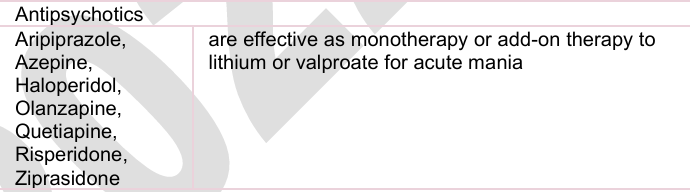
a. Aripiprazole (basahin nalang)
[MOOD DISORDERS: Antimania]
antipsychotic is effective as monotherapy or add-on therapy to lithium or valproate for acute mania
a. Aripiprazole
b. Diazepam
c. Fluoxetine
d. Acetazolamide
a. Lorazepam
c. Clonazepam
-High potency BZD
[MOOD DISORDERS: Antimania]
alternative treatment for mania
a. Lorazepam
b. Alprazolam
c. Clonazepam
d. Temazepam
b. antidepressants
[MOOD DISORDERS: Antimania]
Monotherapy with ________ can precipitate mania in bipolar patients.
a. antipsychotics
b. antidepressants
c. lithium
d. benzodiazepines
b. Major Depressive Disorder (MDD)
[DEPRESSION]
A depression of mood without any obvious medical or situational causes, manifested by an inability to cope with ordinary events or experience pleasure is called ________.
a. Bipolar disorder
b. Major Depressive Disorder (MDD)
c. Cyclothymic disorder
d. Generalized anxiety disorder
b. unipolar
[DEPRESSION]
Major Depressive Disorder is also known as ________ depression.
a. bipolar
b. unipolar
b. Major Depressive Disorder (MDD)
[DEPRESSION]
Characterized by one or more major depressive episodes without a history of manic or hypomanic episodes
a. Bipolar disorder
b. Major Depressive Disorder (MDD)
c. Cyclothymic disorder
d. Generalized anxiety disorder
a. dopamine
c. serotonin
d. norepinephrine
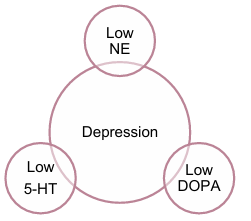
[DEPRESSION]
According to the monoamine hypothesis, low levels of ________ contribute to depression.
(Multiple Answers)
a. dopamine
b. acetylcholine
c. serotonin
d. norepinephrine
c. NE
Serotonin= SERT
NE= NRT
[DEPRESSION]
binds to its receptor and the reuptake via NRT
a. dopamine
b. serotonin
c. NE
b. serotonin
Serotonin= SERT
NE= NRT
[DEPRESSION]
binds to its receptor in the post-synaptic neuron and the reuptake via SERT
a. dopamine
b. serotonin
c. NE
b. serotonin
c. NE
[DEPRESSION]
degraded by MAO (2)
a. dopamine
b. serotonin
c. NE
a. dopamine
c. serotonin
d. norepinephrine
[DEPRESSION: Antidepressants]
Antidepressants increase the levels of
(Multiple Answers)
a. dopamine
b. acetylcholine
c. serotonin
d. norepinephrine
c. serotonin
d. norepinephrine
NE > 5-HT
TCAs have greater effect on NE
[DEPRESSION: Antidepressants]
The main mechanism of action of tricyclic antidepressants is to block the reuptake of ____and ________.
(Multiple Answers)
a. dopamine
b. acetylcholine
c. serotonin
d. norepinephrine
a. anti-HAM (antiHistamine , Alpha receptor blockers, Anti Muscarinic receptors)
[DEPRESSION: Antidepressants]
Aside from blocking NE and 5-HT reuptake, tricyclic antidepressants also have ___ activity
a. anti-HAM
b. MAOa inhibitor
c. MAOb inhibitor
a,b,c,d
Amitriptyline, Nortriptyline "-triptyline"
Imipramine Desipramine - "-pramine"
Doxepin, Clomipramine
[DEPRESSION: Antidepressants]
TCAs examples:
(Multiple Answers)
a. “-triptyline”
b. “-pramine”
c. Doxepin
d. Clomipramine
e. Mianserin
b. Amitriptyline
[DEPRESSION: Antidepressants]
management of neuropathic pain
a. Imipramine
b. Amitriptyline
c. Mianserin
d. Maprotiline
c. Imipramine
[DEPRESSION: Antidepressants]
The drug of choice for enuresis (bed-wetting) among tricyclic antidepressants is ________.
a. Nortriptyline
b. Amitriptyline
c. Imipramine
d. Clomipramine
b. insomnia
c. anxiety
[DEPRESSION: Antidepressants]
Tricyclic antidepressants may be used in the management of ____and ________ disorder.
a. bipolar
b. insomnia
c. anxiety
d. personality
c. weight
[DEPRESSION: Antidepressants]
A common adverse effect of tricyclic antidepressants is ________ gain.
a. muscle
b. water
c. weight
d. bone
b. orthostatic hypotension
d. QT prolongation
[DEPRESSION: Antidepressants]
Tricyclic antidepressants may cause ________ and _______.
a. bradycardia
b. orthostatic hypotension
c. hypertension
d. QT prolongation
c. sedation
“anti-HAM”
[DEPRESSION: Antidepressants]
A common CNS adverse effect of tricyclic antidepressants due to antihistamine activity is ________.
a. insomnia
b. agitation
c. sedation
d. tremor
d. Mianserin
-the rest is a Tricyclic antidepressant
[DEPRESSION: Antidepressants]
Tetracyclic antidepressant
a. Nortriptyline
b. Doxepin
c. Clomipramine
d. Mianserin
a. Amoxapine
-the rest is a Tricyclic antidepressant
[DEPRESSION: Antidepressants]
Tetracyclic antidepressant
a. Amoxapine
b. Doxepin
c. Clomipramine
d. Amitriptyline
b. Maprotiline
-the rest is a Tricyclic antidepressant
[DEPRESSION: Antidepressants]
Tetracyclic antidepressant
a. Desipramine
b. Maprotiline
c. Clomipramine
d. Amitriptyline
a. NE
c. 5-HT
d. tyramine
e. histamine
[DEPRESSION: Antidepressants]
MAOA metabolizes
a. NE
b. dopamine
c. 5-HT
d. tyramine
e. histamine
b. dopamine
[DEPRESSION: Antidepressants]
MAOB metabolizes
a. NE
b. dopamine
c. 5-HT
d. tyramine
e. histamine
II. Phenelzine
III. Isocarboxazid
IV. Tranylcypromine
[DEPRESSION: Antidepressants]
Non-selective MAO inhibitor
I. Moclobemide
II. Phenelzine
III. Isocarboxazid
IV. Tranylcypromine
V. Selegiline
I. Moclobemide
[DEPRESSION: Antidepressants]
Selective MAOA Inhibitor
I. Moclobemide
II. Phenelzine
III. Isocarboxazid
IV. Tranylcypromine
V. Selegiline
V. Selegiline
[DEPRESSION: Antidepressants]
Selective MAOB Inhibitor
I. Moclobemide
II. Phenelzine
III. Isocarboxazid
IV. Tranylcypromine
V. Selegiline
b. atypical
-psychotic features; phobia
[DEPRESSION: Antidepressants]
MAOi Use: Management of ___ depression
a. typical
b. atypical
a. Tyramine-rich food
(cheese, wine, beer, chicken, liver, banana) → will cause hypertensive crisis
[DEPRESSION: Antidepressants]
MAO inhibitors Drug interactions
a. Tyramine-rich food
b. Iron-rich food
c. Fatty food
b. orthostatic hypotension
[DEPRESSION: Antidepressants]
common cardiovascular adverse effect of MAO inhibitors is ________.
a. hypertension
b. orthostatic hypotension
c. bradycardia
d. arrhythmia
a. anticholinergic effects
c. weight gain
[DEPRESSION: Antidepressants]
MAO inhibitors may cause _______and ________ .
a. anticholinergic effects
b. edema
c. weight gain
d. hypertension
b. serotonin
[DEPRESSION: Antidepressants]
Severe toxicity of MAO inhibitors may present with shock, hyperthermia, seizure, and ________ syndrome.
a. neuroleptic malignant
b. serotonin
c. cholinergic
d. extrapyramidal
d. blocks 5-HT reuptake
[DEPRESSION: Antidepressants]
Atypical antidepressant (Trazodone) MOA
a. blocks Ca channel
b. blocks Na channel
c. blocks Ach reuptake
d. blocks 5-HT reuptake
a. Nefazodone
c. Trazodone
[DEPRESSION: Antidepressants]
Atypical antidepressant
a. Nefazodone
b. Amoxapine
c. Trazodone
d. Mianserin
d. hypnotic
[DEPRESSION: Antidepressants]
Atypical antidepressant (Trazodone) use
a. bipolar disorder
b. schizophrenia
c. insomnia
d. hypnotic
a. insomnia management
-because it causes sedation
[DEPRESSION: Antidepressants]
Atypical antidepressant (Trazodone) off-label use
a. insomnia
b. schizophrenia
c. insomnia
d. hypnotic
a. sedation
[DEPRESSION: Antidepressants]
Atypical antidepressant (Trazodone) A/E
a. sedation
b. diarrhea
c. constipation
d. insomnia
a. priapism
[DEPRESSION: Antidepressants]
A major adverse effect of trazodone is prolonged erection known as ________.
a. priapism
b. dysuria
c. impotence
d. anorgasmia
c. norepinephrine-dopamine
[DEPRESSION: Antidepressants]
Bupropion is classified as a ________ reuptake inhibitor.
a. serotonin
b. histamine
c. norepinephrine-dopamine
d. acetylcholine
b. smoking cessation
[DEPRESSION: Antidepressants]
Bupropion is commonly used for ________
a. alcohol abuse
b. smoking cessation
c. anxiety
d. morphine addiction
c. se❌ual
[DEPRESSION: Antidepressants]
An advantage of bupropion over many antidepressants is that it does not commonly cause ________ dysfunction.
a. renal
b. hepatic
c. se❌ual
d. cognitive
(naka emoji kasi may warning knowt)
b. depressed
[Special Populations]
In elderly patients, ________ mood may be less prominent than other symptoms.
a. elevated
b. depressed
c. euphoric
d. anxious
c. SSRIs
[Special Populations]
antidepressant class is often considered the first choice in elderly patients with depression
a. MAO inhibitors
b. Tricyclic antidepressants
c. SSRIs
d. Benzodiazepines
b. Bupropion
[Special Populations]
is effective and well tolerated in elderly patients
a. Haloperidol
b. Bupropion
c. Phenelzine
d. Diazepam
a. Venlafaxine
[Special Populations]
Aside from SSRIs, ________ is another antidepressant that is effective and well tolerated in elderly patients.
a. Venlafaxine
b. Haloperidol
c. Lithium
d. Selegiline
a. Mirtazapine
[Special Populations]
is effective and well tolerated in elderly patients and may also improve appetite and sleep
a. Mirtazapine
b. Fluoxetine
c. Imipramine
d. Isocarboxazid
b. sleep disturbances
-also anxiety, failing adjustment, & boredom
[Special Populations]
Symptoms of depression in childhood may include
a. paralysis
b. sleep disturbances
c. apnea
d. intoxication
c. Boredom
-also anxiety, failing adjustment, & sleep disturbances
[Special Populations]
symptom of depression in pediatric patients
a. Mania
b. Hallucinations
c. Boredom
d. Hyperactivity only
c. Fluoxetine
[Special Populations]
The only FDA-approved antidepressant for treating depression in patients below 18 years of age is ________.
a. Sertraline
b. Bupropion
c. Fluoxetine
d. Venlafaxine