NYS EMT Certification and Clinical Emergency Care Notes
 Call Kai
 Learn
Learn Practice Test
 Spaced Repetition
 Match
Match Flashcards
 Knowt Play
1/41

Earn XP
Description and Tags
Comprehensive vocabulary flashcards covering New York State EMT certification standards, emergency assessments, pediatric/geriatric protocols, medical conditions, and trauma guidelines based on class lecture materials.
Name | Mastery | Learn | Test | Matching | Spaced | Call with Kai | Chat |
|---|
No analytics yet
Send a link to your students to track their progress
42 Terms
Community Paramedicine / Mobile Integrated Health
An evolving healthcare model that focuses on providing care directly to the patient at home, emphasizing prevention, telehealth, and telemedicine.
NYS EMT Original Certification Requirements
Pass all LMS modules (70% each), pass the program (75% GPA), submit all Independent Study Certificates, do not miss more than 4 classes, obtain 10 patient contacts, obtain clinical competency, pass the Practical Skill Exam, and pass the NYS Certifying Exam with a 70%.
NYS Certifying Exam Parameters
A Computer Based Testing (CBT) examination consisting of 110 questions, with a 2.5-hour time limit and a 70% passing threshold.
Prone Position
Body positioning in which the patient lies face down on their stomach.
Supine Position
Body positioning in which the patient lies face up on their back.
Recovery Position
Body positioning in which the patient is placed lying on their side to assist with secretion management and airway maintenance.
A.V.P.U. Scale
A primary assessment grading tool for mental status: Alert (fully awake and responsive), Verbal (responds to speech), Pain (responds only to painful stimulus), Unresponsive (no reaction to voice or pain).
Medical Orders for Life-Sustaining Treatment (MOLST)
A state-sanctioned advance directive format containing actionable medical orders, including a DNR section, which EMTs in NYS are authorized to follow.
Patient Restraint Guidelines (NYS)
Protocols allowing EMTs to restrain patients who lack decisional capacity and present a danger to themselves or others, requiring deescalation documentation, a minimum of 5 providers, police presence, and avoiding the prone position.
LISA (Primary Assessment)
Mnemonic for initial primary assessment steps: L - Life threats identification, I - Impression of patient, S - Spinal precautions, A - AVPU mental status check.
S.A.M.P.L.E.
A history-taking mnemonic standing for Signs & symptoms, Allergies, Medications, Pertinent medical history, Last oral intake, Events leading up to the emergency.
O.P.Q.R.S.T.I.
A medical history assessment mnemonic for pain/symptoms standing for Onset, Provocation, Quality, Region/Radiation, Severity (0-10 scale), Time, Interventions.
D.C.A.P. - B.T.L.S.
An assessment acronym for trauma evaluation checking for Deformities, Contusions, Abrasions, Punctures/penetrations, Burns, Tenderness, Lacerations, Swelling.
Systolic Blood Pressure
The measurement of force exerted against arterial walls during the contraction phase of the heart's cycle.
Diastolic Blood Pressure
The measurement of residual pressure remaining in the arterial system during the relaxing and filling phase of the heart's cycle.
Oropharyngeal Airway (OPA)
An airway adjunct indicated for unresponsive patients without a gag reflex, measured from the corner of the mouth to the earlobe.
Nasopharyngeal Airway (NPA)
An airway adjunct indicated for patients with an intact gag reflex; contraindicated in patients with skull or facial trauma, measured from the tip of the nose to the earlobe.
Hypoxia
A medical condition in which the entire body or a specific tissue region is deprived of adequate oxygen supply to function properly.
Angina Pectoris
A clinical condition where coronary arteries spasm under physical exertion, producing chest pain that typically lasts 3 to 8 minutes and resolves with rest and nitroglycerin.
Myocardial Infarction (MI)
The blockage of one or more coronary arteries causing tissue ischemia and eventual infarction, presenting with persistent chest pain not relieved by rest or nitroglycerin.
Nitroglycerin (NTG) Administration Criteria
Assisted sublingual administration (0.4 mg tablet/spray) of patient's prescribed NTG requiring systolic BP > 120 mmHg and no erectile dysfunction medication usage within the last 72 hours.

Cardiac Concussion
Commotio cordis caused by a direct blow to the precordial area timed specifically during the upstroke of the T wave, producing a sudden spike in intracavitary pressure and potentially precipitating ventricular fibrillation.
Shockable Cardiac Rhythms
Pulseless Ventricular Tachycardia (pVT) and Ventricular Fibrillation (VFib).
Nonshockable Cardiac Rhythms
Asystole and Pulseless Electrical Activity (PEA).
Aortic Dissection
A structural tearing of the aorta wall causing severe internal hemorrhage, characterized by tearing chest pain radiating between the scapulas, unequal radial pulses, and blood pressure discrepancy between arms.
Compensated Shock
The early stage of hypoperfusion where the body maintains organ perfusion, marked by systolic BP >= 90 mmHg and preserved mental status.
Decompensated Shock
The late stage of hypoperfusion characterized by systolic BP < 90 mmHg and deteriorating mental status.
Pediatric Hypotension Limit (Ages 1-10)
The lower threshold for systolic blood pressure in pediatric patients calculated as: SBP<70+(2×age in years).
Status Epilepticus
A medical emergency characterized by a continuous seizure lasting longer than 5 minutes or recurrent seizures occurring without intervening recovery of consciousness.
AEIOU-TIPS
Mnemonic for causes of altered mental status: Alcohol/Acidosis, Epilepsy/Endocrine/Electrolytes/Encephalopathy, Infection, Overdose/Oxygen deficiency, Uremia, Trauma/Temperature, Insulin, Psychiatric conditions, Stroke/Seizure/Shock/Sepsis.
Cincinnati Prehospital Stroke Scale
A stroke assessment system evaluating three key physical signs: facial droop, arm drift, and abnormal speech.
Transient Ischemic Attack (TIA)
A temporary focal neurological deficit caused by ischemia that spontaneously resolves within 1 hour, acting as a precursor warning for full cerebrovascular accidents.
Epinephrine Dosage (Anaphylaxis)
Intramuscular injection of 0.3 mg for patients weighing >= 66 lbs (30 kg) and 0.15 mg for patients weighing < 66 lbs.
S.L.U.D.G.E.M.
Mnemonic for cholinergic/organophosphate toxicity symptoms: Salivation, Lacrimation, Urination, Defecation, GI upset, Emesis, Miosis.
Frostnip
A superficial cold injury occurring after prolonged exposure where skin surface freezes without damaging underlying deep tissues, generally painless.
Immersion Foot
Also called trench foot, a cold tissue injury caused by prolonged immersion and exposure of feet to cold water.
Frostbite
The most serious local cold injury in which tissue actually freezes, potentially causing gangrene and requiring surgical tissue excision.
Hypothermia
A dangerous systemic condition involving the lowering of core body temperature below 95°F (35°C).
Cushing's Triad
A group of three physical signs indicating increased intracranial pressure: elevated blood pressure, bradycardia, and irregular respirations.
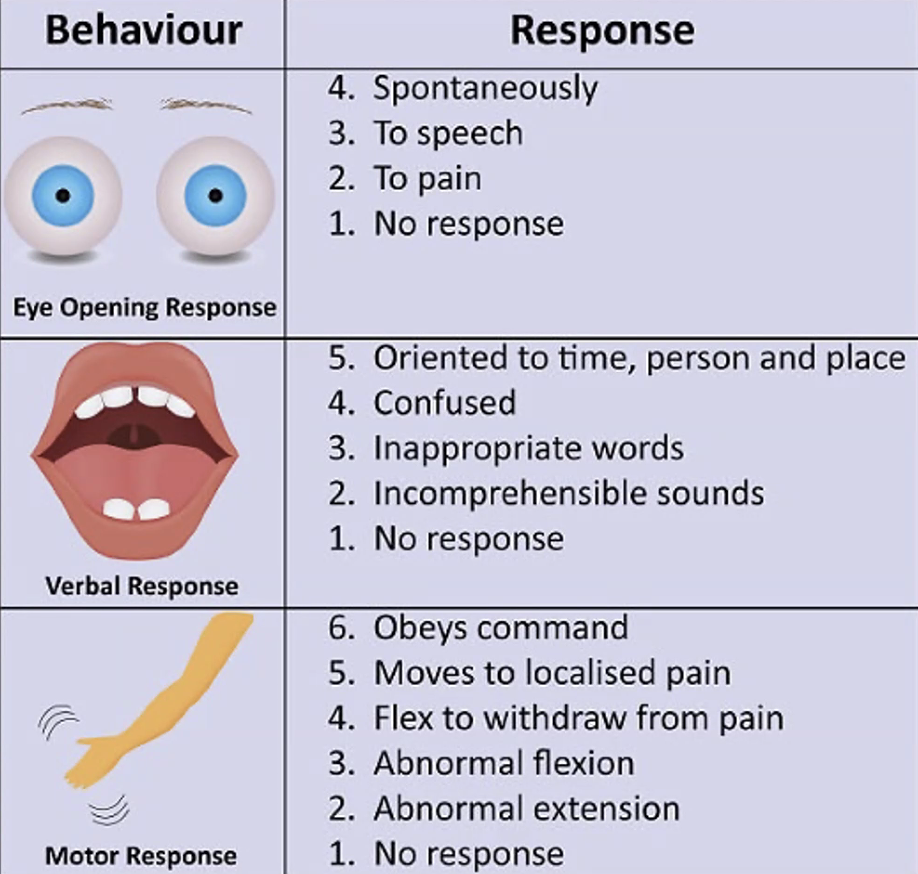
Glasgow Coma Scale (GCS)
A neurological assessment scale evaluating eye opening (1-4), verbal response (1-5), and motor response (1-6) to score conscious level.
High-Altitude Pulmonary Edema (HAPE)
An altitude-related illness occurring at or above 10,000 feet where fluid accumulates in lungs, producing dyspnea, pink frothy sputum, cyanosis, and tachycardia.

Central and Peripheral Nervous System Hierarchy
Anatomical division where CNS includes brain and spinal cord, and PNS includes sensory nerves and motor nerves (divided into somatic voluntary and autonomic involuntary sympathetic/parasympathetic).