psych - sensation and perception

0.0(0)
Studied by 0 people
call kaiCall Kai
Locked
learnLearn
examPractice Test
spaced repetitionSpaced Repetition
heart puzzleMatch
flashcardsFlashcards
GameKnowt Play
Card Sorting

1/6

encourage image

There's no tags or description

Looks like no tags are added yet.

Last updated 5:06 AM on 9/7/26
Name
Mastery
Learn
Test
Matching
Spaced
Call with Kai
Chat

No analytics yet

Send a link to your students to track their progress

7 Terms

1
New cards

Definition of visual perception

Visual perception is the process of interpreting information received through the eyes to create a meaningful understanding of the environment.

2
New cards

Explanation of the process of sensation and perception in visual perception.

  1. Light enters the eye through the cornea and pupil.

  2. The lens focuses light onto the retina.

  3. Rods and cones in the retina detect the light (sensation).

  4. Signals travel along the optic nerve to the brain.

  5. The visual cortex in the occipital lobe interprets the signals (perception).

  6. The brain combines this information with experience, context and expectations.

Example -

You see a red stop sign.

  • Sensation: Your retina detects red light and the shape.

  • Perception: Your brain recognises it as a stop sign and understands you should stop.

3
New cards
<p><span style="font-family: Calibri, sans-serif; line-height: 115%;"><strong>Biological Factors</strong> influencing visual perception - Binocular Depth Cues</span></p>

Biological Factors influencing visual perception - Binocular Depth Cues

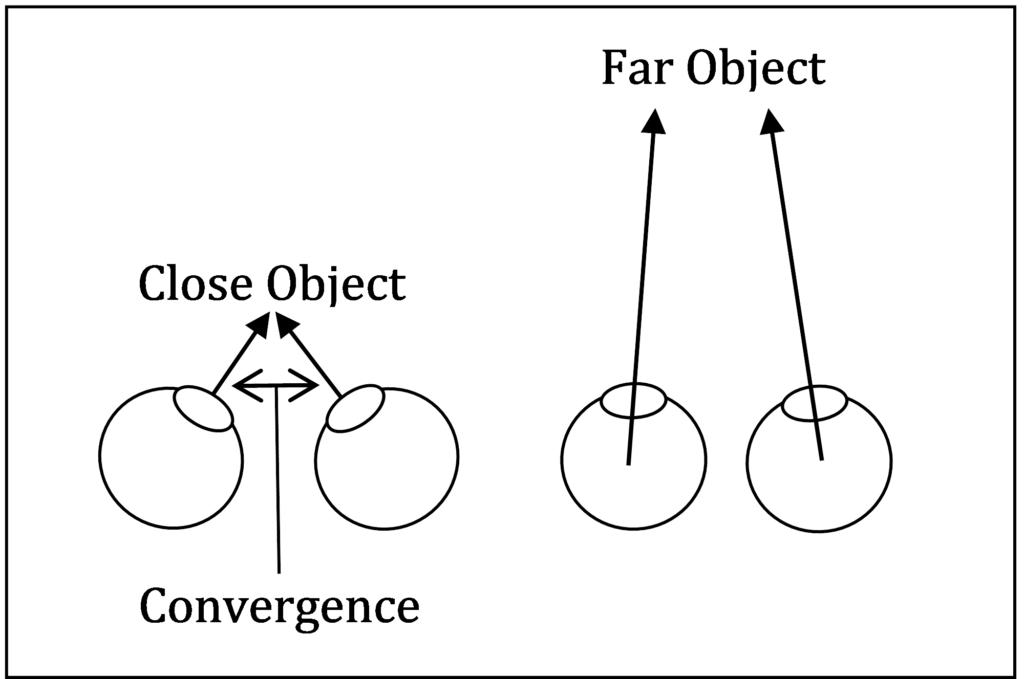
These require both eyes.

  • Convergence - When an object is close, both eyes turn inward.

  • The brain uses the amount of eye muscle movement to estimate distance.

  • More convergence = closer object.

Example:

Holding your finger near your nose makes your eyes turn inward.


  • Retinal Disparity - Each eye sees a slightly different image.

  • The brain compares these differences.

  • Larger differences mean the object is closer.

Example:

Close one eye, then the other while looking at your thumb, it appears to shift.


<p>These require both eyes.</p><ul><li><p class="w6asjq_TextBase _85PZeG_Text"><strong>Convergence</strong> - When an object is close, both eyes turn inward.</p></li><li><p class="w6asjq_TextBase _85PZeG_Text">The brain uses the amount of eye muscle movement to estimate distance.</p></li><li><p class="w6asjq_TextBase _85PZeG_Text">More convergence = closer object.</p></li></ul><p class="w6asjq_TextBase _85PZeG_Text">Example:</p><p class="w6asjq_TextBase _85PZeG_Text">Holding your finger near your nose makes your eyes turn inward.</p><p class="w6asjq_TextBase _85PZeG_Text"></p><ul><li><p class="w6asjq_TextBase _85PZeG_Text"><strong>Retinal Disparity</strong> - Each eye sees a slightly different image.</p></li><li><p class="w6asjq_TextBase _85PZeG_Text">The brain compares these differences.</p></li><li><p class="w6asjq_TextBase _85PZeG_Text">Larger differences mean the object is closer.</p></li></ul><p class="w6asjq_TextBase _85PZeG_Text">Example:</p><p class="w6asjq_TextBase _85PZeG_Text">Close one eye, then the other while looking at your thumb, it appears to shift. </p><p></p>
4
New cards
<p><span style="line-height: 115%;"><strong>Biological Factors</strong> influencing visual perception - Monocular Depth Cues</span></p>

Biological Factors influencing visual perception - Monocular Depth Cues

These work with one eye.

  • Accommodation - The lens changes shape to focus.

  • A rounder lens focuses on close objects.

  • A flatter lens focuses on distant objects.

Example:

Reading a book then looking at a distant building. The eye accomodates to what it sees.


  • Pictorial Cues - These are clues in a flat image that create depth.


  • Linear Perspective - Parallel lines appear to meet in the distance, e.g train tracks.

  • Interposition - One object blocks another, making it seem closer.

  • Texture Gradient - Textures become finer and less detailed as they/the object moves away.

  • Relative Size - Smaller - looking objects appear farther away, e.g two people standing at different distances.

  • Height in the Visual Field - Objects higher in the picture appear farther away, e.g mountains near the top of a landscape.


<p>These work with one eye.</p><ul><li><p><strong>Accommodation</strong> - The lens changes shape to focus.</p></li><li><p class="w6asjq_TextBase _85PZeG_Text">A rounder lens focuses on close objects.</p></li><li><p class="w6asjq_TextBase _85PZeG_Text">A flatter lens focuses on distant objects.</p></li></ul><p class="w6asjq_TextBase _85PZeG_Text">Example:</p><p class="w6asjq_TextBase _85PZeG_Text">Reading a book then looking at a distant building. The eye accomodates to what it sees.</p><p></p><ul><li><p><strong>Pictorial Cues </strong>- These are clues in a flat image that create depth.</p></li></ul><p></p><ul><li><p><strong>Linear Perspective</strong> - Parallel lines appear to meet in the distance, e.g train tracks.</p></li></ul><ul><li><p>Interposition - One object blocks another, making it seem closer.</p></li><li><p><strong>Texture Gradient</strong> - Textures become finer and less detailed as they/the object moves away.</p></li><li><p>Relative Size - Smaller - looking objects appear farther away, e.g two people standing at different distances.</p></li><li><p><strong>Height in the Visual Field</strong> - Objects higher in the picture appear farther away, e.g mountains near the top of a landscape.</p></li></ul><p></p>
5
New cards

Psychological Factors – Gestalt Principles

  • Figure-Ground - The brain separates an object (figure) from its background (ground).

  • Closure - The brain fills missing gaps.

  • Proximity - Objects close together appear grouped.

  • Similarity - Similar objects are grouped together.


6
New cards

Social Factors – Perceptual Set

A perceptual set is a tendency to perceive something in a certain way because of expectations.

Factors Influencing Perceptual Set Past Experience

Previous experiences influence perception.

Example: A nurse quickly recognises medical equipment.

Motivation

Needs or desires affect perception.

Example: A hungry person notices food first.

Context

Surroundings change interpretation.

Example: The letter "B" can look like "13."


Culture

Cultural background affects interpretation.

Example: Müller-Lyer illusion affects some cultures differently.

Emotional State

Feelings influence perception.

Example: Someone anxious mistakes a shadow for a person.

Memory

Stored memories help identify objects.

Example: Recognising a friend's face.
7
New cards
<p>Visual Distortion vs Visual Illusion</p>

Visual Distortion vs Visual Illusion

Visual Distortion

  • A visual distortion is when an object appears altered from reality.

Example: Looking through a curved mirror.

Visual Illusion

  • A visual illusion is a false perception caused by the way the brain interprets visual information.

Example: Müller-Lyer illusion.


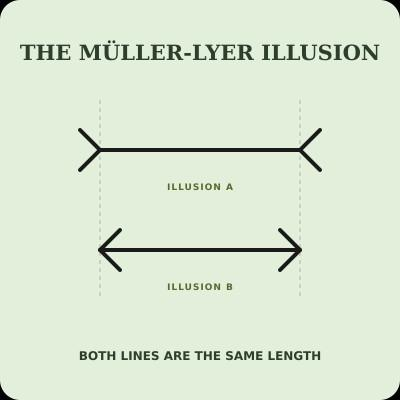
Müller-Lyer Illusion - two equal-length lines appear different lengths because of the arrowheads.

  • One line has inward-pointing arrows.

  • One has outward-pointing arrows.

  • The brain interprets them as being at different distances.

Why?

The brain uses linear perspective and past experience with corners and buildings, making one line seem farther away and therefore longer. The lines are the same lengths.


Ames Room Illusion - A trapezium shaped room makes people appear dramatically different sizes.

  • one corner is much farther away

  • floor, ceiling and walls are slanted.

From one viewing point, it looks like a normal room.

The brain assumes the room is rectangular, so it interprets the farther person as shrinking instead of recognising the unusual room shape.


Synaesthesia - Synaesthesia is a neurological condition where stimulation of one sense automatically triggers another sensory experience.

Why? -

  • Cross-activation theory: Brain areas for different senses are unusually connected.

  • Disinhibited feedback theory: Normally separate brain pathways communicate more than usual.

  • It may also have a genetic basis because it often runs in families.

Examples

  • Seeing colours when hearing music.

  • Numbers having colours.

  • Words producing tastes.


<p><strong>Visual Distortion</strong></p><ul><li><p class="w6asjq_TextBase _85PZeG_Text">A visual distortion is when an object appears altered from reality.</p></li></ul><p class="w6asjq_TextBase _85PZeG_Text">Example: Looking through a curved mirror.</p><p><strong>Visual Illusion</strong></p><ul><li><p class="w6asjq_TextBase _85PZeG_Text">A visual illusion is a false perception caused by the way the brain interprets visual information.</p></li></ul><p class="w6asjq_TextBase _85PZeG_Text">Example: Müller-Lyer illusion.</p><p class="w6asjq_TextBase _85PZeG_Text"></p><p class="w6asjq_TextBase _85PZeG_Text"><strong>Müller-Lyer Illusion </strong>- two equal-length lines appear different lengths because of the arrowheads.</p><ul><li><p class="w6asjq_TextBase _85PZeG_Text">One line has inward-pointing arrows.</p></li><li><p class="w6asjq_TextBase _85PZeG_Text">One has outward-pointing arrows.</p></li><li><p class="w6asjq_TextBase _85PZeG_Text">The brain interprets them as being at different distances.</p></li></ul><p>Why?</p><p class="w6asjq_TextBase _85PZeG_Text">The brain uses linear perspective and past experience with corners and buildings, making one line seem farther away and therefore longer. The lines are the same lengths.</p><p class="w6asjq_TextBase _85PZeG_Text"></p><p class="w6asjq_TextBase _85PZeG_Text"><strong>Ames Room Illusion </strong>- A trapezium shaped room makes people appear dramatically different sizes. </p><ul><li><p class="w6asjq_TextBase _85PZeG_Text">one corner is much farther away</p></li><li><p class="w6asjq_TextBase _85PZeG_Text">floor, ceiling and walls are slanted.</p></li></ul><p class="w6asjq_TextBase _85PZeG_Text">From one viewing point, it looks like a normal room.</p><p class="w6asjq_TextBase _85PZeG_Text">The brain assumes the room is rectangular, so it interprets the farther person as shrinking instead of recognising the unusual room shape.</p><p class="w6asjq_TextBase _85PZeG_Text"></p><p class="w6asjq_TextBase _85PZeG_Text"><strong>Synaesthesia </strong>- Synaesthesia is a neurological condition where stimulation of one sense automatically triggers another sensory experience.</p><p class="w6asjq_TextBase _85PZeG_Text">Why? -</p><ul><li><p class="w6asjq_TextBase _85PZeG_Text PDq2pG_selectionAnchorContainer">Cross-activation theory: Brain areas for different senses are unusually connected.</p></li><li><p class="w6asjq_TextBase _85PZeG_Text">Disinhibited feedback theory: Normally separate brain pathways communicate more than usual.</p></li><li><p class="w6asjq_TextBase _85PZeG_Text">It may also have a genetic basis because it often runs in families.</p></li></ul><p class="w6asjq_TextBase _85PZeG_Text">Examples</p><ul><li><p class="w6asjq_TextBase _85PZeG_Text">Seeing colours when hearing music.</p></li><li><p class="w6asjq_TextBase _85PZeG_Text">Numbers having colours.</p></li><li><p class="w6asjq_TextBase _85PZeG_Text">Words producing tastes.</p></li></ul><p></p>



