SSR - Lecture 3
 Call Kai
 Learn
Learn Practice Test
 Spaced Repetition
 Match
Match Flashcards
 Knowt Play
1/18

There's no tags or description
Looks like no tags are added yet.
Name | Mastery | Learn | Test | Matching | Spaced | Call with Kai | Chat |
|---|
No analytics yet
Send a link to your students to track their progress
19 Terms
Empirical cycle
• observation
• induction → theory
• deduction → null hypothesis, alternative hypothesis
• testing → set alpha, choose power
• evaluation → making decision
sampling distribution
• tells us how likely our data are under certain hypothesis (e.g. null hypothesis)
test statistic
• statistic that summarizes data and is used for hypothesis testing, because we know how it’s distributed under different hypotheses → e.g. number of heads, sum of dice, t-statistic, F-statistic, …
What does alpha determine?
• how strict we are in our decision to reject null hypothesis (historically set to 5%)
Type 1 error
• rejecting null hypothesis even though it’s actually true → = alpha
Type 2 error
• not rejecting H0 even though it’s actually false → = beta
P-value
• conditional probability of observed test statistic or more extreme assuming null hypothesis is true
When do we reject H0?
• when p-value </= alpha
What does alpha determine?
• how willingly we reject null hypothesis
Which effects does it have if you increase/decrease alpha?
• Increase alpha = reject null hypothesis more often
• Increases Type I error rate
• Decreases Type II error rate
Rejection region
• dictated by alpha → The stricter the alpha, the further into the tail the region starts
What are common misconceptions about p-value? (3)
• significant result means effect is important → significance = effect size + sample size
• non-significant result means null hypothesis is true
• significant result means that null hypothesis is false\
What can non-significance mean? (2)
• there is no effect in reality
• sample size was not high enough to detect effect
evidence of absence
• evidence means that there is no effect
absence of evidence
• we have not enough/inconclusive data to make inference about whether effect exists or not
Describe the decision table
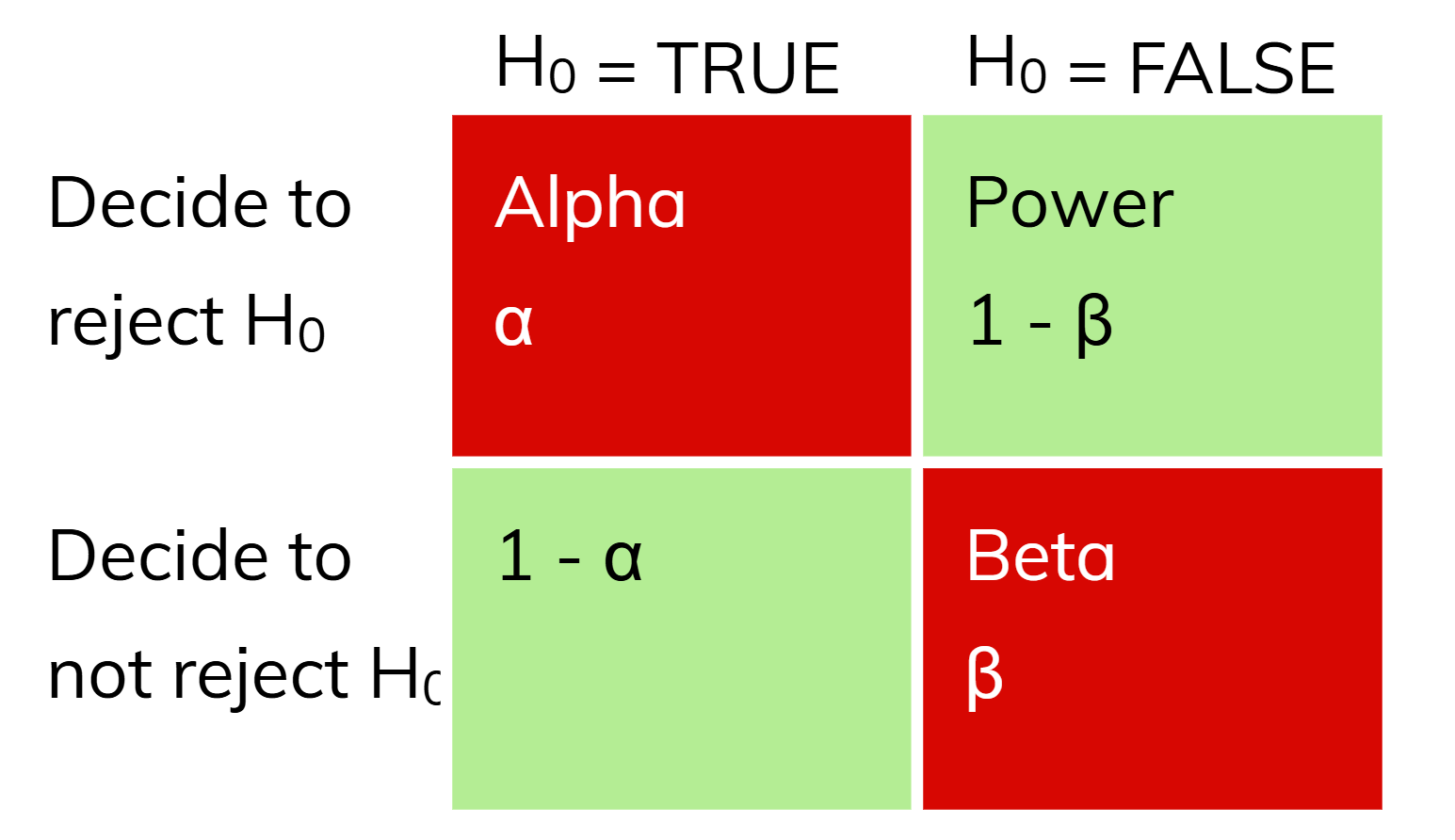
What is the best way to keep both alpha and beta low?
• high sample size
What is power?
• correctly reject H0 → True positive
• Power = 1 - beta
• depends on sample size
What is 1-alpha?
• correctly accept H0 → true negative