ch. 1: dental materials
 Call Kai
 Learn
Learn Practice Test
 Spaced Repetition
 Match
Match Flashcards
 Knowt Play
1/48

There's no tags or description
Looks like no tags are added yet.
Name | Mastery | Learn | Test | Matching | Spaced | Call with Kai | Chat |
|---|
No analytics yet
Send a link to your students to track their progress
49 Terms
what are the 4 rationales for studying dental materials?
to understand the behavior of materials
to handle materials properly
to assess and treat the patient
to educate the patient
(view slideshow for specifics)
what is a biomaterial?
a man-made material used to replace tissues or function in close contact with living tissues
enamel is weak in its resistance to _______
bending
what structure of the tooth acts as cushioning for enamel and is more susceptible to acid attack?
dentin
what is the function of the periodontium?
provides feedback regarding forces placed on the tooth
e.g. ow, im biting too hard
what three structures make up the periodontium?
PDL, cementum, alveolar bone
what is the function of gingival tissue?
seals out chemicals and microbes from gaining access to the periodontium and deeper tissues
what factors restrict the use of replacement materials in the mouth?
biting forces, degradation, temperature changes, biocompatibility, and esthetics
why are biting forces a concern with dental materials?
biting forces can fracture teeth or dental materials
what is an example of degradation of a dental material?
corrosion of metal
how do temperature changes affect dental materials?
they cause expansion and contraction
what does biocompatibility mean?
the material does not cause harm to the patient
why are esthetics important when choosing dental materials?
the material should have an acceptable/natural appearance

what is a herbst appliance used for?
a fixed orthodontic device used to correct a severe overbite (class II) by holding and guiding the lower jaw into a forward position

what is a palatal expander used for?
a custom orthodontic device that widens the upper jaw over time to create a better bite and make room for permanent teeth
what does the ADA Council on Scientific Affairs evaluate?
dental drugs, materials, instruments, and equipment
is submitting a product for ADA evaluation required?
no. it is a voluntary process
how long is the ADA Seal awarded for?
3 years
what are “specifications” for dental materials?
specific requirements for physical and mechanical properties measured in a laboratory
how does the FDA classify dental materials?
as medical devices
what is an FDA Class I dental device? give examples
least regulated; only good manufacturing practices are required
examples: prophy paste and brushes
what is an FDA Class II dental device? give examples
requires FDA approval and may be “grandfathered in”
examples: composites and amalgam.
what is an FDA Class III dental device? give an example
most regulated; requires FDA approval and premarket approval
example: bone grafts
what does the International Standards Organization (ISO) do?
attempts to unify standards among member countries
what does CE approval mean?
compliance with ISO standards
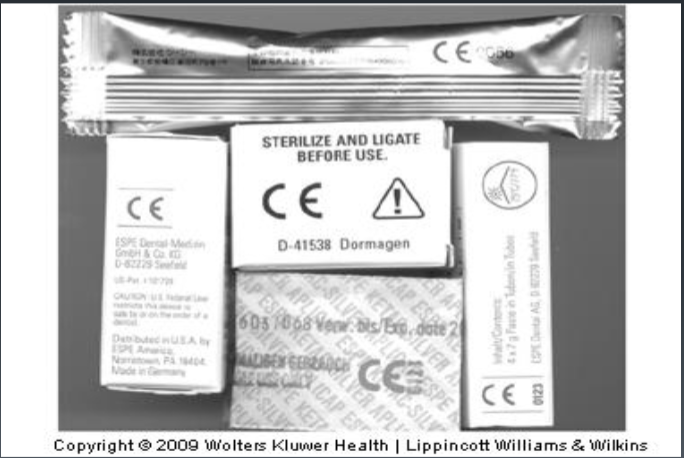
where is the CE symbol required for dental products to be sold?
european union markets
what are the three ways dental materials can be classified?
by use, location of fabrication, and longevity of use
how are restorations held in place?
by undercuts (mechanical retention), adhesion, or both
what is the difference between the walls of an inlay and an amalgam restoration?
an inlay has divergent walls, while an amalgam has convergent walls

what are cements used for?
used for luting objects together
what are bases and liners used for?
help protect the pulp from irritating materials, such as acids
examples of preventive materials
pit and fissure sealants
mouth guards
fluoride trays
what are direct restorative materials?
materials constructed directly in the oral cavity that are initially putty-like and set to become hard
what are the three examples of direct restorative materials?
amalgam, composites, and glass ionomers
how does amalgam form/set?
liquid mercury is combined with powdered materials
how do composites set?
they polymerize through a specific chemical reaction
how do glass ionomers and other cements set?
through an acid-base chemical reaction
what is Ketac?
a glass ionomer dental material that releases fluoride
what are indirect restorative materials?
materials fabricated outside the mouth on a replica of the patient’s oral tissues
what are examples of indirect restorative materials?
gold crowns, bridges, onlays, inlays, porcelain crowns, PFM crowns, and indirect restorative polymers

what is an interim restoration?
a long-term temporary restoration
how long are temporary restorations usually used?
6-12 months
are permanent restorations actually permanent?
no, all restorations eventually wear out
class I caries
all pit and fissure restorations

class II caries
cavities in proximal surfaces of premolars and molars

class III caries
cavities in proximal surfaces of incisors and canines

class IV caries
cavities in proximal surfaces of incisors and canines that do involve the incisal edge

class V caries
cavities on the cervical third of facial or lingual surfaces

class VI caries
cavities on incisal edges of anterior teeth and cusp tips of posterior teeth
