Whale Cart Museum Facilitator
 Call Kai
 Learn
Learn Practice Test
 Spaced Repetition
 Match
Match Flashcards
 Knowt Play
1/54

There's no tags or description
Looks like no tags are added yet.
Name | Mastery | Learn | Test | Matching | Spaced | Call with Kai | Chat |
|---|
No analytics yet
Send a link to your students to track their progress
55 Terms
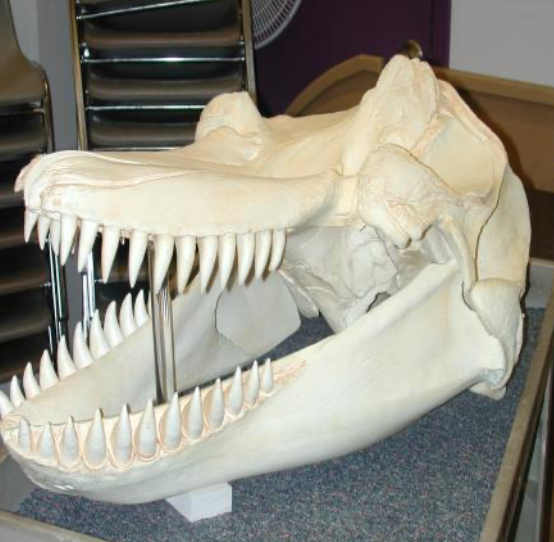
Orca Skull (Cast) Specimen Fast Facts
Male Orca Length & Weight: 24 ft, 10,000 lbs
They have:
a blowhole on top of their head, between their eyes.
a hollow jawbone that is filled with a fatty substance that sends vibrations from the water to their inner ear.
a depression in their skull where their melon (used for echolocation and communication) would sit.
conical teeth that curve backwards (which is how we know they are dolphins).
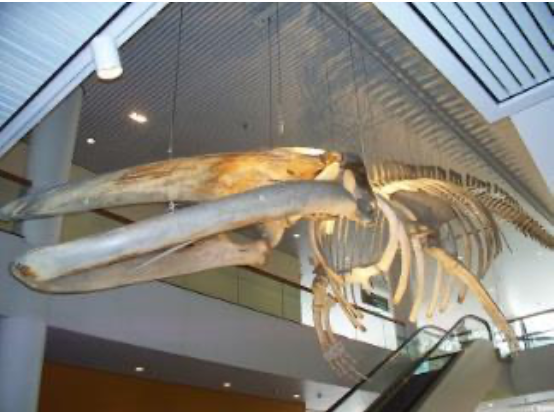
Fin Whale Skeleton Specimen Fast Facts
Skeleton Length & Weight: 57 ft, 2925 lbs
Actual Fin Whale Weight: over 60,000 lbs (6 African Elephants)
Acquisition: It hung in the Hotel del Coronado in San Diego in the late 1800s, then it spent 77 years at Colorado College. The college donated it to the museum in 1977.
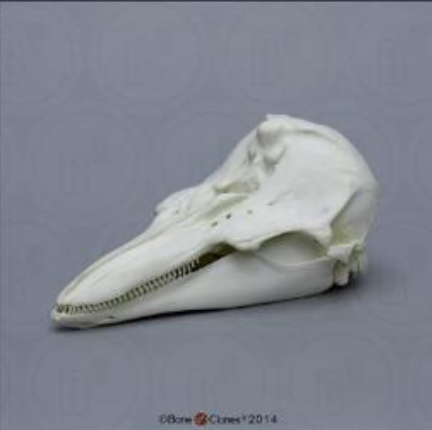
Harbor Porpoise Skull (Cast) Specimen Fast Facts
Harbor Porpoise Length & Weight: 6 ft, 200 lbs
They have:
a depression in the skull for a melon.
a blowhole on top of their head.
flat shaped teeth.
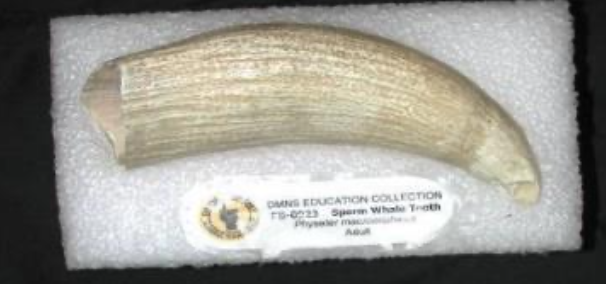
Sperm Whale Tooth Specimen Fast Facts
Sperm Whale Length & Weight: 54 ft, 80,000 lbs (the largest toothed whale)
They have:
large blunt teeth for preying on giant squid. They only have teeth on their bottom jaws. They suck up their prey instead of biting it into smaller pieces.
the ability to stun their prey with the sounds they produce through their melon.
teeth that were commonly used to make scrimshaw (carved ivory).
The whale in Moby Dick was a Sperm Whale.

Narwhal Tusk (Cast) Specimen Fast Facts
Narwhal Length & Weight: 16 ft, 3,600 lbs
Their tusk is:
a Narwhal’s upper left canine that grows through the upper lip. (It is mostly male Narwhals that have tusks. Females usually do not have them.)
thought to be a secondary sexual characteristic for establishing social structure and sensing surroundings.
potentially the source of the unicorn myth.
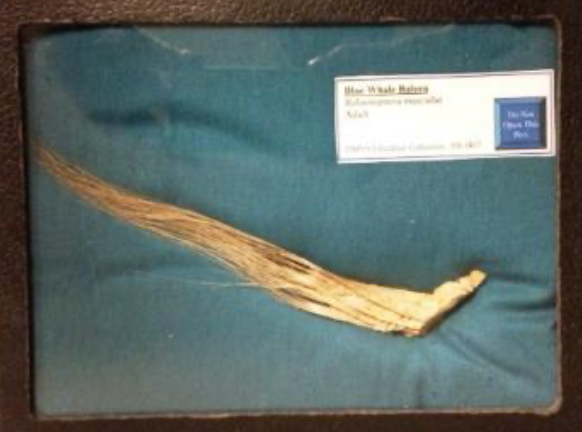
Blue Whale Baleen Specimen Fast Facts
Blue Whale Length & Weight: 80-100 ft, 120-190 tons (240,000-230,000 lbs)
Blue Whales have:
aprox. 600 baleen plates (which are made of keratin) in their upper jaw that trap krill and plankton while allowing them to filter the saltwater back into the ocean.
the ability to eat about 2,000 lbs of fish each day.
2 blowholes.
Blue Whales are the largest whale.

Bowhead Whale Baleen Specimen Fast Facts
Bowhead Whale Length & Weight: up to 65 ft, 75-100 tons (150,000-200,000 lbs)
Bowhead Whales have:
baleen plates that can reach 12 ft in length (the longest baleen plates of any whale).
the thickest blubber.
potentially the longest lifespan of any mammal (possibly 100+ yrs old)
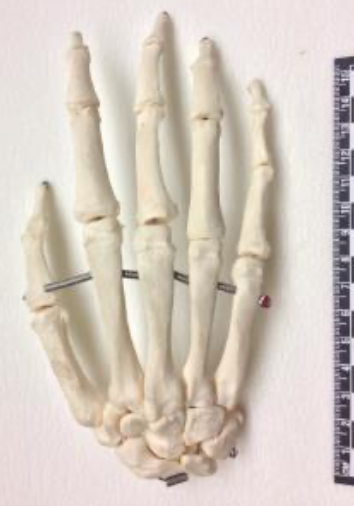
Articulated Human Hand (Replica) Specimen Fast Facts
Similarities and Differences between human and whale hands and forearms:
Both humans and whales have carpal bones, metacarpals, and digits.
Most baleen whales only have 4 digits (no digit 1, aka thumb).
Whales’ forearms are tiny in comparison to the rest of their body, with flippers often acting as rudders while the whale’s tail provides most of the thrust.
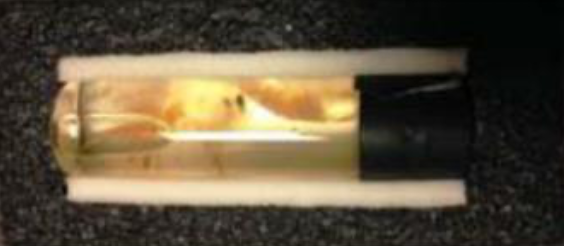
Krill Specimen Fast Facts
They are a shrimp-like crustacean that makes up a significant part of a baleen whale’s diet. They are pink form the algae they eat. A blue whale can eat up to 8,000 lbs of krill a day.
What order are whales?
the mammalian order Cetariodactyla
What is the closest living relative of whales?
the hippopotamus
Where do whales live?
in every ocean on the planet and some major freshwater systems as well (e.g. River Ganges, Yangtze River, Amazon River)
What are the two major groups of whales?
Toothed whales (odontoceti-latin for toothed sea creature)
Major groups: river and marine dolphins, porpoises, beluga and narwhal, sperm and pygmy sperm whales, beaked whales
Baleen whales (mysticeti-latin for moustache aka baleen)
Major groups: grey whales, rorquals (e.g. blue whale), right and pygmy right whales
Are all dolphins whales?
Yes, but not all whales are dolphins.
Both toothed and baleen whales have:
streamlined bodies
flukes, fins, and flippers
the ability to communicate underwater
blubber for insulation
intelligence
Whales are mammals. What are some mammalian characteristics that they share with us?
warm-blooded
breathe air through lungs
give birth to live young that suckle on milk secreted by the mom’s mammary glands
What are the smallest and biggest whales?
Hector’s dolphin (4.5 ft and 110lbs) and blue whale (80 ft and 100 tons/200,000 lbs)
What is the oldest living fossil assigned to the whale lineage?
Pakicetus, found in Pakistan, from the early Eocene (~55 mya). This fossil was a terrestrial wolf-sized mammal with an elongated body. Scientists found that wales become increasingly modified for an aquatic lifestyle as time progresses from this fossil.
What modifications helped whales transition from being terrestrial to aquatic over time?
elongated body with long mobile neck
development of fins
loss of coat (hair)
loss of most of the pelvic girdle
Nostrils moved backwards and became able to be sealed (blowhole)
What are vestigial structures and how do they apply to the fin whale skeleton?
Vestigial structures are body parts that have lost all or most of their function. You can see the vestiges of the of the pelvis on the fin whale skeleton.
How do whales breathe?
Their nostrils (blowhole migrated to the top of their head and gained the ability to be sealed to keep water out. Whales come to the surface to breathe. When they exhale through their blowhole they are exhaling air, not water. After breathing at the surface, they can hold their breath to forage and dive for long periods of time (up to 90 mins!) at depths of up to 1.9 miles below the surface. This is aided by the fact that their muscles can function anaerobically for a period of time and can build up larger amounts of lactic acid.
How do whales hear?
They do not have ears on the outside of their body or eardrums, instead they receive vibrations through their throat. They have hollow jaws filled with an oily substance that transfers underwater vibrations to their inner ear.
How do whales give birth?
Whales give live birth. When a baby whale is born, a female “nanny” whale helps the baby to the surface for their first gulp of air.
Fun fact: Blue Whales can gain hundreds of pounds each day when feeding on its mother’s high-fat milk.
How do whales sleep?
Whales are conscious or active breathers, so they can never be fully unconscious. To be able to rest their brain and breathe at the same time, one hemisphere of the whale’s brain will sleep at a time.
How and why do toothed whales use echolocation?
How: They will create a sound or vibration that is magnified by their melon, then, they will listen for the echo that returns and interpret it in order to know the shape, size, speed, and distance of other things in the water.
Why: It helps them navigate and it may even allow them to stun their prey.
Do baleen whales echolocate?
There is no evidence that baleen whales (without a melon) echolocate in the localized manner that toothed whales do. Blue whales may use low frequency sounds over hundreds of miles, possibly for navigation and communication though.
Define adaptive radiation
rapid ecological and morphological diversification, driven by natural selection, into a new environment.
Define ambergris
a waxy substance found in the digestive system of sperm whales.
Define artiodactyla
the mammalian group of even-toed ungulates (hoofed). This includes cows, sheep, goats, sheep, and technically, whales.
Define baleen
plates and strands of keratin (same protein in human fingernail) extending from the jaws of some whales; used to filter large amounts of krill from ocean water, similar to a pasta strainer; also referred to as “whalebone”.
Define blowhole
nostrils between the eyes and on top of the head of a whale. They can be sealed against the water.
Define blubber
a thick layer of fat that insulates; source of oil.
Define cetacea
the mammalian order that contains whales. Whales are now in Cetariodactyla.
Define Cetariodactyla
a newly proposed mammalian order that includes whales as hippos closest living relatives, nested within the rest of the artiodactyls (even-toed ungulates such as cows, sheep, etc).
define counter-shading
opposite coloring on dorsal vs. abdomen.
Define dorsal fin
the fin on a whale’s dorsal (back) side.
Define echolocation
the use of sound for navigation as performed by living creatures such as bats and whales (same principal as SONAR).
Define flipper
a broadened, flattened limb, adapted specifically for swimming.
Define fluke
each of the two lobes of a whale’s tail, controlled by giant muscles and composed of cartilage.
Define fusiform
body shape tapered at both ends, sort of torpedo shaped.
Define melon
a depression in the skull of toothed whales that is filled with a warlike substance, called spermaceti, creating the appearance of a hump on the whales’ head and making echolocation possible
Define plankton
microscopic animal and plant life floating in the ocean
Define spermaceti
the grayish, wax-like substance found in the melon’s of toothed whales; used in the past for making cosmetics, candles, etc.
Define ‘Whippo hypothesis’
The idea that whales are closely related to hippos, a type of artiodactlyl (even-toed ungulate). Thus, according to this hypothesis, whales are not merely related to artiodactyls, whales ARE artiodactyls.
When did the earliest fully aquatic whales live?
Scientists think that the earliest fully aquatic whales around 40 mya (the middle of the Eocene).
When did whales break into the suborders Odontoceti and Mysticeti?
The earliest known member of the Mysticeti, the modern filter-feeding whales is from the latest Eocene, around 34 million years ago. The earliest known member of the Odontoceti, the modern toothed whales, is from the early Oligocene, around 30 million years ago. This suggests that the split between Mysticeti and Odontoceti occurred during the late Eocene.
What is the only other group of mammals that we know is fully aquatic?
Sirenia (sea cows and dugongs). These are not whales. Also, Sirenia are herbivores and whales are not.
Why did marine mammals go back to the sea?
We don’t know the exact answer, but early terrestrial ancestors began feeding in the water and became more adapted to aquatic conditions over time.
Does sonar testing impact whales?
Yes, research is still being done on the extent that it impacts whales, but it can cause changes in behavior and feeding as well as death, serious injuries, and minor injuries (such as temporary hearing loss. One proposition is that sonar testing be done in designated parts of the ocean to lessen the impacts.
How do we know the age of whales?
Scientists are still developing systems for determining whale age. Some of these include analyzing how many layers of earwax a whale has, determining the number of methyl groups in whale skin samples, and using other clues such as dating a harpoon tip that was in a bowhead whale.
Why do dolphins wear sponges on their beaks, or rostra?
Some dolphins (primarily females) wear sponges on their beaks to protect their beaks from damage when they probe for more nutritious bottom dwelling fish. These bottom dwelling fish doe not have swim bladders so they are harder to find with echolocation, hence making it necessary for them to probe the sea floor.
Define anaerobic
oxygen deprived/lacking.
Define crustacean
a sub-group of arthropods that are marine dwelling, including, crabs, lobsters, shrimp, and barnacles.
Define krill
a small, shrimp-like crustacean.
Define ventral
the bottom or belly of an animal, in humans that would be our stomach/chest.