1.2.1 How do processes work together to create landform features at different scales in river and coastal landscapes in the UK?
 Call Kai
 Learn
Learn Practice Test
 Spaced Repetition
 Match
Match Flashcards
 Knowt Play
1/66

Earn XP
Description and Tags
Name | Mastery | Learn | Test | Matching | Spaced | Call with Kai | Chat |
|---|
No analytics yet
Send a link to your students to track their progress
67 Terms
What is weathering?
Breakdown of rock in the landscape around the river
Where does weathering happen? [One term answer]
In-situ

What is freeze-thaw weathering?
Water, upon collecting in a crack in a rock, repeatedly freezes and thaws causing the rock to break into smaller ieces
What is exfoliation?
Repeated heating and cooling of the rock causes expansion and contraction, so the outer rock layer breaks into smaller pieces
What is chemical weathering?
Rocks disintegrate and dissolve in slightly acidic rainwater
What is carbonation (a type of chemical weathering)?
Rainwater absorbs CO2 from the air, becoming, becoming acidic, causing alkaline chalk and limestone rocks to slowly dissolve
What is biological weathering?
Rocks are broken apart by the roots of plants
What are the two main types of mass movement in river valleys?
Slumping and soil creep
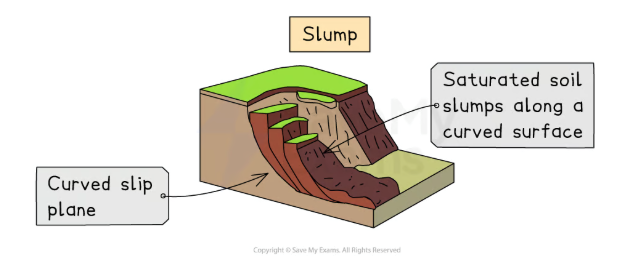
What is slumping?
When slope is eroded by the river, undercutting the slope
Fill in the gap:
Slumping often occurs when a _, less resistant material overlies a _, more resistant material
Slumping often occurs when a softer, less resistant material overlies a harder, more resistant material
What is soil creep?
Influence of gravity causes weathered material to slowly move down the slope towards the river
What is abrasion?
Rocks carried in river smash into the bank/bed of the river, wearing it down
What is attrition?
Rocks crash together as they move along in the river, knocking bits off each other
What is hydraulic action?
When water is forced into cracks in the banks/bed of the river, forcing them to expand
What is solution?
Where chemicals in the river dissolve minerals in the bank/bed of the river
When does deposition occur?
Reduction in river _
_ is reduced due to dry weather
_ water
Increase in size of the _
River _
Reduction in river gradient
Discharge is reduced due to dry weather
Shallow water
Increase in size of the load
River flooding
What is solution (in terms of transportation)?
Dissolved minerals carried in the flow of the water
What is suspension (in terms of transportation)?
Fine particles, clay and silt, float in the river flow and carried long distances
What is saltation?
Rocks bouncing along the river bed
In what velocity rivers is saltation more frequent?
High velocity rivers
What is traction?
Larger gravels, cobbles and boulders roll over smaller rocks on the riverbed
What is alluvium?
Clay, silt, sand and gravel carried by a river
What is erosion?
Wearing away of the bed and banks of the river channel by AB, HA, solution and attrition
What landforms may typically be found in the upper course? [4 landforms]
V-shaped valleys
Waterfalls
Plunge pools
Gorges
Describe v-shaped valleys:
Steep sides and a narrow valley floor
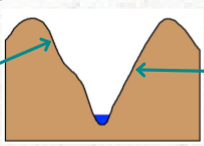
How are v-shaped valleys formed?
River erodes downwards in a [ ] gradient through [ ] and [ ]
Loose material falls slowly down slope ( [ ] )
This material is [ ] away by the river
[ ] sides created, flow of water also swings [ ]
[ ] [ ], this process results in the valley cut into the hillside to form [ ] [ ]
River erodes downwards in a steep gradient through HA and AB
Loose material falls slowly down slope (slumping)
This material is transported away by the river
Steep sides created, flow of water also swings laterally
Over time, this process results in the valley cut into the hillside to form interlocking spurs
What are interlocking spurs?
Ridges of hard rock that project alternately from opposite sides of a steep, v-shaped valley
Which two types of weathering occur in v-shaped valleys?
Biological and freeze-thaw on the valley sides
![<p><strong>How does a waterfall [and gorge] form?</strong></p><ol><li><p>River flows over layers of [ ] resistant rock overlying softer, [ ] [ ] rock</p></li><li><p>Softer rock at base of waterfall [ ] more quickly from [ ] and [ ] of the falling water and its load</p></li><li><p>A [ ] and overhang is created</p></li><li><p>Over [ ], the [ ] eventually collapses under its own [ ] into the plunge pool</p></li><li><p>This causes the waterfall to [ ] [ ], upstream</p></li><li><p>The retreat leaves behind a steep sided [ ] bottomed [ ] called a gorge</p></li></ol><p></p>](https://assets.knowt.com/user-attachments/b25da4a4-0441-4967-83ba-3d50c92d08b7.png)
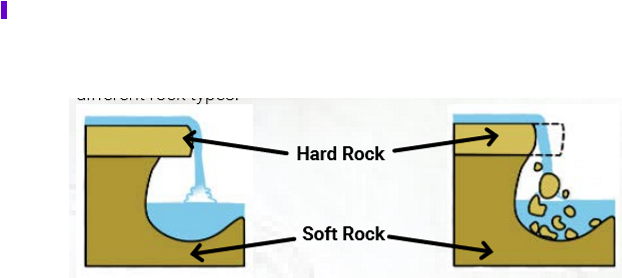
How does a waterfall [and gorge] form?
River flows over layers of [ ] resistant rock overlying softer, [ ] [ ] rock
Softer rock at base of waterfall [ ] more quickly from [ ] and [ ] of the falling water and its load
A [ ] and overhang is created
Over [ ], the [ ] eventually collapses under its own [ ] into the plunge pool
This causes the waterfall to [ ] [ ], upstream
The retreat leaves behind a steep sided [ ] bottomed [ ] called a gorge
River flows over layers of more resistant rock overlying softer, less resistant rock
Softer rock at base of waterfall erodes more quickly from HA and AB of the falling water and its load
A notch and overhang is created
Over time, the overhang eventually collapses under its own weight into the plunge pool
This causes the waterfall to retreat backwards, upstream
The retreat leaves behind a steep sided narrow bottomed valley called a gorge
Where are meanders usually found in a river?
In the middle and lower courses
![<p><strong>How are meanders [and slip off slopes] formed?</strong><br></p><ol><li><p>Water travels faster on the [ ] bend, [ ] erosion takes place</p></li><li><p>A [ ] [ ] is created on the outside bend as material falls into the river and gets [ ] downstream</p></li><li><p>[ ] continues on inside bends</p></li><li><p>Erosion [ ] away cliffs on the outside bend</p></li><li><p>Deposition creates [ ] [ ] [ ] on the inside bend</p></li></ol><p></p>](https://assets.knowt.com/user-attachments/3e6075a9-d3de-4469-a1b4-0ac7ac6f3620.png)
How are meanders [and slip off slopes] formed?
Water travels faster on the [ ] bend, [ ] erosion takes place
A [ ] [ ] is created on the outside bend as material falls into the river and gets [ ] downstream
[ ] continues on inside bends
Erosion [ ] away cliffs on the outside bend
Deposition creates [ ] [ ] [ ] on the inside bend
Water travels faster on the outside bend, lateral erosion takes place
A river cliff is created on the outside bend as material falls into the river and gets transported downstream
Deposition continues on inside bends
Erosion wears away cliffs on the outside bend
Deposition creates slip off slopes on the inside bend
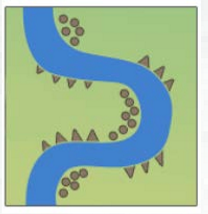
What causes a meander to move across the river’s floodplain?
Continued erosion and deposition
What is the thalweg?
Path of fastest water (least resistance)
Why do slip off slopes form?
As a result of deposition on the meander’s inside bend
How is an oxbow lake formed?
Over time, erosion [ ] the river so that meanders travel [ ] each other
Perhaps in the event of a [ ], the meander [ ] breaks, creating a straight river and bend
[ ] occurs outside of the straight channel, old bend is cut off
Over time, erosion bends the river so that meanders travel towards each other
Perhaps in the event of a flood, the meander neck breaks, creating a straight river and bend
Deposition occurs outside of the straight channel, old bend is totally cut off
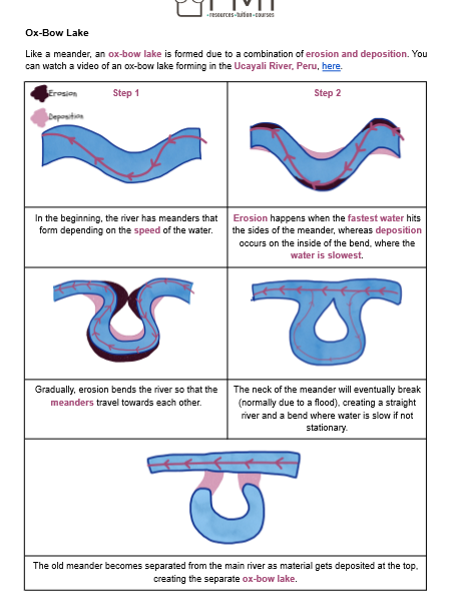
What are the only landforms formed due to both erosion and deposition combined?
Meanders and oxbow lakes
What are the depositional landforms in a river?
Floodplains
Levees
Estuaries
Point bars
What are the erosional landforms in a river?
Interlocking spurs
Waterfalls
Gorges
River cliffs
What essentially is a floodplain?
The deposition of finer, lighter alluvium
Why is a floodplain useful?
The silt makes the land fertile
How are levees formed?
[ ] deposited on river bank [ ]
Levees grow in [ ] over time
Sediment deposited on river bank tops
Levees grow in height over time
What does the upper course look like?
River starts as many tributaries, narrow and v-shaped
What does the middle course look like?
Tributaries merging to form a rounder and deeper channel, many meanders
What does the lower course look like?
Very wide and very deep channel, levees, lots of deposition
What is an estuary?
Large mudflats and saltmarshes exposed at low tide that build into permanent habitats on the river (the tidal mouth of a river)
What are distributaries?
Finger-like river chanels which branch away from a main river channel
What is a confluence?
Point where two rivers meet
What is a point bar?
A mound of deposited material found in a river bend
Where are point bars commonly found?
On the inside bend of a meandering river
What are bedding planes?
Natural breaks in the strata caused by gaps in time during periods of rock formation
What are joints?
Vertical fractures caused by either onctraction when sediment has dried out, or tectonic movement
What are folds?
Buckles and crumples of rocks pushed together
Why do folds form?
Formed by pressure during tectonic activity
![<p><strong>How do headlands and bays form?</strong></p><ol><li><p>Waves erode a [ ] coastline by [ ] and [ ]</p></li><li><p>Soft rock is [ ] resistant, so it erodes quickly to form bays</p></li><li><p>Hard rock is more resistant, remaining [ ]</p></li><li><p>Waves become shallower approaching a headland, making waves steeper and more [ ], [ ] erosion</p></li><li><p>Waves [ ] [ ] where the water is deeper into a bay</p></li><li><p>[ ] [ ] creates a coastline with alternating headlands and bays</p></li></ol><p></p>](https://assets.knowt.com/user-attachments/4853e456-928e-4a60-a46c-1056539ffa75.png)
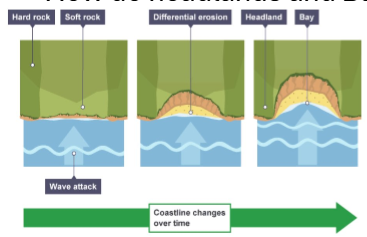
How do headlands and bays form?
Waves erode a [ ] coastline by [ ] and [ ]
Soft rock is [ ] resistant, so it erodes quickly to form bays
Hard rock is more resistant, remaining [ ]
Waves become shallower approaching a headland, making waves steeper and more [ ], [ ] erosion
Waves [ ] [ ] where the water is deeper into a bay
[ ] [ ] creates a coastline with alternating headlands and bays
Waves erode a discordant coastline by HA and AB
Soft rock is less resistant, so it erodes quickly to form bays
Hard rock is more resistant, remaining headlands
Waves become shallower approaching a headland, making waves steeper and more destructive, increasing erosion
Waves lose energy where the water is deeper into a bay
Differential erosion creates a coastline with alternating headlands and bays
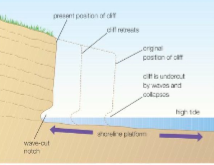
What is a wave cut notch?
A dent in the cliff usually at the level of high tide
![<p><strong>How does a wave cut platform form?</strong></p><ol><li><p>Sea attacks [ ] of cliff between high and low water mark</p></li><li><p>A [ ] [ ] [ ] is formed by HA and AB</p></li><li><p>As the notch increases in size, the cliff becomes [ ] and [ ], leading to the retreat of the cliff [ ]</p></li><li><p>[ ] carries away the eroded material, leaving a wave-cut [ ]</p></li><li><p>Process repeats and cliff continues to [ ]</p></li></ol><p></p>](https://assets.knowt.com/user-attachments/0e49b374-b43b-4108-81fe-3449a9f2d663.png)
How does a wave cut platform form?
Sea attacks [ ] of cliff between high and low water mark
A [ ] [ ] [ ] is formed by HA and AB
As the notch increases in size, the cliff becomes [ ] and [ ], leading to the retreat of the cliff [ ]
[ ] carries away the eroded material, leaving a wave-cut [ ]
Process repeats and cliff continues to [ ]
Sea attacks base of cliff between high and low water mark
A wave cut notch is formed by HA and AB
As the notch increases in size, the cliff becomes unstable and collapses, leading to the retreat of the cliff face
Backwash carries away the eroded material, leaving a wave-cut platform
Process repeats and cliff continues to retreat
Where are rock pools commonly found?
On wave-cut platforms
Why do rock pools form in wave-cut platforms?
Small depressions in the rock fill with seawater at high tide
![<p><strong>How do caves/arches/stacks/stumps form?</strong></p><ol><li><p>[ ] widened in the headland through HA and AB</p></li><li><p>Waves continue to [ ] away at the crack, opening up to form a [ ]</p></li><li><p>Cave becomes larger and eventually [ ] through the [ ] to form an [ ]</p></li><li><p>[ ] [ ] [ ] continually widens through further erosion</p></li><li><p>Arch [ ] becomes too heavy and [ ] into the sea, leaving a [ ]</p></li><li><p>The stack is [ ] at the [ ] until it collapses to form a [ ]</p></li></ol><p></p>](https://assets.knowt.com/user-attachments/c941c408-cd18-4f56-bba4-584d1b65972a.png)
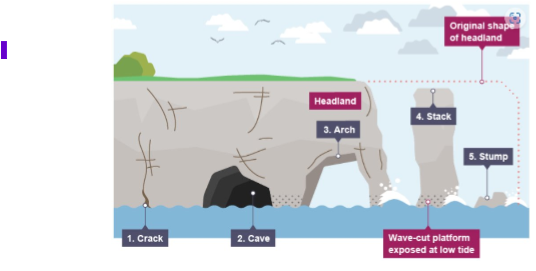
How do caves/arches/stacks/stumps form?
[ ] widened in the headland through HA and AB
Waves continue to [ ] away at the crack, opening up to form a [ ]
Cave becomes larger and eventually [ ] through the [ ] to form an [ ]
[ ] [ ] [ ] continually widens through further erosion
Arch [ ] becomes too heavy and [ ] into the sea, leaving a [ ]
The stack is [ ] at the [ ] until it collapses to form a [ ]
Cracks widened in the headland through HA and AB
Waves continue to grind away at the crack, opening up to form a cave
Cave becomes larger and eventually breaks through the headland to form an arch
Base of arch continually widens through further erosion
Arch roof becomes too heavy and collapses into the sea, leaving a stack
The stack is undercut at the base until it collapses to form a stump
What is LSD?
Waves approaching at an angle, moving sediment along the beach in a ZIG ZAG pattern
What depositional landforms might involve LSD? [4]
Beaches
Tombolos
Bars
Spits
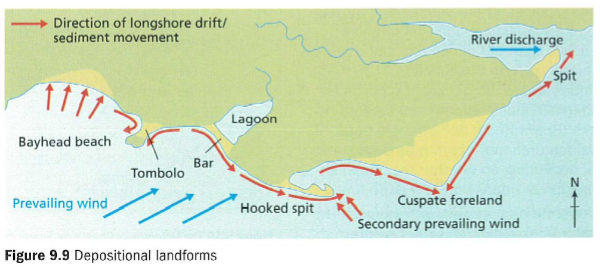
What is a tombolo?
A ridge of sand/shingle formed by deposition that links an island to the mainland
How does a tombolo form?
[ ] transports sediment along the coast
Wave [ ] creates an area of low energy in the sheltered water behind an island
[ ] builds up sand and [ ] until a ridge connects the island to the mainland
LSD transports sediment along the coast
Wave refraction creates an area of low energy in the sheltered water behind an island
Deposition builds up sand and shingle until a ridge connects the island to the mainland
![<p><strong>How is a spit formed?</strong></p><ol><li><p>LSD transports sediments along the coast</p></li><li><p>Coastline changes [ ] or reaches an [ ], but LSD continues to carry sediment out to sea</p></li><li><p>[ ] occurs as waves lose energy, building up a ridge of sand/shingle [1 ] [2 ] [3 ] [4 ]</p></li><li><p>Spit [ ] [ ] as more sediment is deposited by LSD</p></li><li><p>End of the spit may [ ] due to changes in [ ] or [ ] direction</p></li></ol><p></p>](https://assets.knowt.com/user-attachments/51241a71-ed37-49f9-8be8-acacacb46efd.png)
How is a spit formed?
LSD transports sediments along the coast
Coastline changes [ ] or reaches an [ ], but LSD continues to carry sediment out to sea
[ ] occurs as waves lose energy, building up a ridge of sand/shingle [1 ] [2 ] [3 ] [4 ]
Spit [ ] [ ] as more sediment is deposited by LSD
End of the spit may [ ] due to changes in [ ] or [ ] direction
LSD transports sediments along the coast
Coastline changes direction or reaches an estuary, but LSD continues to carry sediment out to sea
Deposition occurs as waves lose energy, building up a ridge of sand/shingle attached to the mainland
Spit extends outwards as more sediment is deposited by LSD
End of the spit may hook due to changes in wind or wave direction
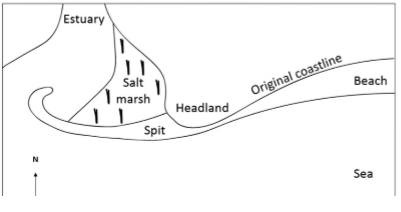
What often form behind spits in sheltered water?
Salt marshes
How does a bar form?
LSD transports sediment along the coastline
Sediment is [1 ] [2 ] [3 ] [4 ] [5 ] [6 ] [7 ] as waves lose energy
Continued [ ] extends ridge across the bay
Over time, the ridge eventually joins the two [ ], forming a [ ]
LSD transports sediment along the coastline
Sediment is deposited across the entrance to a bay as waves lose energy
Continued deposition extends ridge across the bay
Over time, the ridge eventually joins the two headlands, forming a bar
What is the water trapped behind the bar formed called?
A lagoon