Lumbar OMM
 Call Kai
 Learn
Learn Practice Test
 Spaced Repetition
 Match
Match Flashcards
 Knowt Play
1/16

There's no tags or description
Looks like no tags are added yet.
Name | Mastery | Learn | Test | Matching | Spaced | Call with Kai | Chat |
|---|
No analytics yet
Send a link to your students to track their progress
17 Terms
How do you diagnose a lumbar vertebra?
Have the patient seated with feet ON the floor
1. Assess TART changes by dragging your finger down the lumbar region and seeing where the redness lasts the longest. That’ll be your specific vertebrae
2. Put your fingers on the transverse processes and have the patient bend forward into flexion and then lean back into extension. If no difference is noted, the patient will have a Type 1 Neutral somatic dysfunction
3. Whichever transverse process feels more prominent/posterior will be the direction of rotation. You can then determine the direction of side bending from there (Type 1 Neutral = rotation and side bending are in OPPOSITE directions whereas Type 2 Flexed/Extended = rotation and side bending are in the SAME direction)
Important landmark for lumbar vertebrae:
L4 = essentially at the level of the iliac crests
L5 = just inferior to that
What do you ALWAYS do prior to performing any lumbar HVLA?
Soft tissue
Lumbar MET

Anterior Lumbar CS locations

AL 1 + 5 CS = stand on _________ side
Same
Mnemonic: 1 and 5 same side. 2- 4 across the floor
AL 2, 3, 4 = stand on __________ side
Opposite
AL 1 CS

AL 2 CS

AL 3, 4 CS

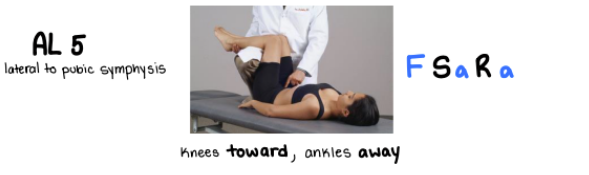
AL 5 CS
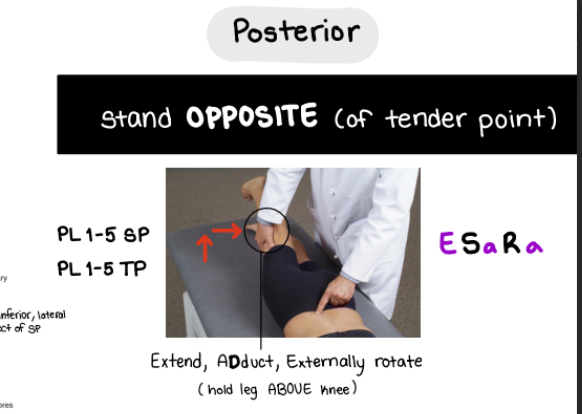
PL (Posterior Lumbar) CS
QL CS

QL CS locations (can pick any of them to perform treatment on)

Initial HVLA setup for both Type I (Neutral) and Type II (Flexed/Extended)
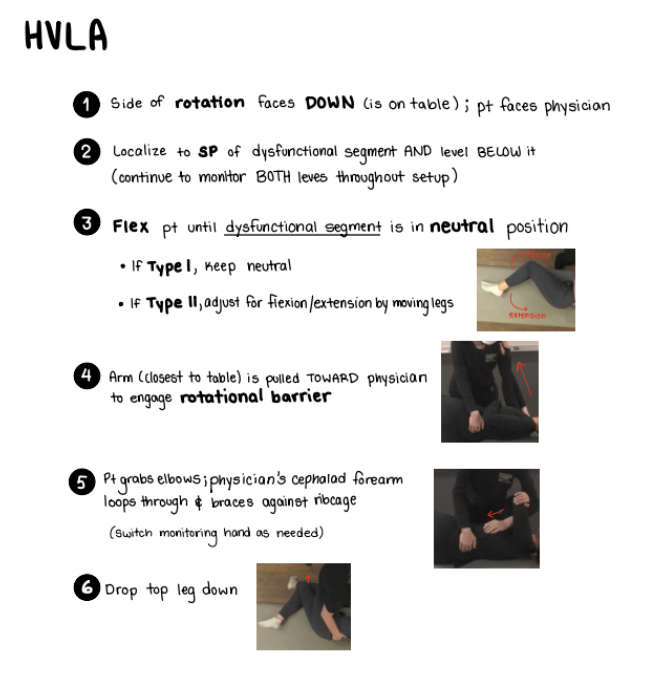
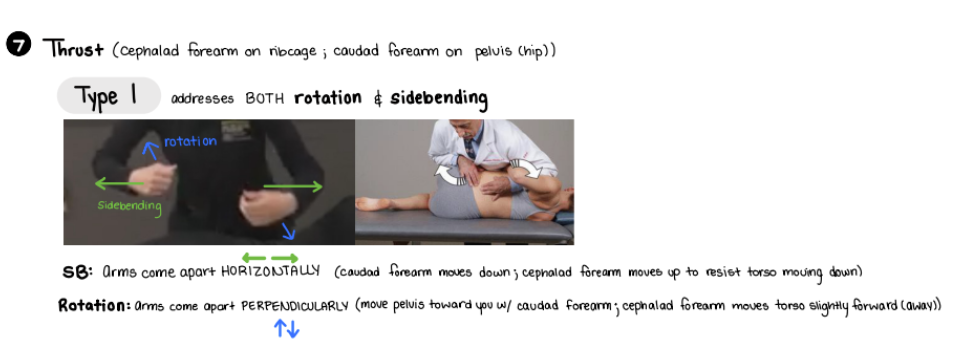
HVLA thrust for Type I (neutral)
Arms pull apart
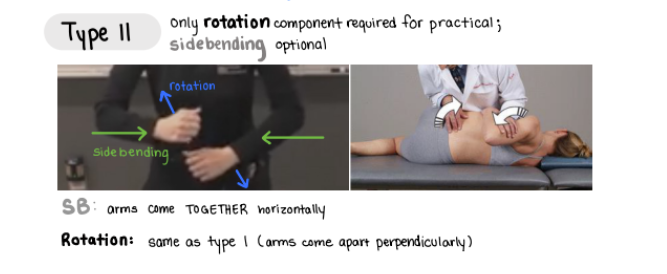
HVLA Thrust for Type II (Flexed/Extended)
Arms come together