269 Respiration ⭐️
 Call Kai
 Learn
Learn Practice Test
 Spaced Repetition
 Match
Match Flashcards
 Knowt Play
1/51

There's no tags or description
Looks like no tags are added yet.
Name | Mastery | Learn | Test | Matching | Spaced | Call with Kai |
|---|
No analytics yet
Send a link to your students to track their progress
52 Terms
What are the two types of respiration
Pulmonary respiration
Cellular respiration
What is the purpose of pulmonary respiration
Ventilation
Exchange O2 and CO2 in the lungs
What is the purpose of cellular respiration
Uses O2 and produces CO2 by the tissues
What is ventilation
The mechanical process of moving air into and out of the lungs
What are the two pressure differences
Intrapulmonary pressure
Atmospheric pressure
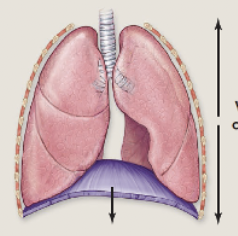
What is inspiration
Occurs when volume of the lungs increases
Causes diaphragm to contract (thoracic cavity increases)
Control is located in the medullar oblongata
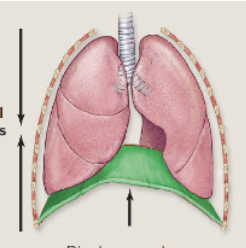
What is expiration
Occurs when volue of the lungs decreases
Causes diaphragm to relax (thoracic cavity decreases)
Control is located in the medullar oblongata
What is diffusion
Random movement of molecules from high concentration to low concentration
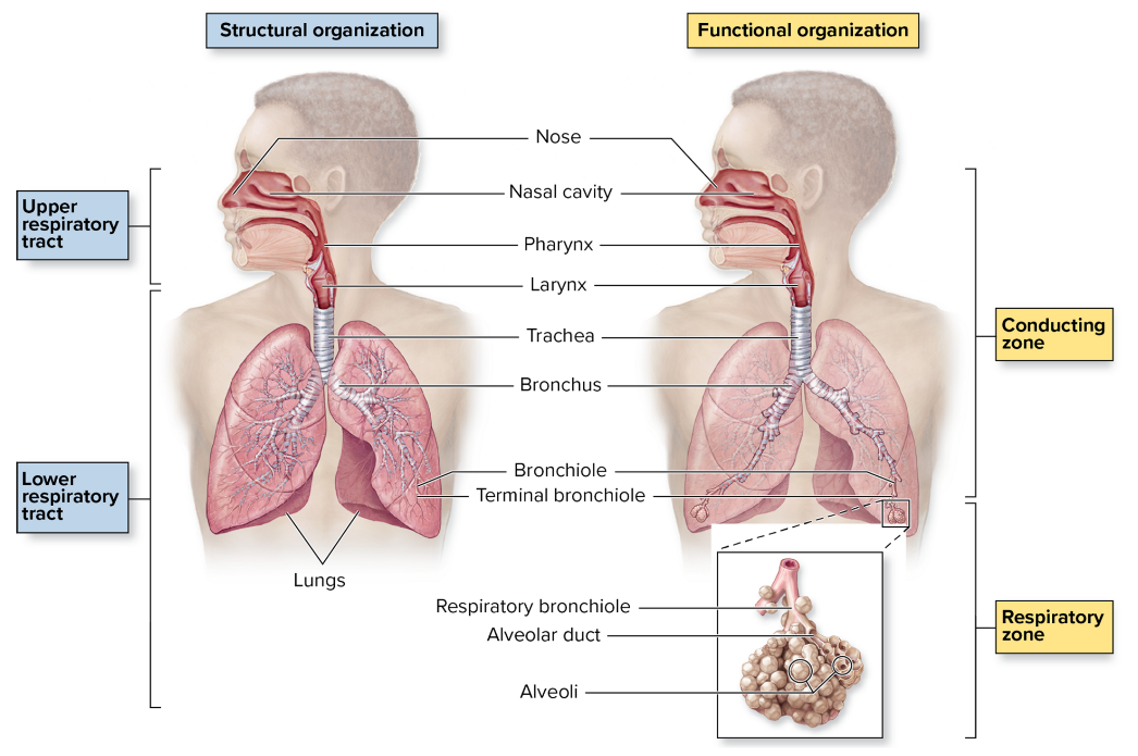
How is the respiratory system broken up
There the structural organization which has a upper and lower respiratory tract
Then there the functional organization which has the conducting zone and respiratory zone
What does air way resistance depend on
Pressure difference between the two ends of the airway
Resistance on diameter of airway
What is the equation for air flow
Air flow = P1 - P2 / Resistance
What is pulmonary ventilation
Movement of gas into and out of the lungs
What is the equation for venilation
V = VT x f
(VT - volime of gas moved per breath, f - frequency of breathing)
What is tidal volume (TV)
Amount of air inhaled or exhaled in 1 normal breath
What is inspiratory reserve volume (IRV)
Excess air that can be inhaled with maximum effort (after normal breath)
What is expiratory reserve volume (ERV)
Exess air that can be exhaled with maximum effort (after normal breath)
What is residual volume (RV)
Air remaining in the lungs after maximum expiration (can never be fully voluntarily exhaled)
What is vital capacity (VC)
Air that can be forcefully exhaled after maximum inspiration
ERV + TV + IRV
What is inspiratory capacity (IC)
Maximum amount of air that can be inhaled after normal expiration
TV + IRV
What is functional residual capacity (FRC)
Air remaining in the lungs after normal expiration
RV + ERV
What is total lung capacity
Maximum amount of air in the lungs at the end of maximum inspiration
RV + VC
What is the normal resting respiration vs during exercise
Resting - 12-17 breaths/minute
Exercise - 45-65 breaths/minute
What is alveolar ventilation
Portion of the tidal wave that reaches alveolar compartment - portion of tidal wave that does not reach alveolar compartment (gas trapped within anatomical dead space)
What is used to measure lung volume
A spirometry
What is Dalton’s Law
Total pressure of gas = sum of pressure that each gas would exert independently
What is the equation of air pressure
Pair = PO2 + PCO2 +PN2
What is Fick’s law equation
V gas = A/T x D x P (P1 - P2)
(A - tissue area, T - thickness, D - diffusion coefficient, P1-P2 - differenace in partial pressure)
Why is there a differenace of diffusion between oxygen and carbon dioxide
They are different in size and have different coefficients
What is the equation for partial pressure of O2 and CO2
PAO2 = (PB x FIO2) - 47 mmHG
(PB - biometric pressure, FIO2 - factors of inspired oxygen)
What circuit does blood use to go to the lungs
Pulmonary circuit
What is the ventilation-perfusion relationship (V/Q)
Maintains a balanced ratio of matching airflow (V) to blood flow (Q)
Ideal is 1.0
underperfused V/Q < 1.0
overperfused V/Q > 1.0
Light-moderate exercise improves V/Q ratio
Heavy exercise may result in V/Q inequality
What two ways is oxygen transported within the blood
Oxyhemoglobin - being bound to hemoglobin (99% is transported this way)
Deoxyhemoglobin - not bound to hemoglobin
What the amount of oxygen that can be transported depended on
The hemoglobin concentration
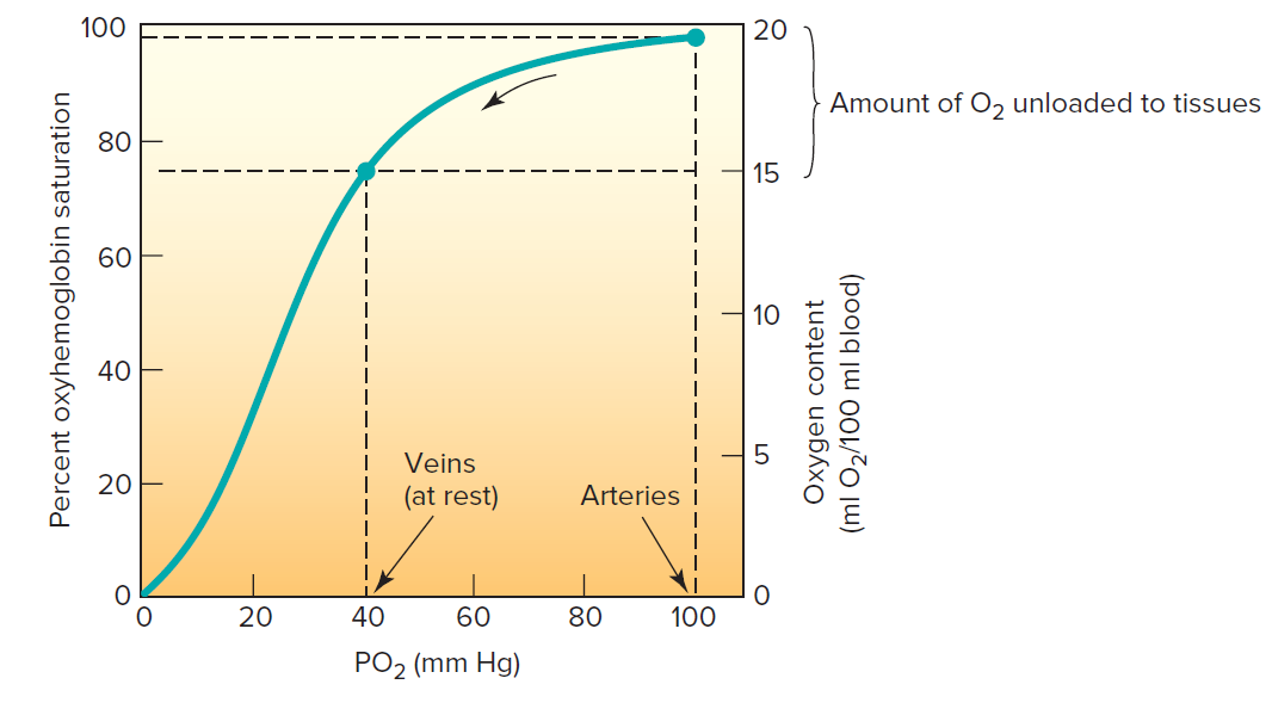
What is the oxyhemoglobin dissociation curve
Sigmoidal curve (S shaped)
This curve relates to how much oxygen we can take into the tissue at any given partial pressure
Factors that affect this curve include:
pH (decrease in pH = lower hemoglobin-oxygen binidng strength, curve shifts right)
Temperature (increasing blood temp = lower hemoglobin-oxygen binding strength, curve shifts right)
Diphosphoglyceric acid
What is the deoxygemoglobin oxyhemoglobin relationship
Deoxygemoglobin + O2 ←> oxyhemoglobin
The direction of reaction depends on pressure of oxygen in blood and strength of binding between hemoglobin and O2W
What is myoglobin
Serves as a O2 binding protein in skeletal muscle
Has higher binding strength for O2 than hemoglobin
Stores O2
Under very low conditions of oxygen during max exercise, myoglobin will give up O2 for the production of ATP in the electron transport chain
What are the three ways CO2 can be transported in the blood
Dissolved in plasma
Bound to hemoglobin
Bicarbonate
What is the carbonic anhydrase equation
←———————————————-Lung
CO2 + H2O ——→ H2CO3 → H + HCO3-
Muscle ————————————→
How does CO2 transport in the blood at the tissue level
H+ binds to hemoglobin
HCO3- diffuses out of RBC into plasma
Cl- diffuses into RBC (Chloride shift)
How does CO2 transport in the blood at the lung level
O2 binds to hemoglobin (drives off H+)
Reaction reverses to release CO2
Cl- diffuses into RBC (chloride shift)
What is hyperventilation
Increased ventilation = CO2 exhalation
It reduces PCO2 and H+ concentration (pH increases)
What is hypoventilation
Decreased ventilation = CO2 buildup
It increases PCO2 and H+ concentration
What ventilatory changes occur during exercise
Ventilation increases in proportion to the exercise intensity
It also increases during prolonged submaximal exercise in hot environment + during graded potential
How does PCO2 react when VE drifts upward during a hot environment exercise
It remains constance during to the changes in CO2 stimulate cause the brain to ventilate more
How are the buffering systems different in trained vs untrained
Training has increased buffering capacity
Untrained has reduced buffering capacity
How is inspiration controlled
The control system is located in the medulla oblongata
Output from the respiratory control center regulates motor neurons in the spinal cord that control respiratory muscles. Primary neural pacemaker responsible for inspiration is the preBotzinger complex
How is expiration controlled
The control system is located in the medulla oblongata
Input to the respiratory control center from both humoral chemoreceptors and neural sources (higher brain centers and afferent pathways. Ex. muscle mechanoreceptors and chemoreceptors)
What are the central chemoreceptors sensitive to
PCO2 and H+ concentration in cerebrospinal fluid
What are the peripheral chemoreceptors sensitive to
PO2, PCO2, H+ and K+ in the blood
What are muscle mechanoreceptors
Muscle spindles, golgi tendon organs, joint pressure receptors
What are muscle chemoreceptors
Sensitive to K+ and H+ concentrations
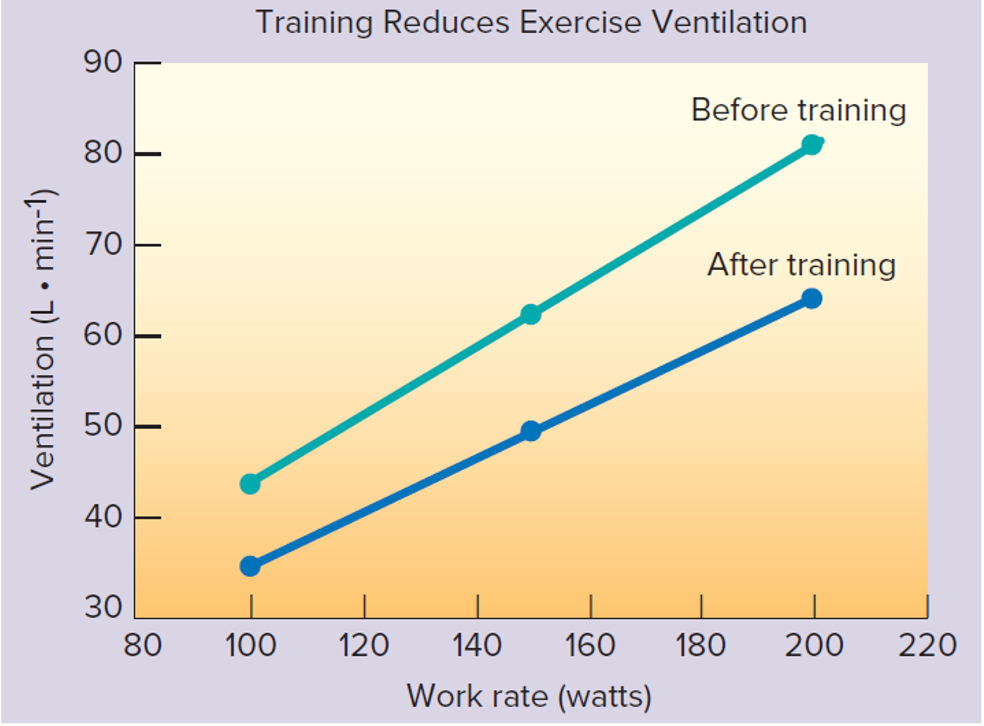
How does endurance training imapct ventialtion during exercise
It causes ventilation to be lower