Tort SQE
 Call Kai
 Learn
Learn Practice Test
 Spaced Repetition
 Match
Match Flashcards
 Knowt Play
1/16

There's no tags or description
Looks like no tags are added yet.
Name | Mastery | Learn | Test | Matching | Spaced | Call with Kai | Chat |
|---|
No analytics yet
Send a link to your students to track their progress
17 Terms
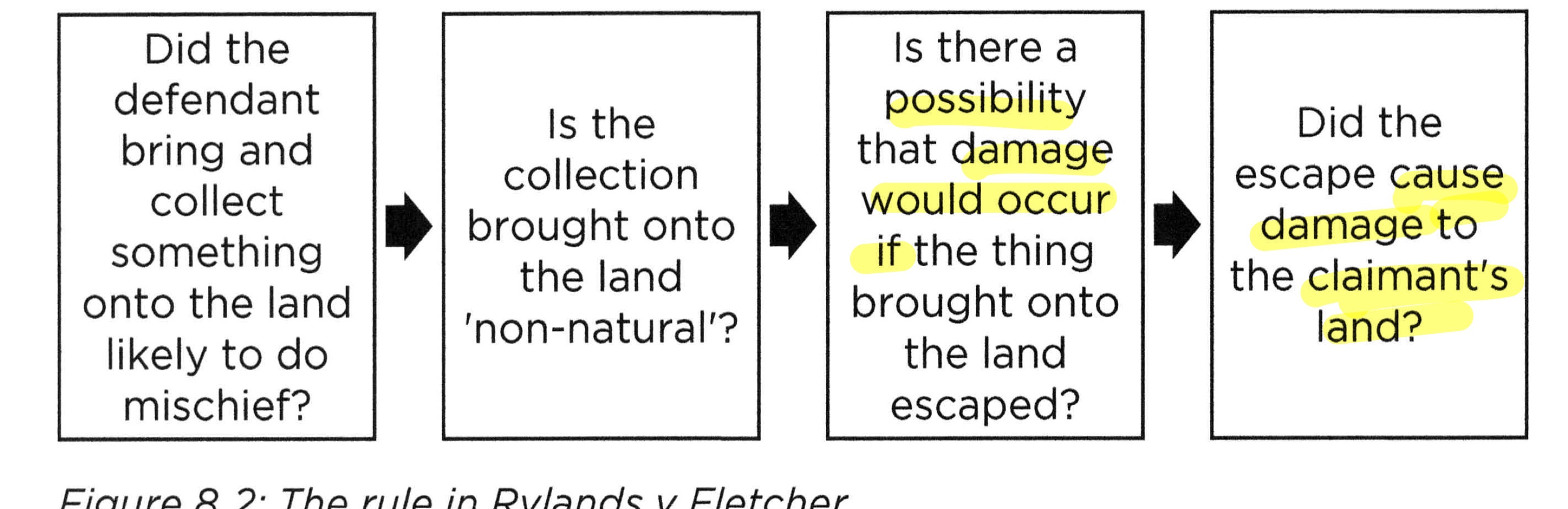
nuisance - rule in rylands v fletcher
To be liable: the defendant must have collected and kept something non-natural on their land which is likely to do mischief if it escapes.
• The claimant must have suffered harm/property damage, but cannot claim personal injury under the rule in Rylands v Fletcher.
• defences applicable: contributory negligence, consent, statutory authority, act of God and unforeseeable act of a stranger.
• awarded damages if successful
does DOC exist? test:
legal test for establishing whether a duty of care exists
2 approaches:
by analogy (e.g. established DOC situations)
caparo 3 stage test
foreseeability of harm,
relationship of proximity between parties,
whether it is fair, just, and reasonable to impose a duty of care.
tort - other relevant factors when considering the standard of care
cost of precautions
social value
likelihood of harm
seriousness of injury.
employer's claims involving exposure to asbestos
for questions about employer's claims involving exposure to asbestos - ensure you consider the claimant’s illness:
If the claimant suffers from mesothelioma the Compensation Act 2006 (joint and several liability) is the position.
If the claimant develops lung cancer due to negligent exposure to asbestos then Barker is the position, namely that the claimant can claim from any liable employers, but the damages will be apportioned relating to how long the claimant worked for that employer.
negligent mistatement pure econ loss recoverable exception hedley byrne
liability for econ loss due to negligent misstatement confined to where:
statement/advice had been given to a known recipient for a specific purpose for which the maker was aware and upon which the recipient had relied and acted to his detriment
Hedley Byrne - court: DOC could arise even where harm was pure economic loss; restricted to 4 situations:
a) where a special relationship of trust/confidence existed between the parties
b) where the party preparing the statement has voluntarily assumed the risk (either expressly or impliedly)
c) where there has been a reliance on the information/statement
d) where reliance on the statement was reasonable in the circumstances.
Negligence framework
duty of care owed?
breached that duty by falling below required standard of care?
causation - was breach of duty factual cause of injury?
remoteness - was damage suffered not too remote?
damages etc
negligence - liability for omission to act / acts of third parties
no liability for omission to act, except:
The law of tort typically does not impose liability for omissions; liability arises from actions that cause injury or damage (Smith v Littlewoods Organisation Ltd [1987] AC 241).
Exceptions to the General Rule
High Degree of Control: If a defendant has significant control over a claimant, they may have a duty to act e.g. Reeves v Commissioner of Police for the Metropolis [1999] 3 All ER 897, where police had a duty to protect a prisoner from self-harm.
aka Special relationship (D-C or D-third party) e.g. Dorset Yacht - supervisors of young offenders (escaped and caused damage to boats) owed DOC to owner of boats
Assumption of Responsibility: When D voluntarily takes on responsibility for another's welfare -
Stansbie v Troman [1948] 2 KB 48 - a contractor's omission resulted in harm (decorator had duty to lock home when leaving - also special relationship; D has assumed responsibility to C in some way to protect C from the damage which the third-party eventually causes)
Barrett v Ministry of Defence [1995] 1 WLR 1217 - officer's intervention (taking control of situation) created a duty to ensure safety (naval airman died choking on vomit)
D negligently created dangerous situation: If D’s omission creates a dangerous situation - Goldman v Hargrave [1967] 1 AC 645, where failure to extinguish embers led to further damage.
Positive Duty Imposed by Statute: Statutory requirements can create liability for omissions, e.g. Occupier's Liability Act 1957 mandates safe premises for visitors
Defences to Negligence
Consent
C had full knowledge of nature & extent of risk;
C voluntarily accepted the risk
Contributory Negligence
extent of damages reduced by not wearing seatbelt - 25% injuries prevented / 15% injuries less severe / no difference 0%
Illegality
vicarious liability elements
D1 commit tort
D1-D2 relationship akin to employment
tort committed in the course of employment
critical Q: performing services in business on his own account?
traditional unauthorised mode test (liable for either a wrongful act they have authorised, or a wrongful and unauthorised mode of an act that was authorised)
close connection test: sufficiently close connection
between the employee’s job and the tort to make it fair and just to impose liability on the employer.
acts not authorised but so closely connected = considered ‘mode’ of act authorised by employer
e.g. cases of unlawful/criminal act which the job gave opportunity for employee to commit
employer’s liability - common law duty of care:
An employer is expected to provide:
competent staff
liable if employer knew/ought to have known about employee’s behaviour (e.g. history of practical jokes)
adequate plant and equipment
liable if defective equipment causes C’s injury
not liable if employee wouldn’t have worn safety equipment even if provided anyway
a safe system of work
safe premises.
duty is to take reasonable care only - e.g. placed sawdust on floor but ran out before whole of floor could be covered; not liable as did what was reasonable
trespassers (occupiers’ liability act 1984)
duty of care only arises if:
(NB property damage not covered)
_
The occupier will owe a duty of care to trespasser if:
(a) They are aware of the danger or have reasonable grounds to believe that it exists;
(b) They know or have reasonable grounds to believe that the trespasser is in the vicinity of the danger concerned or that they may come into the vicinity of the danger; and
that someone is in the vicinity of the danger at the time (this can alter on day and night - or summer and winter) of the accident
(c) The risk is one against which, in all the circumstances, they may reasonably be expected to offer the other some protection.
e.g. unreasonable to expect school to fence off playground (child injured on playground near school field)
Visitors (occupiers’ liability act 1957)
duty of care:
occupiers owe a common duty of care to ensure visitors are reasonably safe while using the premises for the purpose he is invited/permitted to be there
DOC for children: occupiers should be prepared for children to be less careful than adults
DOC for skilled visitors: occupiers can expect workers to appreciate and guard against risks associated with their work.
Occupiers may avoid liability for injuries caused by the negligence of independent contractors (e.g. visitor injured by faulty execution of contractor work); occupiers must:
prove it was reasonable to entrust the work to an independent contractor
take reasonable steps to ensure contractor was competent
take reasonable steps to ensure work was properly done (e.g. inspect the work)
can an occupier exclude liability for death or personal injury?
cannot exclude as business occupier;
but for private premises - occupier could provide a notice restricting/excluding liability
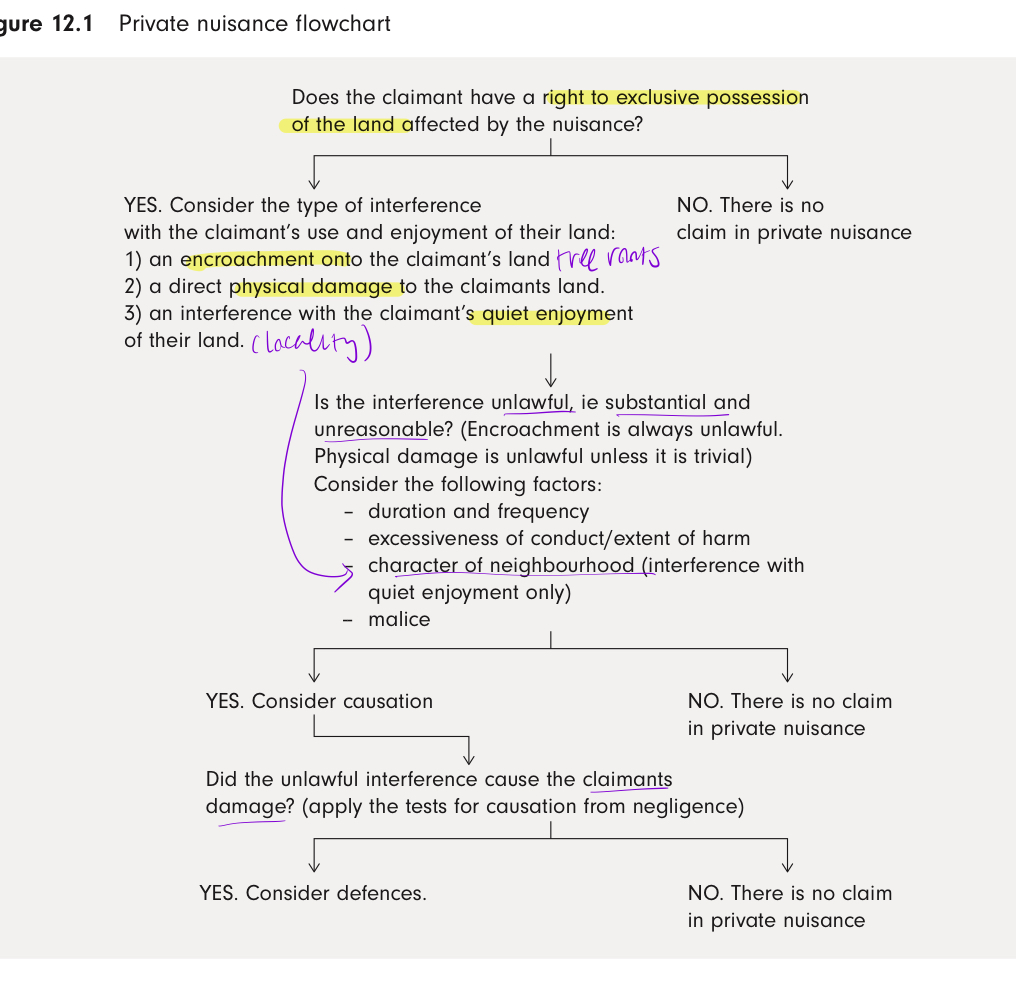
private nuisance
Protects: claimant’s use/enjoyment of land.
Claimant: must have a proprietary interest/right to exclusive possession—e.g. owner or tenant, not a guest/licensee.
Elements
Interference with land: either
encroachment;
physical damage to land; or
loss of amenity/quiet enjoyment—e.g. noise, smells, dust, vibration.
Interference is substantial and unreasonable.
Damage/interference of the relevant type was reasonably foreseeable.
_
Unreasonableness
Physical damage to land will normally be unreasonable.
For amenity interference, consider:
duration/frequency—usually requires continuity or a continuing state of affairs;
character of locality;
abnormal sensitivity of claimant;
malice;
public benefit.
An isolated event is normally insufficient.
__
older notes:
Private nuisance protects land and property from unreasonable interference.
C must have right to exclusive possession of property/land affected
use of property/land must be unreasonable
C must suffer some harm, injury or damage (to land only; cant claim personal injury)
_
Material injury to property
‘sensible personal discomfort’ (take into account locality)
Encroachment on land
interference will always be unreasonable if it causes damage to property. If the vapours had not caused damage but only personal discomfort the court would take into account the locality and character of the neighbourhood.
_
Not recoverable: Personal injury.
recoverable: damage to the claimant’s interest in land, including:
Physical damage to land — buildings, soil, trees and fixtures.
Loss of amenity/use and enjoyment — noise, smells, dust, vibration, loss of sleep or comfort.
Land-related financial loss — reasonable repair/remedial costs, treatment costs and sometimes diminution in the land’s value.
_
Exam trigger
Continuing unreasonable interference with private land → private nuisance.
Interference with a class/public right + claimant’s special damage → public nuisance.
Escape from an extraordinary accumulation causing foreseeable property damage → Rylands v Fletcher.
Primary victims — psychiatric harm
Primary victim = directly involved in the accident and:
physically injured, or
within the foreseeable zone of PHYSICAL injury
(including reasonably believing themselves to be in physical danger).
To recover:
recognised psychiatric illness;
physical injury was reasonably foreseeable;
breach caused the psychiatric illness.
Key rule: no need to prove psychiatric harm was separately foreseeable—foreseeable physical injury is enough.
_
Rescuers: only primary victims if exposed, or reasonably believed themselves exposed, to physical danger.
_
Primary victim → only need to physical injury to be foreseeable (no need psychiatric)
Secondary victim → foresee psychiatric injury.
psychiatric harm secondary victim elements
diagnosed psychiatric illness
Harm foreseeable in a person of reasonable fortitude
rship - Close tie of love and affection with primary victim
time and space - Present at the accident or immediate aftermath
perception - Direct perception through unaided senses
causation - Illness caused by witnessing that event
_
detail:
Secondary-victim elements
A recognised psychiatric illness
Grief, sorrow, distress or anxiety alone is insufficient.Reasonable foreseeability - PSYCHIATRIC! harm
Psychiatric illness must have been reasonably foreseeable in a person of reasonable fortitude in the claimant’s position.An accident involving the primary victim
The claimant must witness an accident in which the primary victim is killed, injured or imperilled—not merely a later medical crisis or death resulting from an earlier failure to diagnose or treat.A close tie of love and affection with the primary victim
Presumed for relationships such as spouses and parent–child; otherwise it must be proved.Proximity in time and space
The claimant must be present at the accident or its immediate aftermath.Direct perception through unaided senses
They must personally see or hear the accident/immediate aftermath—not merely be told about it by another person.Causation
The psychiatric illness must have been caused by directly perceiving that accident or its immediate aftermath.
Public nuisance
Protects: public rights and the comfort/convenience of the public—e.g. unobstructed use of a highway.
Elements
Unreasonable conduct materially affects a class of the public.
An individual claimant must suffer particular/special damage beyond that suffered by the class generally.
Key distinctions
No proprietary interest in land required.
May cover an isolated event.
Particular damage may include personal injury or property/economic loss.
Usually pursued publicly by the Attorney General; an individual sues only where special damage is suffered.
Defences: statutory authority, consent, contributory negligence, necessity, act of God and unforeseeable act of a stranger.
No prescription defence.
Remedies: damages and/or injunction.
_
Exam trigger
Continuing unreasonable interference with private land → private nuisance.
Interference with a class/public right + claimant’s special damage → public nuisance.
Escape from an extraordinary accumulation causing foreseeable property damage → Rylands v Fletcher.