CENTRAL NERVOUS SYSTEM
 Call Kai
 Learn
Learn Practice Test
 Spaced Repetition
 Match
Match Flashcards
 Knowt Play
1/70

There's no tags or description
Looks like no tags are added yet.
Name | Mastery | Learn | Test | Matching | Spaced | Call with Kai | Chat |
|---|
No analytics yet
Send a link to your students to track their progress
71 Terms
C7
benzodiazepine: An electronegative (EN) atom at the [___] increases activity.
substituent at N1, carbonyl group at C2
benzodiazepine: to maintain basic activity, substitutions are strictly required at the [_______] positions on Ring B.
5-phenyl ring
Benzodiazepines: Baseline molecule activity is enhanced by the presence of a [_______] attached at position 5 (Ring C).
2’/6’ (ortho)
Benzodiazepines: An Electron-Withdrawing Group (EWG) attached at the [_______] positions of Ring C will increase activity.
4’ (para)
Benzodiazepines: An Electron-Withdrawing Group (EWG) attached at the [_______] position of Ring C will decrease activity.
-OH at C3 of Ring B
Benzodiazepines: Adding a(n) [______] increases polarity and shortens the half-life
fourth heterocyclic ring
Benzodiazepines: A [_______]. reduces duration when attached across atom 1 and 2.
Triazolam
Benzodiazepines: [_______] is the short-acting agent with a fused triazole ring.
Midazolam
Benzodiazepines: [_______] is the short-acting agent with a fused imidazole ring.
Diazepam
Benzodiazepines: Lacking both a 3-OH and a 4th ring makes [_______] a long-acting agent.
5,5-disubstituted
Barbiturates: To exhibit sedative-hypnotic activity, the C5 position must be [_______].
C2 position
Phenothiazines: An electronegative atom is essential to increase activity when placed at the [_______].
3-atom unbranched
Phenothiazines: The optimal linker length at the N-10 alkyl side chain is a [_______] chain.
Tertiary
Phenothiazines: To ensure antipsychotic action, the terminal nitrogen amine is always [_______].
Aliphatic
Phenothiazines: -promazine belongs to the [_______] structural subtype based on its terminal nitrogen.
Piperidine
Phenothiazines: -ridazine belongs to the [_______] structural subtype based on its terminal nitrogen.
Piperazine
Phenothiazines: -perazine belong to the highly potent [_______] structural subtype.
Aliphatic
Phenothiazines: The subtype with the highest antiHAM profile but the lowest antipsychotic potency/EPS is [______}
Piperazine
Phenothiazines: The subtype with the highest antipsychotic potency and EPS risk but lowest antiHAM side effects is [_______].
Keto group
Butyrophenones: At the C1 position, a [_______] is optimal for high antipsychotic activity.
Pimozide
Butyrophenones: The C1 keto group can be structurally replaced by a para-F-phenyl group in the drug [_______].
para-position
Butyrophenones: On the left phenyl ring, the most potent molecules have a Fluorine (F) atom attached at the [_______] position.
a. ortho
b. meta
c. para
3-carbon chain
Butyrophenones: Between the C1 carbonyl and the terminal nitrogen, a [_______] is strictly optimal for potency.
Cyclic tertiary
Butyrophenones: Attached at the 4th carbon, a [_______] amino group is essential for activity.
Aryl group
Butyrophenones: The cyclic tertiary nitrogen is usually substituted with a(n) [_______] at its para position.
Desipramine
TCAs: The stimulating, secondary amine metabolite of Imipramine.
-triptyline; desipramine
TCAs: secondary amines end with [______] except for [______]
-pramine; amitriptyline
TCAs: tertiary amines end with [______] except for [_______]
serotonin
TCAs: tertiary versions are more selective against [_____] reuptake.
norepinephrine
TCAs: nor versions are more selective against [_____] reuptake
phenol
aromatic rings
ionized amine
opioid analgesics: opium 3 important binding sites
A and D
Opioids: The absolute minimum ring requirement for opioid analgesic activity consists of rings [_______].
Phenanthrenes or 4,5-epoxymorphinan
Opioids: Structural class containing all five rings (ABCDE)
morphine, codeine, heroin, thebaine
Opioids: Structural class containing all five rings (ABCDE)
Morphinan
Opioids: Structural class featuring rings ABCD (missing ring E)
levorphanol, dextromethorphan
opioids under morphinan
Benzomorphan
Opioids: Structural class featuring rings ABD, acts as a partial mu agonist
pentazocine
opioids under benzomorphan
Phenylpiperidines
Opioids: Structural class containing only rings AD
loperamide, fentanyl, pethidine, diphenoxylate
opioids under phenylpiperidine
Diphenylheptane
Opioids: Structural class featuring ring A only, with methadone serving as the classic example.
Tramadol
Opioids: An atypical agent that uniquely contains only rings A and C.
Increased
Opioids: Converting the C6 hydroxyl to a ketone (oxidation) results in [_______] analgesic activity.
Decreased
Opioids: Converting the phenolic OH to a methoxy group (methylation, like Codeine) results in [_______] analgesic activity.
Heroin
Opioids: [_______] is the drug structurally known as diacetylmorphine or diamorphine.
Increased
Opioids: Acetylation of both hydroxyl groups to form Heroin leads to [_______] brain penetration and activity.
codeine
opioid that is methylated on C6
decrease; increase
Inhaled anesthetics: halogenation causes [_______] in flammability and [_______] in potency
increase; increase
Inhaled anesthetics: Increasing the molecular weight of the halogens used leads to [_______] potency and [_______] side effects.
asymmetric ethers
Inhaled anesthetics: Structural layout (like Isoflurane or Sevoflurane) that is more stable and potent
methoxyflurane
Inhaled anesthetics: Agent noted for being highly potent but carries high risk for nephrotoxicity due to free fluoride release.
10 carbons
Inhaled anesthetics: Increasing the carbon count raises potency until it reaches a maximum cutoff limit of [_______] for linear chains.
8 carbons
Inhaled anesthetics: Increasing the carbon count raises potency until it reaches a maximum cutoff limit of [_______] for cyclic structures.
Na+ channel blocker
Local Anesthetics: The primary mechanism of action involves functioning as a [_______].
lipophilic end; membrane penetration
Local Anesthetics: The aromatic ring portion represents the [_______] which is essential for [________]
hydrophilic end; binding the receptor
Local Anesthetics: The terminal tertiary nitrogen portion represents the [_______] which is essential for [________] in its ionized form
electron-donating group; ortho or para
Local Anesthetics: Adding [_______] to the [_______] position of the aromatic ring results in increased activity.
duration of action
Local Anesthetics: The chemical nature of the intermediate linker primarily influences the drug's [_______].
Esters
Local Anesthetics: Linker class that is highly susceptible to metabolic hydrolysis, resulting in a short half-life.
Amides
Local Anesthetics: Linker class that is resistant to hydrolysis, providing a significantly longer half-life
Benzoic acid
Local Anesthetics: Chemically, ester-linked local anesthetics (like Cocaine) are classified as [_______] derivatives.
Anilide
Local Anesthetics: Chemically, amide-linked local anesthetics (like Lidocaine) are classified as [_______] derivatives.
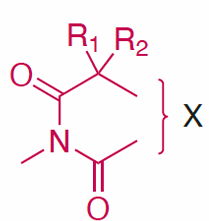
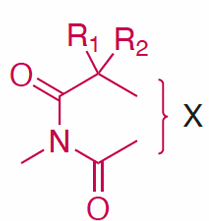
barbiturates (anticonvulsant)
X = amide
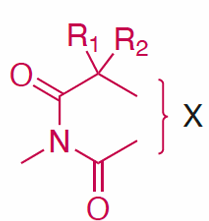
hydantoin (anticonvulsant)
X = amine
oxazolidinediones (anticonvulsant)
X = oxygen
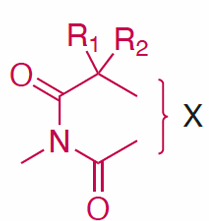
succinimide (anticonvulsant)
X = carbon
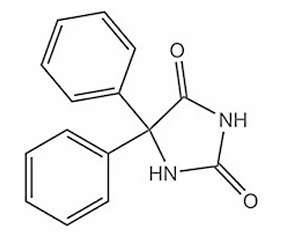
phenytoin
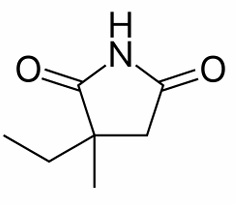
ethosuximide
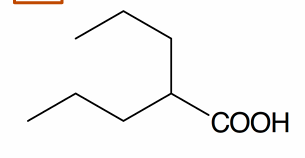
valproic acid
gamma-aminobutyric acid (GABA)
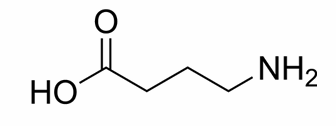
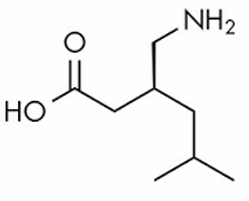
pregabalin