Art History
 Call Kai
 Learn
Learn Practice Test
 Spaced Repetition
 Match
Match Flashcards
 Knowt Play
1/47

There's no tags or description
Looks like no tags are added yet.
Name | Mastery | Learn | Test | Matching | Spaced | Call with Kai | Chat |
|---|
No analytics yet
Send a link to your students to track their progress
48 Terms
Ocher
a naturally occurring clay pigment that ranges in color from yellow to red,
brown, or white
Megalith
a large stone used as, or part of, a prehistoric monument
Low relief
raised forms that project only slightly from a flat background
Post-and-lintel
a form of construction in which two upright posts support a horizontal beam (lentil)
Petroglyph
an image created on a rock surface through incision, picking, carving, or
abrading
Frieze
any sculpture or painting in a long, horizontal format
Pictorial narrative
storytelling in pictures that presents a connected sequence of
events
Register
a horizontal section of a work, usually a clearly defined band or line
Stele (plural steles)
a carved stone slab that is placed upright and often includes
commemorative imagery and/or inscriptions
Votive
an image or object created as a devotional offering to a deity
Libation
the ritual pouring of a liquid, often alcohol, to a spirit or deity as an offering while prayers are said
Hierarchical scale
the use of size to denote the relative importance of subjects in an
artwork
Lost-wax casting
a method of creating metal sculpture in which a clay mold surrounds
a wax model and is then fired. When the wax melts away, molten metal is poured in to fill the space.
Mastaba
a massive, flat-topped rectangular tomb building with slanted side walls; built of either mud brick or cut stone
Hypostyle hall
a large room with rows of columns or pillars supporting the roof
Tholos (plural tholoi)
a round vaulted building, often a tomb, shaped like a beehive
Fresco
a wall or ceiling painting on wet plaster (also called true or buon fresco); wet pigment merges with the plaster, and once hardened the painting becomes an integral part of the wall; painting on dry plaster is called fresco secco
Continuous narrative
multiple events combined within a single pictorial frame
Cyclopean masonry
a stone building technique in which large boulders are roughly
Corbeling
overlapping wood, stone, or brick wall projections arranged so that each
course extends farther from the wall than the course below.

1.5 Hall of Bulls, Lascaux Cave, Dordonge, southwestern France, c. 15,000 BCE
• More popular
• The artists all looked at the wall and saw the dark line that naturally existed on the cave wall and thought it would be a good ground line (Line of the ground) (produced by several generations.)
•Composite view (more than one view) shows that the artist might have wanted to give more information (twisted perspective- perspective is twisted)
• Aurochs (extinct wild cattle)
• Some scholars say the flickering torch light shows the animals moving (Story telling)

1.9 Lion-human figurine, statuette from Hohlenstein-Stadel, southwest Germany, c.
40,000–35,000 CE. 1” Mammoth ivory, height 11 5/8 in (29.5 cm). Museum Ulm, Germany
• Head of a lion (cat) with the body of a human
• Made by wholly mammoth ivory (hard to get)
• This is a 1 ft sculpture (is why this is rare)*
• One of the oldest known sculptures in human history
• Used burin and other stone tools
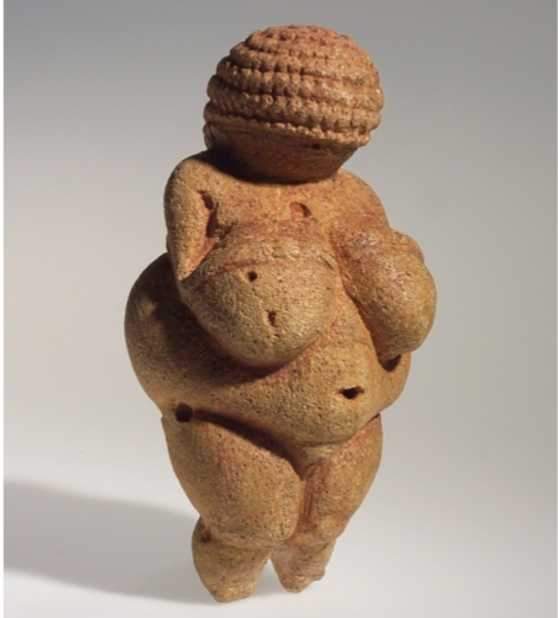
1.10 Woman of Willendorf, Austria, 24,000–22,000 BCE. Oolitic limestone, height
4⅜ in. (11.1 cm). Naturhistorisches Museum, Vienna.
• Limestone its carved from was not native to the region, so likely transported from one place to another
• Most scholars assume she is a fertility figure due to the emphasis on female anatomy*
• Less than 5” high, with substantial belly, pronounced navel, solid thighs, wide hips, and slender arms
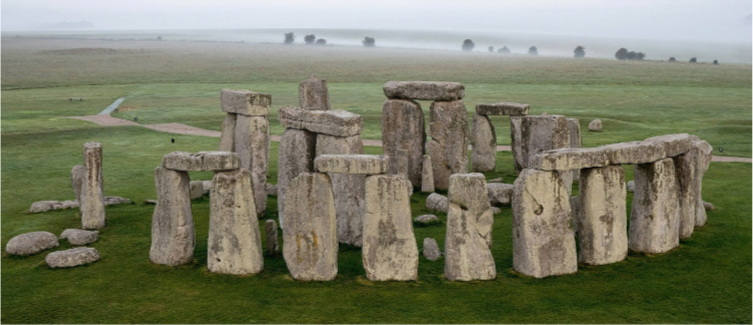
1.15 Stonehenge, Salisbury Plain, southern England, 2900–1500 BCE.
• Prominent position in public imagination is due to its architectural complexity, the transporting of specific stones, and its expressive monumentality
Burial, religious gathering, relates to astronomical (astronomy)
Post-and-lental - (building a door or passageway) two part building technique, two vertical post (post) and a cross beam, (lental) on top

2.2 Elephant relief, Messak Settafet, Libya, Large Wild Fauna Style, with later
inscriptions, 7500–5000 BCE. Abrasives and stone tools on rock surface.
Petragluph- a relief carving onto a rock
Sharp tool carving
• Technique: rubbing grooves into the rock surface to define the contours of animals
• Despite naturalistic appearance, rock art specialists believe it also included symbolic elements
• Symbolic meaning (we don't know)

3.2 Temple of Anu (White Temple) at Uruk (Warka, Iraq), c. 3300 BCE.
Reconstruction proposal, 2012. Whitewashed temple, with niches, approximate
area 57½ × 73 ft. (17.53 × 22.25 m).
• Housed daily rituals and worship of multiple deities and also as the city center
• The builders of the temple monumentalized house design
to elevate it to the realm of the gods
• Dedicated to a certain god this case the god of anu

3.8 (Far Right) Uruk Vase, carved with low relief representations in registers, c. 3200
BCE. Alabaster, height 41⅜ in. (105.1 cm). Iraq Museum, Baghdad.
• Earliest ever pictorial narrative 3200 BC
• This shows a hierarchy of scale (sometimes its hot where its placed its how “bigger image is higher”) how they break down registers
• The relief imagery is divided into registers and may represent ritual offerings to the gods and goddesses/presentation of these offerings to a temple priestess
• One of the most important of Sumerian art

3.11 Votive figures from the Temple of Abu, Eshnunna (Tell Asmar, Iraq), 2750–2600
BCE. Gypsum, limestone, and alabaster with eyes inlaid with shell, black limestone,
and lapis lazuli, largest figure height 29⅞ in. (75.9 cm). The Oriental Institute Museum, University of Chicago.
• Placed in a room where rituals were held
• Votive offering- small offering
• Found within Samarian Temple
Stylization - Fancy way of saying Specific style (Mostly Specific Abstraction)
• Offering to the deities
• They hold small beaker (liquid offering-Libation)
• Each figure has “puppy dog eyes” big wide eyes, this indicates state of prayer or worship
• These offering would stand in as them (not portrait)

3.12a-b Royal Standard of Ur. From Tomb 779, Royal Tombs of Ur (Tell el-Muqayyar,
Iraq), Early Dynastic IIIA period, 2550–2400 BCE. Wood inlaid with shell, lapis lazuli,
red limestone, and bitumen, 7⅞ in. × 18½ in. (20 × 47 cm). British Museum, London.
• Suggested to believe that royals were buried here because of things found
• However, Samaritans most likely don't call kings or queens or have that hierarchy so wealthy people were buried there.
• Hollow wooden box decorated on four sides with inlaid mosaic scenes that feature pictorial narratives
War and peace sides
• Imagery divided into registers with different narratives that link political conflict, war, and feasting in a cause-and-effect Relationship
• Used hierarchical scale, twisted view as well
Lapis Lazuli- Semi precious material / red shell/limestone
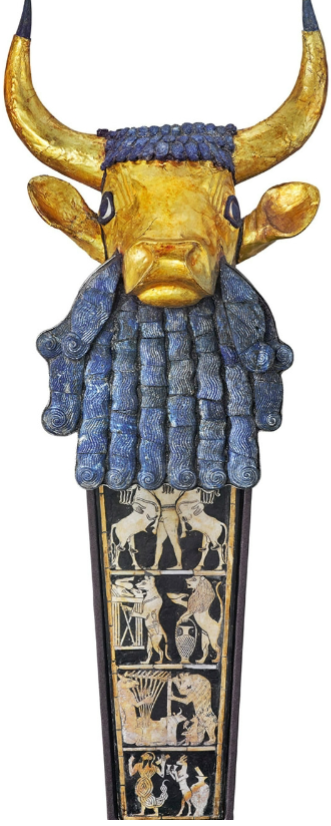
3.13 Great Lyre with bearded bull’s head, from Tomb 789, Royal Tombs of Ur (Tell el-
Muqayyar, Iraq), Early Dynastic IIIA period, 2550–2400 BCE. Wood, gold, silver, lapis
lazuli, shell, and bitumen, length 15¾ in. (40 cm), width 9⅞ in.(25 cm), depth 7½ in.
(19 cm). University of Pennsylvania Museum of Archaeology and Anthropology, Philadelphia.
Was an instrument, found in pieces, was an indication of wealth
• Scenes seem to present either funerary rites or the afterlife in the underworld, but animals take on human roles
• Music played an important role in funerary positions

3.15 Head of an Akkadian ruler, temple of Ishtar, Nineveh (Mosul, Iraq), Akkadian
period, c. 2250–2220 BCE. Copper alloy, height 14⅜ in. (36.5 cm). Iraq Museum, Baghdad.
• Acadican kings were represented as gods on earth
• Represented their kings in a highly idealized (the ideal/perfect) and stylized manner (specifically textures here)
• Almost life sized
• Cast metal
• Lost wax casting- involves creating a clay model of a sculpture, covering it in wax, then covering that in another clay sculpture/model (Highly sophisticated method where they create a clay mold and wax mold to then cast a metal sculpture) then poor molten metal in between where the wax was originally
• Earliest instance we see political unrest
• Eyes were intentionally gauged out (assume politically motivated)
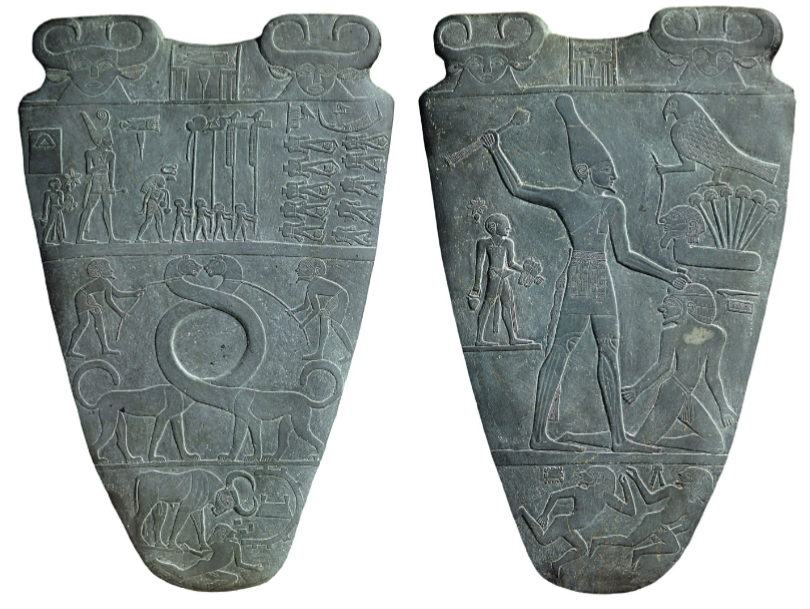
4.3 Narmer Palette (both sides). Excavated at the sacred enclosure of Horus,
Hierakonpolis, Egypt, end of Dynasty 0, c. 3000 BCE. Graywacke, length 25¼ in.
(64.1 cm). Egyptian Museum, Cairo.
• The two top corners symbolically represent a goddess
• Hierarchical scale indicates the status of the figures
• According to this palette the unification of the two happened under King Narmer
• Elaborately decorated for ceremonial purposes
• No clear front or back
• Depicts Narmer, sometimes identified as Menes, the legendary king who first united the two parts of Egypt
• King Narmer is the largest figure with upper egypt crown (Tall oval white) defeating lower egypt crown (Spiral red)
• According to palette upper egypt conquered lower egypt
• Elaborately carved surface, normally used for grinding eye paint, but most likely ceremonial

4.5 Mastaba tomb (sectional drawing), Saqqara, Egpyt, Second or Third Dynasty. The
ka statue of the deceased is visible in its small chamber (serdab). A vertical shaft
links the mastaba superstructure to the underground burial chamber.
Tomb
• Rulers in the first half of the Second Dynasty established rule at Memphis in Lower Egypt
• Early royal tombs at Saqqara consisted of multiroom underground chambers covered by a flat-topped rectangular structure
• Partly above ground, they had slanted side walls built of either mudbrick or cut stone (mastaba)
• Early Dysnatic period
• Kings buried but also regular Egyptians
• The Third dynasty tried to elevate tombs.
• Egyptians viewed death as passage way into next life
• Believed anything buried with them would go with them into the after life
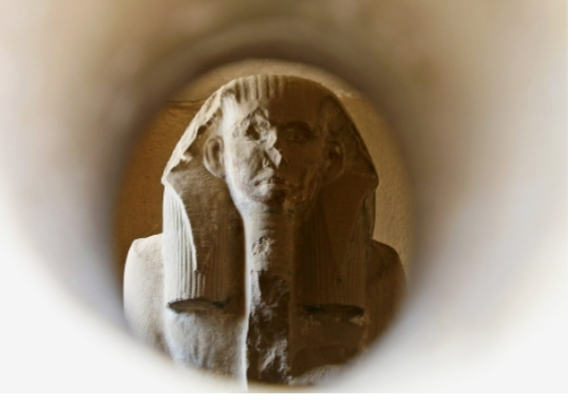
4.7 Ka statue of Djoser, visible through a hole in the serdab wall, Djoser’s funerary
complex. Saqqara, Egypt. Old Kingdom, Third Dynasty, 2667–2648 BCE.
• The ka (life force) was one of several distinct spiritual aspects of a person; it was represented by two upraised, disembodied arms
• A person’s transition to the afterlife was a major concern and therefore the subject matter of much ancient Egyptian art and building
• Replacement body for the body
• Kings were often idealized, so they might have not looked like what they were portrayed as

4.8 Djoser’s funerary complex, looking toward the Step Pyramid from the Heb-Sed
Court, with limestone ashlar buildings for the king’s funerary cult. Saqqara, Egypt.
Old Kingdom, Third Dynasty, 2667–2648 BCE.
• Earliest example of a stone pyramid in egypt
• Pyramid of King Djoser
• This was designed by Imhotep (first recorded architect or artist)
Burial site of Djoser (ruled 2667–2648 BCE), first king
of the Third Dynasty, known to contemporaries as Netjerikhet
• First stone pyramid
• Design attributed to mathematician, philosopher, and healer Imhotep
This site was looted and is not entirely intact as it was
• There was dummy buildings
• Also included a Ka statue
• Ka would inhabit the body of the deceased
• The ka (life force) was one of several distinct spiritual aspects of a person; it was represented by two upraised, disembodied arms
• Replacement body for the body
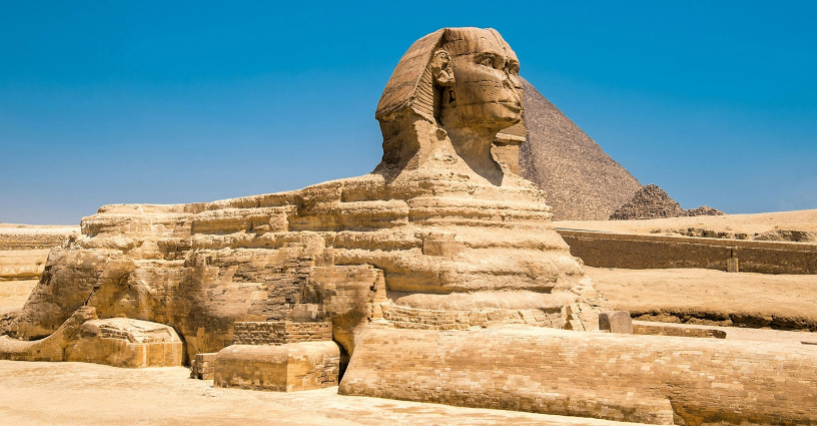
4.15 The Great Sphinx, Giza, Egypt, 2558–2532 BCE. 60 × 240 ft. (18.29 × 73.15 m).
• Partially carved out of the local bedrock and partially built
with stonework
• Great Sphinx was likely a guardian of Khafre’s causeway
• Wears the royal nemes headdress, making it a portrait of an Egyptian ruler (maybe khafre)
• Little is known about the Great Sphinx due to a lack of written evidence

Map 5.2 Maritime trade in the Eastern Mediterranean during the Late Bronze Age, c.
1600–1200 BCE.
Bronze age; 3300-1200 BCE
Around 1200 BCE trade routes collapse in Asia and
Pushes civilization to Iron age 1200 BC- 800 CE
Were all connected via trade (spread ideas) but then
Trade routes collapsed
Assyrians wanted people to view them as mercilist and brutal

5.12 Colossus winged lion (lamassu) that guarded a portal in the Northwest Palace
of Ashurnasirpal II at Kalhu (Tell Nimrud, Iraq), c. 879 BCE. Gypsum, 122½ × 24½ in.
(3.11 × 0.62 m). Metropolitan Museum of Art, New York.
• Lamassu were hybrid mythical creatures with eagle wings, human heads, and lion (or bull) bodies
• Monumental sculptures of lamassu were often installed as guardians flanking the doorways of Assyrian palaces
• The legs of lamassu were often carved so that they were symmetrical when seen from the front, but striding when seen from the side
• Combined naturalism with stylization
• The Lamassu always had 5 legs instead of 4 for the view (complet view for veiwers aproach front see 2 aproch back see 4)
• This is High relief almost 3d (Carved deep into surface)
Under king Nebacunezar

5.15 Ishtar Gate of Babylon, (Iraq). 605–562 BCE. Reconstruction at the Pergamon
Museum, Berlin.
The Ishtar Gate was the ceremonial entrance into Babylon and played a major role in the akitu festival
• The 23-foot-thick walls were covered in blue decorative glazed bricks depicting nearly life-size lions, bulls, dragons, and other mythological creatures
• This gate was dedicated to Ishtar (Inanna) and was flanked by monumental, 50- foot-high towers
• Animals seen here of symbolic to gods also a sign of protection

6.3 Interior hall of the rock-cut tomb of Amenemhat, Tomb 2 (BH2), Beni Hasan, Abu
Qurqas, Egypt, Twelfth Dynasty, c. 1900 BCE.
• One of thirty-nine carved tombs at Beni Hasan commissioned by elite officials
• Façade features octagonal, tapered columns that created
the entrance to a central portal, covered by a since-lost door
• Interior is carved from the solid rock into the non-functional shapes of columns, beams,
lintels, and other architectural
features
• There is a Niche (cut ours on wall)
• Shallow relief
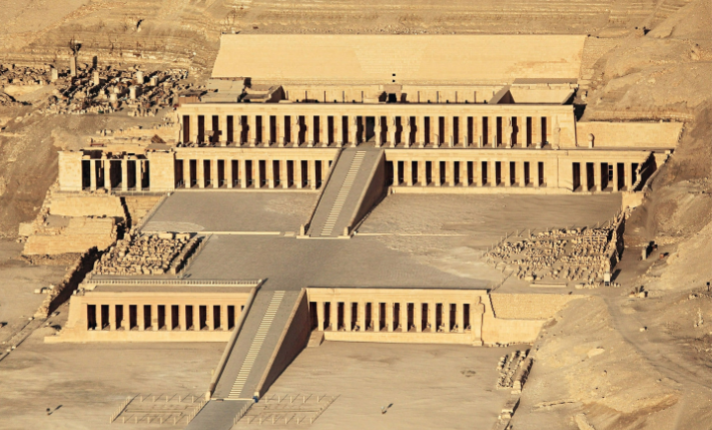
6.7 Funerary complex of Hatshepsut, with ruins of Mentuhotep’s mortuary complex
to the left. Deir el-Bahri, Egypt, Eighteenth Dynasty, c. 1473–1458 BCE
• Only women in new kingdom to have the power and title as the king
• She has a successful reign and was perhaps challenged
• A lot of structures were destroyed by her successor intentionally (her stepson)
-Damnatio Memoriae (legal proceeding that is documented) that's how we know he had her sculptures intentionally destroyed - to damage memory - someone you didn't like you would damn their memory to erase them from the historical record- it affected most of her sculptures and other monuments
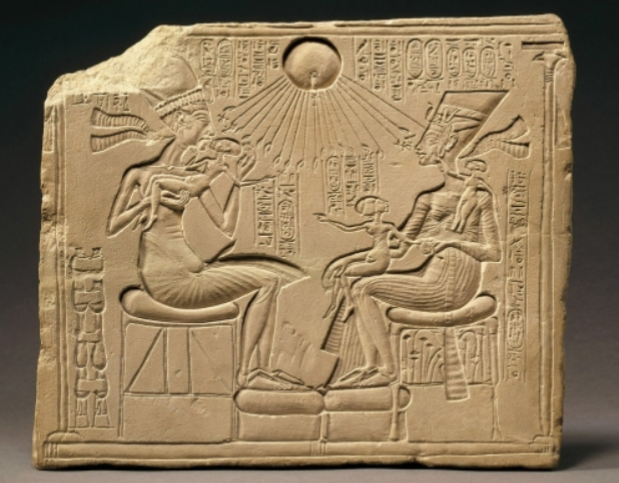
6.10 Stele of Akhenaten (Amenhotep IV), Nefertiti, and their children, from
Akhetaten (Tell el-Amarna, Egypt), Eighteenth Dynasty, 1352–1336 BCE. Limestone
with painted sunken relief, 17⅛ × 15⅜ in. (43.5 × 39.1 cm). Ägyptisches Museum und Papyrussammlung, Berlin.
• Family portrait (one of the first in the history of art)
• Akhenaten and his queen, Nefertiti, are depicted in sunken relief, interacting with their three daughters
• Aten represented at the center top as a sun disk with some rays terminating in ankh hieroglyphs
• Found in a private home, perhaps indicating a new form of religious devotion that extended beyond royal tombs and temples
• most human thing we've seen in this class
• This was found in a private home
Armona period were ognotin makes a cultural shift and doesnt worship dieties

9.2 “Frying pan” from Chalandriani, Syros, Greece, Early Cycladic, c. 2500–2200
BCE. Terra-cotta, diameter 11 in. (27.9 cm). National Archaeological Museum, Athens.
• Called a frying pan due to its shape but is is not a frying pan
• Made of terra-cotta and incised with designs
• This example depicts a longboat at sea, an important symbol of social power
• Function unknown, but some have speculated that they relate to fertility or served as makeup palettes
• It was polished so it would function as a mirror
• Maybe it was a makeup palette/ fertility symbol
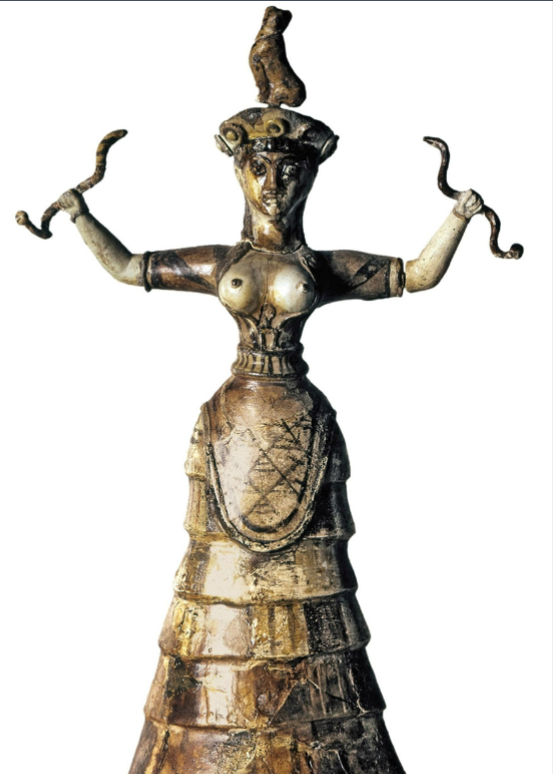
9.11 Snake goddess, from the palace at Knossos, Crete, Greece, c. 1600 BCE.
Faience, height approx. 11½ in. (30 cm). Heraklion Archaeological Museum, Crete, Greece
• Found near the Throne Room on the western side of the palace
• Rectangular boxes were cut into the floor and filled with ceremonial offerings (for deity or king), including small works of sculpture
• She holds a snake in each hand, bears her breasts, and wears an elaborate floor-length skirt
• She may represent a priestess or goddess
• Had to be put back together she was found in pieces
• Clothing represented southwest asian culture
• Pinched waist in (both men and women) could relate to corset practices
• Cat on her head (professor doesn’t think its supposed to be on her head)
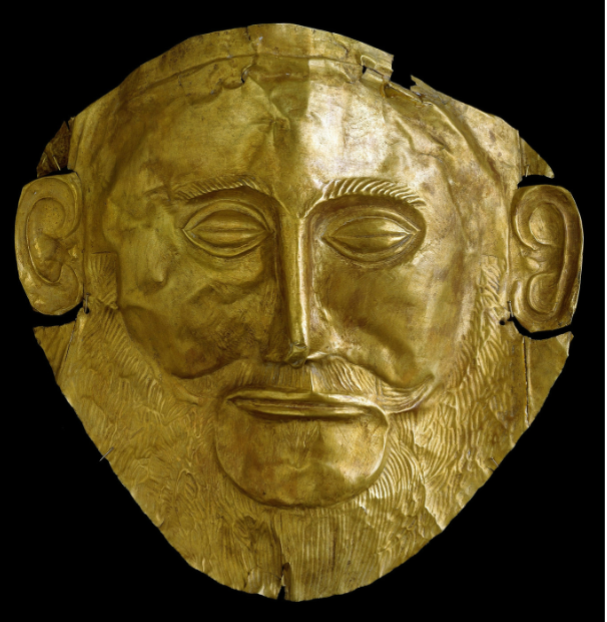
10.3 Gold death mask (“Mask of Agamemnon”), from Grave Circle A, Mycenae,
Greece, c. 1550–1500 BCE. Gold, height 10¼ in. (26 cm). National Archaeological Museum, Athens.
Grave Circle A, tombs of miycena
• It was most likely not Agamennom’s
• Schelieman tended to exaggerate (we think he over restored it)
• However it attest to the status of an individual
• This mask was placed on deceased men
• Named after Homer’s legendary leader of the Greeks against the Trojans
• Like others found at the site, has a rounded face, bald head, and prominent ears
• Authenticity/restoration of the object has been called into
question
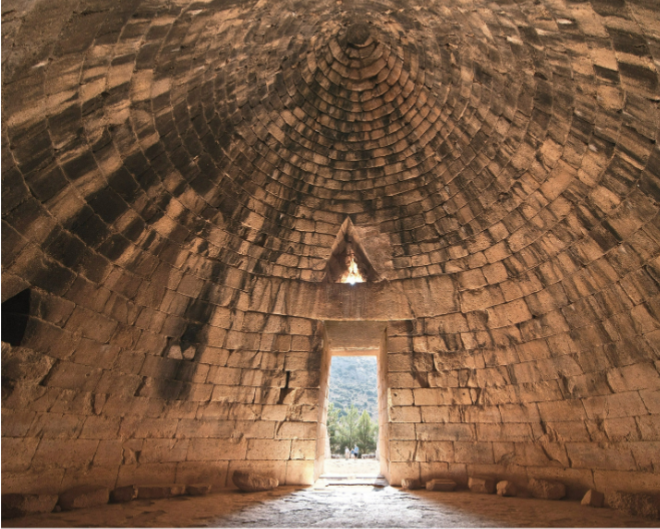
10.8 Interior of Treasury of Atreus tholos tomb, Mycenae, Greece, c. 1300–1250 BCE
• Using innovative architectural technique called corbeling (the dome) this is in a region prone to earthquakes and it still stands today
• Tallest dome structure in ancient world at this point in time
• Here stones are held in place by themselves and get smaller the higher you go.
• The center stone locks it all in shape called the key stone (it will crumble if its removes)
• Tomb’s facade was decorated with colorful stones, rather than figural imagery
Bonus
There is a transition that occurs (from old to new stone age 9600 BC when the weather changes)
People of this age start to build a megalific structure-structure made of large stones. (beginning of architectural)

• 5.1 Law stele of Hammurabi. c. 1760 BCE. Originally installed in Babylon but
excavated at Susa (Iran). Black basalt, height 7 ft. 4⅝ in. (2.25 m). Musée du Louvre, Paris.
• Record of the law code of Hammurabi, first existing law code (blueprint)
• The rod and the ring (reps authority/power) are builders tools that help builders measure to pass judgement and enforce laws
• Says he has a god given right to give the laws
• Stele is made of polished basalt and 7.5' tall
• Upper register features figural relief of Hammurabi receiving signs of royal power from the sun god, Shamash
• By appearing with the god Shamash, Hammurabi
demonstrated his divinely-supported rule
• Lower register includes the laws, in cuneiform and written in Akkadian language, in an archaizing manner to connect Hammurabi with a glorious past