BIOL 2160 EXAM V - CHAPTER 20
 Call Kai
 Learn
Learn Practice Test
 Spaced Repetition
 Match
Match Flashcards
 Knowt Play
1/121

There's no tags or description
Looks like no tags are added yet.
Name | Mastery | Learn | Test | Matching | Spaced | Call with Kai |
|---|
No analytics yet
Send a link to your students to track their progress
122 Terms
what is the primary function of the digestive system?
transfer nutrients, water, and electrolytes from ingested food into body’s internal environment
what are the functions of the digestive system?
motility, secretion, digestion, and absorption
what are the types of the digestive motility?
propulsive and mixing movements
what does propulsive movements do?
push contents forward through the digestive tract
what does mixing movements do?
Mixing food with digestive juices promotes digestion of foods and Facilitates absorption by exposing all parts of intestinal contents to absorbing surfaces of digestive tract
what do the secretions of the digestive system consists of?
consists of water, electrolytes, and specific organic constituents
where are the secretions of the digestive system released into?
released into digestive tract lumen and are normally reabsorbed in one form or another back into blood after their participation in digestion
what is digestion?
Biochemical breakdown of structurally complex foods into smaller, absorbable units
how is digestion accomplished?
by enzymatic hydrolysis (carbohydrates → monosaccharides, proteins → amino acids, fats → glycerol and fatty acids)
where is most of the absorption completed in?
small intestine
what happens in absorption?
Small units resulting from digestion, along with water, vitamins, and electrolytes are transferred from digestive tract lumen into blood
what is the difference between the digestive tract and the accessory digestive organs?
if food actually enters the organ
what is the tract of the digestive tract?
continuous mouth to anus
what does the digestive tract include?
Mouth, Pharynx, Esophagus, Stomach, Small intestine, Large intestine (Cecum, Appendix, Colon, & Rectum), and Anus
what do the accessory digestive organs include?
salivary glands, exocrine pancreas, and bilary system (liver & gallbladder)
what are the major tissue layers of the digestive tract?
mucosa (innermost layer), submucosa, muscularis externa, and serosa (outer layer)
where is the mucosa?
Lines luminal surface of digestive tract
why is mucosa fold up extensively?
increases the surface area for nutrients to be absorbed
what is the submucosa?
a thick layer of connective tissue that provides the digestive tract with elasticity
what happens if the digestive tract were not elastic?
would tear itself apart
what is the muscularis externa?
the major smooth muscle (involuntary) coat of digestive tube
what are the layers of the muscularis externa?
circular layer and longitudinal layer
what is the circular layer of the muscularis externa?
inner layer; contraction decreases diameter of lumen
what is the longitudinal layer of the muscularis externa?
outer layer; contraction shortens the tube
what does the serosa do?
secretesserous fluid; Lubricates and prevents friction between digestive organs and surrounding viscera & Supports digestive organs in proper place while allowing them freedom for mixing and propulsive movements
what is the purpose of the lips?
forms opening, Help procure, guide, and contain food in the mouth, & Well-developed tactile sensation
what is the purpose of the palete?
Forms roof of oral cavity (separates mouth from nasal passages)
what is the purpose of the tongue?
Forms floor of oral cavity, Composed of skeletal muscle, Movements aid in chewing and swallowing, & contains taste buds
what were te specific tastes the tongue detects?
sweet, sour, salty, bitter, and umami (savory)
how do we detect poisons?
most poisons are very bitter which will leave us to spit them out
what is the pharynx?
Cavity at rear of throat, Common passageway for digestive and respiratory systems, and where tonsils are
what are tonsils?
made of lymphoid tissues and are located within side walls of pharynx
what are the purpose of teeth?
Responsible for chewing (mastication) and is the first step in digestive process
what are the functions of chewing?
Grind and break food into smaller pieces to make swallowing easier and increase food surface area on which salivary enzymes can act, mix food with saliva, and stimulate taste buds
what produces saliva?
Produced largely by three major pairs of salivary glands
what is the composition of saliva?
99.5% H2O and 0.5% electrolytes and protein
what are the functions of saliva?
Salivary amylase begins digestion of carbohydrates, Facilitates swallowing by moistening food, Helps keep mouth and teeth clean, and Solvent for molecules that stimulate taste buds, and Lingual lipase is produced by the tongue and breaks long chain fats into smaller pieces
what are the antibacterial actions of saliva?
Lysozyme destroys bacteria and Saliva rinses away material that could serve as food source for bacteria
what is a buffer?
something that helps adjust the pH of a solution
what do bicarbonate buffers do?
help neutralize the pH of acidic foods that you eat
why does your breath smell bas when your mouth is dry?
bacteria aren’t being rinsed away and are producing sulfur and other chemicals that smell bad
what’s acidic?
Anything sour. The protons in acid activate the sour taste receptors.
what is swallowing?
Motility associated with pharynx and esophagus; most complex reflex in body
how is swallowing initiated?
Initiated when food or drug is voluntarily forced by tongue to rear of mouth into pharynx
what are the processes of swallowing?
Oropharyngeal stage and Esophageal stage (moves substance from mouth through pharynx and into esophagus)
what is the esophagus?
Fairly straight muscular tube and Extends between pharynx and stomach; Sphincters at each end and Peristaltic waves push food through this
what are the sphincters at each end of the esophagus?
Pharyngoesophageal sphincter and Gastroesophageal sphincter
what does the Gastroesophageal sphincter do?
Prevents reflux of gastric contents
what does the Pharyngoesophageal sphincter do?
Keeps entrance closed to prevent large volumes of air from entering esophagus and stomach during breathing
what is a sphincter?
a circular muscle
what is the stomach filled with?
hydrochloric acid with a ph of between 1 and 2
what helps with acid reflux or heartburn due to the hydrochloric acid and food mixed together?
antacid
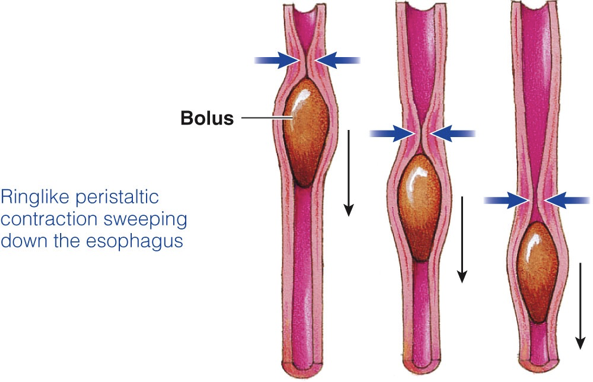
what does the peristalsis work in the esophagus?
works like squeezing a toothpaste bottle, moving the bolus from top to bottom down the esophagus
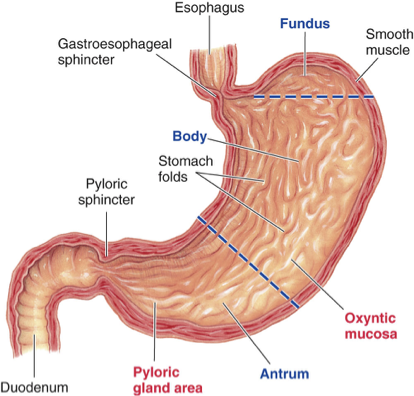
what is the stomach?
J-shaped sac-like chamber lying between esophagus and small intestine
what are the main functions of stomach?
Store ingested food until it can be emptied into small intestine, Secretes hydrochloric acid (HCl) and enzymes that begin protein digestion, and Mixing movements convert pulverized food to chyme
what is the pyloric sphincter?
a circular muscle at the bottom of the stomach that serves as barrier between stomach and upper part of small intestine; controls the movement of chyme from the stomach into the duodenum
what is the duodenum?
the first part of the small intestine, where it connects to the stomach
what are the four aspects of gastric motility?
filling, storage, mixing, and emptying
what does the filling of gastric motility involve?
receptive relaxation
what is receptive relaxation?
Enhances stomach’s ability to accommodate the extra volume of food with little rise in stomach pressure, Triggered by act of eating, and Mediated by vagus nerve (makes stomach relax to fill up stomach more efficiently)
where does storage of gastric motility take place in?
body of stomach
where does mixing of gastric motility take place in?
antrum of stomach
what is the emptying of gastric motility controlled by?
Largely controlled by factors in duodenum
what is the main factor that influences strength of contraction?
amount of chyme in stomach which also promotes the emptying of the stomach into the duodenum
what are the factors prevent the emptying of the stomach into the duodenum?
fat, pH, hypertonicity, and distension
how does fat prevent the emptying of the stomach into the duodenum?
Fat digestion and absorption takes place only within lumen of small intestine
When fat is already in duodenum, further gastric emptying of additional fatty stomach contents is prevented
how does the pH prevent the emptying of the stomach into the duodenum?
Un-neutralized acid in duodenum inhibits further emptying of acidic gastric contents until neutralization can be accomplished
how does hypertonicity prevent the emptying of the stomach into the duodenum?
Gastric emptying is inhibited when osmolarity of duodenal contents starts to rise
how does distension prevent the emptying of the stomach into the duodenum?
Too much chyme in duodenum inhibits emptying of even more gastric contents
what are the additional factors that influence gastric motility?
emotions and intense pain
which emotions tend to decrease motility?
sadness and fear
which emotions tend to increase motility?
anger and aggression
how does intense pain influence gastric motility?
tends to inhibit motility
what juices are secreted by the stomach?
alkaline mucus, pepsinogen, HCl, and intrinsic factor
what does alkaline mucus do?
protects stomach lining from other secretions and must be replaced periodically to battle stomach acids low pH
what does the pepsinogen do?
begins protein digestion when activated
what does HCl do?
activates pepsinogen, breaks down connective tissue, kills microorganisms (only few can survive such conditions like Salmonella or E. coli)
what does the intrinsic factor do?
facilitates re-absorption of Vitamin B12
what are the gastric secretions released by?
from secretory cells that are under the control of endocrine / paracrine cells elsewhere in the stomach and intestine
what stimulates secretin?
by acidic chyme in the duodenum
what does secretin stimulate?
Release stimulates the pancreas to release bicarbonate buffer which help neutralize the chyme in the duodenum before it damages the small intestine
what stimulates gastrin?
by the presence of protein in the duodenum
what does gastrin stimulate?
Release stimulates chief and parietal cells to secrete more HCl because there is still some undigested
what stimulates Cholecystokinin (CCK)?
presence of fat and protein in the duodenum
what does Cholecystokinin (CCK) stimulate?
Release stimulates pancreas to release lipase, as well as proteolytic enzymes, which breaks down lipids (fats) and enzymes that can help break down proteins (proteolytic enzymes)
what are the phases of gastric secretion?
cephalic phase, gastric phase, and intestinal phase
what is the cephalic phase?
Refers to increased secretion of HCl and pepsinogen that occurs in response to stimuli acting in the head before food reaches stomach
what is the gastric phase?
Begins when food actually reaches the stomach and presence of protein increases gastric secretions
what is the intestinal phase?
inhibitory phase; Helps shut off flow of gastric juices as chyme begins to empty into small intestine
why does the stomach growl when you’re hungry?
because of the cephalic phase; When you start thinking about food, your stomach starts secreting HCl in anticipation of you eating. That’s the sound you hear when your stomach growls
what does the pancreas contain?
Mixture of exocrine and endocrine tissue & Elongated gland located behind and below the stomach
what is the endocrine function of the pancreas?
Islets of Langerhans; Found throughout pancreas and secrete insulin and glucagon
what is the exocrine function of the pancreas?
Secretes pancreatic juice consisting of: Pancreatic enzymes and Aqueous alkaline solution actively secreted by duct cells that line pancreatic ducts
what is the main role of the pancreas?
regulating your blood sugar
what are the pancreatic enzymes?
proteolytic enzymes, pancreatic amylase, and pancreatic lipase
what are the digest proteins of proteolytic enzymes?
trypsin, chymotrypsin, and carboxypeptidase
what do proteolytic enzymes do?
break down proteins
what does the pancreatic amylase do?
converts polysaccharides into disaccharides