12/01/25 B cells

0.0(0)
studied byStudied by 0 people
0.0(0)
linked notesView linked note
full-widthCall Kai
learnLearn
examPractice Test
spaced repetitionSpaced Repetition
heart puzzleMatch
flashcardsFlashcards
GameKnowt Play
Card Sorting

1/21

encourage image

There's no tags or description

Looks like no tags are added yet.

Study Analytics
Name
Mastery
Learn
Test
Matching
Spaced

No study sessions yet.

22 Terms

1
New cards
B Cell Receptors
Neuroglobulins on B cells that recognize and bind antigens.
2
New cards
MHC class II
A receptor on B cells that presents processed antigens to T helper cells (CD4+ T cells).
3
New cards
T helper cell (CD4+ T cell)
A type of immune cell that binds to antigen presented by a B cell, leading to B cell activation and strengthened by the CD4 molecule.
4
New cards
Clonal Expansion
The process where activated B cells increase in size (nucleotide expansion due to DNA replication) and proliferate, producing many B cells that target the same specific antigen.
5
New cards

Clonal selection

The process where a B or T cell that recognizes a specific antigen is activated to divide rapidly, producing many identical effector cells and memory cells.

6
New cards
Memory B Cells
B cells produced during clonal expansion that retain receptors for quick recognition of the initiating antigen during future encounters.
7
New cards
Plasma Cells
Specialized B cells produced during clonal expansion that are responsible for high-rate antibody production.
8
New cards
Antibody (Immunoglobulin)
A protein consisting of four polypeptide chains (two heavy and two light) with antigen binding sites and a crystallizable fragment (Fc) that communicates with the immune system.
9
New cards

FAB region (antigen-binding fragments)

The part of an antibody that is crucial for recognizing and binding to antigens.
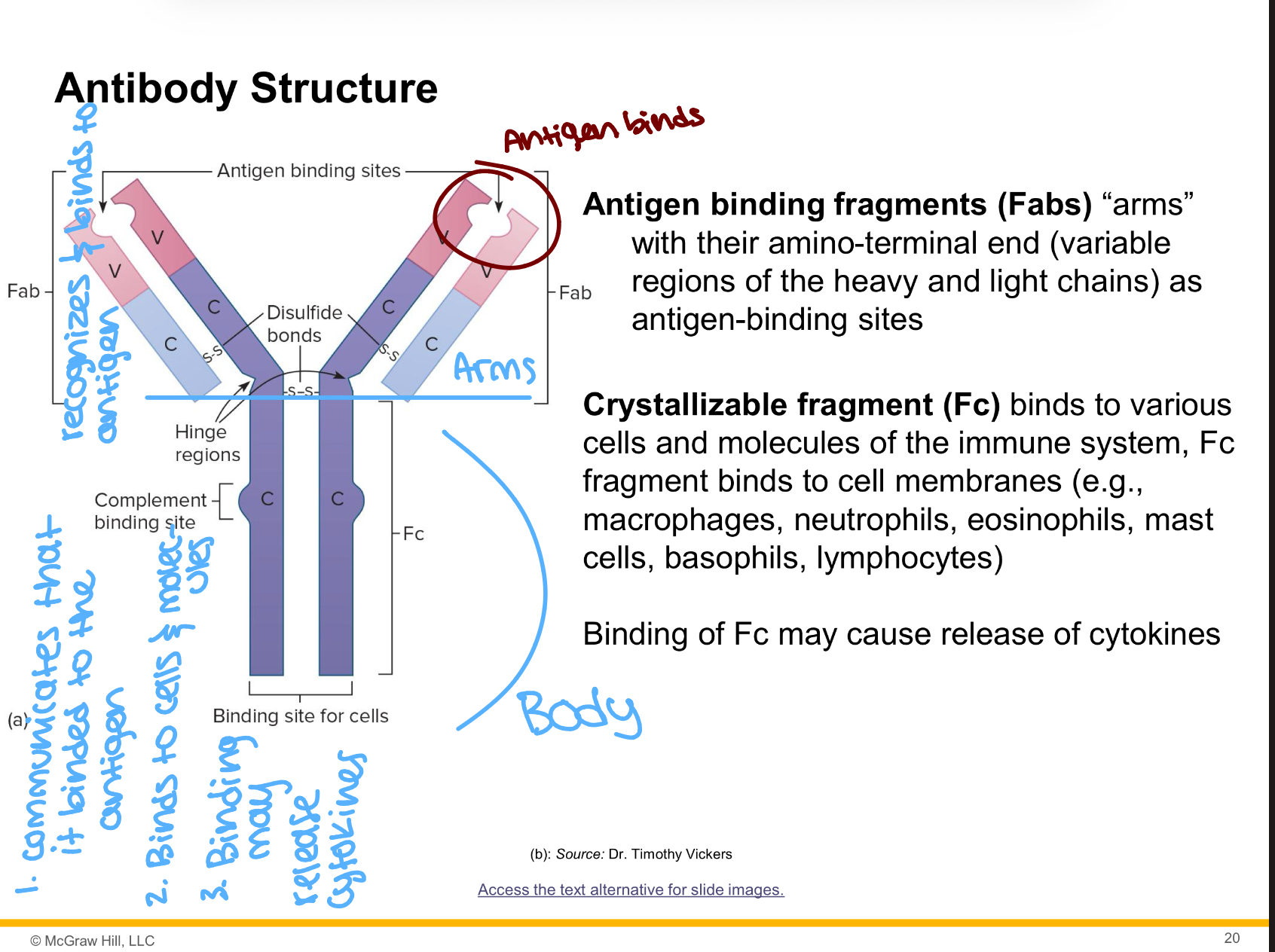
<p>The part of an antibody that is crucial for recognizing and binding to antigens.</p>
10
New cards

Fc region (crystallizable fragment)

The lower part of an antibody that communicates the signal of the bound antigen to the immune system and can bind to different immune cells to induce responses.
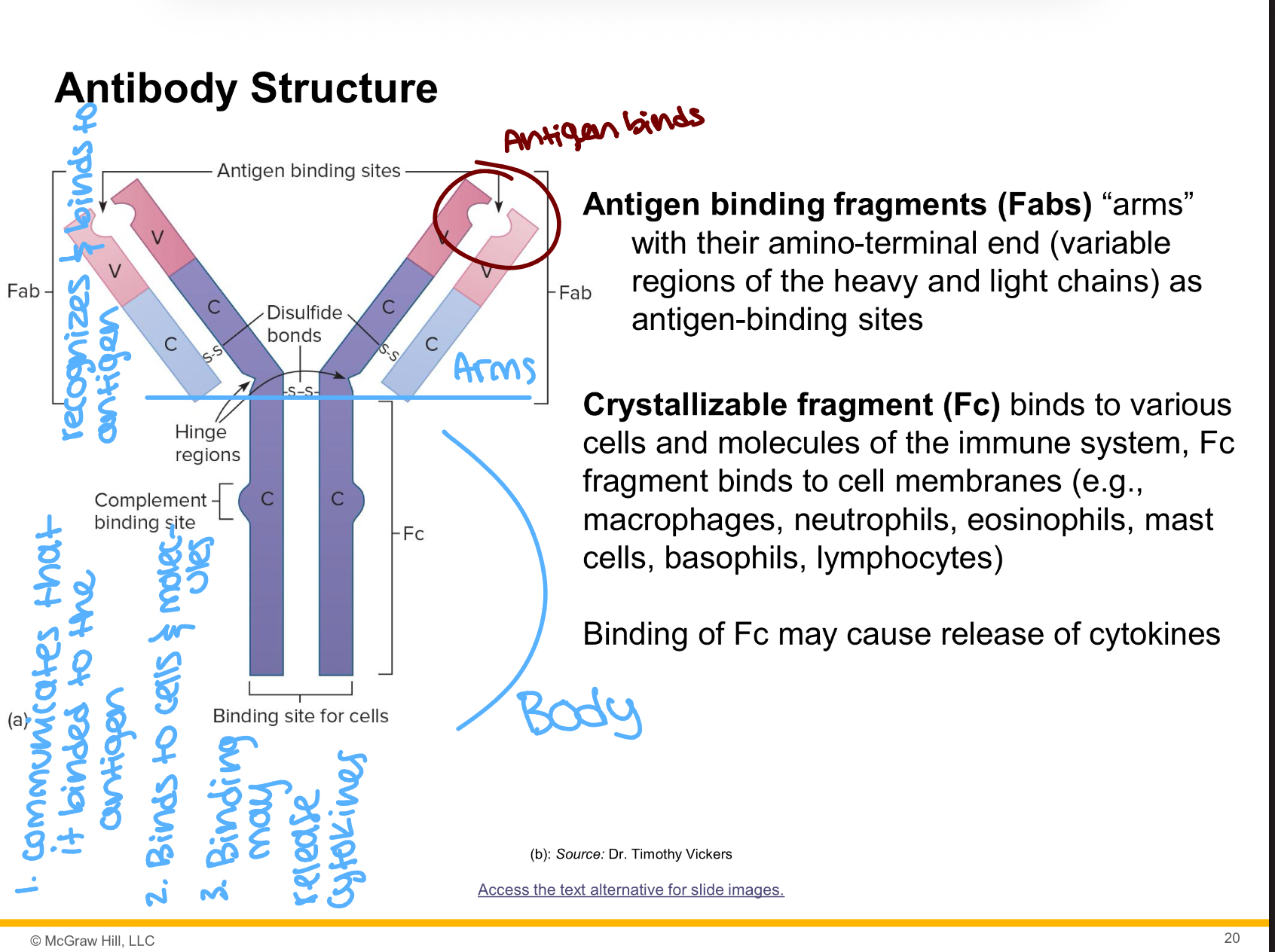
<p>The lower part of an antibody that communicates the signal of the bound antigen to the immune system and can bind to different immune cells to induce responses.</p>
11
New cards

Cytokines

Cytokines are special proteins that act as messengers between cells. They are like signal molecules that tell other cells what to do, influencing a wide range of body activities. For instance, they help coordinate immune responses to fight infections, regulate inflammation (like swelling from an injury), and even guide the formation of new blood cells.

12
New cards
Activation of Complement
A mechanism where antibodies activate the complement system, leading to the formation of pores in pathogens and their destruction.
13
New cards
Opsonization
A mechanism where antibodies adhere to pathogens, marking them for engulfment by phagocytic cells like macrophages.
14
New cards
Blocking Viral Receptors
A mechanism where antibodies prevent viruses from binding to host cell receptors, thereby inhibiting infection.
15
New cards
Agglutination
A mechanism where antibodies bind multiple cells together, making them more easily recognized as foreign by the immune system.
16
New cards
Precipitation
A mechanism where antibodies bind to smaller molecules, forming immune complexes that facilitate their elimination from the body.
17
New cards
Neutralization of Toxins
A mechanism where antibodies bind to and neutralize toxins, preventing them from interacting with host tissues.
18
New cards
Immunoglobulin M (IgM)
A pentamer-structured antibody, it is the first antibody produced in response to infections and is effective in activating complement.
19
New cards
Immunoglobulin E (IgE)
A monomer-structured antibody crucial for allergic reactions and mediating responses against parasitic infections by binding to mast cells and eosinophils.
20
New cards
Latent Period (B Cell Response)
The initial period after first exposure to an antigen (approximately two weeks) during which no antibodies are detectable in the blood.
21
New cards
Primary Response
The immune response following initial antigen exposure, characterized by an initial peak of IgM, closely followed by IgG production.
22
New cards
Secondary Response (Anamnestic Response)
A more rapid and robust immune response upon subsequent exposure to the same antigen, enabled by memory B cells and resulting in a higher antibody titer.