Patient Assessment
 Call Kai
 Learn
Learn Practice Test
 Spaced Repetition
 Match
Match Flashcards
 Knowt Play
1/55

There's no tags or description
Looks like no tags are added yet.
Name | Mastery | Learn | Test | Matching | Spaced | Call with Kai | Chat |
|---|
No analytics yet
Send a link to your students to track their progress
56 Terms
General Impression
Impression of the patient's condition that is formed on first approaching the patient, based on the patient's environment, chief complaint, and appearance.
The general impression can be formed from the time the call is received until the first few minutes of arrival
Scene Size Up
Upon arrival of the scene the EMT looks for MOI/ISO, number of patients, and if help is needed
Initial (Primary) Assessment
AVPU, CC, ABCDE. Used to find life threatening situations and treat them immediately when found.
General (Secondary) Assessment
SAMPLE, Vitals, and Physical assessment.
This is typically done in the ambulance on the way to the hospital
Ongoing Assessment
Start with mental status (AVPU).
Reassess vitals every 5 minutes for the unstable patient, and every 15 minutes for the stable patient
EMS Report
Give ID, Pt age, sex, CC, vitals, impression, care given, and ETA
Keep conscious and clear
Chief Complaint
Why the person called 911. What is distressing the patient the most
Nature of illness
The general type of illness a patient is experiencing. Similar to the CC (chief complaint)
LOC stands for?
Level of consciousness
BSI Stands for?
Body substance isolation - the assumption that all bodily fluids are contaminated
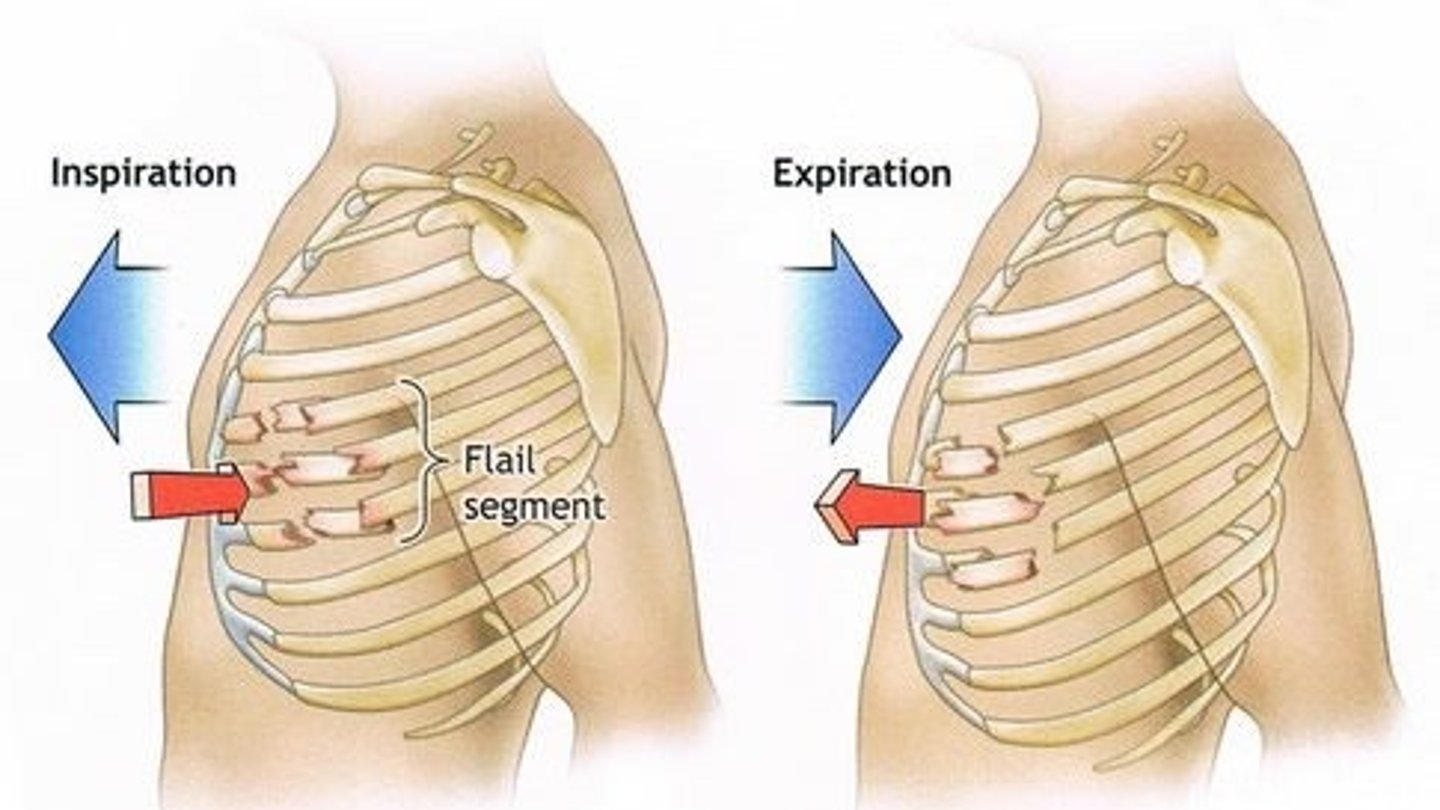
Paradoxical Motion
When 3 or more consecutive ribs are broken in two or more places making the broken area move opposite of the rest.
Sign of a flail chest
Crepitus
A grating or grinding sensation caused by fractured bone ends or joints rubbing together; also air bubbles under the skin that produce a crackling sound or crinkly feeling.
Edema
Swelling
Ex: Pulmonary Edema = swelling (fluid) in the lungs
Baseline Vitals
The first set of vitals when you initiate care.
Can be used to assess quality and responsiveness to treatments. Answer the question, "is my patient improving after xx treatment, staying the same, or getting worse?"
Vital Trending
Comparison of other sets of vitals to the baseline
Ventilations
The mechanical movement of the chest. We look at ventilations
Respirations
The process of taking in oxygen (inspiration) and expelling carbon dioxide (expiration) by way of the lungs and air passages.
In other words, the process of getting air in and out of the tissues. We listen to respirations
Adult Respiratory Rate
12-20/minute
Child Respiratory Rate
15-30/minute
Infant Respiratory Rate
25-50/minute
Descriptive Words for Ventilations
Noisy, quiet, deep, shallow, normal, effortless
Descriptive Words for Ventilation Rhythm
Just regular or irregular
Snoring Respirations
Tongue has fallen into the airway and is blocking it
Gurgling Respirations
Fluid in the upper airway
Wheezing
High pitched whistling sound that is due to bronchoconstriction.
Irreversible narrowing of the lower airway
Stridor
High pitched whistling heart on inhalation due to a partial upper airway obstruction
Rales
Fine crackling sounds heard on auscultation when there is fluid in the alveoli
Rhonchi
Loud rumbling sounds heard on auscultation of bronchi obstructed by sputum
Just know: fluid in the bronchioles
Wet Lung
Pulmonary Edema
When you feel the pulse, what are you feeling?
The contraction of the left ventricular
Pulse Point
Place where artery may be compressed against bone with fingertips to feel pulse
Pulse checked in unresponsive adults and children
Carotid pulse
Pulse checked in responsive adults and children
Radial pulse
Which pulse do you check in infants
Brachial pulse
Words used to describe heart rhythms
Regular or irregular
Words used to describe the pulse
Strong, weak, thready, absent, bounding
Normal pulse range for an adult
60-100 bpm
For now just know child and infant heart rates are faster
Capillary refill should return when?
Less than 2 seconds
Greater than 2 seconds can mean low perfusion due to low blood pressure
When is capillary refill used typically?
In patients under 6 years of age
When can blood pressure be replaced with cap refill?
Patients under 3y/o
Can be used on adults but may not be as accurate
May not be reliable in warm/cold environments or raising or lowering the body part
Auscultation of blood pressure
Listening to the blood pressure. You obtain a systolic and diastolic value
Ex) 120/80
Palpating blood pressure
Applying a blood pressure cuff and using fingers to feel over the artery while releasing cuff pressure. You only get the systolic blood pressure.
May be good in a noisy environment to get a baseline for ausculation
Ex) 120/P (palpation)
How much of the arm should a blood pressure cuff cover?
2/3 of the upper arm/humorous
Descriptive words for assessing patient skin
Hot, cold, cool, warm
Cool/Clammy
Pink, blue, gray, pale
Assessing level of consciousness
AVPU
Alert, Response to verbal stimuli, Response to painful stimuli, Unresponsive
Only one letter can be used
SAMPLE
Used to get patient history
Signs/Symptoms, Allergies, Medication, Pertinent Past, Last oral intake, Events (leading up)
OPQRST
Used to assess a sign/symptom (defines the S in sample)
Onset, Provocation, Quality, Radiation, Severity, Time
DCAPBTLS
Used to remember when evaluation a patient during an assessment
Deformities, Contusions, Abrasions, Punctures, Burns, Tenderness, Lacerations, Swelling.
Detail Assessment
Performed during the general assessment. It is a head to toe assessment done for major injuries, young patients, unresponsive, intoxicated, AMS patient's
Start at the head then throat, chest, abdomen, pelvis, legs, arms, and back. Should be done in 90 seconds or less
Sign
Something you can see, feel, touch, and can validate.
Ex) Vomiting, hypoxia, respiratory distress, etc
Symptom
Something the patient describes
Ex) Dizziness
Pupils descriptor words
Dilated, fixed, unequal, sluggish
Unequal pupils
In this course unequal pupils is a CVA (cerebral vascular accident; stroke) until proven otherwise
PEARL
Pupils equal and reactive to light. This is the normal finding.
Pupils in dark
They dilate
Pupils in light
They constrict