Lecture 6 - Metabolism I
 Call Kai
 Learn
Learn Practice Test
 Spaced Repetition
 Match
Match Flashcards
 Knowt Play
1/28

There's no tags or description
Looks like no tags are added yet.
Name | Mastery | Learn | Test | Matching | Spaced | Call with Kai | Chat |
|---|
No analytics yet
Send a link to your students to track their progress
29 Terms
Carbohydrate metabolism
highly conserved
Mutations are often lethal-evolutionary disadvantage
regulated by allosteric regulators and kinases
Monosaccharides
simplest form of carbohydrates
ends in the suffix “ose”
3-9 carbons (ex. 5 are pentose, 6 are hexose)
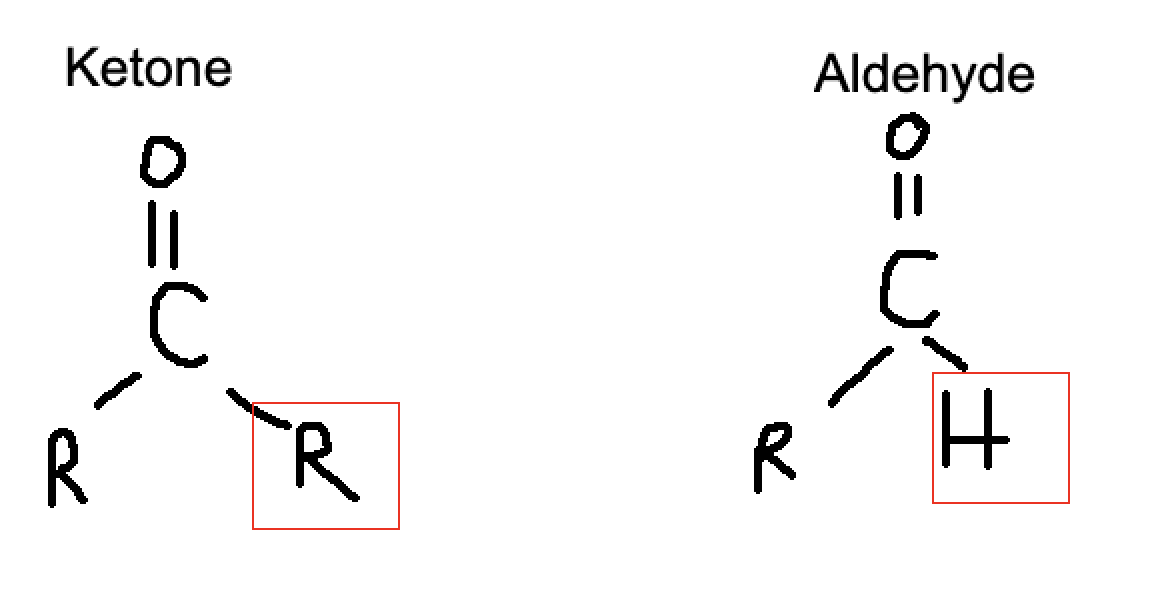
Carbonyl group
Ketoses vs. aldoses
Both are monosaccharides
Ketoses: has ketone group on Carbon 2 (good rule: the carbonyl group in ketose is usually NOT at the end of the chain)
Aldoses: has aldehyde group on Carbon 1
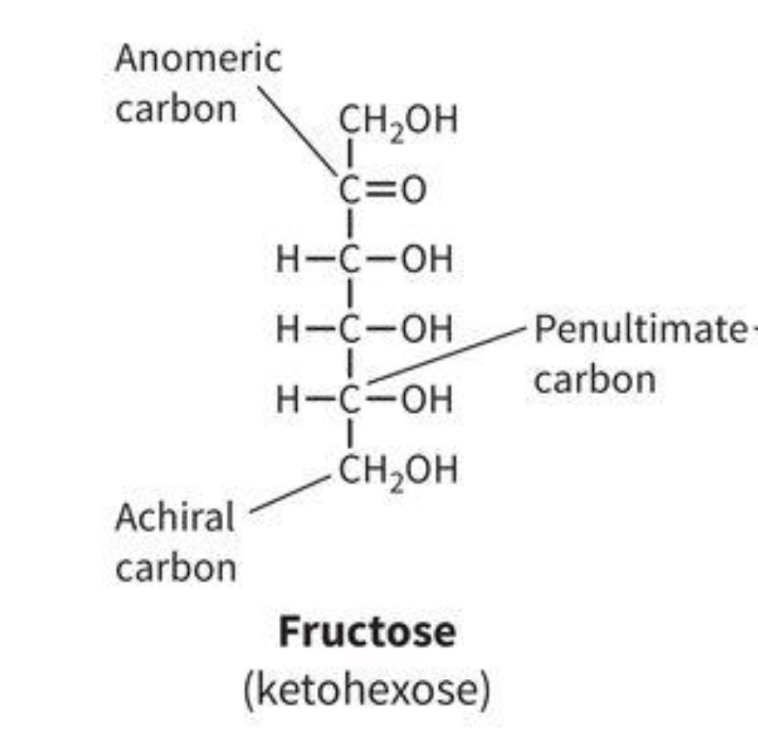
Anomeric carbon
Feature of a monosaccharide
carbon with a carbonyl
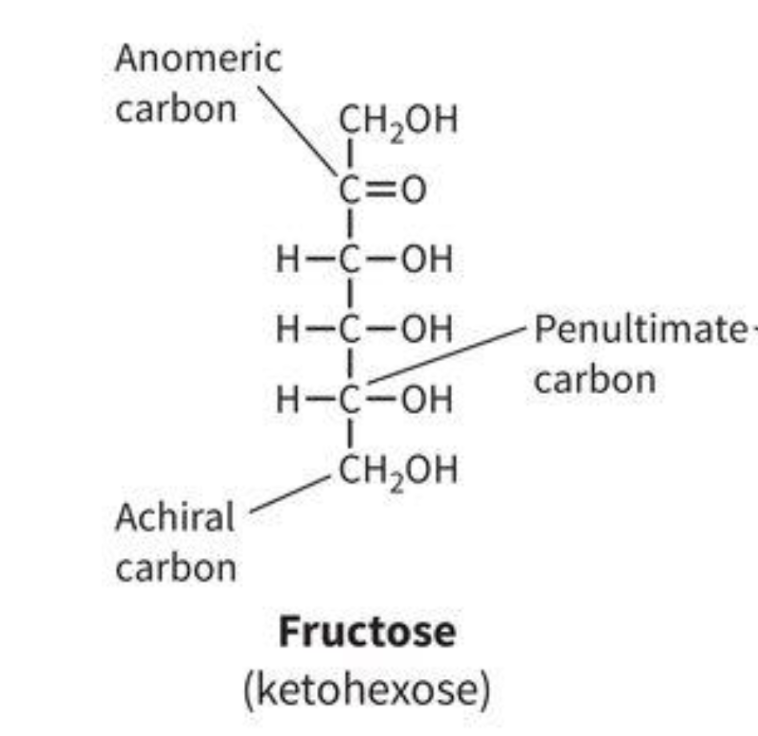
Penultimate carbon
Feature of a monosaccharide
the farthest chiral carbon from the anomeric carbonyl (C=O)
usually right next to the achiral carbon
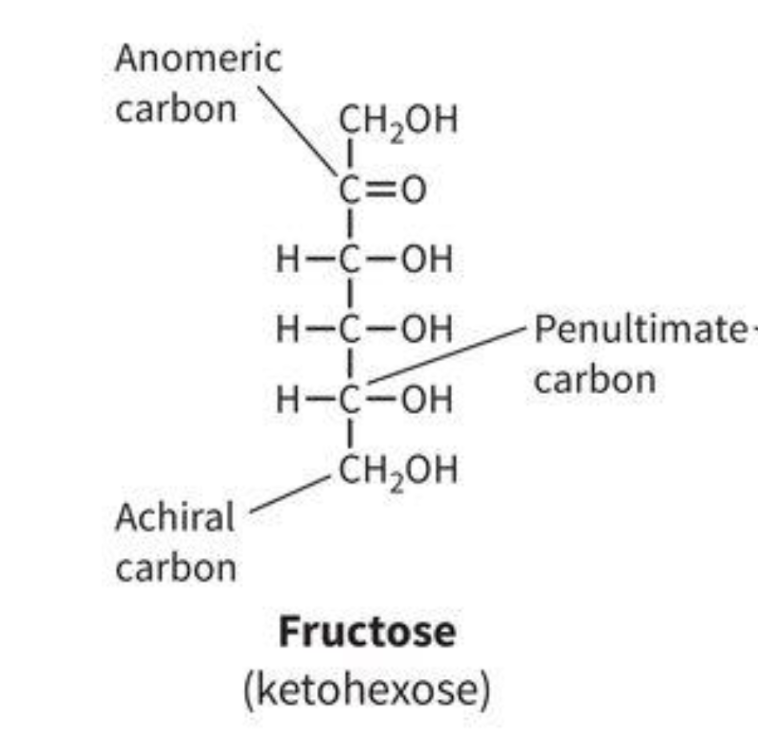
Achiral carbon
Feature of a monosaccharide
The farthest carbon away with two hydrogens
D vs L
Penultimate carbon → if the OH group is on the right, its D.
if the OH group is on the left, its L.
most carbohydrates are D
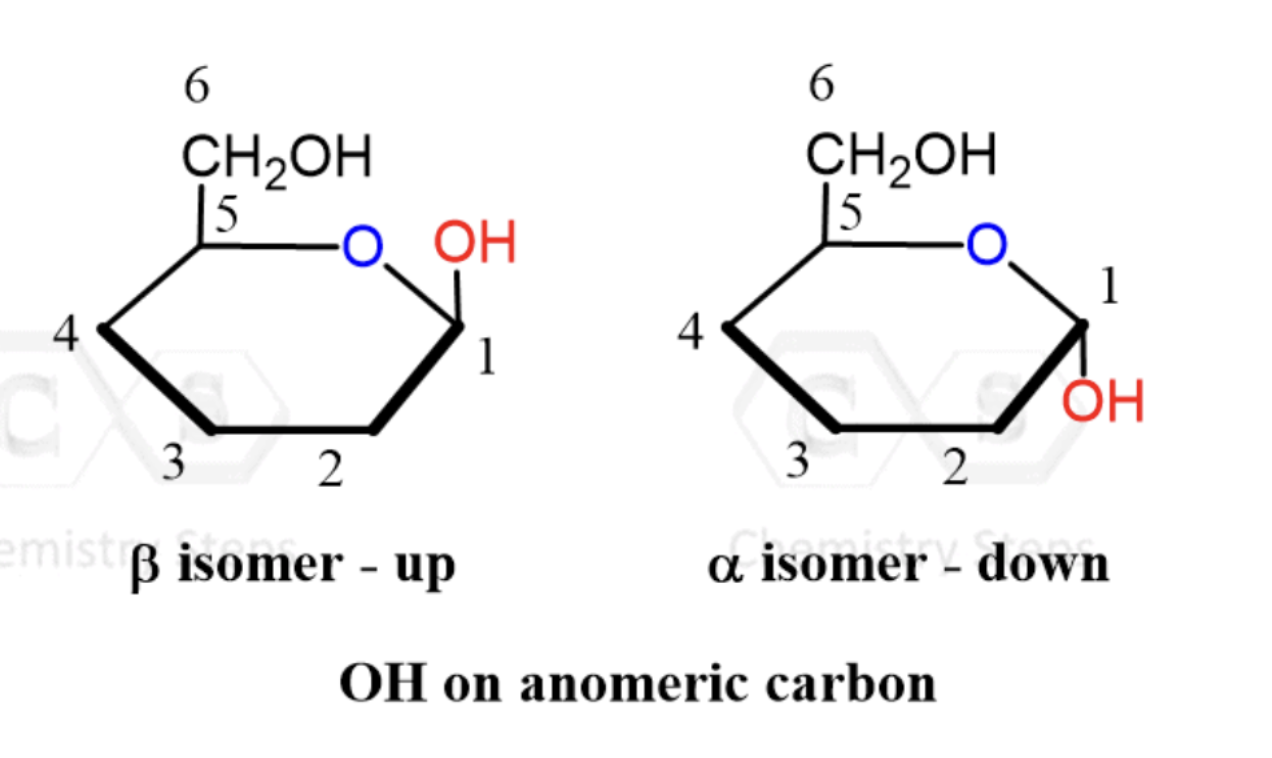
Beta isomer vs alpha isomer
beta - OH on anomeric carbon points up
alpha - OH on anomeric carbon points down
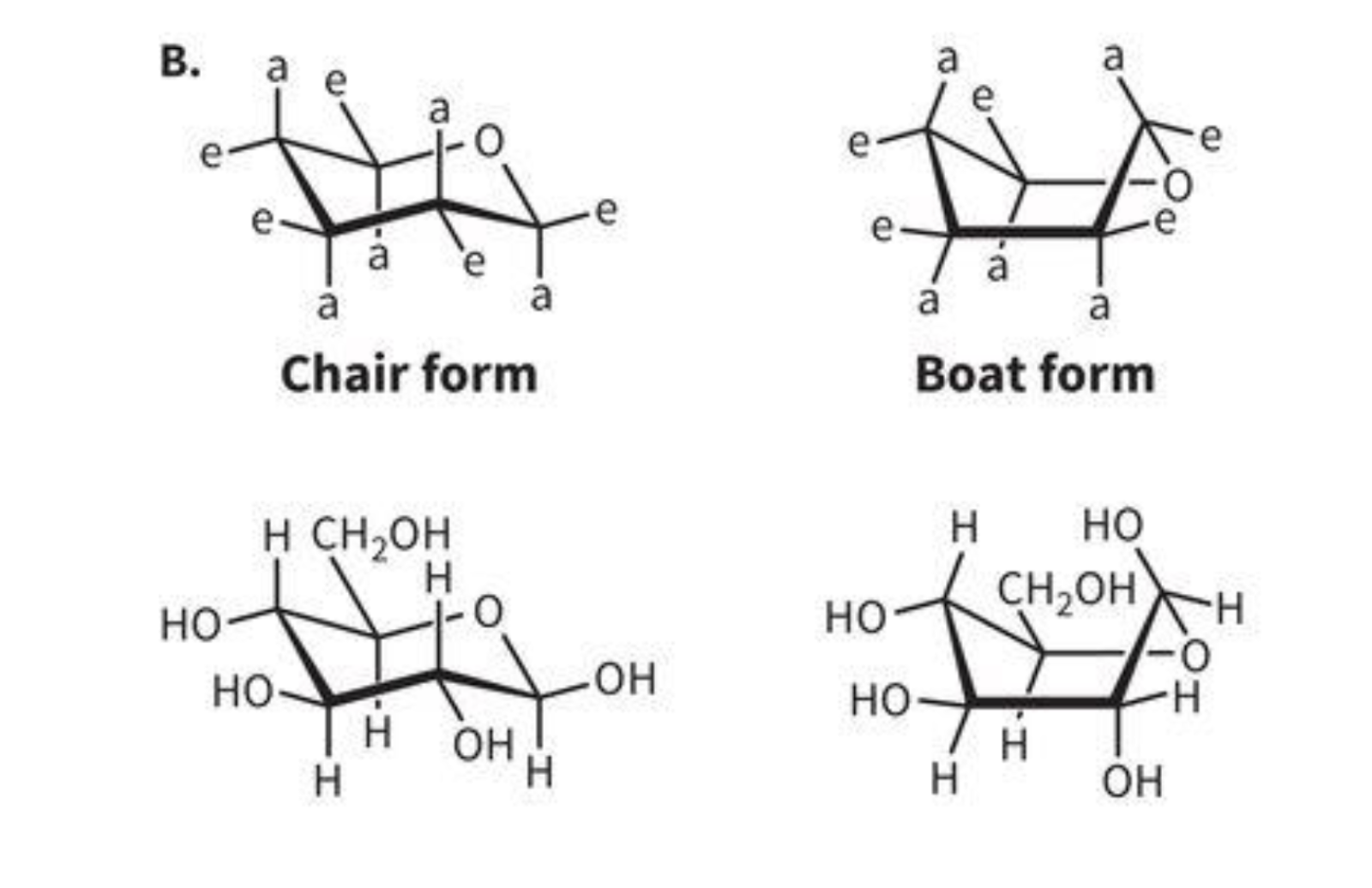
Confirmations of monosaccharide rings
Chair form - monosaccharide zig-zags, and the ends of the backbone point in opposite direction
Boat form - ends of backbone point in same direction
How can monosaccharides be modified?
By attaching side chain groups
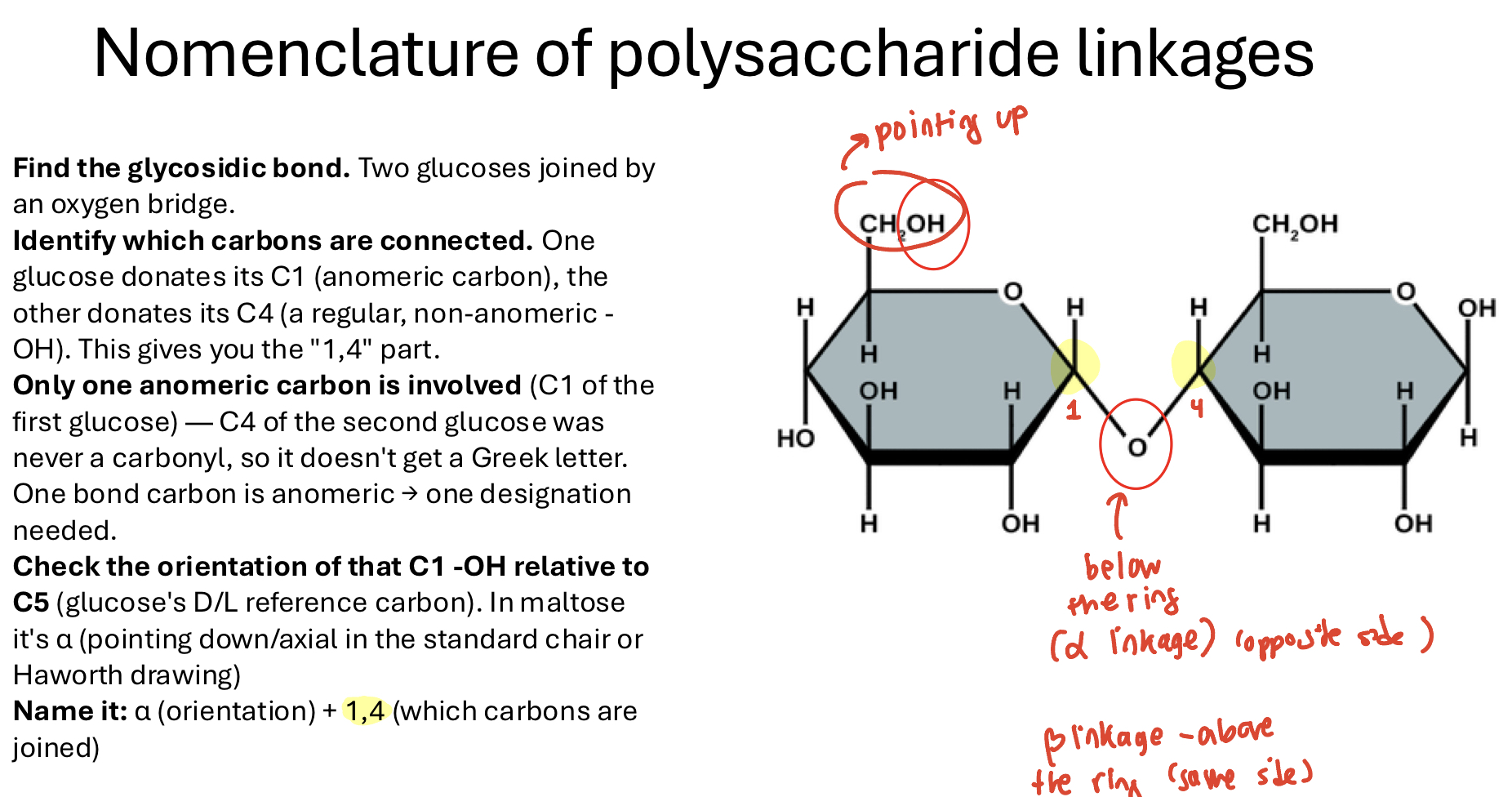
Nomenclature of polysaccharide linkages
Image
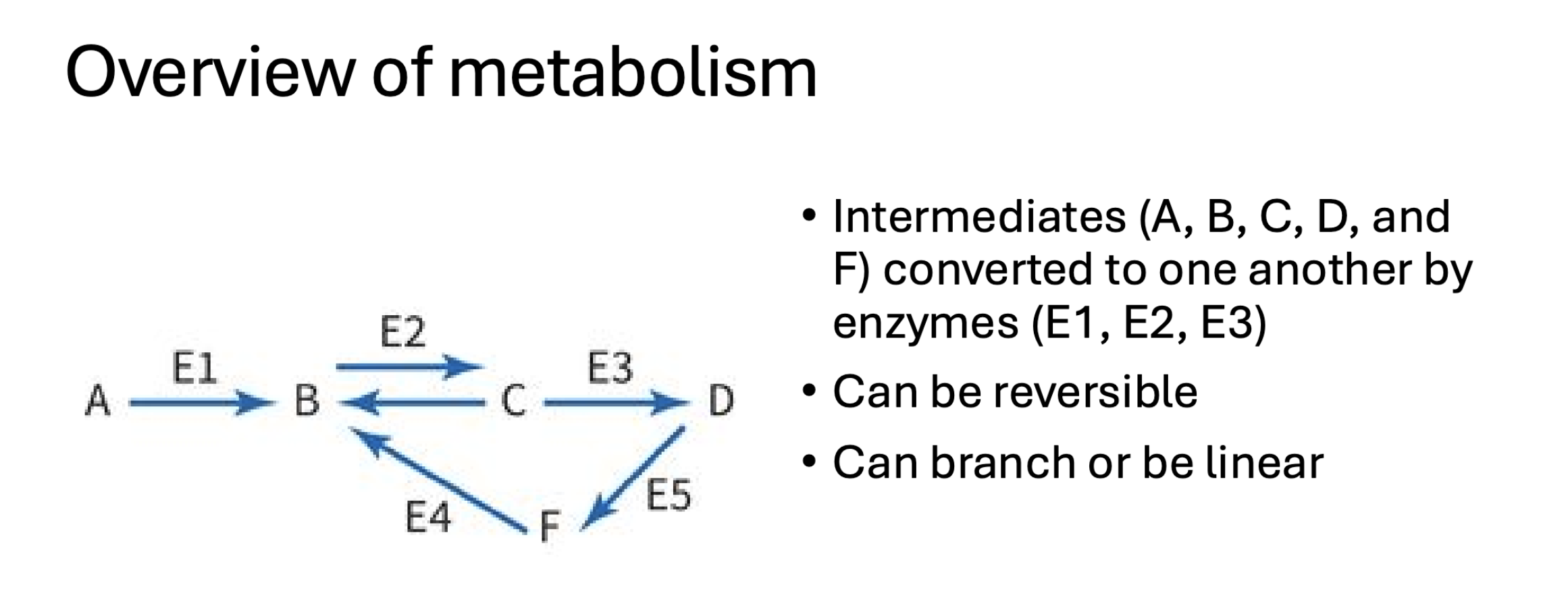
Overview of metabolism
Metabolism = total of all chemical rxns carried out by an organism (anabolism + catabolism)
Anabolic
Processes that build up molecules
reductive (gain of electrons), requires energy
Catabolic
The process of breaking down molecules
Yields energy (product is energy), oxidative (loss of electrons)
Metabolites + list examples
molecules made or used when living things break down stuff during metabolism
carbs
lipids
amino acids
nucleotides
What is glycolysis (generally), and its inputs/outputs
When glucose is broken down to pyruvate
inputs: 1 glucose, 2 NAD+, 2 ADP, 2Pi
outputs: 2 pyruvate, 2 NADH, 2 H+, 2ATP, 2 water
Note: glycolysis generates 4 ATP, but it uses 2 ATP, so net +2 ATP
Schiff base (main idea)
When an amine (NH2-R) reacts with the carbonyl carbon of a ketone or aldehyde
Amine + carbonyl carbon → Schiff base + water
Schiff base attracts and stabilizes the charge as an electron sink for the active site → makes difficult chemical rxns easier for the enzyme to perform
TIM mechanism
TIM converts DHAP to GAP
Glu removes H from C1 of DHAP
(Glu acts like a base)
Electrons at C1 move to C1-C2 bond. at the same time, C2=O electrons move to oxygen → C2 oxygen becomes negatively charged (alkoxide), making it unstable
His donates H to C2 oxygen → negatively charged oxygen becomes OH → intermediate stabilizes, and DHAP temporarily becomes enediol
(His acts like an acid)
His takes H from OH at C2 → electrons from OH move back to oxygen → C2=O reforms (His acts like a base)
Glu donates H to C1 → becomes aldehyde carbon
GAP is produced
This process is reversible
NAD/NADH
Redox coenzyme that shuttles protons and electrons
NAD → NADH
picks up 2 electrons and 1 proton
GAPDH mechanism
Cysteine sulfur (S) attacks the carbonyl carbon of GAP. At the same time, the C=O electrons move onto oxygen → thiohemiacetal intermediate forms.
NAD⁺ accepts 2 electrons and an H from thiohemiacetal → NAD+ becomes NADH → thioester intermediate forms
Pi attacks the carbonyl carbon of the thioester → the cysteine is released → 1,3-BPG forms.
NADH leaves → another NAD⁺ binds
1,3-BPG is high energy because there is repulision between phosphates at a short distance
Phosphoglycerate mutase mechanism
3PG binds to the active site
The phosphate group on phosphohistidine is transferred to the OH on C2 of 3PG
→ This forms 2,3-BPGThe phosphate that was originally on C3 of 3PG is transferred to His
→ 2PG forms and the His becomes phosphorylated again2PG is released
explain what this means - Due to cellular metabolite concentrations, free energies become almost entirely favorable during glycolysis
Inside a real cell, the concentrations of metabolites can make many biochemical reactions energetically favorable, even if their standard free energies aren't favorable
How is step 1 of glycolysis regulated (hexokinase)?
HK is regulated by G6P, its product, via allosteric inhibition → slows glucose phosphorylation
Inhibitors of PFK: ATP
Allosteric inhibitor for PFK
if the cell already has a lot of ATP, it signals that it doesn’t need to make more → PFK slows down and glycolysis slows down
PFK and AMP
High AMP levels → allosteric activator for PFK
When there is high AMP, it signals there is low ATP → AMP binds to and activates PFK → glycolysis happens and more ATP is produced
How is PFK affected by pH levels?
Low pH inhibits PFK
high rates of glycolysis → increased production of lactate (low pH, very acidic) → if it’s too acidic, there is low pH, and PFK is inhibited, slowing down glycolysis
How is PFK affected by citrate?
Citrate is an allosteric inhibitor
citrate is part of the TCA cycle, so if citrate levels are too high, it signals that the TCA cyle has enough fuel → that means that no more material has to be sent via glycolysis → glycolysis slows down
Explain feed forward activation in PFK
Cell needs energy (signaled by low ATP and high AMP)
AMPK (energy sensor) is activated → promotes PFK-2 activity
PFK-2 makes F2,6BP → F2,6BP activates PFK-1 → glycolysis increases → more ATP generated
If insulin increases → F2,6BP activated → glycolysis increases
If glucagon increases → F2,6BP is decreased → glycolysis decreases
How is pyruvate kinase (PK) regulated?
Activators of PK:
AMP
F1,6BP
Insulin
Inhibitors of PK:
Alanine
ATP
Acetyl-coA