Module 2 - Topic 1
 Call Kai
 Learn
Learn Practice Test
 Spaced Repetition
 Match
Match Flashcards
 Knowt Play
1/14

There's no tags or description
Looks like no tags are added yet.
Name | Mastery | Learn | Test | Matching | Spaced | Call with Kai | Chat |
|---|
No analytics yet
Send a link to your students to track their progress
15 Terms
Phenotype vs Genotype
Phenotype = physical attributes.
Genotype = genetic attributes.
Qualitative vs Quantitative Genetic Traits
Qualitative phenotypes = phenotypes with a discrete character that we can describe (e.g., colour genes). Controlled by 1, 2, or few genes.
Quantitative phenotypes = phenotypes that need to be measured (e.g., complex trait such as weight and length). Controlled by 10s to 100s of genes.
What are Quantitative Genetics Measured by
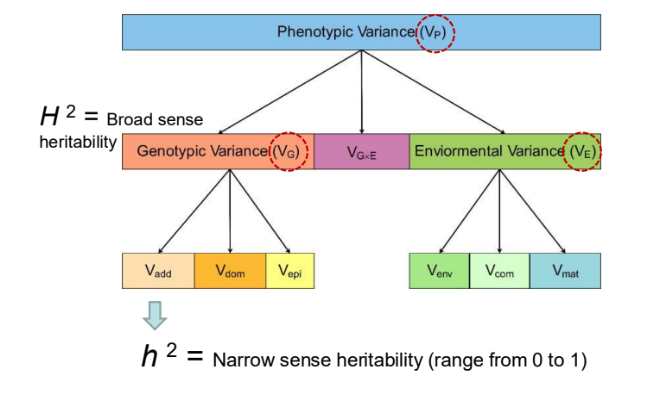
Phenotype variance = Genetics variance + Environment variance.
Vp = Vg + Ve.
Quantitative genetics = a measurable or continuous trait / phenotypic variation.
Accurate phenotype prediction = Vg and Ve knowledge and interaction (G x E).
What is Heritability
Heritability of a character in a population determines the response to selection.
Heritability is the proportion of phenotype variance attributed to additive genetic variation.
If a trait has;
Low heritability (i.e., h^2 < 0.2) in a population, most of the phenotypic variance is due to environmental influence, slow to change trait via selection forces
High heritability (i.e., h^2 > 0.6) in a population, most of the phenotypic variance is due to additive genetic variation not environment, trait can easily be changed via selection forces
What is Additive Variation and Heritability
The heritability of a trait within a population is the proportion of observable differences in a trait between individuals within a population that is due to genetic differences.
Genetic variance of a trait can be controlled by many genes and their interactions (i.e., additive genetic variation - Va).
Narrow sense heritability (h^2) determines the extent to which a character is passed on from parent to offspring within a population.
Traits that are beneficial will only be passed on if they are heritable.
How to Estimate Narrow Sense Heritability
3 methods:
Mean trait values
Variance components
Average Parent-offspring regression
Summary
Traits of importance in conservation are primarily quantitative – i.e., fitness.
Variation for quantitative characters is due to both genetic and environmental effects.
The evolutionary potential of a character is determined by its additive genetic variation / heritability.
What is the Heritability of Morphological and Fitness Traits
Morphological traits usually have heritability in the range of 0.3 - 0.8 (the theoretical upper limit is 1).
Life-history (fitness) traits of wild vertebrate populations usually have heritability below 0.4.
The difference is attributed to selection having a larger impact on fitness traits rather than morphological traits which removes the additive genetic variation from the population.
Heritability for a particular trait is not constant. It will vary among different populations that are genetically divergent.
What is the Heritability of Traits
If a trait has a heritability of 0.5, it means that the observed phenotypic variation is 50% due to additive genetic variation.
Heritability is a population level parameter
Heritability is also specific to a particular population in a particular environment.
What are the Different Types of Selection
Selection:
Preference of high-performing individuals in a population over their contemporaries to be parents of the next generation
Selection can be natural or artificial
Natural selection:
The main force for natural selection is the survival of the fittest in a particular environment
Stronger individuals survive to reproduce
‘Survival of the fittest’ phenomenon
Artificial selection:
The identification by humans of desirable traits in plants and animals and the steps are taken to enhance and perpetuate those traits in future generations
What is the Response to Selection
It is a measure of genetic progress of change.
The selection differential measures the strength of selection.
What is a Trait Response to Selection
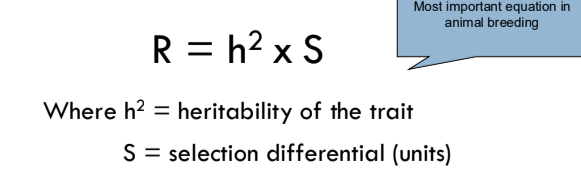
The genetic change (Response) produced by directional selection can be predicted from the intensity of selection (Selection differentials) and the heritability.
Response to Selection Considerations
Selection depletes the additive genetic variation (Va) as alleles go to fixation over time.
Therefore, h^2 also declines.
Heritability is a statistical property of a population, not a general fact about the genetic basis of a phenotypic trait.
Summary
Heritability's are lower for fitness traits due to selection eroding additive genetic variance over time.
Heritability influences response to selection in breeding programs.
Using the breeder's equation (R = h2 x S) investigators can estimate certain population parameters.
Summary of the Chytrid Frogs