Lecture 1: Animal Diversity
 Call Kai
 Learn
Learn Practice Test
 Spaced Repetition
 Match
Match Flashcards
 Knowt Play
1/15

There's no tags or description
Looks like no tags are added yet.
Name | Mastery | Learn | Test | Matching | Spaced | Call with Kai | Chat |
|---|
No analytics yet
Send a link to your students to track their progress
16 Terms
What are the 4 characteristics of animals? (these are not unique to animals)
Multicellularity
Heterotrophy
Internal digestion
Motility
What are the 3 synapomorphies for animals.
hox like genes, junctions between cells, extracellular molecules (collagen and proteoglycan)
Sponges are mostly ___ feeders.
Sponges lack ____.
Mostly marine filter feeders
Lack distinct tissue/organs (monoblastic)
Describe ctenophores
Have nerve net
Separate mouth / anal pores
Lack most Hox genes
(Diploblastic (chart tells us)
No distinct organs (chart tells us)
draw phylogeny for animals
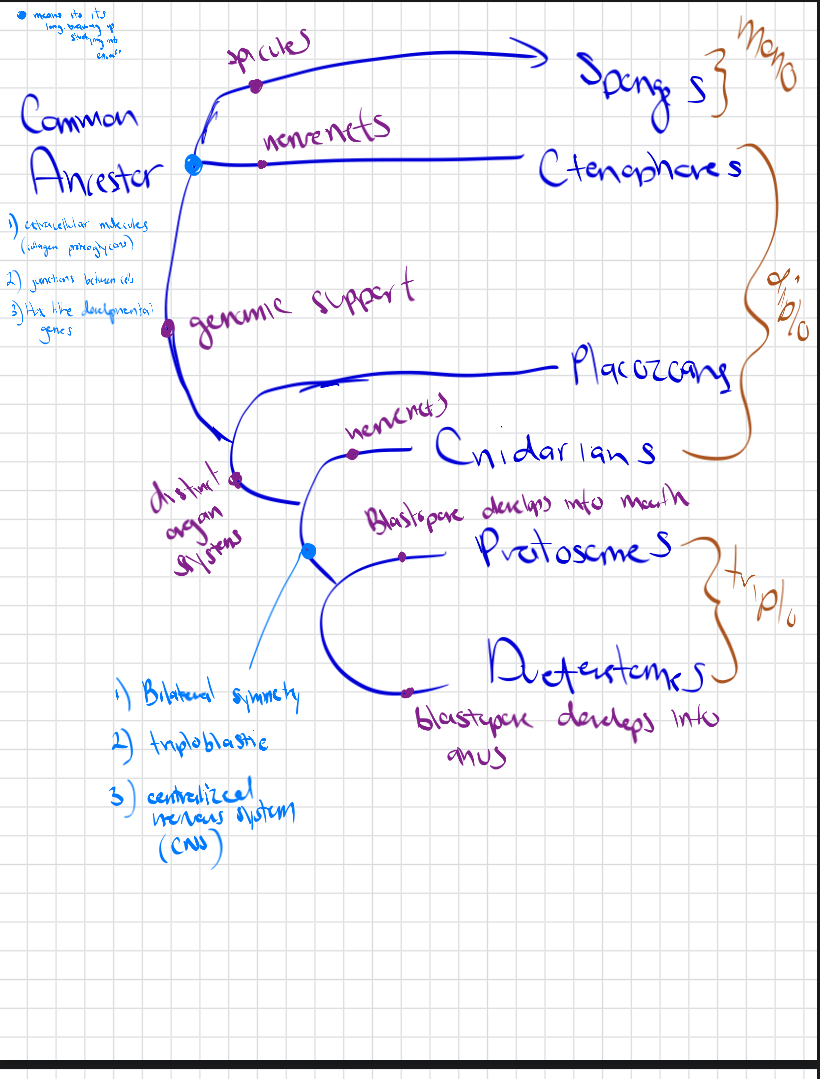
describe placozoans
No nervous tissue
No gut or other distinct organs
No mouth or anal pores
Diploblastic (chart tells u this)
describe cnidaria
(true jellies, corals, anemones, etc.)
Diploblastic
Have nerve tissue (nervous net)
Single opening to the gut (unlike ctenophora. cnideria , only have one opening to eat and poop out of).
What kind of symmetry do triploblasts have and what relation does it have to an organism’s head? Also name the two clades in them
Bilateral symmetry (Capable of cephalization - formation of a head)
Clades are protostomes and deuterostomes
name four animals in the protosomes clade
Includes mollusks, most worms, arthropods (insects, spiders, crustaceans)
name the 4 animals in the deuterostomes’ clade
Includes echinoderms (starfish and see urchins), hemichordates (some worms), chordates, invertebrates.
what 3 groups lack distinct organs/tissue?
Sponges
Ctenophores
Placozoans
name which groups are mono, diplo, and triploblastic out of (Sponges, Ctenophores, Placozoans, Cnidaria, Protosomes, Deuterostomes)
mono: sponges, diplo: ctenophores, placozoans, cnidaria triplo: protostomes, deuterostomes
What are the different types of symmetry? Which groups have which type? What
advantage(s) do bilaterally symmetrical organisms have over radially symmetrical ones?
Bilateral symmetry (like how ur face is symmetrical when split between ur eyebrows)
Triploblasts have this
If u have this Cephalization, formation of a head end (meaning they have a distinct front end), happens
radially symmetrical (symmetrial like how an umbrella is)
Diploblasts have this
What are the major differences between protostomes and deuterostomes?
Protosomes
blastopore becomes mouth, end becomes the anus
nerve cord runs down belly and digestive track runs down back
Deuterostomes
The blastospore becomes anus, end becomes the mouth.
nerve cord runs down back and digestive track runs down belly
diff bwtween diplo and triploblasts.
Diploblastic(have Ectoderm and Endoderm):
Triploblastic(have Ectoderm, mesoderm, endoderm)
what is the difference between the endoderm, mesoderm, ectoderm
1.Ectoderm: skin and nervous system
2.Mesoderm (meat) : muscle and bones
3.Endoderm: digestive tract and lungs