Organic Free-Radical Substitutions and Additions
 Call Kai
 Learn
Learn Practice Test
 Spaced Repetition
 Match
Match Flashcards
 Knowt Play
1/38

There's no tags or description
Looks like no tags are added yet.
Name | Mastery | Learn | Test | Matching | Spaced | Call with Kai | Chat |
|---|
No analytics yet
Send a link to your students to track their progress
39 Terms
Radicals are electron
deficient
What is the charge of a radical
neutral (no formal charge)
What is not required for radical reactions
solvent
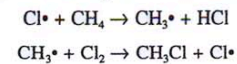
Identify the mechanism
free-radical substitution
How can the addition of HBr to alkenes, and the polymerization of alkenes/dienes be initiated
heat, peroxides, or UV
All radical reactions are
chain reactions
What is the initiation step of radical reactions
radical generation
What is the propagation step of radical reactions?
radical reacts with a stable molecule to produce a new radical (this step can be repeated many times)
What is the termination step of radical reactions?
radicals are destroyed and reaction is stopped.
On average how many propagation steps does a radical undergo before termination?
100’s or 1000’s
The energy required for the generation of organic radicals reflects their
relative stability
Stable radicals require the BLANK energy to form and vice versa, and are generated most rapidly
least
The stability of radicals generally increases with increasing
substitution on a carbon atom that carries the unpaired electron
Why are allylic and benzylic radical easy to generate
they are stabilized through resonance

identify the form
allylic radical resonance form
What is the order of stability for radicals?

A reaction usually involves radicals if any of the following reactants or conditions are present
AIBN (radical initiator)
peroxides
UV light
high temp
Why can electrophilic substitution not produce a radical
must happen in a solvent (cannot be gas phase)
To determine which hydrogen atom is most easily abstracted to generate a radical, what must be determined
which radical intermediate is the most stable
Typical radicals (including benzylic) are what geometry, and why
planar, the carbon is sp2 hybridized
in free radical substitution, the radical can be attacked from either face with equal probability, which implies what of the stereochemistry
it will be a 50/50 mixture (racemic) of R and S regardless of if it begins as and R or and S molecule

In free radical bromination, this step is exothermic or endothermic?
endothermic
What is Hammond postulate?
a transition state resembles the structure of the nearest stable species (reactant, intermediate or product)
For an exergonic reaction, the transition state is most similar in energy to
the reactants
For an endergonic reaction, the transitions state is most similar in energy to
the products
what is the “reactivity-selectivity principle”
highly reactive species are nonselective in their reactions, relatively non-reactive species are very selective in their reactions
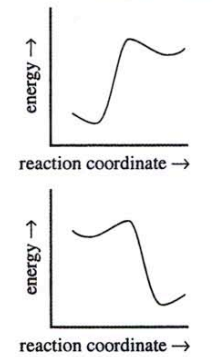
Which energy diagram signifies a reaction with high regioselectivity
Top
what is the heating of molecules to extremely high temperatures called
pyrolysis
what is a typically pyrolysis reaction
cleavage of sigma-bonds to give radicals
In free radical bromination, which radical will attach the carbon
Br
the polymer must have BLANK bonded to each carbon of the monomer regardless of the type of bond in the monomer
the same number of hydrogens
Addition polymers give a polymer with a BLANK that has the same BLANK as the monomer
repeating unit, chemical formula
Addition polymerization reactions typically proceed by way of BLANK
highly reactive species (free radical or carbocation)
Condensation polymers are formed by BLANK, accompanied by formation of BLANK
reaction of two functional groups to link monomer units, small molecule (like water or HCl)
Condensation polymers do NOT involved what kind of intermediate
free radical
Free radical polymerization reactions produce only
addition polymers
When determining the best reactant for a desired product, it is most important to keep in mind the likelihood of what
desired regioselectivity
In free-radical polymerization of vinyl monomers, addition occurs almost exclusively in
heat to tail fashion
What is head to tail addition
propagating radical attacks less hindered, less substituted carbon