The Menstual Cycle
 Call Kai
 Learn
Learn Practice Test
 Spaced Repetition
 Match
Match Flashcards
 Knowt Play
1/62

There's no tags or description
Looks like no tags are added yet.
Name | Mastery | Learn | Test | Matching | Spaced | Call with Kai | Chat |
|---|
No analytics yet
Send a link to your students to track their progress
63 Terms
The average menstrual cycle lasts 28 days, with ovulation typically occurring around
day 14
The first menstrual cycle is termed
menarche.
. However, if an individual does not experience menarche before age 16, she is said to have
primary amenorrhea.
Primary amenorrhea may be caused by congenital abnormalities or congenital obstructions, such as an
imperforate hymen- hymen with no opening
what is Secondary amenorrhea
the cessation of menstruation characteristically diagnosed in the postmenarchal woman who has had 3 to 6 months without a menstrual cycle; may be associated with endocrinologic abnormalities or pregnancy.
what is the hypothalamic–pituitary–gonadal axis
complex interactions that take place between the hypothalamus, pituitary gland, and ovaries as part of the female reproductive cycle.
where and what is the purpose of the hypothalamus
the area within the brain that is located just beneath the thalamus and controls the release of hormones by the anterior pituitary gland
what is the anterior pituitary gland
the anterior segment of the pituitary gland, which is responsible for releasing follicle-stimulating hormone and luteinizing hormone during the menstrual cycle
The hypothalamus releases Gonadotropin-Releasing Hormone GnRH, which, in turn, stimulates the
release of hormones by the anterior pituitary gland.
the anterior lobe of the pituitary gland is responsible for the release of two chief hormones that influence the menstrual cycle:
follicle-stimulating hormone (FSH) and luteinizing hormone (LH)
what is follicle-stimulating-hormone (FSH)
the hormone of the anterior pituitary gland that causes the development of multiple follicles on the ovaries
What is luteinizing-hormone (LH)
the hormone of the anterior pituitary gland that surges around day 14 of the menstrual cycle, resulting in ovulation
The ovary produces two hormones during the menstrual cycle,
estrogen and progesterone
What is estrogen
the hormone released by the ovary during the proliferative phase that initiates the proliferation and thickening of the endometrium
what are other functions of estrogen
regeneration of the endometrium after menses and the induction of salt and water retention. It also stimulates contractile motions within the uterine myometrium and the fallopian tubes.
what is progesterone
a hormone that prepares the uterus for pregnancy, maintains pregnancy, and promotes development of the mammary glands; primarily produced by the ovary and placenta
During the second half of the menstrual cycle, following ovulation, progesterone is produced by the
corpus luteum of the ovary
The hypothalamus releases GnRH, which influences the
anterior pituitary gland.
The anterior pituitary gland produces FSH and LH, which influence the
ovary
The ovary produces estrogen and progesterone, which influence the
endometrium
The ovarian cycle consists of two phases:
follicular phase and the luteal phase
The follicular phase of the ovarian cycle is considered to begin on and lasts up to?
day 1 and lasts until day 14; ending with ovulation
During the follicular phase, the anterior pituitary gland secretes FSH, which initiates the
follicular development of the ovary
during this phase, only one follicle will progress from
primordial follicle to primary follicle and then to become a secondary follicle; eventually maturing to become the Graafian follicle or dominant follicle before ovulation
This Graafian follicle contains the developing oocyte (egg) within a region called the
cumulus oophorus
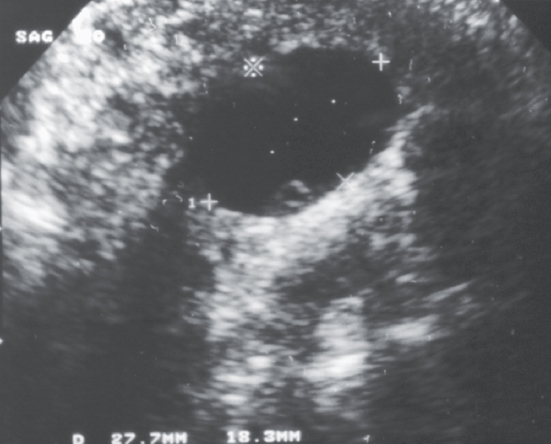
Around day 14, LH, produced by the anterior pituitary gland, stimulates ovulation, at which time the Graafian follicle ruptures and expels a small amount of fluid and the ovum into the peritoneum. At the time of ovulation, the individual may feel a twinge of pain, and this is termed
mittelschmerz
The ovum that was expelled by the ovary is picked up by the
fimbria of the fallopian tube and is propelled through the tube
The second phase of the ovarian cycle, days 15 to 28, is termed the luteal phase. After the Graafian follicle ruptures, bleeding occurs into that space, resulting in the
corpus hemorrhagicum. That structure then rapidly converts into a temporarily endocrine gland in the form of the corpus luteum
what is the corpus luteum
literally interpreted “yellow body,” primarily produces progesterone to maintain the thickness of the endometrium and prepares the endometrium for the (conceivably) fertilized ovum. All the other follicles undergo atresia.
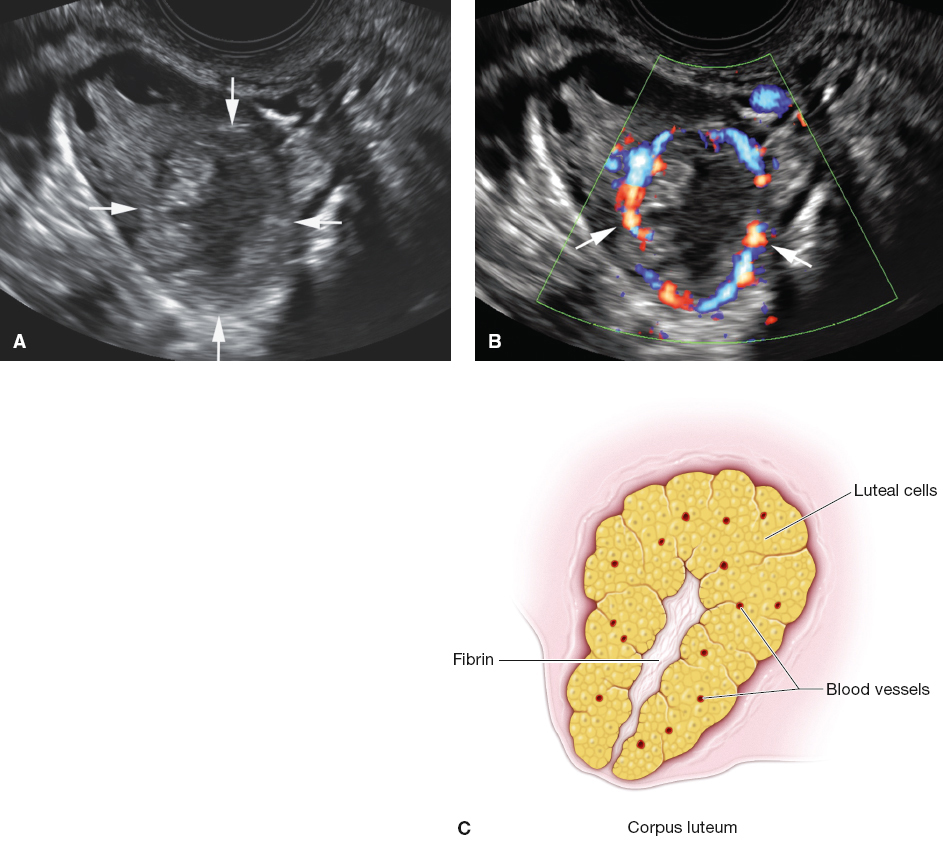
Remember this chain of events
primordial follicle > primary follicle > secondary follicle > Graafian (dominant) follicle > ovulation > corpus hemorrhagicum > corpus luteum > corpus albicans
While the corpus luteum depends on LH to be maintained, progesterone negatively inhibits the production of LH by the anterior pituitary gland, resulting
regression of the corpus luteum.
The remaining structure of the corpus luteum is now termed the
corpus albicans, which can often be seen sonographically as a small echogenic scar on the ovary.
. For example, during the early follicular phase and late luteal phase, the ovarian artery will demonstrate a
high-resistive pattern, with increased impedance, and absent or low end-diastolic velocity.
During the late follicular and early luteal phases, the ovary will demonstrate a
low-resistive pattern, with low impedance and higher levels of diastolic flow.
what is the innermost portion of the endometrium
functional layer (stratum functionale), is the layer that is stimulated by the hormones of the ovary to undergo changes throughout the menstrual cycle; also provides an appropriate location for the implantation of the products of conception
The outermost portion of the endometrium is
basal layer (stratum basale), is only slightly altered during the menstrual cycle. It consists of dense, cellular stroma.
The endometrial cycle consists of two phases:
proliferative phase and the secretory phase.
when does the proliferation phase occur
During the first half of the menstrual cycle
the proliferation of the endometrium, which is described as the multiplication of similar forms, occurs during the
proliferative phase of the endometrial cycle because the functional layer increases in thickness
The proliferative phase may be divided into two phases
early and late, with the late proliferative phase often being referred to as the periovulatory phase; which occurs around the time of ovulation
The secretory phase of the endometrial cycle occurs
after ovulation and is stimulated by progesterone. Progesterone maintains the thickness of the endometrium in preparation for implantation.
Should fertilization not take place,
menses begin on day 1 of the cycle, resulting from a lack of estrogen and progesterone.
Conversely, if fertilization does occur, the endometrial thickness is maintained by the continual production of progesterone by the
corpus luteum of pregnancy
days 1 through 5 of the menstrual cycle correlate with
menses, when endometrium is shedd
Following menses, the ovary is in the
follicular phase, whereas the endometrium is in the proliferative phase
Following ovulation, the ovary begins the
luteal phase, whereas the endometrium enters the secretory phase
“Ovaries Freely Let Every Period Start”
Ovary
Follicular
Luteal
Endometrium
Proliferative
Secretory
Days 1–14
ovary in follicular phase
endometrium is proliferative phase
Days 15–28
Ovary in luteal phase
endometrium in secretory
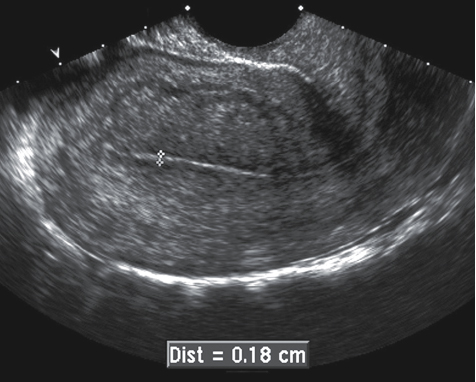
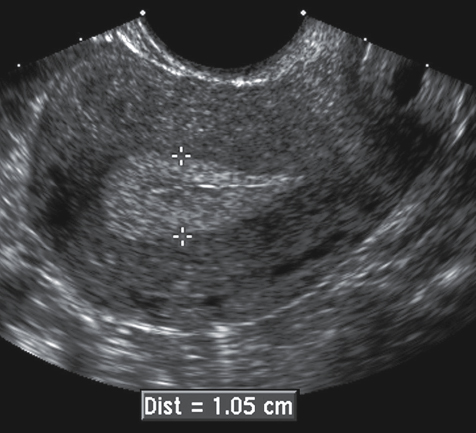
. During menses, the endometrium typically appears as
thin, echogenic line (4mm)
During the early proliferative phase, the
the functional layer gradually increases in size and becomes more hypoechoic (4 and 8 mm)
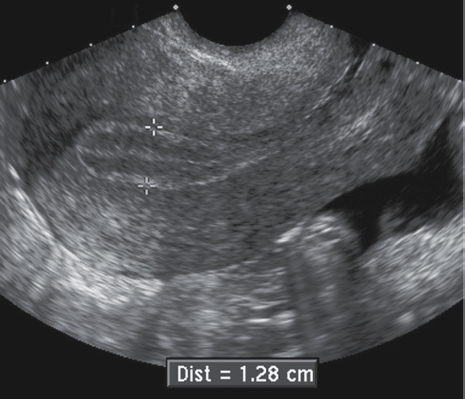
During the late proliferative phase or periovulatory phase, which is between days 5 and 14, the endometrial layers
display a stark contrast (6 and 10 mm)
In the periovulatory phase,
three-line sign-the outer echogenic basal layer surrounds the more hypoechoic functional layer, with the functional layer separated by the echogenic endometrial stripe
Following ovulation,
the secretory endometrium is maintained by the production of progesterone because the endometrium becomes thickened and echogenic in appearance (7 and 14 mm)
Fertilization, or conception, typically occurs on
day 15 with the union of the egg and sperm in the fallopian tube.
The cells that surround the blastocyst, the syncytiotrophoblastic cells (trophoblastic cells), then begin to produce
human chorionic gonadotropin (hCG); maintaining the corpus luteum to produce estrogen and progesterone, which, in turn, maintains the thickness of the endometrium so that implantation can take place and the pregnancy can continue to progress normally
Dysfunctional uterine bleeding (DUB) is abnormal vaginal bleeding that occurs outside of a regular menstrual cycle, usually caused by hormonal imbalances rather than structural uterine issues and
may be idiopathic or possibly related to hormonal imbalances, resulting in endometrial changes with subsequent irregular bleeding. IE, polycystic ovary syndrome which causes anuovulation
Abnormal uterine bleeding (AUB) is a
difference in frequency, duration, and amount of menstrual bleeding, and it may be caused by a number of complications
One of the more common suspicious pathologies that results in AUB is the presence of
fibroid tumors or leiomyomas within or abutting the uterine cavity
another etiology of AUB and painful menstruation
Adenomyosis, which is ectopic endometrial tissue within the myometrium of the uterus
In perimenopausal or postmenopausal population, AUB origins are
endometrial hyperplasia, endometrial polyps, and endometrial carcinoma,
Causes of Abnormal Uterine Bleeding Can Be Structural or Nonstructural
Uterine fibroids (leiomyoma)
Adenomyosis
Cervical polyps
Endometrial polyps
Endometrial hyperplasia
Endometrial cancer
Hypothyroidism
Anovulation
Iatrogenic
Ovulatory dysfunction
Coagulopathy
Abnormal Uterine Bleeding Term
Amenorrhea- Absence of menstruation; can be classified as either primary amenorrhea or secondary amenorrhea
Cryptomenorrhea - Monthly symptoms of menstruation without bleeding
Dysmenorrhea
Menorrhagia (hypermenorrhea) - Abnormally heavy and prolonged menstruation
Metrorrhagia (intermenstrual bleeding) - Irregular menstrual bleeding between periods
Menometrorrhagia- Excessive or prolonged bleeding at irregular intervals
Oligomenorrhea - Irregular cycles >35 days apart
Polymenorrhea- Frequent regular cycles but <21 days apart
Hypomenorrhea - Regularly timed menses but light flow