AP Psych Unit 4: Sensation and Perception
 AP Practice
 Call Kai
1/98

Earn XP
Description and Tags
Last updated 11/17. All of Ms. Rabadan's slides from Unit 4.
Name | Mastery | Learn | Test | Matching | Spaced | Call with Kai | Chat |
|---|
No analytics yet
Send a link to your students to track their progress
99 Terms
Sensation
The experience of sensory stimulation.
Bottom-Up Processing
When sensory receptors pick up signals for the brain to integrate and process
brains
Beginning with stimulation of our senses, we interpret sensory information with our _______
Transduction
The action or process of converting something and especially energy or a message into another form
Light waves to neural impulses
Sound waves to neural impulses
Physical pressure/temperature to nerve impulses, etc.
Examples of Transduction
Perception
The process of creating meaningful patterns from raw sensory information (brain making sense of impulses)
Top-Down Processing
Perceiving things based on your prior experiences and knowledge
Perception
"I see a cat” or “I hear footsteps” is an example of…
schemas and past experiences
Unlike sensation, perception uses ______________________ to interpret sensory information to construct deeper meaning
The Basic Process
Energy stimulates receptor cell in one of the sense organs. If stimulus is strong enough, a signal is sent by receptor through sensory/afferent nerves (we know what these are) to appropriate area of cerebral cortex (we also know what this is).
Receptor cells
Specialized neurons that respond to specific types of stimuli.
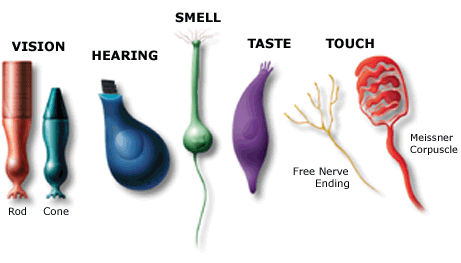
Sense organs
Where do receptor cells exist?
Law of specific nerve energies (Muller)
One-to-one relationship between stimulation of a specific nerve and the resulting sensory experience. (For example, applying pressure with your finger to your eye results in a visual experience – try it!)
Johannes Muller
Who founded the law of specific nerve energies?
How many neurons fire, which neurons are activated or inhibited, the rate at which the neurons fire
Different stimuli affect…
Absolute threshold
The minimum amount of energy that can be detected 50% of the time
50%
If the responders can identify a sound ___ of the time they hear it, that’s absolute threshold
A candle flame 30 miles away
Example of Vision’s absolute threshold
A watch ticking 20 feet away
Example of Hearing’s absolute threshold
A drop of perfume in a six-room house
Example of Smell’s absolute threshold
A teaspoon of sugar in a gallon of water
Example of Taste’s absolute threshold
A wing of a fly on your check, dropped 1 cm
Example of Touch’s absolute threshold
Difference Threshold
The smallest change in stimulation that can be detected 50% of the time
Just Noticeable Difference (JND)
Another name for Difference Threshold
Weber’s Law
JND is a constant proportion of the specific stimulus (Example: Would you feel an additional 2.5 pounds on each side of barbell when you’re benching 200 lbs? Benching 45 lbs?)
Sensory adaptation
An adjustment of the senses to the level of stimulation they are receiving
When you get back in, your ears won’t instantly adjust.
If you are blasting your car radio, then ___________.
Toothpaste/orange juice (ice cream/soda) phenomenon
“sweet” taste buds adapt (become less sensitive)
Perfume, swimming/baths
Sensory adaptation examples
Signal Detection Theory (SDT)
Challenges the notion of the absolute threshold (the threshold can change, detection of a stimulus depends on a person’s experience, expectations, motivations and fatigue.)
How and when we will detect the presence of a faint stimulus or signal
SDT is a mathematical model that predicts…
Subliminal Perception
The notion that we may respond to stimuli that are below our level of awareness (ah!)
The unconscious activation of certain associations may alter perception, memory or response
A “subliminal stimulus falls below our threshold for conscious detection, HOWEVER…
Priming
Occurs when an individual's exposure to a certain stimulus influences their response to a subsequent prompt, without any awareness of the connection.
Individuals flashed a pleasant or unpleasant image before viewing a photo of a person were influenced to judge the person positively if they saw a pleasant picture and negatively if unpleasant.
Priming Example
Subliminal stimulus
Falls below the threshold for conscious detection
390-750 nanometers
We can only see a small part of the electromagnetic spectrum…how much?
Wavelength vs. Frequency
The frequency of a wave is inversely proportional to its wavelength
Hue
Colors we see such as red and green. Determined by wavelength
purple, red
Hue: Shorter wavelength results in ________________; longer results in ___
Brightness
“Loudness” or intensity of a color. Determined by amplitude. (In other words, closeness to white or black)
Saturation
Vividness of a hue
Cornea
Transparent protective coating over the front of the eye
Pupil
Small opening in the iris through which light enters the eye (“Constricts/dilates” bc of iris)
Iris
Colored part of the eye, filters some light. Muscle that widens/contracts to make pupil bigger or smaller
Separating wavelengths of light
Red contacts claim to reduce glare and make ball “pop” by…
Lens
Focuses light onto the retina
Retina
Lining of the eye containing receptor cells that are sensitive to light
Fovea
Center of the visual field
blurry, clear
Baby in the video is farsighted, meaning nearby objects are ______ and far objects are _____.
rods and cones
Visual receptors are called… (Located in Retina)
Rods
About 120 million. Respond to light and dark. Very sensitive to light. Provide our night vision. DO NOT Detect color.
Cones
About 8 million. Respond to color as well as light and dark. Work best in bright light
Psychophysics
The branch of psychology that deals with the relationships between physical stimuli and mental phenomena.
in the fovea
Cones are found mainly…
Blind Spot
Area where axons of ganglion cells leave the eye
Bipolar Cells
Receive input from receptor cells. One-to-one in fovea
Ganglion cells
Receive input from bipolar cells. Axons of these cells form optic nerve.
Optic Nerve
Carries neural messages from each eye to brain
rod
Which is more sensitive: A rod or a cone?
Axons of ganglion cells
What is the optic nerve made up of?
Optic chiasm
Point where part of each optic nerve crosses to the other side of the brain
Thalamus
Relays sensory info to visual cortex in occipital lobes
Feature Detectors
Neurons in the brain that respond to specific aspects of a stimulus: edges, lines, movements, angles
send signals to other areas of the cortex for higher-level processing
Feature detectors in the visual cortex…
Supercell clusters
teams of cells that respond to complex patterns, such as faces
Hubel and Weisel
Theory: The properties of complex cells could more logically result from combining input from similarly oriented simple cells than from cells with circular receptive fields.
Additive color mixing
Mixing of lights of different hues. E.G. Lights, T.V., computer monitors (RGB)
add
Lights _____ wavelengths
Subtractive color mixing
Mixing pigments, e.g., paints.
absorb or subtract
Pigments ______________ wavelengths
Trichromatic theory
Three different types of cones
red
CONE 1) Respond to ______ (long wavelength)
green
CONE 2) Respond to _______ (medium wavelength)
blue-violet
CONE 3) Respond to _______________ (short wavelength)
Mixing of the signals from cone receptors
Experience of color is the result of…
Dichromats
People who are blind to either red-green (most common) or blue-yellow
Monochromats
People who see no color at all, only shades of light and dark
Colorblindness
Deficiency in red, green, or blue cone
Optic Chasm
Contributes in conveying visual information from the eye to the cortex, overlaps the optic nerves
True
True or False: Trichromatic theory cannot explain all aspects of color vision
Opponent-Process Theory
Expands upon the Trichromatic Theory. Color receptors work in pairs working in opposition from one another. Can explain color afterimages.
yellow-blue, red-green, black-white
In the Opponent-Process Theory, all color receptors work in pairs. What are those pairs?
Color Afterimages
Firing levels decrease (sensory adaptation) due to overstimulation; next color which is relatively “less” of the original color will be interpreted as opposing color pair
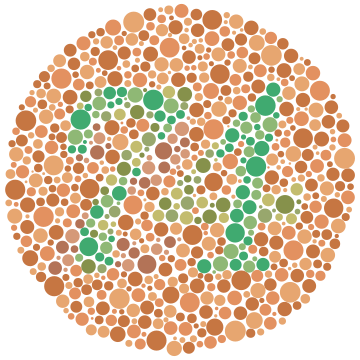
Isihara Colorblindness Test
Describe this image
Dark Adaptation
Increased sensitivity of rods and cones in darkness
Light Adaptation
Decreased sensitivity of rods and cones in bright light
di
Most animals are ___chromats
mono
Rodents tend to be ____chromats
Bees
____ can see ultraviolet light
Stomatopods
______________ have the most complex color hyperspectral vision in the animal kingdom, allowing them to differentiate between colors that may appear the same to other human and non-human animals.
Sound
A psychological experience caused by sound waves hitting the ear.
Soundwaves
Changes in pressure caused by molecules of air moving
Frequency
Number of cycles per second in a wave. Measured in Hertz (Hz). Determines pitch
Hertz
Frequency is measured in…
Amplitude
Magnitude (height) of sound wave. Measured in decibels (dB). Determines loudness
decibles
Amplitude is measured in…
Overtones
Multiples of the basic tone
Timbre
Quality of texture of sound, created by overtones. We know the difference between Cartman singing and Kyle singing because of the differences in….