The Strong Nuclear Force
 Call Kai
 Learn
Learn Practice Test
 Spaced Repetition
 Match
Match Flashcards
 Knowt Play
1/13

There's no tags or description
Looks like no tags are added yet.
Name | Mastery | Learn | Test | Matching | Spaced | Call with Kai | Chat |
|---|
No analytics yet
Send a link to your students to track their progress
14 Terms
True or False: The gravitational attraction between nucleons is strong enough to balance the electrostatic repulsion.
False
On what particles does the strong force act?
a) Protons only.
b) Neutrons only.
c) Protons and electrons.
d) Protons and neutrons.
d) Protons and neutrons.
What is the correct order of the strength of forces acting on the atomic level from weakest to strongest?
a) Gravitational, strong nuclear, electrostatic.
b) Electrostatic, strong nuclear, gravitational.
c) Gravitational, electrostatic, strong nuclear.
d) Strong nuclear, electrostatic, gravitational.
c) Gravitational, electrostatic, strong nuclear.
True or False: The strong nuclear force only acts on atomic distances.
True
True or False: The strong nuclear force is always attractive.
False
Complete the sentence: The strong nuclear force only depends on…
a) distance.
b) charge.
c) mass.
d) the type of nucleon.
a) distance.
True or False: Adding neutrons increases the size of the nucleus and decreases the effectiveness of the strong nuclear force.
True
Complete the sentence: When a nuclide has an incorrect ratio of protons to neutrons, it…
a) remains stable and unchanged.
b) undergoes radioactive decay.
c) merges with another nuclide to balance the ration.
d) permanently loses its nuclear force.
b) undergoes radioactive decay.
Define the term, strong nuclear force.
The strong nuclear force is the force that acts between the nucleons inside the nucleus to hold them together.
Describe the forces acting in the nucleus.
In the nucleus protons repel each other by the electrostatic force. Protons attract each other by the gravitational force. The strong nuclear force acts between the neutrons and protons to hold them together.
Fill in the blanks: The strong nuclear force only acts at the _____ level, between ______, and over _____ distances.
The strong nuclear force only acts at the atomic level, between nucleons, and over short distances.
Explain the stability of a nuclide in terms of the operation of the strong nuclear force over very short distances, electrostatic repulsion, and the relative number of protons and neutrons in the nucleus.
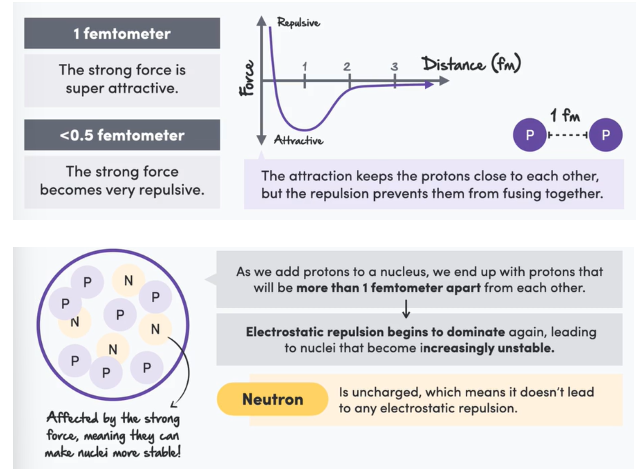
Explain natural radioactive decay in terms of stability.
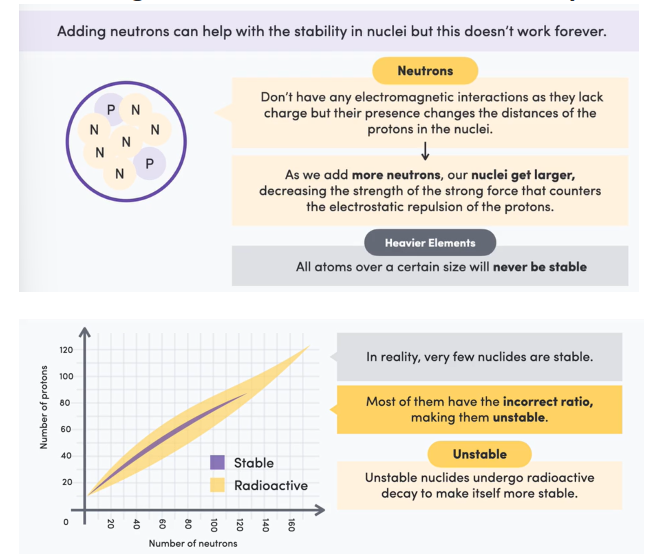
How does the strong force explain the stability of nuclides?
The strong force overcomes the electrostatic repulsion between protons within nuclides.